Showing posts with label housing element. Show all posts

Sunday, April 5, 2020

Fable: THE TOWN MOUSE AND THE COUNTRY MOUSE

A Town Mouse once visited a relative who lived in the country. For lunch the Country Mouse served wheat stalks, roots, and acorns, with a dash of cold water for drink. The Town Mouse ate very sparingly, nibbling a little of this and a little of that, and by her manner making it very plain that she ate the simple food only to be polite.


[Illustration]


After the meal the friends had a long talk, or rather the Town Mouse talked about her life in the city while the Country Mouse listened. They then went to bed in a cozy nest in the hedgerow and slept in quiet and comfort until morning. In her sleep the Country Mouse dreamed she was a Town Mouse with all the luxuries and delights of city life that her friend had described for her. So the next day when the Town Mouse asked the Country Mouse to go home with her to the city, she gladly said yes.
When they reached the mansion in which the Town Mouse lived, they found on the table in the dining room the leavings of a very fine banquet. There were sweetmeats and jellies, pastries, delicious cheeses, indeed, the most tempting foods that a Mouse can imagine. But just as the Country Mouse was about to nibble a dainty bit of pastry, she heard a Cat mew loudly and scratch at the door. In great fear the Mice scurried to a hiding place, where they lay quite still for a long time, hardly daring to breathe. When at last they ventured back to the feast, the door opened suddenly and in came the servants to clear the table, followed by the House Dog.

[Illustration]

THE TOWN MOUSE AND THE COUNTRY MOUSE


The Country Mouse stopped in the Town Mouse's den only long enough to pick up her carpet bag and umbrella.
"You may have luxuries and dainties that I have not," she said as she hurried away, "but I prefer my plain food and simple life in the country with the peace and security that go with it."

Better a little in safety, than an abundance surrounded by danger.

Sunday, December 15, 2019

THE MILKMAID AND HER PAIL

[Illustration]

 A MILKMAID had been out to milk the cows and was returning from the field with the shining milk pail balanced nicely on her head. As she walked along, her pretty head was busy with plans for the days to come.

"This good, rich milk," she reused, "will give me plenty of cream to churn. The butter I make I will take to market, and with the money I get for it I will buy a lot of eggs for hatching. How nice it will be when they are all hatched and the yard is full of fine young chicks. Then when May day comes I will sell them, and with the money I'll buy a lovely new dress to wear to the fair. All the young men will look at me. They will come and try to make love to me,—but I shall very quickly send them about their business!"

As she thought of how she would settle that matter, she tossed her head scornfully, and down fell the pail of milk to the ground. And all the milk flowed out, and with it vanished butter and eggs and chicks and new dress and all the milkmaid's pride.

Do not count your chickens before they are hatched.

Sunday, September 29, 2019

Fable: THE EAGLE AND THE BEETLE

A BEETLE once begged the Eagle to spare a Hare which had run to her for protection. But the Eagle pounced upon her prey, the sweep of her great wings tumbling the Beetle a dozen feet away. Furious at the disrespect shown her, the Beetle flew, to the Eagle's nest and rolled out the eggs. Not one did she spare. The Eagle's grief and anger knew no bounds, but who had done the cruel deed she did not know.

Next year the Eagle built her nest far up on a mountain crag; but the Beetle found it and again destroyed the eggs. In despair the Eagle now implored great Jupiter to let her place her eggs in his lap. There none would dare harm them. But the Beetle buzzed about Jupiter's head, and made him rise to drive her away; and the eggs rolled from his lap.


[Illustration]

THE EAGLE AND THE BEETLE

Now the Beetle told the reason for her action, and Jupiter had to acknowledge the justice of her cause. And they say that ever after, while the Eagle's eggs lie in the nest in spring, the Beetle still sleeps in the ground. For so Jupiter commanded.

Even the weakest may find means to avenge a wrong.

Sunday, May 5, 2019

FABLE: The Wolf, the Nanny-Goat, and The Kid


A Nanny-goat went out to fill her empty milk bag
And graze newly sprung grass, 
She fastened the latch tight,
Warned her Kid saying: 
"Do not, upon your life,
Open the door unless  you are  shown
This sign and told this password: 
'Plague on the wolf and his breed!' "
As she was saying these words,
The Wolf by chance  prowling around,
  Overheard the spoken words
And kept them in his memory.
Nanny-Goat, as one can well believe,
Had not seen the glutton beast.
As soon as she departs, he changes his voice
And in a counterfeit tone 
He asks to be let in, saying: "Plague on the Wolf,"
Believing he'd go right in.
The  canny Kid looks through the crack,
"Show me your white paw, else I'll not open."
He shouted at once. (White paw is a thing
Seldom  seen in wolfdom, as everyone knows.)
This Wolf, aghast  upon hearing these words,
Went  slinking home the same way he had come.

Where would the Kid be now, had he believed
The password, which by chance
Our Wolf had overheard?

Two guarantees are  better than one,
Even a third one would not be extreme.

Better be sure than sorry

Sunday, December 16, 2018

Fable: THE SHEEP AND THE PIG

ONE day a shepherd discovered a fat Pig in the meadow where his Sheep were pastured. He very quickly captured the porker, which squealed at the top of its voice the moment the Shepherd laid his hands on it. You would have thought, to hear the loud squealing, that the Pig was being cruelly hurt. But in spite of its squeals and struggles to escape, the Shepherd tucked his prize under his arm and started off to the butcher's in the market place.

The Sheep in the pasture were much astonished and amused at the Pig's behavior, and followed the Shepherd and his charge to the pasture gate.

"What makes you squeal like that?" asked one of the Sheep. "The Shepherd often catches and carries off one of us. But we should feel very much ashamed to make such a terrible fuss about it like you do."

THE SHEEP AND THE PIG

"That is all very well," replied the Pig, with a squeal and a frantic kick. "When he catches you he is only after your wool. But he wants my bacon! gree-ee-ee !"
It is easy to be brave when there is no danger.

Sunday, May 27, 2018

Apartments coming to a neighborhood near you in Marinwood/ Lucas Valley/Terra Linda

Editor's Note: The fight for sensible land use is being fought in Seattle too. Like Marin, zealous planners, politicians and housing advocates are rezoning neighborhoods for affordable housing, micro apartments and the conversion of single family neighborhoods into multifamily apartment blocks. This is the idea behind the Priority Development Area in Marinwood and the rest of the 101 corridor. This is the future of Marinwood if they get their way and pass SB-1. It will allow redevelopment ANYWHERE without a declaration of blight.

The Fight Against Small Apartments

Why Neighborhood Groups Are Uniting to Stop Developers from Building Tiny, Affordable Units

KELLY O

In May of 2009, a rumor was floating around City Hall. Homeowners on Capitol Hill were furious about a construction project. So one sunny afternoon, while workers hammered nails into a few unfinished buildings near 23rd Avenue and East John Street, I went knocking on doors to find out what the problem was.
One neighbor was Alan Gossett. Gossett was trying to sell his blue Craftsman house, which shared an alley with the new development. Standing on the corner of his rear deck, Gossett pointed through the trees to the half-built structure and said, "I think this is going to be a magnet for very sketchy people."
Why sketchy?
According to permitting paperwork, the building was a commonplace cluster of six town houses—the sort that would typically attract well-to-do buyers. But inside each town house, the developer was building up to eight tiny units (about 150 to 250 square feet each, roughly the size of a carport) to be rented out separately. The tenants would each have a private bathroom and kitchenette, with a sink and microwave, but they would share one full kitchen for every eight residents. The rent would be cheap—starting at $500 a month, including all utilities and Wi-Fi—making this essentially affordable housing in the heart of the city. And, remarkably, for affordable housing, it was built without any subsidies from the city's housing levy. But Gossett was bracing for 46 low-income renters in the space where he'd been expecting six new homeowners instead.
Gossett and other neighbors felt hoodwinked, they told me.
There was no public notification and no review process that allowed neighbors to pose objections. This was due to a loophole in the permits: The city and developers classified the building as six units (with up to eight bedrooms each), instead of as an apartment building with dozens of units, which would have required a more public process. Neighbors said they feared that the area wasn't ready for so many new residents and that the influx of newcomers would usurp on-street parking. But Gossett also seemed concerned by who his new neighbors might be.
"Anyone who can scrape up enough money to live month-to-month can live there," he said, worried that low-income interlopers would jeopardize his chances to sell his own house. "I don't think most people want to live next to a boarding house with itinerant people living in it."

Saturday, March 31, 2018

C.S. Lewis on Tyranny


"Of all tyrannies, a tyranny sincerely exercised for the good of its victims may be the most oppressive. It would be better to live under robber barons than under omnipotent moral busybodies. The robber baron's cruelty may sometimes sleep, his cupidity may at some point be satiated; but those who torment us for our own good will torment us without end for they do so with the approval of their own conscience." - C. S. Lewis

Monday, February 12, 2018

Marin Voice: Marin County can do better with its housing plan

Marin Voice: Marin County can do better with its housing plan
By Sharon Rushton
Guest op-ed column

POSTED:   12/04/2013 06:27:50 PM PST


Sharon Rushton of Mill Valley is Chairperson of Sustainable TamAlmonte, a group of Tamalpais Valley and Almonte leaders and active residents

ONE OF THE CORE VALUES that most Marin residents share is a love and respect for nature, which has been demonstrated by a long history of environmental conservation.

However, since the adoption of the 2007 Marin Countywide Plan, Marin County's leadership has been taking Marin in a different direction.

The most significant finding of the plan's Environmental Impact Report was that "land uses and development consistent with the 2007 Countywide Plan would result in 42 significant unavoidable adverse environmental impacts." These impacts include, but are not limited to, traffic congestion, flooding, impending sea level rise, air and noise pollution, endangering habitat and a potential water deficit.

The Marin Board of Supervisors had an opportunity to reduce these unfortunate impacts, but instead, approved the plan with a "Statement of Overriding Considerations," essentially stating that providing housing was more important than protecting the environment and public health and safety from the harm that such residential development could cause.

Supervisors recently adopted the 2012 Housing Element, a plan to meet state housing quotas. According to that plan's EIR, implementation would result in many of the adverse impacts disclosed in the countywide plan. Indeed, the plan's inventory, which identifies sites that are supposedly suitable for new housing (particularly affordable housing), includes sites located in Marin's most hazardous areas, thus fostering environmental injustice by encouraging Marin's most vulnerable residents to live where they must fend against the county's highest health and safety risks.

Furthermore, proposed housing element programs reduce local control, public input, transparency and environmental protection by fast-tracking permit review and furthering streamlined environmental review of high-density affordable housing.

Other housing element programs also treat affordable housing differently than market-rate housing, giving affordable housing exceptions — exemptions to density limits, development standards and safety regulations.

Such exceptions are a boon to housing developers but pave the way for lower income households to live in conditions substandard to those of higher income households.

Moreover, high-density development has greater environmental impacts and is incompatible with the character of most Marin neighborhoods.

Why are county planners ignoring environmental constraints and pushing for more housing?

County officials have felt pressured to fulfill the state-mandated Regional Housing Needs Allocation quota due to incentives, such as transportation funding, and penalties, such as accelerated housing element cycles, possible legal action by a third party and possible carrying over of requirements from this housing element cycle to the next cycle for non compliance.

Yet, to simply comply with the allocation is shortsighted.

First of all, the allocation is based on unrealistic jobs and population projections and conflicts with the state Department of Finance's and Marin County's forecasts.

Secondly, Marin needs to conduct a much more comprehensive, cumulative and long-term cost analysis. The costs related to dealing with the adverse environmental impacts caused by overdeveloping our county far outweigh the incentives attached to compliance or penalties attached to noncompliance.

Consider the staggering costs associated with lack of water, cleaning up pollution, increased damages and injuries due to worse traffic and placing housing in high seismic activity zones; increased illness due to exposing residents to toxic air contaminants; constructing and maintaining dikes to protect buildings from sea level rise; building new schools, etc.

County supervisors should take back Marin's land-use planning and meet the true housing needs of all Marin's constituents, including lower-income households, in a manner that upholds community character, respects the limits of our environment, infrastructure, and public services, and protects public health and safety.

Sharon Rushton of Mill Valley is chairwoman of Sustainable TamAlmonte, a group of Tam Valley and Almonte residents concerned about the preservation of the area's semi-rural quality of life.


Sharon Rushton
Chairperson
Sustainable TamAlmonte

Wednesday, January 17, 2018

Micro Apartments- Revenge of "Socks"


Time to re think the micro apartment idea.

Editor's Note: In Marin County the new standard for micro apartments is 220 square feet or roughly the size of a one car parking spot.  See Can we build cities out of apartments the size of a parking space?

I remember in my college days, there was a guy in the dormitory that we called, "Socks".  He was so named because his room stank of dirty socks.    His personal hygiene was less than optimal and his diet consisted of Domino Pizzas and beer. Though he was friendly, he lived alone because no one could stand to live with him.  He never dated.  His room was the standard size but "Socks" room seemed impossibly small and cramped. 

When I see articles about "micro apartments",  I often think of "Socks".  How would you like to move in to your expensive eco-friendly apartment only to find "Socks" as your next door neighbor? Even if you were a ultra neat, germaphobe,  your next door neighbor, "Socks" would foul your air, imposing his slovenliness into your life.

No micro apartments for me, thank you.  I will deal with the longer commutes and enjoy a little sunshine.  My Prius gets me to work just fine with less hassle and faster than a bus.

Now, fresh from the hearing on Public Nudity,  the San Francisco Board of Supervisors are considering a 150 square foot minimum apartment size.  They are capping occupancy to two people per apartment.

Sounds like an interesting way to get rich.  Subdivide small apartments into tiny micro apartments. Furnish with Ikea cabinets, granite countertops, sleek european style fixtures and a flatscreen and murphy bed and Voila! Triple your money.

Not good public policy, though.  More people in smaller places mean more stress on the public infrastructure-water, sewer, police, fire, traffic, garbage. More people=more pollution.
Patrick Kennedy in the living area of his SmartSpace apartment, the sofa turns into a bed. Developer Patrick Kennedy has built a prototype micro-apartment in a Berkeley storage warehouse.  Photo: Brant Ward, The Chronicle / SF


More photos and story  SF Supervisors Back Micro Apartments


Saturday, December 2, 2017

Planning for displacement of thousands of people due to Plan Bay Area

"Hit the Road Jack.  We are here from ABAG to rebuild your neighborhood."

by Tim Redmond : sfbg.com – excerpt

Regional planners want to put 280,000 more people into San Francisco — and they admit that many current residents will have to leave…Social Engineering video

CLIMATE CHANGE AND “SMART GROWTH”

The threat of global climate change hasn’t convinced the governor or the state Legislature to raise gas taxes, impose an oil-severance tax, or redirect money from highways to transit. But it’s driven Sacramento to mandate that regional planners find ways to reduce greenhouse gas emissions in California cities.

The bill that lays this out, SB375, mandates that ABAG, and its equivalents in the Los Angeles Basin, the Central Coast, the Central Valley and other areas, set up “Sustainable Communities Strategies” — land-use plans for now through 2040 intended to reduce greenhouse gas emissions by 15 percent…

The notion of smart growth — also referred to as urban infill — has been around for years, embraced by a certain type of environmentalist, particularly those concerned with protecting open space. But now, it has the force of law…

And while ABAG is not a secret government with black helicopters that can force cities to do its will — land-use planning is still under local jurisdiction in this state — the agency is partnering with the Metropolitan Transportation Commission, which controls hundreds of millions of dollars in state and federal transportation money. And together, they can offer strong incentives for cities to get in line…
The vast majority of the housing that will be built will be too expensive for much of the existing (and even future) workforce and will do little to relieve the pressure on lower income people. But there is nothing whatsoever in the plan to ensure that there’s money available to build housing that meets the needs of most San Franciscans.

 Instead, the planners acknowledge that 36 percent of existing low-income people will be at risk for displacement. That would be a profound change in the demographics of San Francisco… (more)

THE NUMBERS GAME

Projecting the future of a region isn’t easy. Job and population growth isn’t a straight line, at best — and when you’re looking at a 25-year window in a boom-and-bust area with everything from earthquakes to sea-level rise factoring in, it’s easy to say that anyone who claims to know what’s going to happen in 2040 is guessing…

But no matter which alternative you look at, two things leap out: There is nothing effective that ABAG has put forward to prevent large-scale displacement of vulnerable communities. And despite directing growth to transit corridors, the DEIR still envisions a disaster of traffic congestion, parking problems, and car-driven environmental wreckage…

THE DISPLACEMENT PROBLEM

ABAG has gone to some lengths to identify what it calls “communities of concern.” Those are areas, like Bayview Hunters Point, Chinatown, and the Mission, where existing low-income residents and small businesses face potential displacement. In San Francisco, those communities are, to a great extent, the same geographic areas that have been identified as PDAs….

“The projections don’t take into account social change,” Jason Henderson, a geography professor at San Francisco State University and a local transportation expert, told me. “And social change does happen.”…

Henderson argues that the land-use policy is flawed. He suggests that it would make more sense to increase density in the Bay Area suburbs along the BART lines. “Elegant development in those areas would work better,” he said. You don’t need expensive high-rises: “Four and five stories is the sweet spot,” he explained...

SIDELINING CEQA

ABAG and the MTC have a fair amount of leverage to implement their plans. MTC controls hundreds of millions of dollars in transit money; ABAG will be handing out millions in grants to communities that adopt its plan. And under state law, cities that allow development in PDAs near transit corridors can gain an exemption from the California Environmental Quality Act….

Under SB 375 and Plan Bay Area, CEQA exemptions are available to projects that meet the Sustainable Community Strategy standards and are close to transit corridors. And when you look at the map of those areas, it’s pretty striking: All of San Francisco, pretty much every square inch, qualifies.

 That means that almost any project almost anywhere in town can make a case that it doesn’t need to accept full CEQA review.

The most profound missing element in this entire discussion is the cost of all this growth…
Instead of looking at displacement as inevitable, and traffic as a price of growth, the planners could tell the state Legislature and the governor that it’s not possible to comply with SB375
— not until somebody identifies the big sums of money, multiples of billions of dollars, needed to build affordable housing; not until there are transit options, taxes, and restrictions on driving.

Because continued car use and massive displacement — the package that’s now facing us — just isn’t an acceptable option… (more)

Short Takes: Tidbits on planning from around the Bay you need to know
Regional planning hits Chinatown

When regional planners at the Metropolitan Transportation Commission funded a study to create a bus-rapid transit system on Van News Avenue, they decided, in the interest of speeding the buses along, to allow only one left turn — onto Broadway.
That would turn Broadway into a much-busier thoroughfare — and have a huge impact on Chinatown, where there’s heavy pedestrian traffic. That, Cindy Wu says, is one of the problems with regional planning — it doesn’t always consider the impacts on existing, fully developed neighborhoods.

 Wu is a planner with the Chinatown Community Development Center and a member of San Francisco’s Planning Commission. She’s concerned that Plan Bay Area, with its macro focus, ignores the micro — the people who already live in communities that will feel the pressure.
Thousands of Chinese Immigrants may be displaced from one of the Oldest Chinatowns in American

“Chinatown is performing amazingly,” she told me recently. There’s low car use, high density … all the things ABAG seems to want. And yet, it’s in the Priority Development Area, where new construction could lead to displacement. “It doesn’t get to the neighborhood scale, where people will be forced to control the impacts of growth.”

Gen Fujioka, policy director at CCDC, noted that the plans says people displaced from a San Francisco community like Chinatown can be accommodated elsewhere in the region. “Like that’s an acceptable alternative,” he said…  (more)

Wednesday, October 18, 2017

Smart Growth and the Ideal City- a model for the Bay Area

Smart Growth and the Ideal City

May 6, 2005

American suburbs are "a chaotic and depressing agglomeration of buildings covering enormous stretches of land." The cost of providing services to such "monotonous stretches of individual low-rise houses" is too high. As a result, "the search for a future kind of residential building leads logically to" high-density, mixed-use housing.

This sounds like typical writings of New Urbanist or smart-growth planners. In fact, these words were written nearly forty years ago by University of Moscow planners in a book titled The Ideal Communist City. The principles in their book formed a blueprint for residential construction all across Russia and eastern Europe. With a couple of minor changes, they could also be the blueprint for smart growth.

Mixed-use developments, wrote the Moscow planners, allow people easy access to "public functions and services" such as day care, restaurants, parks, and laundry facilities. This, in turn, would minimize the need for private spaces, and the authors suggest that apartments for a family of four need be no larger than about 600 square feet. Prior to the late 1960s, such apartments were built in five- to six-story brick buildings, but the authors looked forward to new, reinforced-concrete building techniques that would allow fifteen- to seventeen-story apartment buildings.

Like the New Urbanists, the soviet planners saw several advantages to such high-density housing. First, it would be more equitable, since everyone from factory managers to lowly janitors would live in the same buildings. While New Urbanists are less concerned about housing everyone in nearly identical apartments, they do promote the idea of mixed-income communities so that the wealthy can rub shoulders with lower-income people.

Second, the soviets believed apartments would promote a sense of community and collective values. Single-family homes were too "autonomous," they said, while the apartment "becomes the primary element in a collective system of housing." Similarly, many New Urbanists claim that their designs will produce a greater sense of community.

Third, high-density housing was supposed to allow easy access to public transportation. "Private individual transportation has produced such an overwhelming set of unresolved problems in cities that even planners in bourgeois societies are inclined to limit it," the Russians prophetically observed. With their high-density apartments, as many as 12,000 people could live within 400-yard walking distances of public transit stations. That's about 70,000 people per square mile, slightly greater than the density of Manhattan. "The economic advantages of (public transit) for getting commuters to and from production areas are obvious," says the book, "and it is also an answer to congestion in the central city."

Urban Planning, East German-Style

Soviet-block countries were building such new cities even as the University of Moscow planners were writing their book. In 1970, East Germany developed a standard building plan known as the WBS 70 (WBS stands for Wohnungsbausystem, literally, "house building system") that was applied to nearly 650,000 apartments in East Berlin and other East German cities. "The WBS 70 was the uniform basis of the accelerated housing construction until the end of the GDR," says a paper titled Architecture as Ideology. According to page 23 of this paper, the WBS 70 offered a generous 700 square feet in its three-room apartments, not counting 75 square feet of private balcony.
To get an idea of just how small 700 square feet is, take a look at this photo from someone else's web site of the living room of a WBS 70 apartment in Halle. The WBS 70 was one of the major designs used in Halle-Neustadt, a bedroom community built between 1964 and 1990 for about 100,000 people on the outskirts of the manufacturing city of Halle. I first became aware of Halle-Neustadt at a 1998 conference on sustainable transportation at which two planners from the University of Stockholm declared it to be one of the most sustainable (i.e., least "auto-dependent") cities in the developed world.

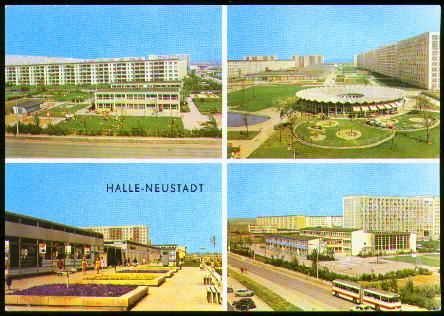
As shown on a vintage postcard, Halle-Neustadt consists of rows of apartment buildings surrounded by pleasant-looking green spaces, with a central commercial area and road corridor featuring large, articulated buses. The new city was also connected to Halle by an extensive streetcar system and an S-Bahn (commuter-rail line), and the city met the "Ideal Communist City" density of about 70,000 people per square mile.

The Stockholm planners' paper noted that almost all the apartments had two bedrooms because government planners decreed "that the ideal family consisted of four family members and that the number of flat rooms should be one less than the number of family members." They also noted that the government discouraged car ownership by placing most of the parking on the outskirts of the city "at a relatively large distance from the residential houses."

What the Swedish researchers failed to note in their 1998 presentation, but faithfully recorded in their full paper, was that Halle-Neustadt was only "sustainable" during the socialist period. When Germany reunified, many residents moved out, and those who stayed bought cars so that auto ownership "reached nearly the level of western Germany." Naturally, this created major congestion and parking problems: "The cars are parked everywhere -- on pavements, bike-ways, yards and lawn." The Swedes feared that proposed construction of new parking garages would "undermine" the "planning concept of concentrating the parking places on the city's outskirts." (See page 263 of The Vanishing Automobile for a somewhat greater discussion of the Stockholm paper.)

Visiting Halle-Neustadt


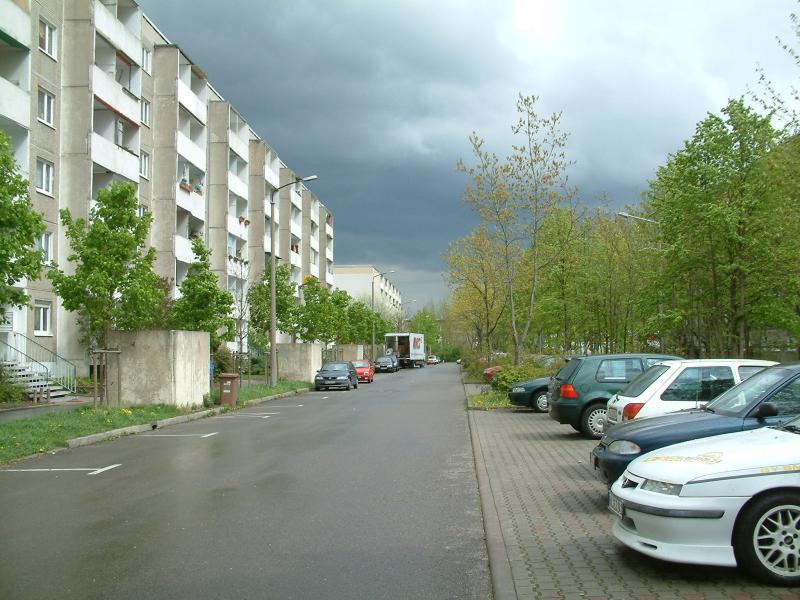
On April 27, 2005, I had the opportunity to join Wendell Cox on a tour of Halle-Neustadt and other formerly East German cities. The first thing we noticed is that the "parking problem" is gone, as are most of the green spaces, which have been turned into parking lots.

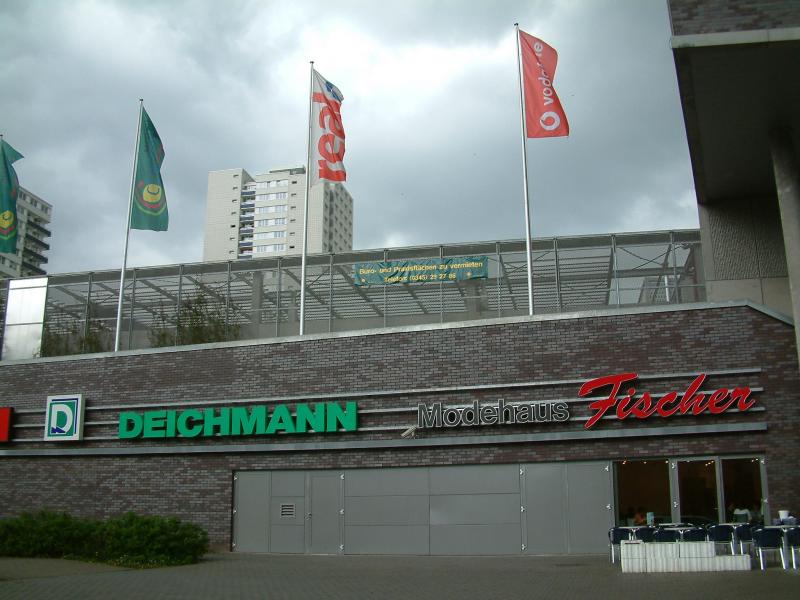
The city center also enjoys a modern new shopping mall supported by a multi-story parking garage.

The apartment buildings themselves range from reconstructed to totally abandoned. According to various web sites on the city, Halle-Neustadt's population peaked at 94,000 in 1990 but since has fallen to 60,000. After reunification, the apartments were privatized and are now owned by various housing companies. These companies have successfully lobbied the federal government to fund the demolition of unneeded buildings, and more than two dozen high-rises in Halle-Neustadt are scheduled for destruction. Yet the population of east German cities is declining so fast that demolition cannot keep up: despite numerous demolitions, the region is expected to have even more vacant housing in 2010 than it does today.

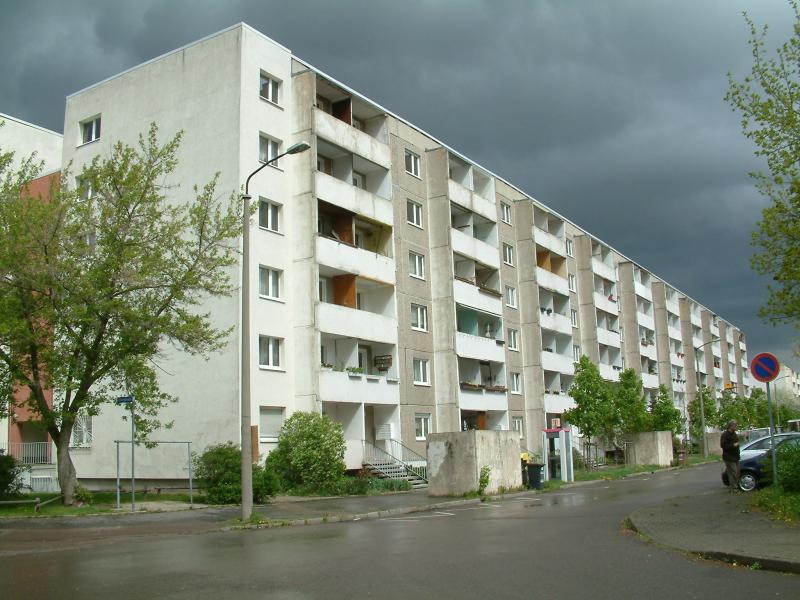
Wendell and I looked closely at two basic styles of building. First was a six-story apartment structure that probably represented the pre-mass-produced buildings described with such fanfare in The Ideal Communist City. These buildings had no elevators, so it is not surprising that many of the top floor apartments appear unoccupied.

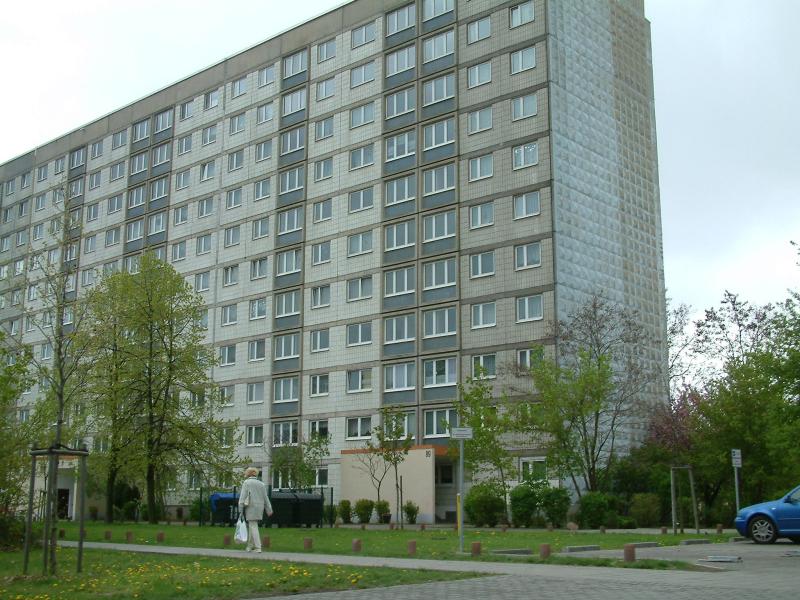
The second building type was eleven stories tall and probably represented the previously mentioned WBS 70. Some of these were in good condition, obviously reflecting investments made by the new private landlords.

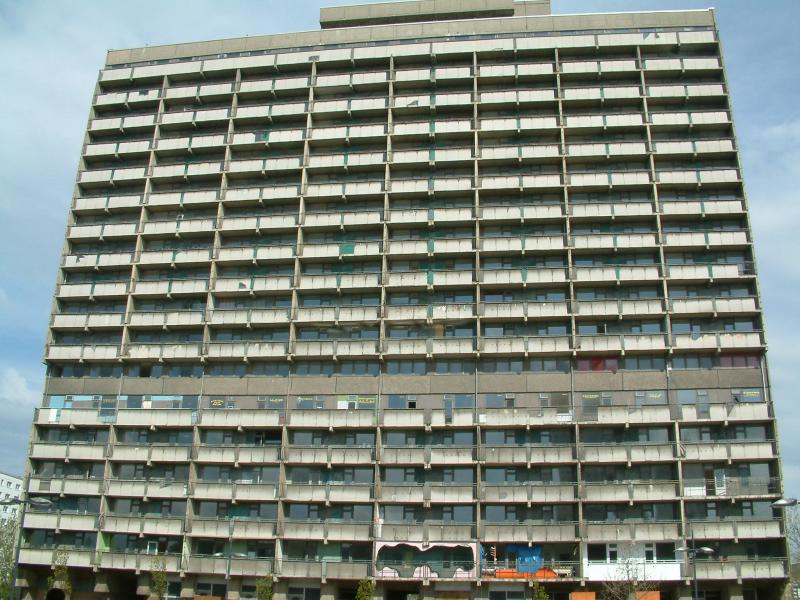
But many others were clearly abandoned and ready for demolition. We saw a few other building types, including some with even more stories, but did not examine them closely.
Germans pronounce the letter "H" as "ha" while "neu" is pronounced "noi." So residents often refer to Halle-Neustadt as "Hanoi," an ironic reference to the bombed-out nature of much of the suburb. They commonly refer to the apartments as "die platte," meaning "the slab," referring to the method of construction.

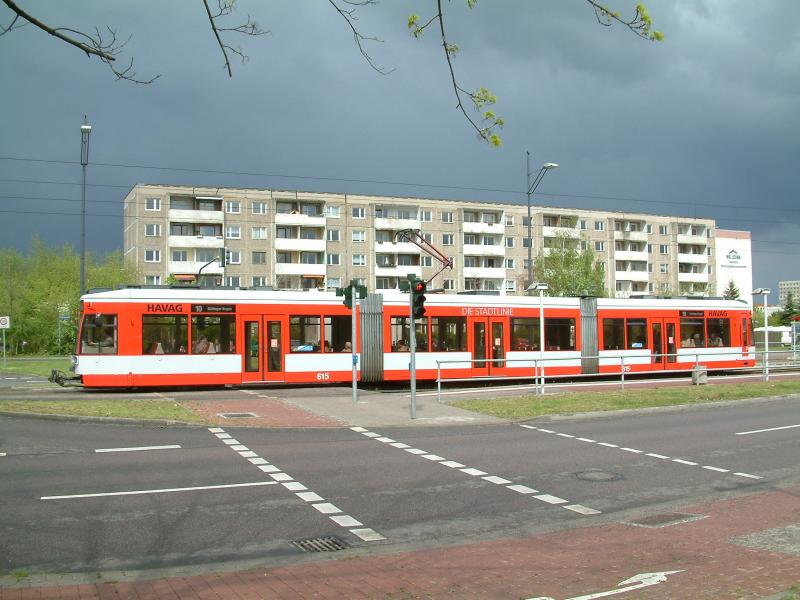
Following reunification, many of Halle's inefficient factories went out of business. The city has partly compensated by doubling the size of its university. Halle-Neustadt's central corridor still has frequent streetcar service to the university, but the commuter line connecting Hanoi with Halle's factories receives little use.

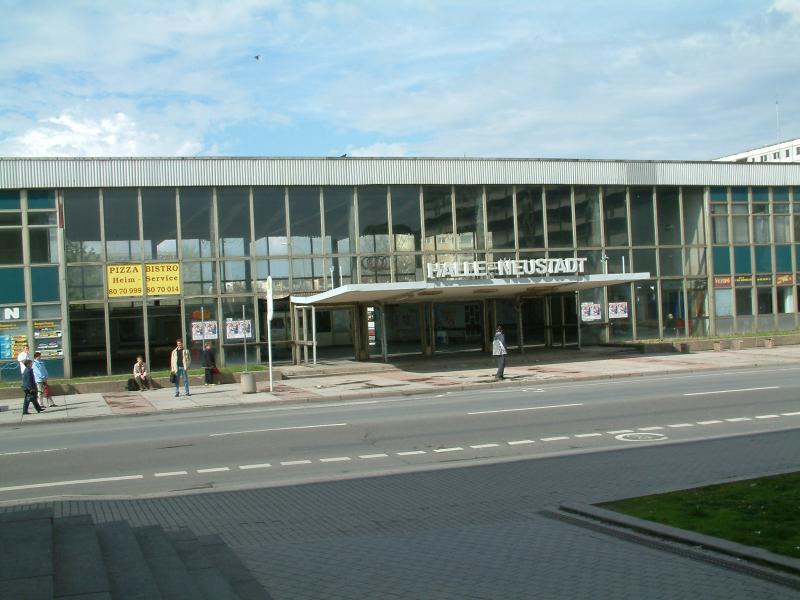
From a distance, the S-Bahn station still appears attractive.

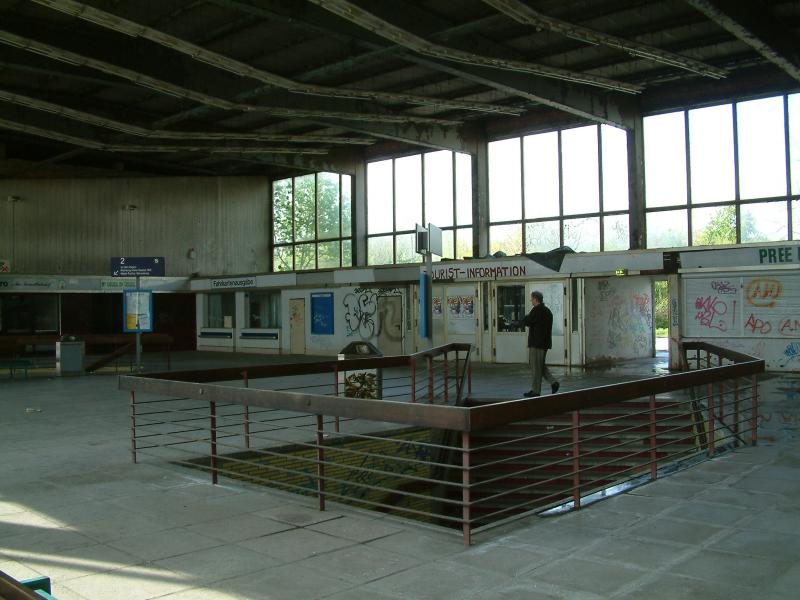
A closer look reveals many of the windows are broken, the inside is covered with graffiti, and the restaurant and other facilities advertised on the outside are abandoned. The actual loading ramp has room for fifteen-car trains, but today four-car trains are more than sufficient.

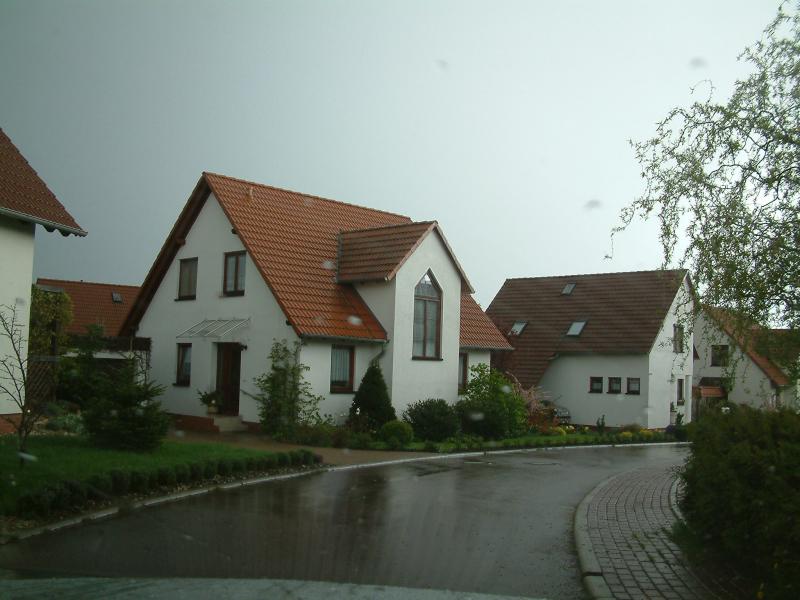
Where did all the people go? Many found jobs in western Germany; since reunification, east Germany has lost more than 1.25 million people. But many of those who stayed got away from the slabs by moving to suburbs of new duplexes and single-family homes.

Wendell and I did not have to search very far to find such suburbs, mostly added onto existing villages.

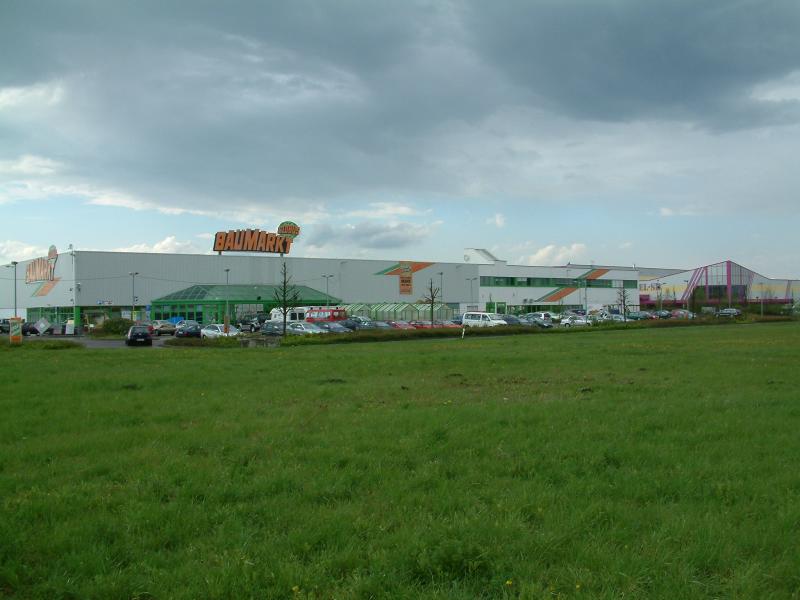
But well away from any village, in the middle of farmlands, we found several big-box stores, including a home improvement center, a furniture store, and a hypermart.

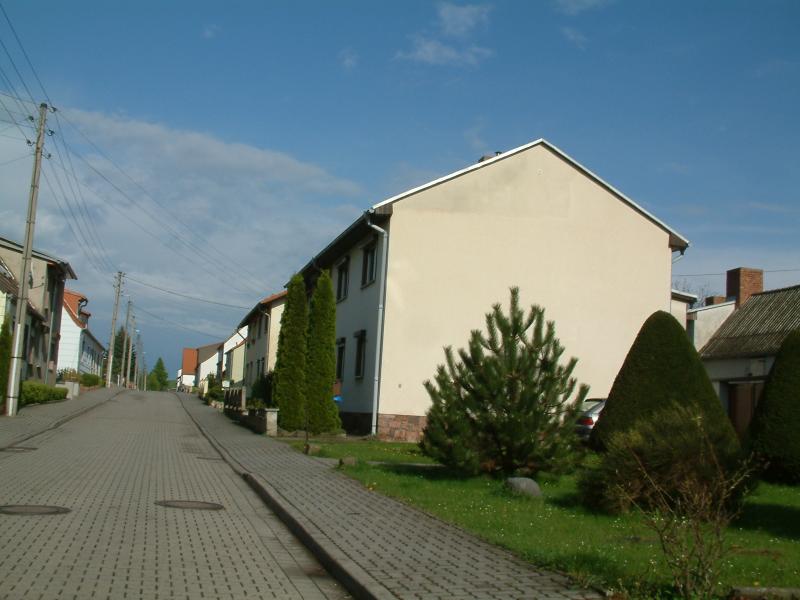
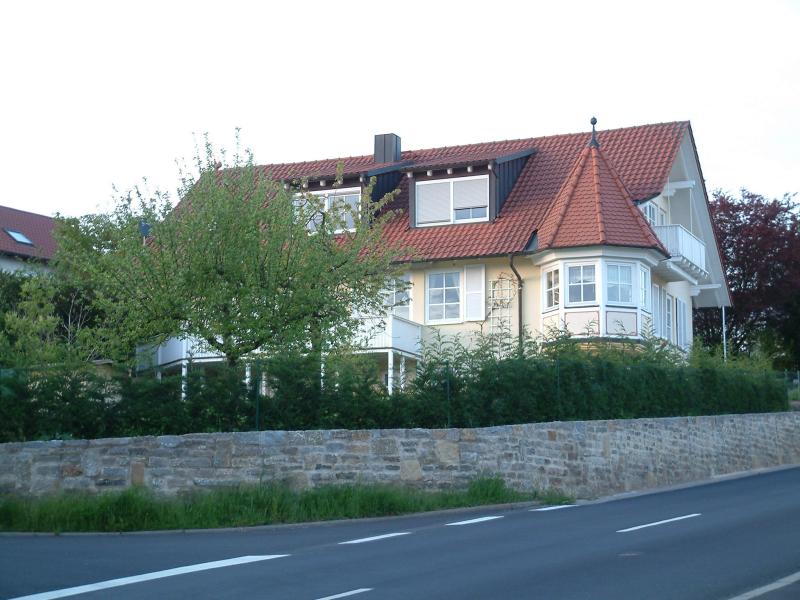
Today no one in Germany refers to such suburbs as "monotonous." This term is instead reserved for the grey slabs of concrete that most people are abandoning as fast as they can. Throughout Europe, high-rise apartments are increasingly becoming ghettos for Muslim and other foreign "guest workers." While the houses shown above are admittedly smaller than ones found in modern American suburbs, the Germans are fast catching up. A little further from Halle we found a suburban village that included many large homes with large backyards such as the one below.

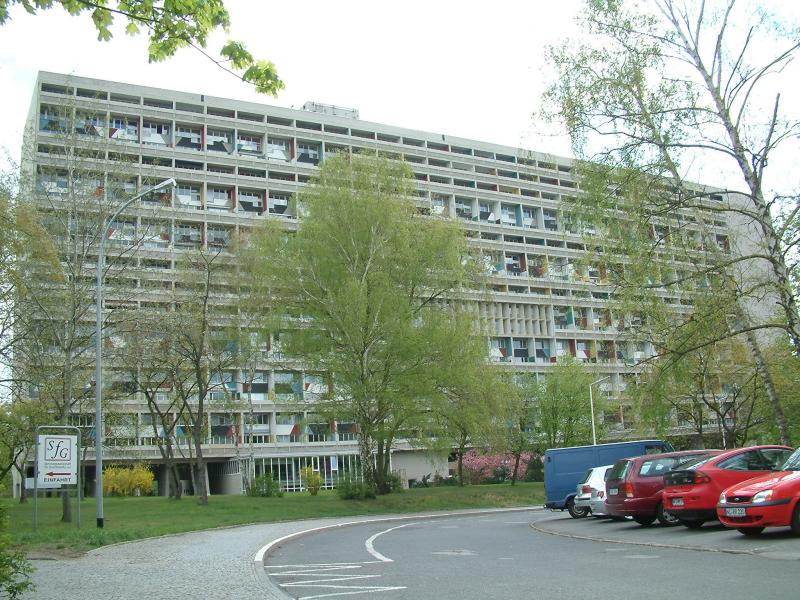
After leaving Halle-Neustadt, Wendell and I went to Berlin where we found Corbusier House, the 1957 prototype for much high-rise housing. Planning historian Sir Peter Hall calls Le Corbusier "the Rasputin of the tale" of authoritarian urban planning, because his "Radiant City" inspired so many bad urban plans around the world, including Halle-Neustadt and American public housing projects. But I suspect the 1,400 people living in Corbusier House are pleased with their setting. This is partly because, though a bad urban planner, Le Corbusier was a master architect, but mainly because Corbusier House residents chose to live there, whereas residents of soviet-block countries had no choice.

There will always be a market, though probably a small one, for high-density housing, whether in Radiant-City high rises or New-Urban mid rises. The problems arise when planners ignore the market and try to impose their ideology on people through prescriptive zoning codes, regulations, and subsidies.

A Communist Plot?

I have always resisted the notion that smart growth and sustainability are some kind of international plot to take away American sovereignty. Even if it were true, saying so marks one as a kook and eliminates all credibility. But I don't think it is true; we have enough central planners in our own midst that we don't have to look for them elsewhere.
And yet I get a creepy feeling when I look at the publication date of "The Ideal Communist City." Though written in the mid 1960s, the book was first released in English by a New York socialist publisher in 1971.
The earliest mention of smart-growth concepts I can find in the planning literature came out just two years later in the book, Compact City: A Plan for a Livable Urban Environment. Like The Ideal Communist CityCompact City advocated scientific or "total-system planning." Like The Ideal Communist City, but unlike New Urbanists, Compact City advocated high-rise housing. Like the New Urbanists, it quoted Jane Jacobs' book, The Life and Death of Great American Cities, in support of mixed-use and transit-oriented developments.

By 1980, research by Northwestern University economist Edwin Mills had thoroughly discredited the hypothesis that more compact cities would have less congestion and air pollution because people would be more likely to walk and ride transit. That didn't stop the U.S. House of Representatives from holding hearings titled Compact Cities: A Neglected Way of Conserving Energy. In 1996, compact cities were tied to sustainability in a book titled, Compact City: A Sustainable Urban Form?

Which brings us full circle to 1998 when University of Stockholm researchers tell an international group of planners that Halle-Neustadt is one of the most sustainable cities on earth -- knowing full well (but not mentioning) that the prerequisite for Hanoi's sustainability was keeping its residents poor and oppressed.

While I don't seriously equate urban planners with communists, the similarities between the Ideal Communist City and smart growth are far more numerous than their differences. As the table below shows, both seek to use planning to create a sense of community and promote collective rather than individual transportation. Beyond the superficial difference that the soviets preferred high rises and smart growth prefers mid rises, the main difference is that the communists tried to put everyone in identical small apartments while smart growth allows people to have as big a house or apartment as they can afford, but just tries to get them to build those houses on small lots.

The Ideal Communist City vs. Smart Growth

Concept                        Ideal Communist City    Smart Growth
Higher density housing                 Yes                 Yes
Mixed-use developments                 Yes                 Yes
Mixed-income housing                   Yes                 Yes
Transit-oriented development           Yes                 Yes
Discourages auto parking               Yes                 Yes
Calls suburbs "monotonous"             Yes                 Yes
Minimizes private yards                Yes                 Yes
Maximizes common areas                 Yes                 Yes
Minimizes private interiors            Yes                  No
Height of residential buildings     High Rise            Mid Rise
Though they publicly claim they want to reduce congestion, most smart-growth plans admit they seek to increase congestion to encourage people to use transit. Though they publicly claim to worry about affordable housing, smart-growth plans drive up land and housing costs with the hidden agenda of encouraging people to live in multifamily housing or at least on tiny lots.

Before visiting Europe, I spent a few days in Madison, Wisconsin. After returning, I spent a few days in Hamilton, Ontario. Though neither region is growing particularly fast, in both places politicians talk about the dangers of uncontrolled growth and how the firm hand of government planning was needed to prevent chaos and sprawl. Part of their plans, of course, call for packing more of that growth into urban infill than the market would build.

In particular, the plan for Hamilton requires that 40 percent of all new development be high-density infill. Currently the rate is just 18 percent. Now, 40 percent is a lot less than the near-100 percent imposed by Russia and East Germany. But Hamilton's plan means that 22 percent of its new residents will be forced to live in housing that they wouldn't normally choose. Experience in Portland and other cities shows that regulation that attempts to make much smaller changes in the housing market can lead to huge increases in housing costs.

Planners call this giving people more "choices"; what they mean is forcing people to accept lifestyles that they would not choose for themselves. How is this fundamentally any different from the philosophy of the Ideal Communist City?

Saturday, May 13, 2017

A second look: Marin Grassroots Protestors outside the Citizen Marin Town Hall Meeting on March 20, 2013

Editor's Note: This video is worth a second look after the "State of Emergency" news conference by Marin Grassroots. Here you will see many of the same participants refusing to interact with their fellow citizens inside the meeting. Notably, John Young of Marin Grassroots won't go in because "he wasn't invited and on the agenda" at the end of the tape.
Brief video with the protestors outside the Citizen Marin Town Hall on March 20, 2013.  The Town Hall event was open to the community to talk about affordable housing solutions.  People from all perspectives were encouraged to speak up about their views on affordable housing.
This group of activists were organized by Cesar Lagleva,  a Marin Profesional Public Employee Union Shop Steward (M.A.P.E.) encouraged others to protest against the public event.  Their cries of Racism, NIMBYism and Classism are meant to intimidate people from speaking openly about housing.  The irony is that most people inside at the event SUPPORT a fair allocation of affordable housing provided it is financially responsible and fits in to existing neighborhood densities.
Cesar was author of the highly offensive Marin Voice article I mentioned in an earlier post here.
Also present was the every present protestor and self proclaimed "Janitor of Political Waste Management", Jimmy Fishbob Geraghty. His daily rants about "racist Marinites" can be found on the San Rafael Patch and Marin IJ online.  You will often see him holding signs and protesting around the Bay Area.  If you can't get enough of him on the public news sites, you can get the full rants on his facebook page.   After this footage was shot, I spoke with him briefly, and came away with a positive impression of him.  He seems earnest but misguided and genuinely a nice guy.  It was one of my personal highpoints of the evening.

Local affordable housing lobbyist,  Dave Coury, also was present wearing his button to end Racism, Nimbyism and Classism.  He had been overheard at the February 2013 planning meeting asking for "affirmative action complaints against the Dixie School district" on his cell phone in the lobby during testimony about the Housing Element and its effects on school funding for Dixie School District.  He also has publicly called on the supervisors to simply zone all land in Marin within 1/2 mile of 101 Freeway as 30 units per acre multifamily housing.  We can only guess his client list funding his activities. In the July 9, 2013 Board of Supervisors meeting,  Dave Coury called the struggle for housing in Marin ""a war" and linked a shooting in Marin City to the housing issue.
Cesar Lagleva, sat next to me at a One Bay Area Plan meeting on April 16th.  I greeted him and offered to shake his hand and he shot back "don't touch me".  Clearly, we have a ways to go on our friendship.
Cesar Lagleva, is one of the organizers for Concerned Marinites to End Nimbyism (CMEN ..no jokes please) and their website is http://www.concernedmarinites.org/. where you will find more of their rhetoric.    It is amazing to me that this public employee union official  attacks the taxpayers that support him with such language  I am told he is a clinical social worker or psychologist. Here is a puff piece put out by his union.
Supervisor Steve Kinsey was the keynote speaker.  He thanked M.A.P.E. for organizing and told the crowd that "Marin can be very unwelcoming". Like the rest of the crowd gathered,  he was invited to participate the open town hall inside and share his views.  Supervisor Kinsey did not attend but stopped for a TV news interview, got in his car and sped off.
We think a fruitful discussion about affordable housing will begin with honest, open dialog and not with shouts of RACISM, CLASSISM and NIMBYism. 

We still have time to talk and my offer for a cup of coffee to share with Cesar is still open.

Wednesday, February 15, 2017

When Are Micro-Apartments Just Way Too Micro?

When Are Micro-Apartments Just Way Too Micro?


When Are Micro-Apartments Just Way Too Micro?
Reuters

As I've admitted before, I adore a great tiny home, an apartment or house so amazingly minimalist as to demand ingenuity in how people live, how we design furniture, how we conceive of a place. Tiny homes can be a space for brilliant innovation. They can make those of us just in it for eye candy reconsider what's truly essential in our own living spaces. They can also, on a practical level, help make city living more affordable for many people.
And then there is this tiny home, recently described in The New York Times within the "economic underbelly" of Hong Kong:
Twenty-two men live in this particular 450-square-foot apartment in the neighborhood of Mong Kok, in cubicles each hardly larger than a single bed, stacked above one another along two narrow passageways that end in a dank toilet and shower room.
Each cupboardlike cubicle has a sliding door, a small television, some shelves and a thin mattress. Most of the men have lived here for months, some for years.
At least 170,000 people in Hong Kong, the Times reports, live in a situation remarkably like this one. These are people so poor in a high-cost city that they can't afford the luxury of standing upright in their own homes.

An elderly resident poses in his cubicle in Mong Kok district in Hong Kong. (Bobby Yip/Reuters)


A staffer checks a column of lockers at a mini storage service provider inside an industrial building in Hong Kong. With more than half private dwellings now measuring less than 538 square feet, a cottage self-storage industry has mushroomed across Hong Kong, with industrial warehouses diced up into labyrinthine storage cubicles to cater for people whose lives have spilled beyond the walls of tiny homes. (Bobby Yip/Reuters)

These kinds of tiny homes have existed for much longer than the current trend of "micro" apartments in American cities, a topic we're set to discuss next week at CityLab, The Atlantic's summit on city-level innovation. The micro apartments leaders in cities like New York are promoting tend to be chic and thoughtfully crafted to feel larger than they really are (and not necessarily all that affordable). The existence of dwellings like these in Hong Kong is a reminder that micro living can just as easily be not adorable at all.
It's a little hard, though, to pinpoint exactly where the tiny home market veers from intriguing to inhumane. Is it at 150 square feet? Is it when you can't afford the bespoke furniture? Certainly you're there when, as the Times describes, people live in "units fenced off with plasterboard or cagelike wire mesh" – features that evoke a zoo more than a residence.
Recently, it seems as if the Internet has been full of tiny homes that are more ambiguous: 100 square-foot living cubes in Japan, this 100 square-foot apartment in Harlem that's "barely bigger than a prison cell." I'm not sure how I feel about those last two examples, but they hardly evoke the same wonder as, say, this little guy.

Emily Badger is a staff writer at The Atlantic Cities. Her work has previously appeared in Pacific Standard, GOOD, The Christian Science Monitor, and The New York Times. She lives in the Washington, D.C. area. All posts »

Monday, February 13, 2017

California’s housing crisis: It’s a matter of will (THIS is Marin's #1 Political Fight for 2017!)


California’s housing crisis: It’s a matter of will


By John Diaz, San Francisco ChronicleFebruary 10, 2017 Updated: February 11, 2017 12:48pm


In one sense, California’s housing crisis is a matter of simple math. This state was not building anywhere close to the number of homes that would be required to accommodate the addition of 300,000 residents a year over the past decade. Demand is greatly outstripping supply, and it’s only going to get worse with the anticipated population growth of 3.4 million by 2025.
.

So why isn’t that construction happening?

The causes are all political .

There are no inherently evil intentions in the people putting up these barriers. Californians who are fortunate enough to own a home in a comfortable community don’t want to disrupt their good life with newcomers clogging roads, overcrowding schools or overrunning their parks. They worry about the impact of property values.


Taxpayer groups don’t want to subsidize affordable housing. Politicians want to require below-market housing mandates that may or may not have any correlation with a development’s economic viability. Unions demand that any government-promoted housing must require union-level wages. Environmentalists and neighborhood groups want to reserve the right to challenge developments even if they fit within zoning guidelines. No city wants to be told how much it must contribute to the greater good of making its region or its state more affordable.

But add up each of those forces — and the clout that each brings to bear — and it’s clear to see why not enough building is getting done.

So the question arises: Do we have the collective will to change that dynamic, when it results in the nation’s highest poverty rate, our children unable to settle down near us and businesses struggling to recruit and retain workers in a transient economy?

So far, the answer has been no.

Just ask Gov. Jerry Brown, who last year pushed the not-so-radical notion that proposed residential projects that fully complied with local zoning and set aside at list 5 percent of their units for below-market sales should be put on a fast track. Opposition came from various quarters — tenant groups, environmentalists, the League of California Cities — but the true death blow came from the construction trades, which the Legislature’s Democrats dare not cross. Their beef: They wanted any projects that got special treatment to be subject to the equivalent of union wages.

A “prevailing wage” clause is no small deal in construction. A 2005 UC Berkeley study found that such clauses added as much as 37 percent to the price of a unit. It concluded that such union-friendly pacts essentially subsidized construction workers at the expense of low-income buyers. Those requirements work in pricey San Francisco and parts of Los Angeles, but they make projects unattainable most everywhere else.

Brown’s “by-right” plan to streamline housing died last year.

Freshman state Sen. Scott Wiener, D-San Francisco, has come in with a scaled-down plan (SB35) to spur housing construction. It would put the first real teeth in a state process that identifies how much housing each city must provide at each income bracket: Those that are out of compliance would be forced to give fast-track approval to projects that fit their zoning rules.

Asked where he is getting opposition, Wiener said, “You get pushback from everyone.” He has tried to fend off union opposition — at the expense of home buyers — by including a prevailing wage provision.

So it goes in California.

The Legislature also is looking for ways to raise money to subsidize affordable housing, though that is a futile chase:. At an average subsidy of $300,000 a unit statewide — much more in the coastal areas — it would take tens of billions to even come close to meeting the demand. Another fallacy, especially prevalent among San Francisco progressives: The focus should be limited to affordable housing. This crisis is the result of shortages at all price levels.

Gabriel Metcalf, CEO of SPUR, a San Francisco urban planning think tank, said he is struck by the “self righteousness that good liberal Democrats can have” in stopping new housing — and their failure to see the contradiction with their expressed concern for the underclass. “There needs to be a call to (homeowners’) moral conscience to care about other people who do need housing,” he said.

We all need to compromise to preserve the California Dream.

That awakening needs to reach the state Capitol, and city halls everywhere.


John Diaz is The San Francisco Chronicle’s editorial page editor. Email: jdiaz@fchronicle.comTwitter: @JohnDiazChron


What’s in the way? Plenty

Among the many factors why housing is so difficult to build in California:


City


resistance


Each local government is required to create a “housing element” that spells out how it will meet the housing needs at all income levels. But those are goals, not mandates, and many cities don’t bother to follow them.


CEQA


The California Environmental Quality Act can provide a powerful legal tool to stop development — even when the issues being raised against a project have nothing to do with environmental preservation. Competitors, unions and residents who simply don’t like a project have exploited the 45-year-old law to stop housing.


NIMBYs


An “I’ve got mine” mind-set prevails in many affluent areas that are loath to allow newcomers, especially of lesser means, to change the demographics of a neighborhood or city.


Revolving


rules


One of developers’ biggest complaints is the lack of certainty in the planning process, especially in cites such as San Francisco that give opponents multiple chances to slow or stop a project even when it adheres to all the zoning requirements. Delays can add greatly to the cost of each housing unit.


Unrealistic


targets


When politics, not data, drives a city’s affordable housing requirement ... the result can be that projects don’t pencil out. Exhibit A: San Francisco voted in June to double the portion of below-market housing to 25 percent in major projects, a figure the city controller later calculated to be too high.

Friday, October 7, 2016

The Housing Element Law is a Scam (strong language)

Council person from Corte Madera, CA makes terse remarks on the Housing Element Law which burdens small communities with enormous costs of compliance and diverts needed resources from more pressing local needs.  The unrealistic housing growth demands placed on communities from California Housing Community Development agency in California  plus ABAG's "Plan Bay Area" exceed the RESOURCES available to small communities to provide supporting infrastructure.

"The Housing Element Law is a SCAM!"

At last politicians are not afraid to tell it like it is.  Community all across California are rebelling to the housing element law.

Most people in the community that growth can be achieved provided it is rational and acknowleges resource limitations.

Wednesday, August 3, 2016

Friday, June 24, 2016

Soviet-Style Governance In San Francisco Bay Area


See the article in Forbes: Soviet-Style Governance In San Francisco Bay Area


French battlefield, 1914. The guns of the Great War reverberate to this day.


One of the all too many examples of illegal government overreach is currently playing out in the San Francisco Bay area. Unaccountable bureaucrats are imposing a sweeping new regional plan there that reflects the antiprogress, antipeople predilections of today’s leftist regulatory elites. Under the plan most future business and residential developments will be packed, sardine-like, into approximately 5% of the land area of the 9-county, 101-city region. Residents of all political stripes are outraged. Landowners feel they are suffering a government “takings” without compensation. Some environmentalists object that the impact on some of the chosen areas will be detrimental.

The mandate is being imposed ostensibly to reduce greenhouse gases. But that rationale is preposterous. U.S. emissions have already dropped to levels not seen since 1994, thanks, in no small part, to a surge in the production of natural gas, a truly clean source of energy. The other major reduction in omissions comes from better made trucks and cars, not from ant-hill-like residential/business clusters.

Citizen groups are protesting, and the Pacific Legal Foundation has now joined the fight, labeling this scheme illegal because bureaucrats have turned a blind eye to inconvenient data: “They studiously ignored facts showing that high-density development restrictions aren’t needed in order to meet the region’s targets for greenhouse gas reduction.” The foundation notes that this Big Brother-like plan “treats the law like a nuisance.”


The whole exercise displays a Soviet-style planning mentality. We should have learned the folly of treat ing people as if they were movable pawns, as happened in so many of post-WWII’s disastrous urban renewal projects, which did immense harm.

Nationally, be prepared to see a firestorm of opposition develop over the next few years against the plague of government lawlessness, at all levels.

Tuesday, June 21, 2016

Housing Secretary Shaun Donovan's remarks on HUD fair housing goals


Prepared Remarks of Secretary Shaun Donovan Before the NAACP’s 104th Annual Convention
Tuesday, July 16, 2013
Orlando, Florida


As prepared for delivery

Thank you, Hilary (Shelton), for that kind introduction, and for your great work as Director of the Washington Bureau.

Please allow me to also thank your President and CEO, Ben Jealous; your Chairwoman, Roslyn Brock; your Vice Chairman, Leon Russell; and all of the NAACP leadership for their distinguished service.

I also want to thank the organizers who decided to have me speak before Secretary Sebelius and Attorney General Holder.  Both of them are dynamic and tough acts to follow.  It is a pleasure to work with them to advance President Obama’s agenda.  And I am proud to call them both friends and colleagues.

Finally, I want to thank all of you here at the NAACP’s 104th Annual Convention for all your work to shape a fairer and stronger America.  For more than a century, this organization has been a champion of change, fighting to bring our nation closer to the ideals that it preached.

All of us at HUD have been proud to work with you during President Obama’s first term.  And I appreciate this chance to talk about what we can do in this second term to build on this progress.

Building Ladders of Opportunity

We come together today at an important moment in our nation’s history.  Under the President’s leadership, our economy is continuing to recover from the worst economic crisis since the Great Depression.

We have had 40 consecutive months of private sector growth, resulting in 7.2 million new jobs. And families across the country are turning the page on this incredibly painful chapter in their lives.
But let me be clear – all of us in the Administration are not content.  We don’t just want to recover and go back to the way things were in 2005 and 2006.

That’s because, even in those so-called good times, the American Dream wasn’t within equal reach of all communities.  Those occupying the executive suites and boardrooms didn’t reflect the diversity of America.

Neither did the entrepreneurs able to access capital for their businesses.  Neither did the young people who were able to study in the best schools.  Neither did the families who had access to healthcare.  And neither did those living in the strongest neighborhoods.

In other words, rebuilding America back to the way things were simply isn’t good enough.
Instead, we have got to shape a future where ladders of opportunity are available for all Americans.

As you know better than anyone, for African Americans, this is critically important.  Historically, for this community, the rungs on these ladders have been too far apart – making it harder to reach the middle class.

And all of us are here today to say no more.  As part of this effort, HUD has put forth an ambitious agenda to put an end to these disparities.

Specifically, we are adding rungs on the ladder of opportunity by:
• stepping up fair housing enforcement;
• ensuring that all Americans have access to homeownership and can keep it; and
• helping the hardest hit communities rebuild stronger than ever before. 

The First Rung: Fair Housing Enforcement

All of this work has long been a part of HUD’s mission.  In the area of enforcement – we administer the Fair Housing Act.  Passed in 1968—shortly after the assassination of Dr. Martin Luther King—the bill was an important milestone in our nation’s history.

It boldly declared that every person has the right to live wherever he or she chooses.  And all of us at HUD work tirelessly to ensure that this law in our books is a reality in our communities by fighting housing discrimination – whenever and wherever it exists.

During my tenure, I’ve pushed HUD to be more engaged and proactive.  For example, in 2011 alone, HUD charged more cases than it had in the previous decade – and with 25% fewer fair housing staff.

And in total, over the past three years, HUD’s investigative efforts have resulted in more than $65 million in compensation for more than 25,000 individuals that were allegedly subjected to housing discrimination.


And let me be clear: we are not satisfied.  That’s why I want to send a message to all those outside these doors. There are no stones we won’t turn.  There are no places we won’t go. And there are no complaints we won’t explore in order to eliminate housing discrimination. 

Period. 

And part of the reason we’ve been active like never before is because the nature of discrimination has changed over the years.  While blatant, “in your face”, discrimination is still very real today – a quieter form of discrimination has emerged that is just as harmful to our country.

This was a key finding of a HUD report released on June 11th on Housing Discrimination Against Racial and Ethnic Minorities.  It found that after an initial showing – real estate agents and rental housing providers recommend and show fewer available homes to minority families than equally qualified whites.

In the rental market, for example, African Americans learned about 11% fewer available units.
And when it came to purchases, Black homebuyers learned about 17% fewer homes.
Bottom line: people are being denied their freedom of choice and the benefits of full citizenship.  
Yet because of the subtle nature of this discrimination, often times, they don’t even know they have been subjected to this abuse.

That’s why HUD is enhancing its enforcement techniques by initiating investigations on our own without waiting for individuals to file complaints.  We have more than tripled the number of Secretary-initiated complaints that we have filed since 2008.  And in the larger picture—recognizing that discrimination is changing—we are changing our approach to Fair Housing by bringing it into the 21st century. 

Today, it’s about more than just addressing outright discrimination and access to the housing itself.  It’s also about giving every community access to important neighborhood amenities that can make a tremendous difference in a person’s life outcome.

I’m talking about good schools, safe streets, jobs, grocery stores, healthcare and a host of other important factors.  To help families gain this access – HUD is working to strengthen our stewardship of federal dollars to maximize the impact they have on communities in advancing fair housing goals. 

As all of you know, HUD’s programs provide funding to partners at the state and local level.  As part of the Fair Housing Act—for members of the protected classes—these partners have an obligation to affirmatively further fair housing opportunities – otherwise known as AFFH.
But as you and many others, including the Government Accountability Office, have noted, this has proven largely to be a meaningless paper exercise without any teeth.  The process has long been broken and we’re determined to fix it and help it reach its full promise.

That’s why I am proud to announce that this week we will publish a new rule to bring affirmatively further fair housing into the 21st century.  This rule focuses on the traditional tenets of discrimination – and also gets at the essential issues of access to opportunity so imperative to 21st century equity.

Specifically, this new rule will:
• provide a clear definition of what it means to affirmatively further fair housing;
• outline a standard framework with well-defined parameters; and
• offer targeted guidance and assistance to help grantees complete this assessment.

Perhaps most important—for the first time ever—HUD is providing data for every neighborhood in the nation, detailing what access African American families, and other members of protected classes, have to the community assets I talked about earlier –  including jobs, schools and transit.

With this data and the improved AFFH process, we can expand access to high opportunity neighborhoods and draw attention to investment possibilities in underserved communities. 

Make no mistake: this is a big deal.  With the HUD budget alone, we are talking about billions of dollars.  And as you know, decades ago, these funds were used to support discrimination. Now, they will be used to expand opportunity and bring communities closer to the American Dream.

This rule change is something the NAACP has long called for.  And when you’ve spoken, we’ve listened.  We have been proud to work with stakeholders like you every step of the way.  And we will continue to in order to strengthen this work in the months and years ahead to bring Fair Housing into the 21st century.

The Second Rung: Access and Protection of Homeownership.

And to complement this work, we are also working to ensure that families have access to homeownership – and can keep it.  This is a key rung in the ladder to opportunity.  After all, a home purchase often represents a family’s biggest economic investment, serving as a foundation for wealth-building.

It can help a child go to college, a family to start a business or an elderly person to retire in comfort and with dignity.  So homeownership has long been part of the American Dream. Unfortunately, for many families during the crisis – that Dream turned into a nightmare.

A study from Pew found that from 2005-2009, the median household wealth of African Americans fell 53%.  Think about that: more than half of African American wealth wiped out in just the four years before President Obama took office.

We cannot have a healthy America if communities of color are hurting.  That’s why HUD has been working to repair the damage to protect homeownership and help families rebuild their wealth.
In 2009, we launched the Making Home Affordable Program to provide relief to those at risk of foreclosure – helping nearly 1.1 million homeowners receive a permanent modification to their mortgages.

In addition, over the last four years, HUD-approved housing counselors have helped more than nine-million families deal with the financial crisis.

And as part of the National Mortgage Servicing Settlement the Obama administration negotiated with a bi-partisan group of 49 State Attorneys General –more than $50 billion in direct relief has been sent to over 620,000 homeowners as of the end of March.

This relief includes more than 310,000 trial or completed principal reductions – meaning that families have seen their outstanding loan balance permanently reduced to make monthly payments affordable, helping struggling homeowners get back above water.
This work has helped so many turn the page on this painful period in their lives.  And it is making a difference.  Since the beginning of 2012, almost two and a half trillion dollars in home equity has been restored.

But repairing the damage isn’t enough.  We are also working to ensure that a crisis of this magnitude never happens again by holding the banks accountable for what they did.  We all know that a lot of lenders acted recklessly when issuing loans before the housing collapse. And even after the loans were issued, many continued to turn their backs on responsible families.

That’s why as part of the Mortgage Settlement, we set out a series of reforms to ensure that our nation’s five largest banks don’t continue to wreak havoc in our neighborhoods.  Recently, the Settlement’s Independent Monitor, Joe Smith, released a compliance report showing that they have made some progress – including the end of robo-signing – a practice where banks sign off on foreclosures with little or no review.

Unfortunately, other abuses shamefully endure.  Most notably, these financial institutions consistently fail to send notices and communicate decisions to stakeholders in a timely manner. And any delay in providing help can not only cost a family their home – but also their hopes and dreams for the future.

This is unacceptable.  So last month, we put the five financial institutions officially on notice. They must correct these problems or the Obama administration, along with the bipartisan group of 49 state attorneys general, will fine them up to $5 million for each failure or haul them back into court.

As the NAACP knows better than anyone, progress requires activism from the courts to the streets to the boardrooms.  And I assure you that when it comes to pushing for progress in reforming banks – we will stay in the fight for as long as it takes to ensure that this crisis doesn’t happen again so families can stay in their homes.

Of course, keeping a family in their home is only meaningful if they can gain access to credit to buy it in the first place.  And that means strengthening our housing finance system and the Federal Housing Administration.

Over the next few months, Congress will decide if access to credit will be limited to the few … or be available to the many.  And as it considers the future of housing finance – we’ve got to make our voices heard about the need to keep FHA as a cornerstone of homeownership.
That’s because, as you all know, despite the FHA’s legacy of discrimination, in recent times, it has been critical to opening doors for low- and moderate income families.  And during the housing crisis, it helped keep the dream of homeownership alive for families by providing much needed liquidity to the nation’s mortgage finance markets.

In fact, economist Mark Zandi has said that if not for the FHA, “the housing market would have completely shut down.”  And, FHA mortgages have been essential to the African American community, accounting for 50 percent of home purchases in 2012.

Of course, like nearly all mortgage market institutions, FHA sustained significant losses due to the distress in the housing market.  But the Obama administration recognized this early on, and took swift and effective action to protect the FHA and the American taxpayer alike.
As a result, FHA is currently insuring the strongest loans in its history.  So again, I ask you to make your voices heard about the importance of this program, and the work we’ve done to secure its health far into the future so that it can continue to open the doors of homeownership to a wide-variety of qualified buyers.

Too many Americans had their dreams stolen by the housing crisis.  Don’t let Congress blame the victim and take away a rung on the ladder to opportunity.

The Third Rung: Building the Hardest-Hit Neighborhoods

Of course, as we look to the future, I know that housing is just one of the essential elements of a healthy community.  Indeed, as I said earlier, there are many factors that go into building stronger neighborhoods from the quality of their schools to the health of their local economies.

Unfortunately, in too many of our hardest hit communities—no matter how hard a child or her parents work—the life chances of that child, even her lifespan, is determined by the zip code she grows up in.

This is simply wrong.  That’s why President Obama has put forth his ladders of opportunity agenda so that every person, regardless of their zip code, can have a fair chance to succeed.

That means equipping a community with quality housing.  It also means implementing economic, educational and other important building blocks.

Recognizing this, President Obama has laid out an initiative called Promise Zones.  Under this effort, the Administration will partner with communities most impacted by the economic crisis.
Together, we will work with them to create jobs, leverage private investment, increase economic activity, improve educational opportunities and reduce violent crime.  And to do this effectively and efficiently, this is going to be a coordinated effort across the Administration.

Obviously, HUD will play a significant role in the housing piece through our Choice Neighborhoods redevelopment program, which provides local leaders with tools to turn HUD-subsidized housing from one kind of “anchor”—the kind that drags down a community—into a another kind that serves as a centerpiece of a thriving, vibrant neighborhood.

Secretary Sebelius and The Department of Health and Human Services will be ensuring that every resident has the quality healthcare they need.  Attorney General Holder and The Department of Justice will work to keep communities safe, because nobody can parent, and no child can achieve, when they live in a combat zone.

The Department of Education will be making sure that local school districts are providing the elementary and secondary education public school students deserve.  Across the Administration, we are all pitching in to make this happen.

And we do so because we know that by strengthening these communities, we will strengthen cities.  By strengthening cities, we are strengthening states and entire regions.  And all of this leads to a stronger America.

That’s why President Obama has made Promise Zones a key part of his 2014 budget.   It’s why he has committed himself to providing ladders of opportunity for all Americans.  And it’s why all of us at HUD are following his lead.  So I ask you to support the President’s and the Senate Appropriations Committee budget for HUD.

I also ask you to raise your voice and reject the House Republican Appropriations Bill that was recently unveiled which devastates HUD’s ability to serve the most vulnerable communities.
The bill would cut $3 billion from the President’s request from public housing and our other rental assistance programs – meaning 125,000 fewer housing vouchers would be available and 86,000 people who once faced homelessness could be back on the street – among other outcomes.
In short, it’s an attack on poor, working class and middle-class Americans.

So I ask all of you to say “no.”  No, we will not balance budgets on the backs of middle class and vulnerable Americans.  No, we will not withdraw our support of those who need it most.  And no we will not deny so many families their fair chance to get back on their feet and better their lives if they work hard.

NAACP – you know better than most how far we’ve come. You know we can’t turn back now.
Instead, we’ve got to look forward and move forward working together.

Know that HUD is with you every step of the way, working to build ladders of opportunity by:
• stepping up fair housing enforcement;
• ensuring all Americans have access to homeownership and can keep it; and
• helping the hardest hit communities rebuild stronger than ever before. 

And as long as I’m Secretary, know that you have a friend.  You have a champion for – and admirer of your efforts and advocacy.

And you have a partner in the work to build ladders of opportunity for all Americans to shape a stronger and fairer nation.

Thank you.