A blog about Marinwood-Lucas Valley and the Marin Housing Element, politics, economics and social policy. The MOST DANGEROUS BLOG in Marinwood-Lucas Valley.
Showing posts with label Marinwood Nature Preschool. Show all posts
Showing posts with label Marinwood Nature Preschool. Show all posts
My husband was raised on a peach orchard and I grew up on a small farm. Like most kids in those days from both city and country life, we spent most of our free time outdoors. But me and my husband had what many kids didn't: Acreage! And lots of it!! We had amazing childhoods, being able to roam and explore and we were never bored. We would like for our children to have the same opportunity to romp about in nature, play in the mud and climb trees like we did.
Now that we're on the the hunt for a house we've decided that we will settle for nothing less than a massive back yard that spans, oh... maybe a few dozen acres? Ha! Where we live, that's totally obtainable but I'd prefer a home on a much smaller chunk of land. Something big enough for my kids to explore for hours but small enough that I can be heard if I call out from the porch that dinner is ready. Straight up country style - I know.
I've been browsing Pinterest looking for affordable outdoor decor, outdoor toys for the kids and gardening tips and I came across natural playgrounds. It was a total "slap your head say duh". Kind of moment. If there are trees on the land that need to be cleared, well by golly, we could put them to great use! Here are some amazing images I found on Pinterest that I'd like to share with you. Maybe you'll find something here you'd like to build for you kids (or yourself!). Not much space would be needed for many of these projects, just some wood, vines, imagination and a little know-how!
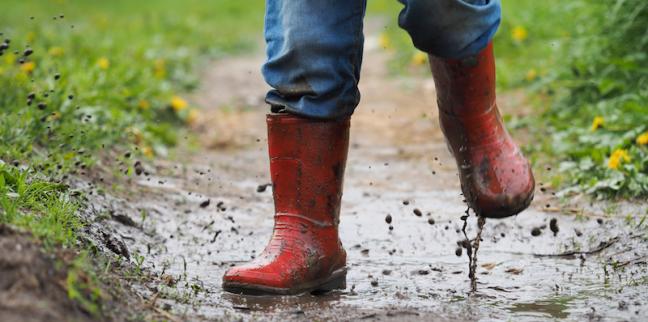
How Learning to Put on Rain Boots Leads to Academic Success
Catherine Koons Hubbard
It is easy to accept that a one-year-old baby is not yet able to dress herself unassisted, or to put on socks and shoes without help. Even people who do not spend their days working and playing with very young children understand that babies and toddlers follow a gradual progression in terms of motor development.
When discussing academics in early childhood, however, some policymakers and administrators often make the mistake of believing that earlier is better. They insist that early reading leads to greater success in the classroom, and they are eager to push so-called benchmark skills while ignoring the skills that ought to come first.
As nature preschool teachers, we often find ourselves in the middle of this conversation. Parents who enroll their children in our programs are, for the most part, in favor of outdoor exploration and play. At the same time, they want their children to enter kindergarten with all the necessary tools to succeed. For many parents, this means a focus on math and literacy.
Our own approach to school readiness, therefore, is not what they expect. We start by having children learn to put on their own rain boots.
We do not mean this in the metaphorical sense. We mean it quite literally. Managing rain boots – or socks, or even warm-weather sandals with straps - are an important part of the kindergarten readiness process.
Learning how to dress one’s self falls into what occupational therapists call “Activities of Daily Living”. ADL skills include self-feeding, toileting, and personal hygiene, such as blowing one’s own nose. Those of us who teach in nature-based classrooms appreciate that learning to care for one’s personal needs while also playing outdoors is not easy. In our program, which takes place in Wisconsin, there are coats, hats, and scarves to manage; there can be emergency bathroom needs; and then there’s the challenge of blowing one’s nose on a chilly day while wearing waterlogged mittens.
We understand that mastering ADL skills takes time and will vary based on individual needs. Nevertheless, we have seen that, as children gain confidence in caring for themselves, they also develop an increasing level of comfort and confidence in being in nature.
We place a great deal of value on self-efficacy at our nature preschool, that is, on children knowing that they have the skills they need to navigate new situations. Unlike self-esteem, which often depends on praise from others, self-efficacy develops when children have opportunities to discover their personal strengths. These will range from child to child. Some children discover an aptitude for balancing on logs and ice. Others develop empathy for animals. Still others are good at making friends, at playing cooperatively, or at solving problems. It is our hope that by the end of the year, they all feel confident in their ability to put on their own rain pants and boots.
Many children, especially those who have just turned three, are new to helping themselves. We do not advocate simply leaving them to figure it out unassisted. However, when parents ask, “But will they be prepared for school?” while simultaneously pulling socks onto feet and lifting feet into boots, we realize that we need to be better at sharing the importance of foundational skills.
Foundational skills in the preschool years include developing large and fine motor skills, developing self-regulation, learning to follow directions, and learning how to think through problems. Teaching a child to put on his own gear encompasses all of these.
As children learn to dress themselves, they are strengthening physical development, improving coordination and memory, and learning spatial and body awareness. Learning to manipulate one’s own gear also serves the very practical purpose of freeing up parents’ and teachers’ time, while enabling children to fix any problems that may occur when playing outdoors, such as dislodging pebbles and sand from their boots or taking off mittens.
We do understand that this process takes time, time that often feels unavailable. A parent frequently has to make a choice between letting a child struggle with boots and being twenty minutes late for school. That is one the reasons we have made teaching children how to put on, and take off, their outdoor gear an active part of our preschool curriculum. Rather than feel that the time we spend on our boots is keeping us from other activities, we try to view the process as an important activity unto itself.
It is worth noting that because our program begins outdoors, children at our nature preschool start by learning to take their outer gear off. This works well, as taking gear off tends to be easier, and because it fits in nicely with our daily routine. We will proceed, however, to putting outer gear on when we feel the children are developmentally ready.
In October of 2015, journalist Kimberly Marselas wrote an article called “Losing Our Grip: More Students Entering Schools without Fine Motor Skills”. It quickly made the rounds on social media, highlighting an alarming trend in which kindergarten teachers reported that a growing number of children lacked the basic motor skills of previous generations. They did not have the hand strength to manipulate glue bottles or manage paper and pencils. They were unsure how to cut with scissors. Several children lacked the adequate trunk strength to sit still for extended periods. One of the reasons given, beyond the increase in screen time, was a decrease in unstructured outdoor free play. Unstructured is the key word here: outside time is not enough. The freedom to play in a nebulous way is something all children need.
If children lack the hand strength and coordination needed to manage paper and scissors, and if, at age five, they are still clutching their pencils in their fists, we are not setting them up for academic success; we are setting them up for occupational therapy.
This is why we have a made a point of communicating to our families the multiple ways in which nature-based play supports large and fine motor development. We explain that by pulling caps off acorns, shucking corn, and building fairy houses in the woods, the children are strengthening their fine motor skills. When they use sweep nets, pond nets, and rake up leaves, their core strength improves, along with their muscles and stamina. And when we encourage children to manage, with as little help as possible, their own outdoor gear and rain boots, they are developing not only motor dexterity and strengthening body awareness, but are also growing in confidence and self-sufficiency. They are learning not to give up when faced with new challenges. They are learning that even things that are difficult at first get easier with repetition. This is what leads to academic success. Just imagine how well your children will do, we tell parents, knowing that on the first day of kindergarten they have the necessary skills to put on their very own rain boots.
At Audubon Nature Preschool, a "classroom" can be a pond, a bamboo forest, a meadow, or a garden. That's because Audubon is a "nature preschool"—one of a growing number of preprimary schools where children spend all or part of their days outdoors.
Five years ago, only a couple dozen such schools operated in the United States. Today, there are close to 250, according to the Natural Start Alliance, a coalition supporting early-childhood and environmental education.
The surge in nature preschools can be partially attributed to Richard Louv's decade-old best-seller, Last Child in the Woods: Saving Our Children from Nature-Deficit Disorder.
Louv, a journalist and author, theorizes that the shift toward nature-based education is happening quickly at the pre-K level because preschools can be less structured than K-12 schools.
"Many preschools are private or independent, so there's more flexibility there," he said in an interview.
Louv coined the term "nature-deficit disorder" to describe the price of humans' isolation from nature, including "diminished use of the senses, attention difficulties, and higher rates of physical and emotional illnesses."
Louv's ideas come at a time when the prevailing trend in schools is toward more academic instruction. And many believe the level of academic rigor has ratcheted up because of the Common Core State Standards.
"Teachers are so tired of the direction that much of education has been going toward," Louv said, "toward more and more testing, toward canceling recess, toward longer school hours, toward anything but real experience in the real world."
A Different Pedagogy
In San Diego, Susan Seiguer, the founder and lead teacher at All Friends Nature School, has used the early-childhood-education program "Growing Up Wild" as her curricular guidepost.
She also borrows the pedagogy of a Waldkindergarten, or forest school. At these schools, children between the ages of 3 and 6 spend their days outdoors, either in a forest or some other natural environment.
Students and teachers gather at the Audubon Nature Preschool in Chevy Chase, Md. Pupils begin their days outside, come together for a morning circle, and then head to learning centers. The day ends with a story and a hike.
—Julie Depenbrock/Education Week
All Friends enrolls 11 children, with one teacher for every four to six students.
"All of our days are spent outside, rain or shine," Seiguer said. "There is no facility."
"Some days we spend our afternoons building a shelter so we have a shady spot to eat our lunch or just to play in," she said. "Other days we may go on a bug hunt and see how many different types of insects are living around us, counting the different types and learning their names."
While San Diego's temperate climate may provide an ideal location for outdoor education, nature preschools have also cropped up in places with more extreme weather.
"One of the big things we say in the nature-based-education world is there's no such thing as bad weather, only poor choices in clothing," said Madison Powell, the director of the Chippewa Nature Preschool in Midland, Mich.
Every Chippewa student has a pair of waterproof, head-to-toe coveralls, as well as boots, gloves, hats, scarves, balaclavas, and changes of clothes and shoes for "indoor" school. Children spend about half the day outside, barring hazardous weather.
"If it's dangerous to be outside—if it's dangerous to be in the elements—then we are inside," Powell said. "We're not throwing them outside just because we're a nature preschool and we say we have to."
At Chippewa, four-day preschool costs around $355 per month. Eligible parents in Michigan can apply for tuition-free preschool through the state-funded Great Start Readiness Program. The Chippewa Nature Center also provides scholarship funding, so no family pays more than 5 percent of its household income.
Powell said about half of the 140 students enrolled receive some form of financial aid.
School Without Walls
At Fiddleheads Forest School in Seattle, co-director Kit Harrington said she keeps enrollment low to strengthen relationships with families. This year, 42 students are enrolled and 180 are in a "waitpool." (Tuition at Fiddleheads ranges from $330 to $780 a month.)
Like All Friends Nature School, Fiddleheads has no building affiliated with its program. Students retreat to a heated greenhouse—which has electricity and running water—when high winds make it impossible to be outside.
Otherwise, students' "classrooms" are two forest groves in the University of Washington Botanic Gardens.
"We sort of are a bridge in between what may be considered a more typical forest school approach and a more structured approach," said Harrington, a former Montessori teacher. She co-directs the preschool with Sarah Heller, whose background is in environmental education.
In winter, Fiddleheads students hike and explore the arboretum, learning about natural science.
"We follow an arc of the year," Harrington said.
"At the start of the school year, we really emphasize grounding the children in the environment, helping them connect with the space, developing a foundational awareness of themselves in relation to the environment," she said, "giving them language to describe their emotional and physical states, as well as giving them an awareness of the expectations of the setting so they are empowered to have ownership over caring for the space and caring for each other."
In the decade since Last Child in the Woods was published, the volume of studies on nature-deficit disorder and the effects of green spaces on school-age children has grown, Louv said.
A 2009 study from England's University of Essex, for example, concludes that "participating in physical activity and experiencing nature play an important role in positively influencing our health and well-being."
"Yet," the authors go on to say, "physical activity levels have dropped dramatically, and inactivity results in 1.9 million deaths worldwide annually, roughly 1 in 25 of all deaths."
'Containerized' Children
Likewise, Jane Clark, the dean of public health at the University of Maryland College Park, argues that the current generation of children has been made sedentary—"containerized" in strollers, car seats, high-chairs, and all manner of accident-preventive secure seating, which allows them little free movement.
"When they get to day care—I used to say—if a parent could just pass their child through the window, they would," Clark said.
Clark drew a diagram from a study in which three generations were asked where they played as children. The grandparent drew a radius around the house, extending several miles in each direction. The parent's circle was smaller, but still included much of the neighborhood and the surrounding woods. Finally, the child drew a circle with just the house and the backyard.
There are a lot of reasons for the shrinking play space, Louv said: the advent of "stranger danger"—parents' perceptions of threats to their children from strangers, increasing urbanization, and the strong pull of technology-based and indoor entertainment.
The schools are not without some criticism, though. "Certainly there are many potential benefits to outdoor education, and they provide an important alternative to the increasing and troubling amount of 'seatwork' and teacher-directed learning that young children are faced with in preschool, pre-K, and kindergarten settings," said Fikile Nxumalo, an assistant professor of early-childhood education at the University of Texas at Austin.
But she is "also concerned about prevailing romanticized engagements with nature in many of these schools—where there is this assumed 'natural' connection between children and nature, and where nature is seen as primarily a site for child development."
Nxumalo favors nature preschools that take a more complex view of the environment and define nature education "within current ecological challenges"—for example, discussing what it means to live ethically with animals deemed "pests" and dealing with litter in the natural environment.
Problem of Access
Though she believes nature schools are a step in the right direction, Nxumalo also sees room for improvement, especially in ease of access to these schools for many urban and economically disadvantaged children.
"I think part of the risk of 'nature preschool as passing trend' is that nature preschool remains something that is not widely accessible to children and families from economically marginalized communities," Nxumalo said. "I think this needs to change."
Louv is hopeful that the more principals, administrators, and school boards get involved, the better chance nature-based education has of reaching the masses.
As for environmental barriers, he contends that even in the densest of cities, nature can be found. It may be less sprawling than it is in the countryside, but it's there—and it's vital.
"Much of our pathology, I think, as a species is we think we can go it alone. The immersion in species not our own is extraordinarily important. This is who we are—it's part of our biology, part of our humanity," Louv said.
At Maryland's Audubon Nature Preschool, located on 40 acres of nature sanctuary, students spend as much time as possible outdoors,said Director Stephanie Bozzo.
"The curriculum emerges from what the children are interested in, but we have a broad idea of which spots on our sanctuary are most appealing during the different seasons," Bozzo said.
Days at Audubon, which costs an average of nearly $800 per month, follow a familiar rhythm. Each morning, children begin outside, come together for a morning circle, and go to learning centers where they move through preplanned activities. Then, they read a story and end the day with a hike.
If the weather is nice and no one complains, Bozzo said, they might spend the entire day outdoors.
Airen Hall has had two sons attend Audubon. Before moving to the area, she said, her oldest had gone to a traditional nursery school in Syracuse, N.Y.
"In our experience, the difference goes far beyond just the kids spending a lot of time outside," Hall said. "The most important differences are in the whole philosophy of the program. [Audubon] is just such a learning-rich environment. They encourage the kids to ask a lot of questions and explore and be curious."
Audubon parents choose from five different classes: Acorns, Sprouts, Saplings, and Oaks. Acorns have class once a week for 90 minutes on the sanctuary grounds. Sprouts and Saplings divide their three hours between indoor and outdoor activities. Oaks, dubbed forest "kindergartners," meet four days a week from 9 a.m. to 2 p.m. and spend half the day outside.
Bozzo tries to keep the children's boundaries wide—"wider than typical teachers are comfortable letting children explore," she said.
"Children don't necessarily feel like they're being watched at all times, which we think is very central to our mission—that children are exploring on their own and what they gravitate towards is whatever they're intrinsically interested in," Bozzo said.
And each day is different.
"That's the beauty of nature—that it's surprising and it's dynamic," Bozzo said

 like we did.



 Printer-Friendly
 Email Article
 Reprints
 Comments