Showing posts with label A21. Show all posts

Monday, June 25, 2018

President Obama Orders Behavioral Experiments On American Public

President Obama Orders Behavioral Experiments On American Public in 2015

President Obama announced a new executive order on Tuesday which authorizes federal agencies to conduct behavioral experiments on U.S. citizens in order to advance government initiatives.


“A growing body of evidence demonstrates that behavioral science insights — research findings from fields such as behavioral economics and psychology about how people make decisions and act on them — can be used to design government policies to better serve the American people,” reads the executive order, released on Tuesday.

The new program is the end result of a policy proposal the White House floated in 2013 entitled “Strengthening Federal Capacity for Behavioral Insights.”

According to a document released by the White House at that time, the program was modeled on one implemented in the U.K. in 2010. That initiative created a Behavioral Insights Teams, which used “iterative experimentation” to test “interventions that will further advance priorities of the British government.” 

The initiative draws on research from University of Chicago economist Richard Thaler and Harvard law school professor Cass Sunstein, who was also dubbed Obama’s regulatory czar. The two behavioral scientists argued in their 2008 book “Nudge” that government policies can be designed in a way that “nudges” citizens towards certain behaviors and choices.
The desired choices almost always advance the goals of the federal government, though they are often couched as ways to cut overall program spending.

In its 2013 memo, which was reported by Fox News at the time, the White House openly admitted that the initiative involved behavioral experimentation.

“The federal government is currently creating a new team that will help build federal capacity to experiment with these approaches, and to scale behavioral interventions that have been rigorously evaluated, using, where possible, randomized controlled trials,” the memo read. 
That document cited examples from the U.K. which showed that sending out a letter to late taxpayers which read “9 out of 10 people in Britain pay their taxes on time” led to a 15 percent increase in compliance.

The new executive order encourages federal agencies to “identify policies, programs, and operations where applying behavioral science insights may yield substantial improvements in public welfare, program outcomes, and program cost effectiveness,” as well as to “develop strategies for applying behavioral science insights to programs and, where possible, rigorously test and evaluate the impact of these insights.”

To jump-start the programs, agencies are encouraged to recruit behavioral science experts to join the federal government and to develop relationships with researchers in order to “better use empirical findings from the behavioral sciences.”

A fact sheet sent out by the White House on Tuesday shows that researchers at numerous universities and think tanks — from MIT, Harvard, and the Brookings Institute, to name a few — have signed on to the program.

The executive order specifically directs federal agencies to develop nudge programs that help individuals, families, communities and businesses “access public programs and benefits by, as appropriate, streamlining processes that may otherwise limit or delay participation.”

This can be achieved by “administrative hurdles, shortening wait times, and simplifying forms,” the order suggests.

The initiative also urges agencies to tinker with how information is presented to individuals, consumers, borrowers, and program beneficiaries.

The “content, format, timing, and medium by which information is conveyed” should be taken into consideration as those characteristics affect “comprehension and action by individuals.”

In programs that offer choices for consumers, agencies are instructed to “consider how the presentation and structure of those choices, including the order, number, and arrangement of options, can most effectively promote public welfare.”

The order also suggests that agencies fiddle with whether to label certain expenditures as “benefits, taxes, subsidies” or other incentives to “efficiently promote” programs.
President Obama’s federal health care law, Obamacare, is replete with “nudge” language and experimentation
.
In its fact sheet, the White House noted that reminding individuals who had started to sign up for Obamacare led to a 13 percent increase in completed applications.

To help determine which presentation was more effective, the Department of Health and Human Services “sent one of eight behaviorally designed letter variants to each of more than 700,000 individuals who had already begun the health insurance enrollment process but had not yet completed an application.”

The most effective version of the letter generated the 13 percent improvement. Other less effective letters only increased enrollment rates by around four percent.
Another nudge contained in Obamacare was brought to light in the debate over whether the individual mandate contained in the law was a tax hike.

Republicans insisted that it was a tax increase, but the White House portrayed it as a penalty on the logic that the word “tax” has a negative connotation.

While the Obama administration touts nudge policies, others are hesitant to get on board.
“I am very skeptical of a team promoting nudge policies,” Michael Thomas, an economist at Utah State University, told Fox News in 2013.

“Ultimately, nudging…assumes a small group of people in government know better about choices than the individuals making them.”


Read more: http://dailycaller.com/2015/09/15/president-obama-orders-behavioral-experiments-on-american-public/#ixzz3mPrpdWh2

Monday, April 16, 2018

Zoning vs. Eminent Domain: How Ventura County Shut Down The Pine Mountain Inn


Zoning vs. Eminent Domain: How Ventura County Shut Down The Pine Mountain Inn


In the northernmost reaches of California's Ventura County, a two-lane rural road called Highway 33 runs into the rugged and mostly undeveloped Transverse Mountain Range. Though it's mostly raw wilderness, a few businesses catering to adventurous explorers have long existed there, some for more than a century.


Monday, December 4, 2017

Tuesday, November 28, 2017

Straight Talk About Planning - The Other Side of Sustainable Development


Most of us see sustainable development as helpful. In fact, sustainable development planning is costing people their property values and the grant money planners provide usually comes with strings that further limit property owners' rights while recasting the social makeup of your community.

Tuesday, November 21, 2017

Agenda 21 in Namibia (Africa)

In case anyone needs confirmation about Agenda 21 and Smart Growth being a worldwide scourge of social engineers, check out this poster for "transit oriented development" in Namibia, a poor Sub-Saharan African nation. People want progress and freedom, not bureaucrats and control.

Saturday, November 18, 2017

Battle for the California Desert: Why is the Government Driving Folks off Their Land?


The Antelope Valley is a vast patch of desert on the outskirts of Los Angeles County, and a segment of the few rugged individualists who live out there increasingly are finding themselves the targets of armed raids from local code enforcement agents, who've assembled into task forces called Nuisance Abatement Teams (NATs).

The plight of the Valley's desert dwellers made regional headlines when county officials ordered the destruction of Phonehenge: a towering, colorful castle constructed out of telephone poles by retired phone technician Kim Fahey. Fahey was imprisoned and charged with several misdemeanors.

But Fahey is just one of many who've been targeted by the NATs, which were assembled at the request of County Supervisor Mike Antonovich in 2006. LA Weekly reporter Mars Melnicoff wrote an in-depth article in which she exposed the county's tactic of badgering residents with minor, but costly, code violations until they face little choice but to vacate the land altogether.

"They're picking on the the people who are the most defenseless and have the least resources," says Melnicoff.

Reason.tv collaborated with Melnicoff to talk with some of the NAT's targets, such as retired veteran Joey Gallo, who might face homelessness if he's forced to leave his house, and local pastor Oscar Castaneda, who says he's already given up the fight and is in the process of moving off the land he and his wife have lived on for 22 years. And, while Antonovich declined an interview, we did catch up with him at a public meeting in order to ask the big question at the center of all this: Why the sudden enforcement of these codes against people living in the middle of the desert, who seemingly are affecting no one?

Writer-Producers: Zach Weissmueller and Tim Cavanaugh. Associate Producer: Mars Melnicoff. Camera: Alex Manning and Weissmueller; edited by Weissmueller.

Approximately 9:48.

Music by Audionautix.com.

Friday, September 29, 2017

New York City Mayor Attacks Private Property, Praises Socialism

New York City Mayor Attacks Private Property, Praises Socialism


By Alexandra DeSanctis — September 6, 2017

Wednesday, September 20, 2017

Agenda 21

UNCED, 1992
Agenda 21 is a comprehensive plan of action to be taken globally, nationally and locally by organizations of the United Nations System, Governments, and Major Groups in every area in which human impacts on the environment. 

Agenda 21, the Rio Declaration on Environment and Development, and the Statement of principles for the Sustainable Management of Forests were adopted by more than 178 Governments at the United Nations Conference on Environment and Development (UNCED) held in Rio de Janerio, Brazil, 3 to 14 June 1992. 

The Commission on Sustainable Development (CSD) was created in December 1992 to ensure effective follow-up of UNCED, to monitor and report on implementation of the agreements at the local, national, regional and international levels. It was agreed that a five year review of Earth Summit progress would be made in 1997 by the United Nations General Assembly meeting in special session. 

The full implementation of Agenda 21, the Programme for Further Implementation of Agenda 21 and the Commitments to the Rio principles, were strongly reaffirmed at the World Summit on Sustainable Development (WSSD) held in Johannesburg, South Africa from 26 August to 4 September 2002. 

Download Agenda 21 HERE

Saturday, September 16, 2017

John and Ken on Agenda 21 in Southern California (we have ours in Plan Bay Area)


So glad this information about Agenda 21 policy ideas is getting out into the mainstream media. Plan Bay Area is part of the same master plan. It all seems very fringe but it is a real thing openly discussed in Europe and Australia and South America.

Friday, July 21, 2017

UN’s Agenda 2030 is Every Totalitarian’s Dream


The United Nations is pushing sustainable development goals, also known as “Agenda 2030”, which is contrived of 17 goals which the United Nations aims to achieve globally by the year 2030. Foreign Correspondent Alex Newman breaks down a few of these goals and shows that the real agenda is global tyranny. Alex’s findings should be beyond alarming for Americans and humanity as a whole.

Saturday, April 1, 2017

Greenwald: Empowering the "Deep State" to Undermine Trump is Prescription for Destroying Democracy


NERMEEN SHAIKH: We’re looking at the growing scandal over the Trump administration’s alleged dealings with Russia before and after the November election. In early January, Democratic Senator Chuck Schumer appeared on The Rachel Maddow Show and suggested the intelligence community may try to get back at Donald Trump.
SEN. CHUCK SCHUMER: Let me tell you, you take on the intelligence community, they have six ways from Sunday at getting back at you. So, even for a practical, supposedly, hard-nosed businessman, he’s being really dumb to do this.
AMY GOODMAN: That was the Senate minority leader, Chuck Schumer, in January.
Some supporters of Trump, including Breitbart News, are now accusing the intelligence agencies of attempting to wage a "deep state coup" against the president. Meanwhile, some critics of Trump are openly embracing such activity, like Bill Kristol, the prominent Republican analyst who founded The Weekly Standard. He wrote on Twitter, "Obviously strongly prefer normal democratic and constitutional politics. But if it comes to it, prefer the deep state to the Trump state."
So, still with us, Pulitzer Prize-winning journalist Glenn Greenwald of The Intercept, speaking to us from Rio de Janeiro, Brazil. Glenn, explain what the deep state is, and respond.
GLENN GREENWALD: The deep state, although there’s no precise or scientific definition, generally refers to the agencies in Washington that are permanent power factions. They stay and exercise power even as presidents who are elected come and go. They typically exercise their power in secret, in the dark, and so they’re barely subject to democratic accountability, if they’re subject to it at all. It’s agencies like the CIA, the NSA and the other intelligence agencies, that are essentially designed to disseminate disinformation and deceit and propaganda, and have a long history of doing not only that, but also have a long history of the world’s worst war crimes, atrocities and death squads. This is who not just people like Bill Kristol, but lots of Democrats are placing their faith in, are trying to empower, are cheering for as they exert power separate and apart from—in fact, in opposition to—the political officials to whom they’re supposed to be subordinate.
And you go—this is not just about Russia. You go all the way back to the campaign, and what you saw was that leading members of the intelligence community, including Mike Morell, who was the acting CIA chief under President Obama, and Michael Hayden, who ran both the CIA and the NSA under George W. Bush, were very outspoken supporters of Hillary Clinton. In fact, Michael Morell went to The New York Times, and Michael Hayden went to The Washington Post, during the campaign to praise Hillary Clinton and to say that Donald Trump had become a recruit of Russia. The CIA and the intelligence community were vehemently in support of Clinton and vehemently opposed to Trump, from the beginning. And the reason was, was because they liked Hillary Clinton’s policies better than they liked Donald Trump’s. One of the main priorities of the CIA for the last five years has been a proxy war in Syria, designed to achieve regime change with the Assad regime. Hillary Clinton was not only for that, she was critical of Obama for not allowing it to go further, and wanted to impose a no-fly zone in Syria and confront the Russians. Donald Trump took exactly the opposite view. He said we shouldn’t care who rules Syria; we should allow the Russians, and even help the Russians, kill ISIS and al-Qaeda and other people in Syria. So, Trump’s agenda that he ran on was completely antithetical to what the CIA wanted. Clinton’s was exactly what the CIA wanted, and so they were behind her. And so, they’ve been trying to undermine Trump for many months throughout the election. And now that he won, they are not just undermining him with leaks, but actively subverting him. There’s claims that they’re withholding information from him, on the grounds that they don’t think he should have it and can be trusted with it. They are empowering themselves to enact policy.
Now, I happen to think that the Trump presidency is extremely dangerous. You just listed off in your news—in your newscast that led the show, many reasons. They want to dismantle the environment. They want to eliminate the safety net. They want to empower billionaires. They want to enact bigoted policies against Muslims and immigrants and so many others. And it is important to resist them. And there are lots of really great ways to resist them, such as getting courts to restrain them, citizen activism and, most important of all, having the Democratic Party engage in self-critique to ask itself how it can be a more effective political force in the United States after it has collapsed on all levels. That isn’t what this resistance is now doing. What they’re doing instead is trying to take maybe the only faction worse than Donald Trump, which is the deep state, the CIA, with its histories of atrocities, and say they ought to almost engage in like a soft coup, where they take the elected president and prevent him from enacting his policies. And I think it is extremely dangerous to do that. Even if you’re somebody who believes that both the CIA and the deep state, on the one hand, and the Trump presidency, on the other, are extremely dangerous, as I do, there’s a huge difference between the two, which is that Trump was democratically elected and is subject to democratic controls, as these courts just demonstrated and as the media is showing, as citizens are proving. But on the other hand, the CIA was elected by nobody. They’re barely subject to democratic controls at all. And so, to urge that the CIA and the intelligence community empower itself to undermine the elected branches of government is insanity. That is a prescription for destroying democracy overnight in the name of saving it. And yet that’s what so many, not just neocons, but the neocons’ allies in the Democratic Party, are now urging and cheering. And it’s incredibly warped and dangerous to watch them do that.
AMY GOODMAN: And The Wall Street Journal's report that says now intelligence officials are not giving President Trump all the information because they're concerned about what he’ll do with it, not to mention intelligence agencies of other countries deeply concerned about what Trump will do with it, and particularly concerned about what he might share with Russia?
GLENN GREENWALD: Well, so, first of all, there’s a media issue here, which is that if you look at The Wall Street Journal report, it’s pretty much exactly the same as every other significant report about Russia over the last six months, many of which have proven to be completely false. It’s based on anonymous officials making extremely vague claims. Even The Wall Street Journal says, "We don’t know who’s doing this, withholding information. We don’t know how much information is being withheld."
Secondly, the idea that Donald Trump is some kind of an agent or a spy of Russia, or that he is being blackmailed by Russia and is going to pass secret information to the Kremlin and endanger American agents on purpose, is an incredibly crazy claim that has been nowhere proven to be true. It reminds me of the kind of things Glenn Beck used to say about Obama while he stood at his chalkboard and drew those—those unstable charts that he drew, these wild conspiracy theories that are without evidence.
We ought to have a serious, sober, structured investigation of the claims that Russia hacked the DNC and John Podesta’s emails and that there were improper ties between Donald Trump and the Russians, and that ought to be made public so that we can see the information. But this constant media obsession of leaking whatever someone whispers to them about Donald Trump and Russia, because they know it will get their reporters huge numbers of retweets on Twitter and tons of traffic by people who are being fed what they want to hear, is really feeding into the worst kind of hysteria and even fake news that the media says they’re trying to combat. These are really serious claims that merit serious investigation, and that’s exactly what we’re not getting.
NERMEEN SHAIKH: Well, in a recent piece in The Intercept by one of your colleagues, they write, "If in fact all of this is 'non-sense,' Trump has the power as president to make that clear immediately—by declassifying all government intercepts of communications between Russian nationals and anyone in his orbit." So, do you think, Glenn, that Trump ought to be doing that?
GLENN GREENWALD: I mean, it’s an interesting point, because, for example, there have been lots of claims made about the communications that General Flynn had with Russian diplomats and what these transcripts supposedly reflect, and yet nobody has seen the transcripts. We’ve seen little bits and pieces of them. We haven’t seen the whole transcript. We ought to see that whole transcript. And my colleague, Jon Schwarz, who wrote that piece, is absolutely right that it’s within President Trump’s power to order it instantly declassified. There’s no review of that decision, and then it could be made public.
On the other hand, it is really bizarre, just as a reporter who has been in the middle of a controversy for the last four years about the leaking of classified information, to hear people suggest that the president now ought to take the most sensitive intercepts that the government is capable of obtaining, which is how they eavesdrop on Russian officials inside the Kremlin, and just toss them to the public like there’s no problem at all with doing that. I think that what you’re seeing here is this really disturbing double standard, that all we’ve heard since the war on terror is that classified information is sacred and anybody who leaks it is treasonous and satanic and belongs in jail for a really long time, and now classified information seems to be something that’s just a plaything, like something that we just toss around for fun if it serves a certain agenda. And I think that that’s one of the issues that’s bothering me about the way this discourse is unfolding.
https://www.democracynow.org/2017/2/16/greenwald_empowering_the_deep_state_to

Saturday, March 18, 2017

Welcome to 2030. I own nothing, have no privacy, and life has never been better

Welcome to 2030. I own nothing, have no privacy, and life has never been better


"Now I can hardly believe that we accepted congestion and traffic jams."


Written by
Ida AukenMember of Parliament, Parliament of Denmark (Folketinget)

Published
Friday 11 November 2016

This article is part of the Annual Meeting of the Global Future Councils
For more information watch the What If: Privacy Becomes a Luxury Good? session from the World Economic Forum's Annual Meeting 2017. 


Welcome to the year 2030. Welcome to my city - or should I say, "our city". I don't own anything. I don't own a car. I don't own a house. I don't own any appliances or any clothes.

It might seem odd to you, but it makes perfect sense for us in this city. Everything you considered a product, has now become a service. We have access to transportation, accommodation, food and all the things we need in our daily lives. One by one all these things became free, so it ended up not making sense for us to own much.

First communication became digitized and free to everyone. Then, when clean energy became free, things started to move quickly. Transportation dropped dramatically in price. It made no sense for us to own cars anymore, because we could call a driverless vehicle or a flying car for longer journeys within minutes. We started transporting ourselves in a much more organized and coordinated way when public transport became easier, quicker and more convenient than the car. Now I can hardly believe that we accepted congestion and traffic jams, not to mention the air pollution from combustion engines. What were we thinking?

Sometimes I use my bike when I go to see some of my friends. I enjoy the exercise and the ride. It kind of gets the soul to come along on the journey. Funny how some things seem never seem to lose their excitement: walking, biking, cooking, drawing and growing plants. It makes perfect sense and reminds us of how our culture emerged out of a close relationship with nature.


"Environmental problems seem far away"


In our city we don't pay any rent, because someone else is using our free space whenever we do not need it. My living room is used for business meetings when I am not there.

Once in awhile, I will choose to cook for myself. It is easy - the necessary kitchen equipment is delivered at my door within minutes. Since transport became free, we stopped having all those things stuffed into our home. Why keep a pasta-maker and a crepe cooker crammed into our cupboards? We can just order them when we need them.

This also made the breakthrough of the circular economy easier. When products are turned into services, no one has an interest in things with a short life span. Everything is designed for durability, repairability and recyclability. The materials are flowing more quickly in our economy and can be transformed to new products pretty easily. Environmental problems seem far away, since we only use clean energy and clean production methods. The air is clean, the water is clean and nobody would dare to touch the protected areas of nature because they constitute such value to our well being. In the cities we have plenty of green space and plants and trees all over. I still do not understand why in the past we filled all free spots in the city with concrete.


The death of shopping

Shopping? I can't really remember what that is. For most of us, it has been turned into choosing things to use. Sometimes I find this fun, and sometimes I just want the algorithm to do it for me. It knows my taste better than I do by now.

When AI and robots took over so much of our work, we suddenly had time to eat well, sleep well and spend time with other people. The concept of rush hour makes no sense anymore, since the work that we do can be done at any time. I don't really know if I would call it work anymore. It is more like thinking-time, creation-time and development-time.

For a while, everything was turned into entertainment and people did not want to bother themselves with difficult issues. It was only at the last minute that we found out how to use all these new technologies for better purposes than just killing time.


"They live different kinds of lives outside of the city"

My biggest concern is all the people who do not live in our city. Those we lost on the way. Those who decided that it became too much, all this technology. Those who felt obsolete and useless when robots and AI took over big parts of our jobs. Those who got upset with the political system and turned against it. They live different kind of lives outside of the city. Some have formed little self-supplying communities. Others just stayed in the empty and abandoned houses in small 19th century villages.

Once in awhile I get annoyed about the fact that I have no real privacy. No where I can go and not be registered. I know that, somewhere, everything I do, think and dream of is recorded. I just hope that nobody will use it against me.

All in all, it is a good life. Much better than the path we were on, where it became so clear that we could not continue with the same model of growth. We had all these terrible things happening: lifestyle diseases, climate change, the refugee crisis, environmental degradation, completely congested cities, water pollution, air pollution, social unrest and unemployment. We lost way too many people before we realised that we could do things differently.

Author's note: Some people have read this blog as my utopia or dream of the future. It is not. It is a scenario showing where we could be heading - for better and for worse. I wrote this piece to start a discussion about some of the pros and cons of the current technological development. When we are dealing with the future, it is not enough to work with reports. We should start discussions in many new ways. This is the intention with this piece.

Editor's Note:  No thanks. This lifestyle is not for me.

Wednesday, March 8, 2017

Carbon credits undercut climate change actions says report

Carbon credits undercut climate change actions says report

By Matt McGrathEnvironment correspondent, BBC News

2 hours ago
From the sectionScience & Environment
Curbing fires in coal waste is one way of generating carbon credits
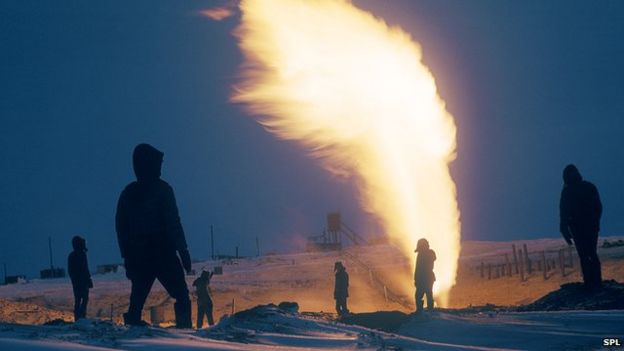
The vast majority of carbon credits generated by Russia and Ukraine did not represent cuts in emissions, according to a new study.

The authors say that offsets created under a UN scheme "significantly undermined" efforts to tackle climate change.

The credits may have increased emissions by 600 million tonnes.

In some projects, chemicals known to warm the climate were created and then destroyed to claim cash.

As a result of political horse trading at UN negotiations on climate change, countries like Russia and the Ukraine were allowed to create carbon credits from activities like curbing coal waste fires, or restricting gas emissions from petroleum production.

Under the UN scheme, called Joint Implementation, they then were able to see those credits to the European Union's carbon market. Companies bought the offsets rather than making their own more expensive, emissions cuts.

But this study, from the Stockholm Environment Institute, says the vast majority of Russian and Ukrainian credits were in fact, "hot air" - no actual emissions were reduced.

They looked at a random sample of 60 projects and found that 73% of the offsets generated didn't meet the key criteria of "additionality". This means that these projects would have happened anyway without any carbon credit finance.

"Some early projects were of good quality, but in 2011-2012, numerous projects were registered in Ukraine and Russia which had started long before and were clearly not motivated by carbon credits," said Vladyslav Zhezherin, a co-author of the study.

"This was like printing money."

According to the review, the vast majority of the offset credits went into the European Union's flagship Emissions Trading Scheme. The authors estimate these may have undermined EU emissions reduction targets by 400 million tonnes of CO2, worth over $2bn at current market prices.Reducing emissions from the oil and gas industry is another way of earning credits

Unlike the Russian and Ukrainian projects, similar offsetting plans in Poland and Germany were said to meet very strict criteria.

"We were surprised ourselves by the extent, we didn't expect such a large number," co-author Anja Kollmuss told BBC News.

"What went on was that these countries could approve these projects by themselves there was no international oversight, in particular Russia and the Ukraine didn't have any incentive to guarantee the quality of these credits."

Because Germany and Poland had tougher emissions targets to meet, they were very careful with their certificates. This wasn't the case in Russia and the Ukraine.

One part of the larger review has been published in the journal Nature Climate Change.

It concerns the activities of projects that made money from the removal of chemicals HFC-23 and sulphur hexafluoride, which add significantly to global warming.

They found that, in 2011, all three projects in the study significantly and simultaneously ramped up the amount of the chemicals they were destroying.

"As researchers we can not prove the fraud, we can just point to the facts so in the HFC case at the moment when they could gain credits they immediately increased production of this greenhouse gas in order to destroy them, and that lead to them getting many more credits than if they had produced it like they did before," said Anja Kollmuss.

Experts familiar with the Russian carbon projects said that there had been longstanding and well acknowledged issues with the destruction of chemicals for carbon credits. This had been seen in China for several years.

Michael Yulkin, from Russia's Environmental Investment Centre rejected the idea that many of these Eastern projects broke the rules.

"That's just not true," he told BBC News.

"All the projects have been validated and the additionality has been proved - it was all following the rules and if the rules allowed them to be in, so you have them in."

Mr Yulkin pointed out that the projects were no longer an issue. The EU emissions trading scheme no longer accepted the credits - and Russia was not taking part in the next commitment period of the Kyoto Protocol.

The authors of the study argue that lessons must be learned for any future market mechanisms that are incorporated into a new global agreement on climate change, expected to be signed later this year at a conference in Paris.

"In future, we need to do better and we can do better, but the devil will be in the detail and tighter controls will be needed," said James Wilde from the Carbon Trust.

"If firms are to invest at scale driven by a price for carbon, they need to know that the schemes setting this price in future will be robust and survive for the lifetime of investments."

Thursday, March 2, 2017

Gaming the Real World (for developers, planners and busy bodys who want to control you)


Interesting look at the latest planning fad to build political support for development. Unfortunately life doesnt work like a video game.  Yes, UN Aagenda 21 is real.

Saturday, November 12, 2016

UN bullies confirm conspiracy


Faith Goldy of TheRebel.media is trying to report on the UN "nanny state" conference in Delhi but they are being thwarted at every turn

Editor's Note: This is the unaccountable Globalism that many of us around the world are fed up with.  There is no liberty when unelected bureaucrats run roughshod over their citizens back home. We must restore national democracy and stop pretending that these unaccountable fools are actually representing us.

I hate cigarettes but I love freedom.  

Friday, September 30, 2016

THE PROBLEM WITH BEING GLOBAL

THE PROBLEM WITH BEING GLOBAL

The globalization of cities and their elites often comes at the expense of many of the people who live there. Forced to compete with foreign capital and immigrant workers, native-born residents of cities from Los Angeles and London to Singapore often feel displaced, becoming strangers in what they thought was their own place.
This phenomena is common for virtually all the leading lights on our list of The Most Influential Global Cities. Higher prices and greater labor force competition seem to be the natural result of global city status, posing enormous challenges to local populations and those that govern them.
Since the late Enlightenment, great cities, often built around markets, were typically places for the aspirational middle and lower classes. The ability to rise in cities from North America and Europe to Asia — through what historian Peter Hall calls “this unique creativity of great cities” — stands as one of the great social achievements of modern times.
But in this era of powerful oligarchs and growing inequality, these planetary centers are less places for upward mobility than most other cities. This is clearly true in the United States, where its premier global city, New York, as well as its prime competitors for international standing, Chicago, Los Angeles and the San Francisco Bay Area, rank among the 10 most unequal cities in the nation.
The property market has a distorting effect. Home prices in affordable markets tend to average three times household incomes. The ratio for the top 10 global cities tend to be much higher, often upward of 10 times incomes.
Pied a terre and investment purchases by wealthy residents of the former Soviet Union, China, the Indian diaspora and the Middle East play a role in this inflation, particularly in London, where an onslaught of Asian buyers, now, by one estimate, purchases 70% of the city’s newly built homes.For young people in London, the possibility of home ownership has begun to evaporate. Regulations that restrict new construction and raise development costs also play a substantial role in the diminishing amount of affordable housing in cities like London, New York and San Francisco.
The Disappearance Of The Middle Class
Rising home prices are among the impacts of globalization that tend to force out the middle class. Even in traditionally egalitarian Toronto, a study by the University of Toronto found that between 1970 and 2001 the proportion of middle-income neighborhoods in the core city had dropped from two thirds to a third, while poor districts had more than doubled to 40%. By 2020, according to the study, middle-class neighborhoods could fall below 10%, with the balance made up of affluent and poor residents.
This leads even usual urban booster to question the direction of their cities, as they lose their counter-culture gloss. As one green journalist laments: “But what are we getting when we throw away height limits and barriers to development, stop worrying about shadows and views, and let the developers loose? Also importantly, who are we getting?”
The impact of rising prices clearly reshapes societies. In Manhattan, half of households are single, according to the American Community Survey; in the city of San Francisco, there are now 80,000 more dogs than children. Similar trends can be seen in London, Paris, Tokyo, Hong Kong, Singapore and other top global cities. Due to high prices, some 45% of Hong Kong’s middle-class couples have abandoned the idea of having children anytime soon, according to a survey commissioned by Citibank.
The Jobs Dilemma
Property prices and development pressures represent just one aspect of how globalization impacts the native working and middle class. The globalized economy often favors the employment of the very skilled, and those who serve them. Many companies, such as in finance, move their middle management jobs to other, less pricey places, from Sioux Falls to India and virtually anywhere else, reducing global cities’ mid-income employment and middle-class populations.
At its apex, in places like New York and London, the new global economy creates what economist Ajay Kapur calls a “plutonomy,” an economy that revolves around serving the wealthiest. This leaves the primary global cities as centers for both concentrated wealth and the greatest poverty, as we have seen in London, New York and other major global cities.  In New York, over a third of workers labor in low wage, service jobs, a percentage that has increased steadily through the recovery, notes a recent study by the Center for an Urban Future.
Not surprisingly the luxury cities — the most affluent parts of certain metropolitan areas — tend to have the highest concentrations of inherited and other rentier wealth in the nation, as well as some of the greatest concentrations of poverty. An asset-based recovery, like America’s current one, favors places like Manhattan, but does little for the Bronx, just across the Harlem River, which ranks at the bottom among the nation’s large counties for the percentage of residents’ income that comes from investments, rents and dividends.
Increasingly, the cores, and often the suburbs, of global cities such as New York San Francisco, London, Paris and other cities where the cost of living has skyrocketed are no longer places where one goes to be someone; they are where you live when already successful or living on inherited largess. They are, as journalist Simon Kuper puts it, “the vast gated communities where the one percent reproduces itself.”
Political Consequences
These trends could shape the future of cities socially and politically. In New York, the election of a strong left-wing mayor, Bill de Blasio,reflected the concerns of working- and middle-class Gothamites that they were becoming superfluous in their own town. Similar leftward trends can be seen in Seattle, another city that has experienced widespread gentrification, and recently passed a $15 an hour minimum wage.
This shift represents, in part, a reaction to the fact that gentrification has done little to address the large and growing population of the poor in many global cities. London may, by recent accounts, have more billionaires than any city on the planet, but it also has the highest incidence of child poverty in the United Kingdom.
Even many of the lower-end service jobs in restaurants, construction and retail have not redounded to the benefit of the native-born in Britain; more than 70% of the jobs created between 1997 and 2007 in the United Kingdom went to foreigners, according to the OECD. Indeed, economist Tony Travers at the London School of Economics estimated that during the last decade London received more immigrants, many from the rest of the EU, than New York or Los Angeles.
Cultural Displacement
The combination of mass migration and the power of the city-hopping global wealthy makes many native-born residents in global cities worried, as one London writer put it, about losing “the soul” of their city.
This trend can be discerned in almost any global city. A Tommy Hilfiger or other chain store in Causeway Bay in Hong Kong, Fifth Avenue in New York, or Regent Street in London is pretty much like any other. Yet for independent merchants in global cities, the price of being there is often too much to bear. In the process many of the most unique shops and restaurants are displaced by the largely high-end chains that can handle the rent.
At the same time, globalization and migration have inspired dangerous reactions, notably nativism, and a growing chasm between guest workers and residents. This has become a political issue even in the most cosmopolitan cities such as London, Singapore and the Randstadt (Amsterdam-Rotterdam-the Hague-Utrecht ).
The fundamental challenge: the global city must accommodate two identities, a global and a local one. A great global city must serve its international role as well as its local economy and the needs of its local residents. A city must be more than a fancy theme park or a collection of elite headquarter towers. It needs a middle and working class, not just the global rich and their servants. It needs families and ordinary residents who may rarely leave town, not just globe-trotters. It needs to be true to itself and the people who, in the first place, created it.
This piece originally appeared at Forbes.
Joel Kotkin is executive editor of NewGeography.com and Distinguished Presidential Fellow in Urban Futures at Chapman University, and a member of the editorial board of the Orange County Register. His newest book, The New Class Conflict is now available for pre-order atAmazon and Telos Press. He is author of The City: A Global History and The Next Hundred Million: America in 2050. His most recent study, The Rise of Postfamilialism, has been widely discussed and distributed internationally. He lives in Los Angeles, CA.