Showing posts with label taxes. Show all posts
Showing posts with label taxes. Show all posts
Tuesday, October 1, 2019

Monday, September 23, 2019
Growth does not pay for itself
The Villages proves the big Florida lie: Growth does not pay for itself | Editorial
By ORLANDO SENTINEL EDITORIAL BOARD
ORLANDO SENTINEL |
SEP 18, 2019 | 6:00 AM

The houses are crowded together at The Villages retirement community. (STEPHEN M. DOWELL / ORLANDO SENTINEL)
The Villages is the fastest-growing metro area in the nation.
In. The. Nation.
If growth pays for itself, as we’ve so often heard in Central Florida, then local governments like Sumter County — the epicenter of The Villages’ development — must be swimming in cash.
Instead, it’s acting like a government drowning in the costs of growth.
Sumter is so desperate for money that its five Republican county commissioners look ready to vote next week for a whopping 25.6% increase in the current property tax rate. (We’ll leave to your imagination the reaction if a group of elected Democrats proposed such an increase.)
The county concedes in its own budget documents that the main culprit for this tax increase is the breakneck rate of growth tied to The Villages’ success.
From July 2018 through June 2019, The Villages added 2,100 new homes, and several hundred others were built outside the retirement community. The county added 159 new commercial buildings with more than 2.5 million square feet of business space.
Even without a property tax increase, Sumter would rake in millions more than the previous year. It’s still not enough.
The county needs even more money to hire deputies, build fire stations and, particularly, to build roads that The Villages must have to continue its relentless march south. The development designed for retirees already is home to 128,000 people, an increase of nearly 40% in less than 10 years, and it has plans for tens of thousands more rooftops south of State Road 44 and Florida’s Turnpike.
It doesn’t help when governments like Sumter refuse to raise taxes until they reach a tipping point, which Sumter apparently has.
According to Florida TaxWatch, Sumter’s various governments in 2017-18 collectively averaged the fourth-lowest property tax rate in Florida. That’s a real selling point until you tell people they’re going to get slapped with a nearly 26% bump in their tax bill in a single year.
On his Sumter County bio page, County Commission Doug Gilpin wrote that the intended to “continue working with my fellow Commissioners to improve services and keep our tax burden low.”
That they did, until now.
Sumter County government doesn’t help itself by charging transportation impact fees designed to favor The Villages. Impact fees are one-time charges on new construction that are supposed to offset the cost of improving or building roads necessitated by that construction.
In Sumter County, the transportation fee charged for a new home is $2,600. Unless that new home is in a retirement or age-restricted community, in which case the fee for each new home is $901.
The Villages is one big retirement and age-restricted community, so homes built there enjoy the lower impact fee rate. Good for them. Bad for nearly everyone else.
The Villages is a textbook example of the big Florida lie that growth is self-sustaining.
And yet, elected officials continue to be dazzled by developer promises of growth delivering more jobs and more taxes.
Growth does mean jobs. The Villages has created many hundreds of them. But many are low-paying service jobs, which has resulted in an affordable housing shortage in Sumter. (That should sound familiar to the rest of this region.)
And all those new tax dollars? Not nearly enough to pay the bills.
Counties like Osceola, consistently among the nation’s fastest-growing areas, are familiar with that tune. Osceola’s had gangbusters growth for years but was so desperate for road money that it tried to get a 1-cent transportation sales tax approved by voters earlier this year.
It failed, as we suspect a 26% property tax increase would if the voters of Sumter County had the opportunity to cast a vote.
We’re not here to say cities and counties should stop growing. We are here to say that bureaucrats and elected officials need to have eyes wide open when developers pitch projects with idealized names like River Cross or The Grow or Sunbridge.
These projects will create jobs. They will generate taxes. And they come with a bill that one day has to be paid.
Just ask property owners in Sumter County.
Tuesday, June 4, 2019
Sunday, May 19, 2019
FABLE: THE GOOSE AND THE GOLDEN EGG

There was once a Countryman who possessed the most wonderful Goose you can imagine, for every day when he visited the nest, the Goose had laid a beautiful, glittering, golden egg.
The Countryman took the eggs to market and soon began to get rich. But it was not long before he grew impatient with the Goose because she gave him only a single golden egg a day. He was not getting rich fast enough.
Then one day, after he had finished counting his money, the idea came to him that he could get all the golden eggs at once by killing the Goose and cutting it open. But when the deed was done, not a single golden egg did he find, and his precious Goose was dead.
Those who have plenty want more and so lose all they have.
Monday, April 15, 2019
I got Stoned and Did My Taxes
I Got Stoned and Did My Taxes
Being comfortably high makes the burden of taxes a bit less awful.


(Adrian Today | Dreamstime.com)
This is my first year married filing jointly, and also my first year being stoned while I do my taxes.
The first hurdle was trying to remember my TurboTax password. Well, the first hurdle was building up the motivation to do my taxes. I smoked a massive joint with my husband and browsed flights to Budapest and Dubrovnik before realizing that I could not procrastinate anymore and also could not fly to Eastern Europe to avoid my tax burden.
The TurboTax password was hidden in plain sight, right in our Dashlane password manager account. That didn’t stop us from staring at the screen for somewhere between five and 20 minutes trying to figure out which one was the password (time is hard to estimate, man). The thought occurred to me that I might be too high to do my taxes. I steeled myself and tried to concentrate.


High people can be quite functional. I have a decent sense of my own limits. I was high for the vast majority of college: an acolyte of the wake-and-bake school of thought, trotting to class each day under the influence of coffee and a spliff. Prattling professors and try-hard college students couldn’t get to me if I was stoned, so I would sit in the back of the class and read the news each morning in a slight stupor—my bookwormish ritual. Weed has always gently mellowed my naturally Type A, ultra-organized personality. If it can dull the pain of higher education, presumably it can dull the pain of taxes too.
At the beginning of TurboTax’s tour, they ask you to answer a few questions about ways your financial circumstance has changed over the past year. I had switched jobs and—more important to the IRS—had gotten married. “Most couples who file together save money on their taxes together! We’ll gather info for both of you, and help get your first refund as a couple.” TurboTax chirped, accompanied by a heteronormative graphic of a diamond ring intertwined with a chunky wedding band.
I uploaded my W2s and started tediously entering freelancing 1099s. I connected my Wealthfront investment account to the TurboTax platform. I attempted to demystify what a 1099-DIV is, and to figure out how to declare our various investments. No real roadblocks thus far, but my mind kept wandering.
As I got to the charitable giving part, a thought came to me: Maybe one good side effect of taxes is that they force people to confront whether charitable giving and (for the religious among us) tithing really matter to them. Oh no, am I becoming one of those people, the ones who let government incentives dictate their actions? I think so, just a little bit.
Last year we gave one-time donations to various causes, but nothing enormous. While filing taxes this month, we realized the error of our ways, and also that a write-off sounds nice. The day after filing, we set up monthly donations to our church (non-denominational, but Baptist-tinged) and to immigrant and refugee respite centers in the Rio Grande Valley. The government nudge wasn’t the single deciding factor—this is something we’d wanted to do for a long time—but it was the catalyst that brought it front of mind. (Tokes.) Thanks for the reminder, taxes!
As the legal theft droned on (asking about property taxes and mortgages), my stoned mind couldn’t help but marvel at the glorious invention of TurboTax. Our entrepreneurial overlords had created software that makes everyone’s yearly government takings way easier to calculate and complete. Now they have a near-monopoly on digital tax-filing services. Also, what a brilliant business concept: a platform that appeals and caters to almost everyone. Shark Tank‘s wise sage Kevin O’Leary has a saying about how entrepreneurs should focus on areas where there are built-in markets (i.e., weddings and funerals). The TurboTax inventors went even further! All hail the free market! I delighted in the built-in audit risk assessment for freelancers far more than any sober human being would. I smoked another joint on the porch and sipped some coffee.
Things took a turn for the worse when I got to the page that asked “Do you want to donate $3 to the presidential campaign fund? This will not reduce your refund or increase your tax due.” I clicked on the description, rightly fearing the worst. TurboTax explained that this opt-in funding of elections could “reduce candidates’ dependence on large contributions and, hopefully, to put everyone on an equal financial footing (so they’d have more time to discuss the issues).”
It was at this point that I realized I wasn’t sufficiently stoned anymore. As if candidates would focus on the substance—and as if that substance would matter to the many hobbits and hooligans swarming around the ballot boxes like flies. As TurboTax auto-checked for more credits and deductions, my brain descended into campaign finance reform, and I made some cannabutter tea (Thai red tea with milk, a hefty chunk of homemade cannabutter, and some sweetener), which produces a long-lasting but mild high.
By the time we were done, we owed the government a lot of money and the covered porch smelled like a hotboxed dorm room.
Pot isn’t a cure-all. It didn’t cure the pain of owing the government roughly $2,000, or the frustration of wondering whether we were entering all our stock holdings correctly. But it did make rote data entry just a little more fun. Marijuana apparently isn’t too dangerous to inhibit me from filing my tax returns. I even managed to figure out the 1099-DIVs.
Weed is one substance in our arsenal that makes the mundane necessities of life a bit more manageable, a bit more whimsical, and a bit less dreaded. If they’re going to make us surrender hard-earned wads of cash, we at least ought to be able to chief a blunt while we do it.
Monday, January 28, 2019
Oakland’s vacant-property tax takes effect, sparking hope — and alarm
Oakland’s vacant-property tax takes effect, sparking hope — and alarm

Kathleen Pender Jan. 26, 2019 Updated: Jan. 26, 2019 4 a.m.
More
%26utm_source%3Dfacebook.com%26utm_medium%3Dreferral&name=Oakland%27s%20vacant-property%20tax%20takes%20effect%2C%20sparking%20hope%20-%20and%20alarm&description=As%20San%20Francisco%20supervisors%20consider%20putting%20a%20vacant-property%20tax%20on%20the%20November%20ballot%2C%20Oakland%20is%20struggling%20with%20the%20reality%20of%20implementing%20one.%20Oakland%20voters%20in%20November%20approved%20a%20tax%20that%20applies%20to%20any%20privately%20owned%20property%20in%20the%20city%20%E2%80%94%20including%20residential%2C%20commercial%20and%20empty%20lots%20%E2%80%94%20that%20is%20not%20%E2%80%9Cin%20use%E2%80%9D%20for%20more%20than%2050%20days%20in%20a%20calendar%20year%20starting%20in%202019.%20The%20annual%20tax%20is%20%246%2C000%20per%20parcel%20for%20most%20properties%2C%20regardless%20of%20size%20or%20value.%20The%20tax%20for%20condo%20or%20duplex%20units%20or%20ground-floor%20commercial%20space%20is%20%243%2C000%20per%20year.%20There%20are%2010%20possible%20exemptions.%20The%20tax%20will%20be%20added%20to%20annual%20property%20tax%20bills%20starting%20with%20the%20one%20that%20goes%20out%20next%20year.%20It%20will%20continue%20for%2020%20years.&picture=https%3A%2F%2Fs.hdnux.com%2Fphotos%2F01%2F00%2F14%2F03%2F16826593%2F5%2FrawImage.jpg&redirect_uri=https%3A%2F%2Fwww.sfchronicle.com%2Fbusiness%2Fnetworth%2Farticle%2FOakland-s-vacant-property-tax-takes-effect-13563273.php%3Futm_campaign%3DCMS%2520Sharing%2520Tools%2520(Premium)%26utm_source%3DUTMSOURCE%26utm_medium%3DUTMMEDIUM)
CommentsPrint
3
 1of3Oakland real estate agent Mel Copland owns one of several empty lots on Oakwood Court in the Montclair neighborhood. He said it’s too expensive to bring infrastructure to the property and the value of the land has dropped 50 percent since the last recession.Photo: Yalonda M. James / The Chronicle
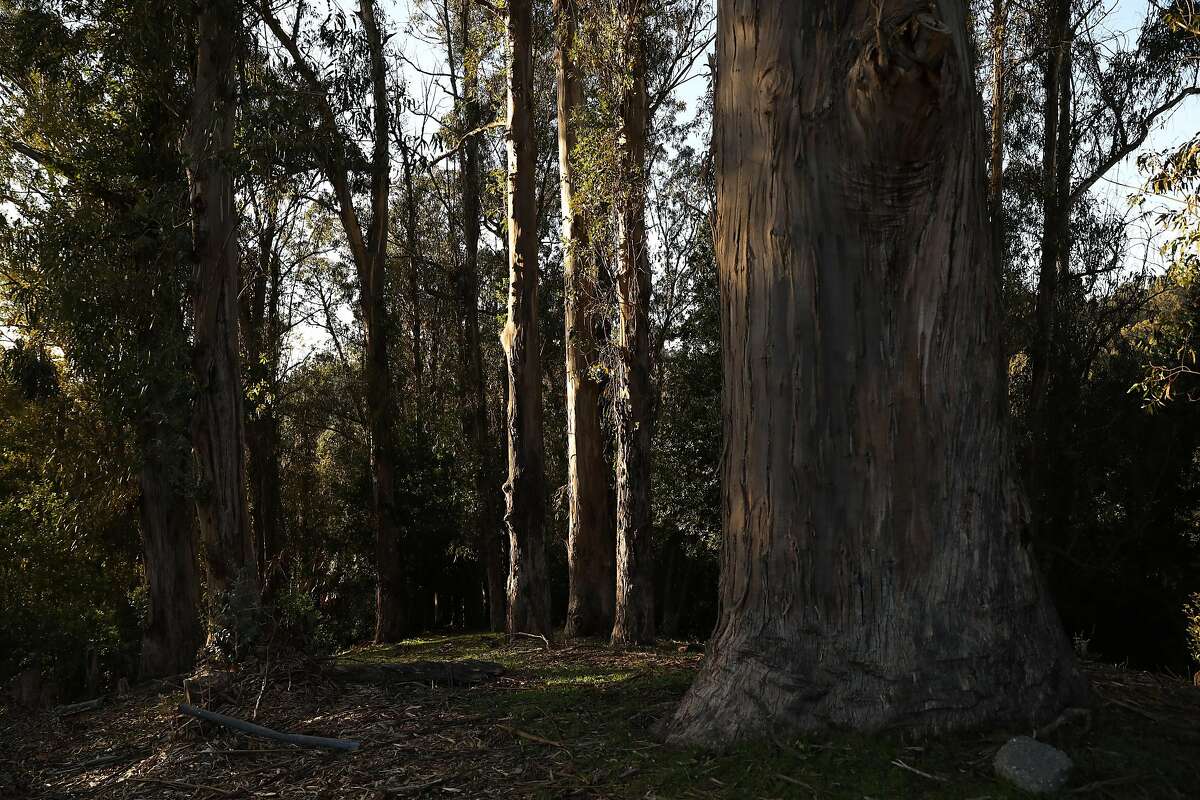 2of3Eucalyptus trees stand on a vacant lot on Oakwood Court in Oakland’s Montclair neighborhood. Oakland voters passed a vacancy tax, but details about how it will be implemented remain unclear.Photo: Yalonda M. James / The Chronicle
 3of3Turkeys cross over to a vacant lot on Oakwood Court in Oakland’s Montclair neighborhood. There are 10 exemptions to Oakland’s new vacant-property tax, as described in Measure W, but not a lot of certainty about how it will be implemented.Photo: Yalonda M. James / The Chronicle
As San Francisco supervisors consider putting a vacant-property tax on the November ballot, Oakland is struggling with the reality of implementing one.
Oakland voters in November approved a tax that applies to any privately owned property in the city — including residential, commercial and empty lots — that is not “in use” for more than 50 days in a calendar year starting in 2019. The annual tax is $6,000 per parcel for most properties, regardless of size or value. The tax for condo or duplex units or ground-floor commercial space is $3,000 per year. There are 10 possible exemptions.
The tax will be added to annual property tax bills starting with the one that goes out next year. It will continue for 20 years.
Oakland’s City Council put Measure W on the ballot, saying it would raise $10 million annually, which can only be used for homeless services, affordable housing, programs to fight blight and illegal dumping, administer the tax and defend any possible lawsuits. Measure W passed with 70 percent of the vote.
Among the many issues now facing the city: defining “in use,” identifying vacant properties, clarifying the 10 exemptions, developing software to administer the program and forming a commission on homelessness to recommend how the revenue should be spent.
The City Council could, by ordinance, restrict the tax to certain zones within the city, but has not done so.
In December, the city’s Finance Department sent a letter to owners of 25,000 non-owner-occupied properties warning them about the tax should their property be deemed vacant. The letter set off alarm bells for some owners.
“I thought it was only on vacant homes, not vacant property,” said James Liu, who lives in Fremont and owns five steep lots on Ascot Drive in the Oakland hills. Liu bought the adjacent parcels in 2012 and 2013, thinking — naively, he admits — that he could develop them, despite their 50 percent slope. But architects and engineers told him it wouldn’t be possible. He put them on the market twice, with no takers. Meanwhile he’s paying $3,000 per year in property taxes on each lot, plus another $3,000 per year to have them cleared of debris.
He said the the additional $6,000 per parcel tax is not just about money. “It’s about fairness. It’s not something I realized could happen in America.”
The measure exempts owners “who can demonstrate that exceptional specific circumstances prevent the use or development of the property.” But most owners won’t know if they qualify for this or any exemption until the Finance Department writes rules implementing the measure and the City Council adopts them.
Another provision that merits clarification says, “for parcels with multiple units, whether residential or non-residential, the parcel is not vacant if any unit on it is not vacant. A condominium, duplex, or town house unit under separate ownership is treated as a separate parcel …”
The Finance Department will probably bring an implementing ordinance to the City Council in April, but it could take “a number of meetings” before it’s adopted, said Karen Boyd, a spokeswoman for the city.
Vacancy-tax exemptions
These are 10 exemptions to Oakland’s new vacant-property tax, as described in Measure W. The Finance Department will clarify them in an implementing ordinance, which must be approved by the City Council.
(1) Owner is “very low income,” as defined by the U.S. Department of Housing and Urban Development. The city wouldn’t define it. But HUD’s website says that the income limit in Oakland is $40,700 per year for a one-person household and goes up with family size.
(2) Owner is 65 or older and “low income,” as defined by HUD. That limit is $62,750 for one person.
(3) Owner of any age receives Supplemental Security Income for a disability or Social Security Disability Insurance benefits and has income that does not exceed 250 percent of the 2012 federal poverty guidelines issued by the U.S. Department of Health and Human Services. That limit is $11,170 for one person and goes up with family size.
(4) The tax would create a “financial hardship due to specific factual circumstances.”
(5) The property is vacant because of a “demonstrable hardship that is unrelated to the owner’s personal finances.”
(6) The property is under active construction.
(7) The owner has an active building permit application being processed by the city.
(8) The owner has a “substantially complete application for planning approval” under review.
(9) The owner can prove that “exceptional specific circumstances prevent the use or development of the property.”
(10) The owner is or is controlled by a nonprofit organization.
Read More
In its letter to property owners, the Finance Department said it would “be difficult to answer questions” until the ordinance is adopted. It strongly urged them, in a bold and underlined comment, to “not make any inquiries regarding this letter or the tax at this time.”
It did give them an email address, VacantPropertyTaxInquiry@oaklandca.gov, but said it could take up to 30 days to get their questions answered.
The city’s finance director, Katano Kasaine, urged the council in a May letter to delay implementation for one year, citing “the aggressive timetable required for the implementation of the tax.” The City Council could delay implementation, but there’s no sign it plans to.
The Finance Department estimated it would cost $425,000 per year to administer the tax, plus a one-time startup cost of at least $100,000. Boyd said the city has received a legal challenge to the tax but provided no details.
Oakland Mayor Libby Schaaf supports the tax, her spokesman Justin Berton said in an email. “It’s a novel idea that will generate new resources to address some of Oakland’s biggest challenges, such as homelessness,” Berton said. It also “taxes people who are failing to utilize their property during a housing shortage, which damages overall community vitality.”
Nobody is sure how many vacant properties there are and how many will get an exemption.
Using data from the county assessor, Hayley Raetz, a researcher at the Terner Center for Housing Innovation at UC Berkeley, estimated that there are about 4,000 undeveloped, privately owned lots in Oakland. Most are small lots in residential neighborhoods.
“If approved by Oakland voters, the tax could act as a deterrent for speculation, and encourage owners of vacant parcels to sell or develop their land, ideally unlocking sites for housing,” Raetz wrote in a report. She did not look at lots with homes or businesses on them, because there’s no methodical way to determine whether they’re vacant.
Looking just at an estimated 4,000 vacant lots, the Finance Department said that the tax could bring in $6 million to $10.5 million a year, depending on how many got exemptions.
Building a home or apartment building on raw land is not easy or cheap, and some vacant lots are in areas prone to landslides and wildfires.
Oakland real estate agent Mel Copland owns one of several empty lots on Oakwood Court in the Montclair neighborhood. “The infrastructure is so expensive, to bring, solar, gas and water to the property, plus a private road,” he said, adding that the value of that land has dropped 50 percent since the last recession. “What’s going to happen, people are not going to pay the tax, and you are going to have a lot of defaulted lots.”
Dragos Badeamic, a structural engineer and contractor who lives outside Sacramento, owns three vacant properties on Woodrow Avenue in Oakland., “I was planning to build some houses there, but for family reasons, I could not do that,” he said.
He’s paying about $1,900 per year in property tax on each of the three lots; the vacancy tax would be nearly three times that per lot.
Badeamic grew up in Romania, where the communists imprisoned his grandfather and seized the family’s property, forcing them to flee the country. He said the tax reminds him of what went on in the early days of the communist regime there. “I never thought I was going to see this here, in the bastion of capitalism,” he said.
SPUR, a Bay Area urban planning think tank, said in its voter guide that it supports the idea of a vacant parcel tax, as a way “to help move vacant land into active use and eliminate blight,” but it opposed Measure W because it would be very difficult to implement fairly. “The definition of what constitutes vacancy is very broad,” it said, and “the exemptions are also very broadly defined,” such as a “demonstrable hardship that is not financial.” It also said a flat tax may disproportionately affect small property owners.
Evelyn Sinclair, who owns a vacant lot next to her home in the Oakland hills near Redwood Regional Park, said she objects to the tax because “we shouldn’t be balancing somebody’s project for helping homeless people and urban blight on a tiny minority of people in the city.”
Candice Elder, director of the East Oakland Collective, a Millennial-focused nonprofit, said that “once everything gets ironed out, (the tax) has the potential to help address some of the issues in homelessness and the housing crisis.” She said it won’t overcome all of the obstacles, but “it’s one component of the solution.”
She hopes the tax will spur landowners “with a challenging piece of property, or low-income owners who can’t afford to develop, to work with the city or with nonprofit agencies to reimagine the use of the land.”
James Vann, co-founder of the Homeless Advocacy Working Group, which campaigned for Measure W, said the tax “will probably deplete itself” as vacant lots, homes and buildings are put to use.
Meanwhile in San Francisco, Supervisor Aaron Peskin said in a news conference Wednesday that he wants the Board of Supervisors to put a vacancy tax on the November ballot. The $250-per-day tax would apply to some commercial and multifamily residential properties that are “intentionally” kept vacant for more than six months of the year. Peskin has been talking about a vacancy tax since 2017 but hasn’t introduced any legislation.
Before crafting a tax, San Francisco might want to consider the challenges facing Oakland.
Kathleen Pender is a San Francisco Chronicle columnist. Email: kpender@sfchronicle.com Twitter: @kathpender
Wednesday, September 26, 2018
The Committee to House the Bay Area and the coming tax tsunami

MTC
The Committee to House the Bay Area and the coming tax tsunami
Posted by: Bob Silvestri - September 25, 2018 - 5:29pmOn Monday evening, I attended an event held by the Coalition of Sensible Taxpayers (CO$T) at Piatti Restaurant, entitled “What they don’t want you to know about taxes, pensions, public education and services.” David Crane, the guest speaker and founder of Govern for California, made a compelling presentation about the coming financial crisis in our state.
Some of the many causes of Crane’s well-reasoned predictions included the State’s bogus accounting tricks, its imaginary investment return projections, and its skyrocketing retiree benefits and healthcare obligations. He also noted how California’s tax revenues have become lopsided and increasingly dependent on fewer and fewer super-wealthy individuals, so that the next recession promises to be long and painful and expensive.
In his words, “You ain’t seen nothing yet.”
What me worry?
Tax revenues at the moment are riding high, so complacency and elaborate spending plans are also riding high in Sacramento. It appears that our State legislators have never seen a dollar they didn’t want to spend… immediately and for years in the future… and more than once.
It’s true that the state has recently created a “rainy day fund,” but as David Crane noted, it’s a pittance compared to what will be needed when the next recession arrives and tax revenues plunge dramatically.
Now, some will say, surely it can’t be all that bad. After all, the economy is booming and just look at housing prices and real estate tax revenues. They have both been skyrocketing for years. So, our state and even our county must be flush with excess cash, right?
Well, sort of, but as David Crane astutely pointed out, how is it then that during this revenue boom and during one of the longest bull markets in our history, unfunded government obligations have continued to rise even while taxes and fees have also continued to rise, but the actual dollars available to pay for education and services to the public (fixing roads, maintaining parks, social services, affordable housing, emergency healthcare, etc.) have continued to fall? It’s simply because even in these times, expenses and future obligations continue to outpace revenues.
Worst of all, even with all this considered, there is yet another overriding problem that has to be added to the mix. Even though tax and fee revenues have continued to expand, a growing list of state agencies and unelected, quasi-governmental organizations, which are largely unknown to the public, are planning to spend the same funds that the state is counting on to bail us out on that “rainy day.”
This brings us to the growth of “off ledger” spending or “shadow government” planning, and decision-making in the state. In the past, I’ve written about the “Enron-ization” of government: how unelected, quasi-governmental agencies and Joint Powers Authorities (JPAs) have added layers of opacity to our public decision-making process and spending of taxpayer funds. That trend has increased over the years and it now includes a host of groups and committees that are sharpening their knives to divide up your tax dollars and burden us with even more taxes and fees in the name of “regional planning.”
This is how the state intends to put off David Crane's inevitable endgame.
It's all about housing, or so they say
MTC is now unofficially the San Francisco Bay Area’s most powerful planning and housing agency. The Association of Bay Area Governments (ABAG), the former nemesis of local control seems to exist only as a consulting firm to MTC or to justify its existence and huge budget by doing “studies” and managing projects set in motion before its planning functions were stripped away by MTC. Our elected representatives who continue to sit on its general assembly and committees, effectively have little say anymore on planning and housing issues.
How this “coup” of the planning and housing development funding powers of ABAG by an unelected state agency came about has been well documented in the Marin Post by Zelda Bronstein (ABAG leaders betray local cities and Regional government sells out Bay Area cities).
So, since the demise of ABAG, MTC is the most important housing agency in the SF Bay Area, even though MTC has questionable legislative authority or credentials to do so. But they have the state funding and everyone else has to beg them for it, so they just took the authority from ABAG and basically dared anyone to stop them.
To paraphrase the famous line the The Treasure of Sierra Madre, MTC’s approach seems to be, “Credentials? We don’t need no stinking credentials!”
A good question in all this is how well have our locally elected officials kept us abreast of these changes in planning decision making? But, that’s a whole other article.
A case in point of this power grab is a new sub-commission of the Metropolitan Transportation Commission (MTC), our largest Bay Area, unelected, state-funded agency. It’s called CASA – The Committee to House the Bay Area.
Unbeknownst to just about everyone, CASA is now the most powerful committee for Bay Area affordable housing planning, even though most of us have never heard of it nor had any say in who was chosen to be on it.
Mi casa es su casa?
CASA’s mission statement reads as follows:
The Committee to House the Bay Area – convenes a diverse, multi-sector set of partners in the Bay Area to identify and act upon game-changing regional solutions to the Bay Area’s chronic housing affordability challenges.
Wow, it’s “diverse” and it’s “game changing.” What could go wrong?
The chairs and co-chairs of CASA and the conveners of their subcommittees are:
Fred Blackwell - Chief Executive Officer | The San Francisco Foundation (Bio), described on the web site as a visionary leader working to ensure shared prosperity, innovation, and equity in the Bay Area.
Leslye Corsiglia - Executive Director | Silicon Valley at Home (Bio), described as “the voice” for affordable housing in Silicon Valley. Based initially in the Housing Trust Silicon Valley, SV@Home is a membership organization that advocates for policies, programs, land use, and funding.
Michael Covarrubias - Chair and Chief Executive Officer | TMG Partners (Bio), a privately-held, full-service development company headquartered in San Francisco focusing on urban infill projects in the San Francisco Bay Area.
Steve Heminger - Executive Director | Metropolitan Transportation Commission (Bio)
I’m sure you remember voting for each of these individuals. Please don’t get me wrong, none of my sarcasm is intended to tarnish the reputations of any of these members or to even question their sincere commitment to good housing policy. But, where are the checks and balances? To whom are the majority of the members of CASA accountable? Where is representative government’s role in all this?
The CASA Steering Committee includes executives from Google and Facebook, heads of well-connected nonprofits and advocacy groups and, yes, some elected representatives. But, elected officials do not represent a democratically chosen demographic and they are outnumbered 10 to 7 by unelected and politically appointed members. Worse still, their Technical Committee of advisors has 32 members, none of which are elected representatives.
In their September 13, 2018 “compact” of purpose and actions, they state:
CASA is tasked with advancing bold solutions that match the scale of the housing crisis--solutions that protect, preserve and produce housing for hundreds of thousands of Bay Area residents. The draft CASA compact proposes a suite of big ideas that could dramatically rewrite the future of housing availability and affordability in the Bay Area. If we do this right, the CASA proposals will improve housing conditions for all residents, while also ensuring that our future moves us towards increased racial equity and fair housing and does no harm to existing communities by spurring or exacerbating the destabilizing processes of gentrification and displacement.
But “right” by whose definition?
I’m sorry, but this is not okay.
But it gets worse.
Tu dinero es mi dinero
CASA’s view of the world of finance is elegantly simple as shown in this chart from their publication on “Findings and Financing Ideas.”
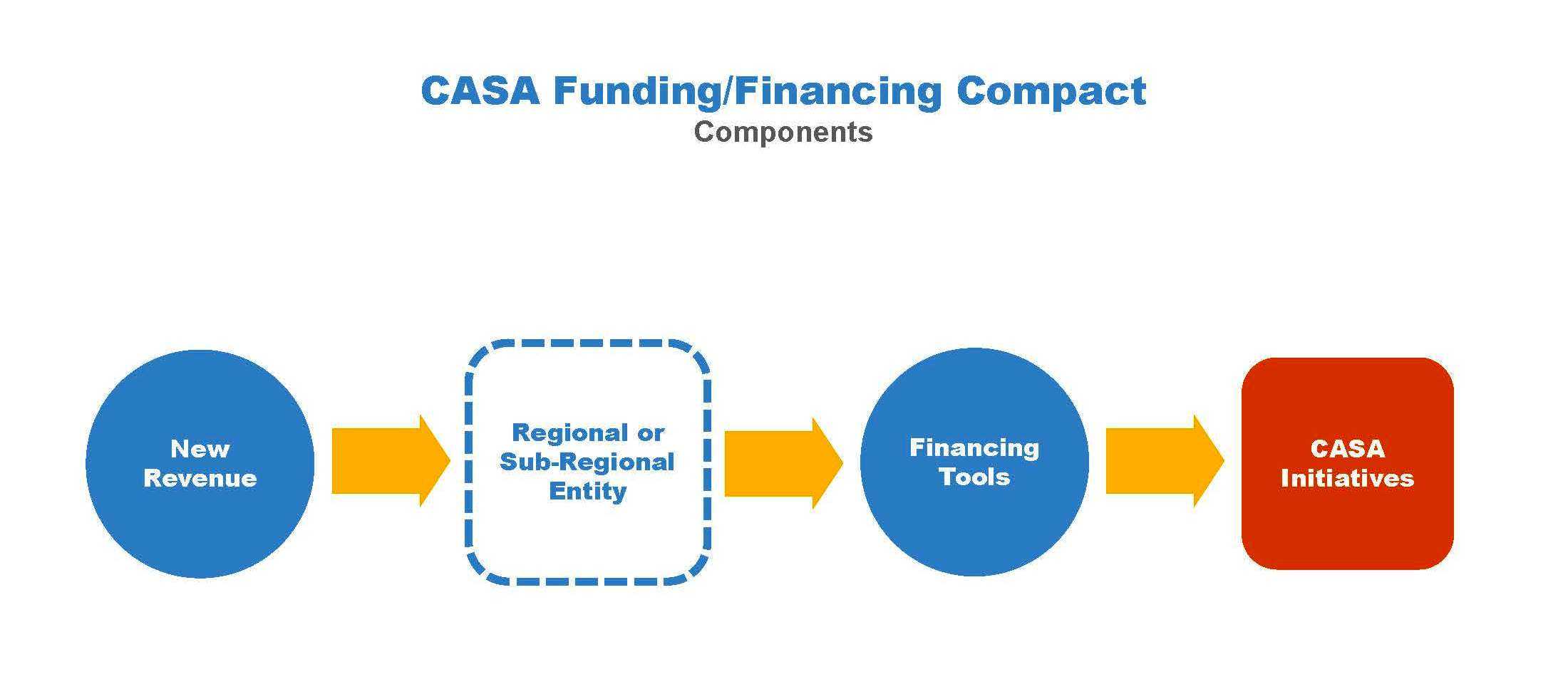
As CASA sees it, they are facing a $1.68 billion funding gap from what is needed to spend on subsidizing more housing. This is after exhausting all existing Federal, state and local funding sources, including Section 8, the Low Income Housing Tax Credit and everything else. So where does this “New Revenue” come from?
In response to this challenge, their entire focus of “creative” ideas for “Potential New Sources of Revenue” boils down to more and more taxes and fees. How’s that for out of the box thinking?

Click on image to enlarge
CASA’s vision leaves no public trough un-dipped and then some. Among the wish list included in their “Funding/Financing Compact” of new region-wide and state-wide funding sources are: (these are proposed new taxes and fees in addition to all existing taxes and fees)
Taxes and Fees on Property Owners: $500 million
A 3.35% inflation indexed windfall tax on home value appreciation;
A $48 per year parcel tax on real estate;
A 1.35% tax on real estate transfers;
A 1% tax on vacant homes;
A 25% short term rental tax on Airbnb, etc.
Taxes and Fees on Developers: $200 million
A $2 to $4 per square foot fee on development inside of “Transportation Priority Areas” (TPA’s);
A $4 to $8 per square foot fee on development outside of TPAs;
A Commercial Linkage Fee on new construction at an unspecified variable rate, based on the number of new workers at the location, and the jobs / housing ratio of the host jurisdiction;
A $5 per square foot “Fiat” commercial linkage fee on all new construction.
Taxes and Fees on Employers: $400 million
An $8 to $32 per employee tax for employers inside TPAs;
A $16 to $64 per employee tax for employers outside TPAs;
An annual Head Tax on jobs / employees, with variable rates based on the number of employees, and the jobs / housing ratio of the host jurisdiction (with no exemptions for middle-wage jobs);
A $30 per job / employee Flat Annual Head Tax on businesses; (note that this is "per job" so it cannot be avoided by hiring consultants or contract workers);
A 1/12 cent Gross Receipts Tax, variable rates based on sector and firm size;
A 1 cent per mile Commuter VMT Fee, paid by the employer for all employees.
Taxes and Fees on Local Governments: $300 million
A 17.5 % Revenue Sharing Contribution from future property tax growth, region-wide, starting in 2020;
A 27.5% Redevelopment Revenue Set-Aside Fee for affordable housing (for city / county portion of property tax revenue), statewide;
A 20 acres of Public Land Set-Aside requirement, annually for affordable housing.
Taxes and Fees on Taxpayers: $200 million (as if all of these taxes and fees don't ultimately fall on taxpayers)
A 1/16 % Sales Tax, region-wide;
Issuance of 5-Yr. Term General Obligation Bonds, issued by a regional housing entity created through state legislation, renewed every five years.
SPECIAL NOTE: According to MTC, only two of these taxes and fees -- the $5 per square foot Flat Commercial Linkage Fee and the $30 per job Flat Annual Head Tax -- will require a public vote. They contend that all the others can be passed by the legislature or directly assessed by MTC, itself.
So, where will all this money go? To local governments to spend on their highest priority housing affordability challenges, where it should go?
Not a chance.
According to CASA it needs to go to a new “Regional Housing Trust Fund!” – Yet another bloated bureaucratic agency run by unelected, political appointees and “stakeholder” groups that profit from its existence, who will dole out the money for their own self-interest: An agency which will inevitably be the scandal du jour ten years hence, when it’s investigated for rampant corruption and political favoritism.
The moral of the story:
This is what happens where there is no public accountability and there are no grownups in the room, who understand anything about basic economics, supply and demand, and how taxes and fees negatively impact overall state economic activity and revenues, new business formation, and so much more.
Time to sound the alarms! All hands on deck!
Tuesday, August 7, 2018
New regional taxes for Affordable Housing. MTC is after your wallet.
1. Lower voter threshold to 55% from 66% for infrastructure and affordable housing tax measures
2.Redevelopment agencies that use Tax increment financing. In other words, they redevelop the area and then tax everyone for the privilege of having their neighborhood destroyed.
3.New "Affordable Housing Authorities" that issue 45 year bonds without voter approval. "Capture" equity increase from real estate.
2.Redevelopment agencies that use Tax increment financing. In other words, they redevelop the area and then tax everyone for the privilege of having their neighborhood destroyed.
3.New "Affordable Housing Authorities" that issue 45 year bonds without voter approval. "Capture" equity increase from real estate.
Nice little package of benefits for the affordable housing industry.
July 18, 2018 Outrageous request for more taxation to building so called affordable housing for people making up to $120,000 where the average household income is $89k. Middle class retirees and moderate income families will be force to subsidize WEALTHIER families that earn more than them. The "affordable housing" development industry is pushing hard to socialize housing costs to provide them funds to build. Does anyone stop and consider how dumb it is to do this? Tax the poor so the middle class can have more?
Friday, June 22, 2018
90 percent of MAPE — represented job classifications have a pay range, that is — on average — 7.8 percent above the market rate.”
Marin public employees’ union authorizes strike

The Marin Association of Public Employees, the union that represents a majority of Marin County’s public employees, has voted to authorize a strike.
The vote was taken last week and ballots were counted late on Friday. Rollie Katz, executive director of the Marin Association of Public Employees, said 654 of the union’s members voted in favor of a strike authorization and 47 voted not to authorize a strike.
The union represents 1,471 of the county’s 2,740 employees. Only 1,280 of the employees represented by the union are members, however; the remaining 191 are fee payers who are entitled to representation but do not enjoy the privileges of membership.
“It’s a pretty strong statement by the members,” Katz said.
The vote authorizes the union’s 15-member bargaining team to call a strike if they deem it necessary. The team is made up of rank-and-file members elected by the full membership. Katz said no date for a strike has been set at this time.
“We hope we don’t have to strike,” Katz said, “but this vote is a very clear sign to the Board of Supervisors that they need to get management to move off of some of their positions and find a resolution.”
The two sides began working with a state mediator on June 13. The next meeting with the mediator is scheduled for June 25.
At last report, Marin County and MAPE were at loggerheads over a new three-year contract.
The county had proposed wage increases of 2.5 percent, 2.5 percent and 2 percent over each of the next three years. The union countered with a proposal for wage increases of 3.5 percent, 4 percent and 3.5 percent.
In addition to the dispute over pay raises, county managers and MAPE are at odds over several changes the county is seeking that could result in significant pay reductions for some lower-paid county employees.
“I can’t talk in detail about what has happened in mediation,” Katz said. “We’ve got a few smaller items off the table, but none of the make-or-break proposals. Nothing has happened that would move the needle significantly.
“We would hope there would be further movement in bargaining,” Katz said. “We’re certainly prepared to compromise. We have been offering compromises.”
There has been speculation that if MAPE calls a strike, other county unions, including the Marin County Management Employees’ Association, might stage a sympathy strike or work slowdown.
Katz said, “My expectation is that if we have a strike a number of other workers, including MCMEA, will be very supportive.”
The last time Marin County employees went on strike was the summer of 1998. At that time, MAPE was seeking a 10 percent wage increase over two years. County managers started out offering a 7.5 percent wage hike over three years. At the end of the seven-day strike, however, the county agreed to a contract that gave employees a 10.5 percent wage increase over three years.
As of July 2017, 55 percent of Marin County’s employees lived outside of Marin. Many say they can’t afford Marin housing prices.
Mary Hao, Marin County’s director of human resources, said Marin County recently conducted a survey of salaries across the Bay Area, including San Mateo, Napa, Solano, Sonoma, Alameda and Contra Costa counties; the city and county of San Francisco; and the cities of Novato, Berkeley, Santa Rosa, San Rafael, Vallejo and Palo Alto.
“This cross sampling helps us determine the market rate for the same or similar jobs in those collective areas, based on median of the pay in these jurisdictions versus average,” Hao wrote in an email. “What we discovered in our research was that 90 percent of MAPE — represented job classifications have a pay range, that is — on average — 7.8 percent above the market rate.”
Friday, June 8, 2018
Western Cities Want to Slow Flood of Chinese Home Buying. Nothing Works.
Western Cities Want to Slow Flood of Chinese Home Buying. Nothing Works.
Governments from Vancouver to Sydney to Toronto are using taxes and other restrictions to tackle real-estate bubbles.
Crowds swept into the Beijing Exhibition Center on a recent morning for a real-estate expo that drew thousands of people interested in foreign property.
That kind of surging interest has created a flood of capital that is washing over cities throughout the globe, distorting home prices, irritating local residents—and defying almost every attempt to restrain it.
In Vancouver, Chinese home-buyers snapped up homes so fast in 2016 that prices escalated at a rate of 30% a month compared with a year earlier. Officials imposed a 15% foreign-buyers tax, and Chinese buyers turned to Toronto, where they soon bid up home prices.
Seeking to curb the market surge in the Toronto area, officials in the province of Ontario introduced their own 15% foreign-buyers tax in April last year.
Chinese buyers had by then begun returning to Vancouver, driving prices to fresh highs in mid-2017 and provoking a new round of measures in February. By May, sales numbers had fallen 35% from a year earlier, but prices, on an adjusted basis, still climbed 11.5%, according to the Real Estate Board of Greater Vancouver.
The hot pursuit of places to park money abroad by Chinese investors drove an estimated $100 billion in property purchases outside China in 2016, according to Juwai.com, a Chinese real-estate website. The buying frenzy, which grew from $5 billion in 2010, helped swell prices for housing and commercial real estate in cities on the Pacific Rim and beyond.
Chinese buyers have scooped up condos, apartments and houses from Vancouver to Auckland to Sydney. While foreign capital was welcome in the years following the financial crisis, officials have found that trying to control the flood of foreign money into housing is like squeezing a balloon: Taxes on foreign buyers in one city only divert them to another spot—and sometimes buyers return, taxes or no taxes.
Governments world-wide “are still at the trial-and-error stage,” said Aaron Terrazas, senior economist at Seattle-based Zillow Group, an online real-estate listing service. “They are trying to figure what works and what doesn’t.”
Officials in Canada and Australia, where relatively affordable homes and large Mandarin-speaking populations attract Chinese buyers, worry the price bubbles threaten their regional economies.
Montreal’s housing market has shown no signs of overheating, but after Valerie Plante was sworn in last year as mayor, she asked provincial officials for authority to tax foreigners buying property in Canada’s second-largest city.
After seeing what happened in Vancouver and Toronto, Ms. Plante worried her city was next. “We need to be very cautious,” a spokeswoman for the mayor’s office said.
Related video: This is the new American dream

This is the new American Dream
At the Beijing real-estate expo in April, Bao Yingqi of B.Y. Realty, was, in fact, making a pitch for Montreal, saying the city has yet to impose high taxes on foreign buyers. “This makes Montreal stand out for investors,” she said.
Montreal has new housing and an interesting French-speaking culture, Ms. Bao said, who was wearing a black beret. She sat in a booth decorated with a Canadian flag and described Montreal as the “Paris of the West.”
Zhang Yuxing, a 43-year-old Beijing resident, listened. He had planned on Vancouver, but taxes have gone too high.
Now, he said, his top choice is Montreal.
The impact of foreign buyers on home prices isn’t entirely clear, according to analysts and the International Monetary Fund. Low interest rates, liberal immigration policies in Canada and Australia as well as a tight housing supply in some areas also contributed to rising home prices.
Accurately tracking foreign home-buyers isn’t easy, although some local governments can now tally the number of people paying foreign-buyer taxes.
Some purchases aren’t counted, for instance, when foreign buyers hold dual citizenship, or if the transactions are made through companies or local proxies that obscure a buyer’s identity.
In Australia, Jonathan Kearns, the Reserve Bank of Australia’s head of financial stability, said in November that he estimated foreign buyers accounted for 10% to 15% of homes under construction, equal to about 5% of total residential sales in the country.
The share was highest in Melbourne and Sydney, Mr. Kearns said, where foreign buyers accounted for around a quarter of newly built apartments. Around three-quarters of the foreign buyers were from China, he said.
Sydney’s home state of New South Wales doubled its foreign-buyers tax to 8% in July 2017, but that didn’t arrest demand.
The rise in home prices has recently slowed in Sydney and Melbourne, but Chinese developers still dominate foreign investment in residential development across Australia, according to real estate company Knight Frank. Chinese nationals bought $1.5 billion in residential sites last year, about a third of Australia’s total.
Chinese property buying is an “unstoppable juggernaut,” said Jon Ellis, chief executive of Investorist, an online portal for cross-border property transactions.
Outgoing Vancouver Mayor Gregor Robertson described it as the “water bed effect of capital flooding wherever taxes are lowest and regulation is weak.”
For-sale signs in Vancouver feature Mandarin characters. Older abodes are leveled to make way for the construction of new homes, which real-estate agents say Chinese buyers prefer. Bus shelters and benches in Richmond, a suburb south of Vancouver’s airport, carry real-estate ads, also in Mandarin.
Mr. Robertson said rising home prices dominated much of his decadelong tenure. One reason was a lack of coordination among the three main levels of Canadian government—federal, provincial and municipal, he said.
“It’s a complex challenge between regulating offshore investment, local real-estate practices and addressing housing supply within cities, all in sync,” Mr. Robertson said in an interview. “The reality is that interventions take time and aren’t wholly predictable.”
After the first Vancouver 15% tax failed to put a lid on foreign buyers, Mr. Robertson worked with the province of British Columbia on more aggressive steps. In February, province officials raised the foreign-buyers tax to 20% and expanded coverage well beyond Vancouver. Officials also imposed a new levy—0.5% of the property value and climbing to 2% next year—on homeowners who don’t pay income tax in Canada.
In April, British Columbia also announced measures to deter the resale of condo units before construction was completed, to discourage investors from flipping units before they are occupied.
At the Beijing expo, Florence Chan said she originally wanted to buy a home in Vancouver but changed her mind. “The taxes are too high,” she said, adding that Melbourne is looking better.
Chinese buyers like the swanky 661 Chapel Street, a luxury condominium complex in Melbourne.
In December, Aw Sei Cheh, general manager of the project for Malaysian developer Gamuda Land, said Chinese buyers accounted for roughly 10% of sales at the complex, which has private dining rooms, a wine cellar, a theater and a library. Prices start around $410,000 for a one-bedroom, to more than $2 million for three-bedroom units.
One appeal is location. The complex is close to several top universities where some Chinese buyers intend to send their children, Mr. Aw said.
Beijing has tried to limit capital flight, fearing it shakes confidence in the national economy and could potentially weaken the yuan.
A recent crackdown prompted several Chinese tycoons to unwind foreign purchases by their companies acquired in debt-fueled global shopping sprees, including trophy office towers and luxury hotels.
Officially, Chinese citizens are only allowed to exchange no more than $50,000 worth of yuan a year. Yet people in the industry point to loopholes.
Chinese mom-and-pop investors sidestep limits, for instance, by linking real-estate purchases to the college education of children living abroad; buying such luxury goods as Rolex watches in yuan and exchanging them for dollars to use toward property; or friends and family paying to an overseas account.
One desirable target has been the harbor city of Auckland, New Zealand, home to just over a million people.
Auckland was named the world’s hottest city for luxury real estate based on sales in 2015 by a Christie’s International Real Estate survey. Its open-door immigration policy and light regulation of foreign property deals helped drive 63% annual growth in $1 million-plus home sales in 2015.
Last year, a political backlash erupted over complaints that the city had grown too expensive. New Zealand homeownership rates are at their lowest since 1951, national data show; a quarter of residents under 40 own their home compared with half that age group in 1991.
The center-left Labour Party campaigned on housing measures, and once elected in October pledged a ban on foreign speculators buying existing residential property. The new government also wants to reduce immigration.
“We are determined to make it easier for Kiwis to buy their first home so we are stopping foreign speculators buying houses and driving up prices,” Prime Minister Jacinda Ardern said at news conference last fall.
House prices initially rose as lawmakers considered restrictions in foreign investment. Benjamin Liu, an agent with Ray White Real Estate in Auckland, said one Chinese buyer booked a flight after hearing about the proposed ban.
Foreign capital is now returning to Canada, driving the latest surge in home prices. Buyers from China and the U.S. have found Victoria, the small capital of British Columbia that sits on an island west of Vancouver.
Victoria was declared the world’s hottest new housing market last year in Christie’s International Real Estate survey, based on a 29% increase in annual sales of million-dollar-plus homes. Single-family homes in the Victoria area hit a record high of about $570,000 in May, up 9% from a year earlier, according to the Victoria Real Estate Board.
“Victoria is experiencing the same rapid growth in housing prices and sales volumes that have strengthened Toronto and Vancouver in recent years,” Christie’s International said in its survey last month. “If Toronto and Vancouver can be a measure, it is likely Victoria will continue to perform well despite [new] regulations” targeting foreign buyers.
Attention has already turned to Malaysia and Thailand, which now tops the list for Chinese buyer inquiries, ahead of the U.S. and Australia, according to Juwai.com. Two years ago, Thailand ranked sixth.
Over the next decade, Juwai.com predicts that Chinese investors will spend $1.5 trillion abroad, as much as half of that in foreign property.
The real-estate portal recently teamed up with JD.com Inc.—one of China’s internet retail giants—to market property in the U.S., U.K., Australia and Canada. At the click of a button, online shoppers can connect with a sales agent who will assist in the purchase of an overseas home.
Write to Paul Vieira at paul.vieira@wsj.com and Dominique Fong at Dominique.Fong@wsj.com
Thursday, May 24, 2018
Six Reasons to Vote Against Bridge Toll Hike
Marin IJ Readers’ Forum for May 23, 2018
Six Reasons to Vote Against Bridge Toll Hike
Vote no on Regional Measure 3, the plan to add $1 per year increase in bridge tolls. Over six years, the tax won’t total more than $3, which may seem inconsequential. But it’s significant, like the alcoholic taking a little drink and sliding into addiction. Here are six reasons to vote no.
Big businesses in Silicon Valley, the ones pushing the measure, are building excessive office space which adds to congestion, without taking responsibility for making conditions worse.
Revenue from previous tax increases is rarely accounted for. A statewide 12-cent-per-gallon gas tax increase is generating billions of dollars, and the tax will increase by another 5.6 cents next year.
Bridge tolls and gas taxes place an unfair burden on people least able to afford them — gardeners, nannies and health care workers who commute across the bridges for low wages.
A regional tax undermines local jurisdictional authority and puts money and power into the hands of regional officials who are not directly elected, and therefore not accountable.
If Marin voted unanimously against the measure but voters in the South Bay voted for it, Marin residents would be saddled with the tax and the imposition of voters in the South Bay.
How is it fair for the Marin County Elections Office to include 22 pages in support for the measure, written by the Metropolitan Transportation Commission? Why not an equal number of pages in opposition? Who paid for propaganda printing and postage?
The measure doesn’t provide solutions but creates problems.
— Susan Kirsch, Mill Valley
Thursday, April 5, 2018
Marin’s Dilemma - Service Cuts or Tax Hike
Marin Coalition Presents: Wednesday April 4, 2018
“Marin’s Dilemma - Service Cuts or Tax Hikes”
Speakers:
Mimi Willard -- Founder of the Coalition of Sensible Taxpayers.
Leslie Lundgren Harlander -- President of the Board of Trustees of the Tamalpais
Union High School District.
Marin taxpayer-voters face higher taxes/fees and/or threatened service cuts from almost all local agencies and districts. Schools are squeezed by rising costs (particularly state-mandated increased pension contributions). In 2018, voters will consider ballot measures to raise bridge toll; increase sales taxes; and increase parcel taxes in Dixie School District and Tamalpais Union High School District (serving all of southern Marin -- Redwood, Tam, and Drake). Some districts are planning service cuts, e.g., Novato Unified and Tam Union. School and other essential service funding could improve if commercial properties pay more, via alternative parcel tax structures and/or a 2018 ballot initiative to change proposition 13. Mimi Willard, President of the Coalition of Sensible Taxpayers, will discuss how all this could play out in Marin.
The Tamalpais Union High School District Board of Trustees in March is scheduled to approve placing on the November 2018 ballot a proposed increase in the existing District’s school parcel tax. District Board President, Leslie Lundgren Harlander will provide a perspective of why this tax is important and necessary for the School District.
Mimi Willard is Founder of the Coalition of Sensible Taxpayers. CO$T is a nonpartisan,
nonprofit organization advocating for the interests of Marin taxpayers. A Chartered Financial
Analyst, Ms. Willard’s professional background includes 20 years as a nationally recognized
financial analyst at prominent Wall Street firms.
Leslie Lundgren Harlander is President of the Board of Trustees of the Tamalpais Union High
School District. She has served on the Tamalpais Union School Board for two years. Leslie is
a civil engineer and has worked on a wide range of public works and environmental projects.
She has experience managing multi-million- dollar projects and programs overseeing all
aspects of the work including financial and budget management, personnel, community
outreach and quality control.
Sunday, March 25, 2018
Cardi B, Your New Libertarian Hero, Asks: 'Uncle Sam, I Want to Know What You Doing With My Fucking Tax Money!'
Cardi B, Your New Libertarian Hero, Asks: 'Uncle Sam, I Want to Know What You Doing With My Fucking Tax Money!'
The rapper wants receipts.
Cardi B, a rapper and Instagram celebrity best known for her hit "Bodak Yellow," posted a video on Instagram yesterday where she asks some hard questions about effective tax rates and government spending.
B notes that she is paying a 40 percent tax rate and not getting much for it. She asks for accountability, noting that "when you donate to a kid from a foreign country, they give you updates of what they doing with your donation."
By contrast, B has no idea what Uncle Sam is doing with her "fucking tax money." She speculates about possible uses for government revenues, but points out that "y'all not spending it in no damn prison," because incarcerated African-American men only receive "like two underwears, one jumpsuit for like five months." B wants transparency, demanding "receipts."
The video has been viewed over 4 million times since it was posted late last night.
In her work, B has talked about her experience as an entrepreneur, explaining that after her initial success, "I don't gotta dance, I make money moves."
Subscribe to:
Posts (Atom)