Showing posts with label san francisco. Show all posts

Wednesday, April 10, 2019

San Francisco’s Slow-Motion Suicide

San Francisco’s Slow-Motion Suicide

By MICHAEL GIBSON


April 8, 2019 6:30 AM


(Stephen Lam/Reuters)The city by the bay has survived earthquakes and fires. Can it survive itself?

It’s not what celebrants want to hear when the champagne is exploding out of shaken bottles of Dom, the confetti is falling, and their stock is up 8.7 percent at the market’s close, but I have an announcement to make: San Francisco is past its prime and the fires of creation have abated.

With all the millionaires newly minted by Lyft’s IPO, and with those set to be minted by Uber’s and Palantir’s and AirBnB’s, you might expect this enclave to become the next Babylon of American capitalism. While our moralists in the media — Nellie Bowles, Emily Chang, et al. — busily tsk-tsk the greed and the lust and the hypocrisy and the hubris, there is a story here they miss: The city’s current concentration of wealth likely doesn’t represent the beginning of a golden-if-sinful era, but the end.

Magnificent in the distance, San Francisco is now shockingly ugly up close. In the decade I have lived here, the city has achieved the seemingly impossible: It has combined the expensive and the bland and the appalling into a new form of decadence. To the untrained eye, it looks magical: a city of the future, a city of gasps. Then, slowly, it reveals itself to be a city of lies, one that dismisses the idea of city living.

The distant future Silicon Valley sells with the zeal of a crusader — all the lip service it pays to making the world a better place — shimmers like fool’s gold, monopolistic surveillance capitalism cloaked in the language of the common good. Billboards off the highway announce the coming of artificial intelligence as new nonprofits pop up to defend us against HAL and Skynet, but in reality “AI” is machine learning — pattern-recognition software parsing out subtle statistical connections to win board games and show you better ads.

With a devilish consistency, this city sets you up for disappointment.

Running a venture-capital fund that invests as early as possible in startups, I now see fewer and fewer companies choosing to come launch here. When we opened our doors in 2015, maybe 80 percent of our investments were in Bay Area companies. Last year, half of them were, and we expect to see that number decrease even more in the years ahead. Andreessen-Horowitz, the famed Silicon Valley VC firm, has announced that it’s becoming more or less a hedge fund, presumably to focus on later-stage opportunities. Peter Thiel, who had lived here since the mid 90s, has now decamped to Los Angeles, and says there is a less than 50 percent chance the next great tech company will arise in an increasingly expensive, conformist Silicon Valley.

“Silicon Valley is now more fashion than opportunity,” Thiel told the Swiss newspaper Zeitung. “The heads are the same.”

Lack of independent thought aside, the Economist has identified the source of the problem: You can’t build a successful startup from a garage if a garage costs a million bucks. The flow of new creations is being choked off first and foremost because there are fewer cheap places for new things to start.

The median rent for a one-bedroom apartment in San Francisco recently hit $3690 per month, 30 percent greater than in New York City. Over the last decade, the Bay Area has added 722,000 jobs but built only 106,000 new homes. Proposition M, passed in the 1980s to avoid “Manhattanization,” limits the supply of office space. The city’s average Class A asking rent has risen 124 percent since 2010 to over $80 per square foot.

The legendary urbanist Jane Jacobs once remarked that new ideas come from old buildings, the types of places you can alter without permission because no one cares about them. This is one reason why so many garage startups and garage bands and artists spilling paint in discarded warehouse lofts have left their mark on the world. The true creative class can’t afford to rent expensive new studios.

But in San Francisco, the true creative class can’t afford to rent any space anymore.

The artists have fled. Sadie Valeri, an artist who has been painting and drawing in San Francisco for over 20 years, recently announced that she is closing her famed Potrero Hill atelier. “Our studio lease is ending,” she wrote in an email to her students last month. “And we have been informed that our rent will be increasing significantly to more than we can afford.”

There is no longer a San Francisco music scene, either. The house the Grateful Dead lived in at 710 Ashbury Street during their formative years in the 1960s is surrounded by Victorian townhouses that today sell for $3 million and more. A tourist review of the location puts it well: “Unless you knew who lived there, you wouldn’t know.”

If you can stomach all that blandness, I wish you luck with the appalling. Up and down the city’s disorienting hills, you notice homeless men and women — junkies, winos, the dispossessed — passed out in the vestibules of empty storefronts on otherwise busy streets. Encampments of tents sprout in every shadowy corner: under highway overpasses, down alleys. Streets are peppered with used syringes. Strolling the sidewalks, you smell the faint malodorous traces of human excrement and soiled clothing. Crowded thoroughfares such as Market Street, even in the light of midday, stage a carnival of indecipherable outbursts and drug-induced thrashings about which the police seem to do nothing.

The confused mumble, the incoherent finger-pointing tirade, the twitch, the cold daemonic stare, the drunken stumble and drool — these are the rhythms of a city on the edge of a schizophrenic explosion.

The cause of this blight is codified nostalgia and greed. (Nellie Bowles where are you?) Baby Boomer civil servants act as urban taxidermists stuffing and mounting a dead city so it always resembles the past. The San Francisco Chronicle tells us that there is indeed a mayor, and maybe even a chief of police, but it is not known who is actually in charge. Housing and zoning committees obscure responsibility for governance. But somewhere in the bureaucratic hierarchy faceless city functionaries administer labyrinthine regulations that benefit the rich over the poor, the old over the young, the here over those to come, the past over the future.

In one of the more comical examples of this sclerosis, a real-estate developer worked for five years and paid hundreds of thousands of dollars to show that a proposed housing development wouldn’t cast shadows on a nearby playground or destroy the historic character of the laundromat it sat atop. In another, it took two years for a woman to open an ice-cream shop.

And yet the days pass in a foggy calm. Coit Tower, the Painted Ladies, both bridges, and Alcatraz all stand serene. It is not a city of urgency and restless insomnia, not a city of any discernable power. It never roars like New York or snaps cold like Chicago. It is a pastel city that optimizes its sleep with a device.

I’m not holding my breath for a revolution.

San Francisco has been overwhelmingly Democratic since the 1950s. The last Republican mayor won an election in 1956. It is a one-party city touting a civic philosophy with its back to the wall. From afar city Democrats pay lip service to helping the poor. But up close the facts tell a different story. None of their policies in the last half-century have done much to rescue the poor from poverty. Inflexible limits on the housing supply push marginalized groups even further to the margins. The stratospheric cost of housing has flung minority families to the outer edges of the Bay Area, reinforcing segregation. A UC Berkeley study found that a 30 percent increase in the median rent led to a 28 percent decrease in the number of minority households in a neighborhood. Whole neighborhoods from the city have decamped to the hinterlands of Antioch and Vallejo. Stories of three-hour commutes from Stockton have become more common.

Alas, the media seems to have never taken an economics class, much less read Paul Krugman. It is quite simply baffling. Housing restrictions have made the situation worse and worse for decades. No one seems to notice that the same debates play out time and again to no positive end. Instead, for commentary, reporters invariably trot out someone who disguises greed with the piety of a San Franciscan born and raised. Ah, those picturesque locals! Whatever sad story they tell, they shamelessly aim to limit the housing supply, inflating the prices of their own properties. Meanwhile, the media prints their moralistic scolding of the gentrifiers, i.e. anyone with an urge to build affordable housing. No one seems to care about the unseen: the people who never get to live here because the apartments they would live in aren’t ever built, the bookstores unopened, the dance steps untried, the poetry never recited because the rent’s too damn high.

Cities are nearly immortal; though they decline, they rarely die. But creative clusters can and do bite the dust. They are fragile, fleeting things. Rome survived the fall of a civilization and two world wars; Ancient Athens and Quattrocento Florence dazzled and faded. Now, San Francisco has passed its prime and settled into a sad late-middle age.

“Cities that become dominated by a single industry, cities that reward generation of wealth and financial success over a sense of shared humanity and community have a hard time preserving social capital,” Sam Altman, the president of YCombinator, told the economist Tyler Cowen in a recent interview. “Where I grew up, no one would walk past a person collapsed on the side of the street on their way to work and not do something about it. I hope I never get used to the fact that that happens in San Francisco.”


True revolution would involve curbing the authority of the San Francisco Planning Commission. If Democrats in the city or in Sacramento actually cared about the poor or the environment (density is green), they would enact a land-value tax and establish a redistributive policy to align the interests of the city, current residents, and future citizens. Strong government housing policy could spur growth and redistribute the city’s wealth fairly. But most of all, the freedom to build and experiment is the engine of Silicon Valley dynamism. Allow the experiments of the few to become the prosperity and fulfillment of the many, and the city could thrive once again.

This is unlikely to happen anytime soon, of course. But If the dream is lost, the skills and funding remain . . . for now. I’m advising all the startups I meet with to consider staying in other cities. And anyone else who comes here should be aware that most bathrooms require a code to enter.

MICHAEL GIBSON is a co-founder of 1517 Fund and was previously the vice president for grants at the Thiel Foundation.

Thursday, April 12, 2018

The myth of long-term housing “underproduction”


The myth of long-term housing “underproduction”

Has California—and SF—failed to build housing for the past 50 years? The data show otherwise
In an interview with Phil Matier on CBS April 1, State Sen. Scott Wiener repeated a line I’ve heard from him, and from many others in politics and the news media, over and over:
“There’s a reason we don’t build much housing,” he said, “and it’s been that way for 50 years.”
This is one of the central pieces of the housing market mythology that defines the debate over SB 827 and the larger question of development policy in the city, the region, and the state.
And when you look at the actual facts, it doesn’t seem to hold up.
Here’s how Fernando Marti, co-director of the Council of Community Housing Organizations, puts it:
We have asked reporters to give the source of the assertion that the state has had “50 years of underproduction,” which gets used over and over as though it is fact, and no one has been able to provide a source.
So we looked at the Census data for the Bay Area, going back to 1950, and guess what we found? Construction was booming 50 years ago, and 40 years ago, and 10 years ago. In fact, units were being produced at a much faster rate than population growth throughout the 50s, 60s and 70s, and again in the 2000s until 2008. 
Maybe low-density zoning and Nimbys had something to do with slowing production in the 90s, but then again, it could also be that there was a deep recession in 1990. And how can we explain that those factors seemed to suddenly go away during the construction boom of the 2000s? In the Bay Area, housing production was growing at a rate almost twice as high as population growth. And then, did cities suddenly downzone again in 2008? No, it’s something else…
What the data shows is that, while the rate of production generally tracked population growth, often faster, it crashed in 2008, and even with the booming economy, it hasn’t come back. The sooner we start understanding what’s really been happening since 2008, rather than blaming a fictitious “50 years of underproduction,” the sooner we can get to real solutions that matter. 
The same holds true for San Francisco. We haven’t had 50 years of underproduction; in fact, the population of the city fell from 1950 to 1980. Much of that may have been suburban flight (mixed with the displacement of urban renewal), and neither of those factors were anything to be cheered. But the city didn’t “underbuild” because of Nimbys or CEQA or anything else.
Census figures should the population of SF peaked in 1950 at 775,000. It fell to 740,000, then 715,000, then 678,000 in the next three decades. It wasn’t until 2000 that the city was back to its 1950-level population.
Sponsored link
The opposite was happening in Santa Clara, Marin, and Alameda counties. But in those counties, too, housing production was keeping up with population growth.
Here’s the data, with sources:
Population 1850-2010: US Census
California Housing Units 1970-2010: 2010 Population and Housing Unit Counts, Issued August 2012
Bay Area Housing Units 1950-1960: http://www.bayareacensus.ca.gov/counties/counties.htm
So it’s not “decades of underbuilding” that we’re facing. It’s a decade or two of extreme, unlimited growth in the tech industry driving tens of thousands of workers, who moved here from somewhere else to take jobs, competing for existing housing.
It would have been almost impossible to build housing fast enough to keep up with that demand. That’s why, in the 1980s and 1990s, the people who are getting blamed for the current housing crisis were demanding that the city limit office growth and link it to new housing construction.
The CEQA battles of the 1980s and 1990s weren’t over housing; they were over office buildings, which created a demand for housing that the market wasn’t going to meet – because back then, there was a higher return for developers in office construction than in housing construction.
We can argue over whether SB 827 will solve the current crisis. But as Wiener is fond of saying, everyone has the right to their own opinion, but they don’t have the right to their own facts.

See the story HERE  in www.48hills.org 

Tuesday, April 3, 2018

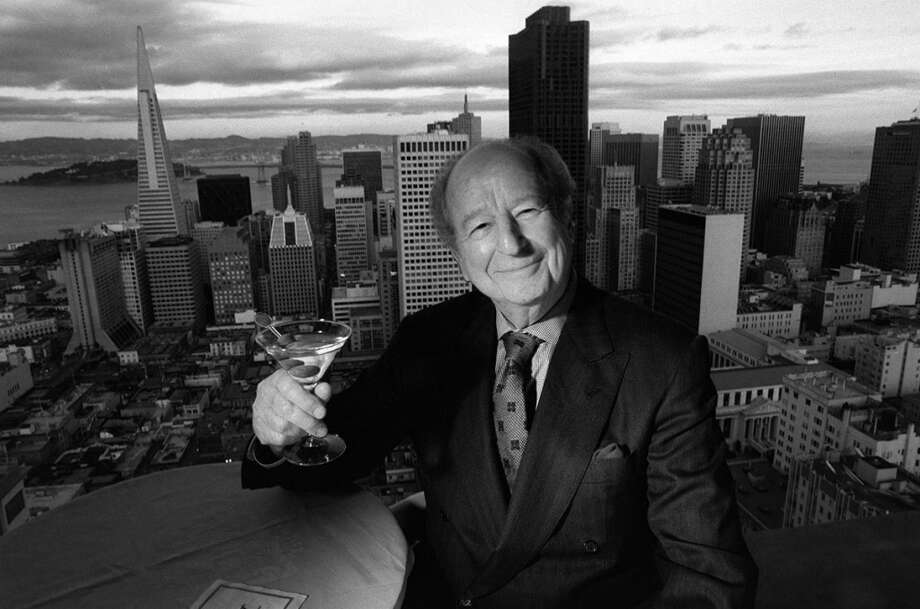
Herb Caen: Those endearing old charms


Photo: RUSSELL YIP


Herb Caen in the Crown Room atop the Fairmont Hotel in 1996.


Excerpted from a Herb Caen column — June 27, 1971

I KEEP READING in learned journals that nostalgia is the hottest movement in the land these days, but I’m not buying. It all seems phony to me, just another exercise in merchandising, a high-pressure plot to put our ladies back in wedgies and ankle-strap shoes, not to mention those awful suits with padded shoulders and nipped-in waists (I’ll take the beautiful hippie girls who let it all hang out). Not a tear came to my eyes as I read Life’s “Nostalgia” issue, and as for the vaunted revival of “No, No, Nanette” on Broadway, that’s a bore, too. Can you really get choked up in 1971 over a song with such lyrics as “Day will break and you’ll awake and start to bake a sugar cake for me to take for all the boys to see”? What’s a sugar cake? Why does she have to get up at dawn to bake it? And I’d rather not think about the kind of “boys” who’d want to see it.

THE MAIN REASON I think the Big Nostalgia Kick is synthetic is that we don’t see any signs of it in San Francisco. If it were really happening it would have happened here first. We’ve led the way in so many wonderful things — rock music, Love Children, cirrhosis, bridge-jumpers, bare boobs, junk art, junk clothes, turning on at the Opera House — that it’s ridiculous to think we couldn’t have kicked off a nostalgia boom if we’d really wanted to. After all, San Francisco practically invented nostalgia. It’s just that we played “Remember when?” for so many years — while the rest of the country was going crazy with progress — that we’ve tired of the game.

WELL, NOBODY can accuse San Francisco of living in the past any longer. In fact, where we seem to be is in a mad rush to destroy every vestige of The City That Was, The City That Knows How, Poor Pitiful Pearl of the Pacific. We can’t tear down old buildings fast enough to make room for new ones that are every bit as distinctive as Pittsburgh’s or Atlanta’s. As the man said when he first entered the restaurant atop Bank of America’s World Headquarters: “Instant Cleveland!” And now the rusty steel bones of the Transamerica pyramid are beginning to rise, its lower extremities already girdled in white Plastic Inevitable that puts you in mind of hotel bathrooms. When the pyramid was first announced, Mayor Alioto, drawing on his rich Florentine background, enthused: “It will be our Giotto Tower!” Well, he may have meant Irving Giotto.

WHILE NOSTALGIA is said to be sweeping the country, it’s a dirty word in San Francisco ’71 (watch out, here comes M. Justin Herman again with his swinging steel ball!). Redevelopment is the name of the game, and if you just had your old house shot out from under you, it’s for your own good, old-timer. “You have to be realistic,” as this big building said to me just the other day over lunch at Jack’s, an old restaurant that survives, miraculously. “Realistic.” I didn’t know how to answer him. Realism to him apparently means congestion, confusion, sterility. One antiseptic building, bustling by day, stone cold dead by night — replacing dozens of little buildings where mama and papa ran a grocery, Joe had a bar, Sam did the laundry, George owned a bookstore and hundreds of people lived, laughed, loved and rejoiced in a “neighborhood.” Gone, all of them, to where?

MAYBE NOSTALGIA is out here because it’s too painful to contemplate the dream and consider the reality. Once there were giants who built well — for the ages, they thought — but their landmarks, the solid evidence of their achievements, could disappear overnight, and they did. Now, it’s only when the fog steals in to blot out their ersatz replacements that you dare think of the past — alone, in a bittersweet reverie.

Friday, February 3, 2017

San Francisco Police Department Suspends Participation With FBI Joint Terrorism Task Force


SAN FRANCISCO (CBS SF) — San Francisco Police Department officials announced Wednesday evening that they have suspended participation with the FBI’s controversial Joint Terrorism Task Force.
According to San Francisco Police Commission protocol, all contracts require approval by the Board of Supervisors after 10 years.
The JTTF Memoranda of Understanding was signed in 2007, so that time has come, according to department officials.
The department will update its guideline for First Amendment activities and will “seek clarification” from the Police Commission as to this guideline’s application to JTTF investigations.
Once that new guideline is adopted, the department may consider renegotiating the JTTF memoranda with the FBI with guidance from the police commission.
Last month, the Asian Law Caucus, the Council on American-Islamic Relations’ San Francisco Bay Area office and the American Civil Liberties Union of Northern California sent a letter to San Francisco Police commissioners urging them to cease the department’s participation in the JTTF.
In the Jan. 5 letter, the groups speculate that, following President Donald Trump’s inauguration, the JTTF would likely increase surveillance of Muslim communities like the New York City police did after Sept. 11, 2001.
According to the FBI, 71 JTTF field offices have been established since 2001. The first was established in New York City in 1980.
“The SFPD is committed to public safety and will continue to work diligently to keep San Francisco safe for everyone,” San Francisco police Sgt. Michael Andraychak said in a statement.

Thursday, September 29, 2016

Low Interest Rates Have Created New Housing Bubble, Says UBS

Low Interest Rates Have Created New Housing Bubble, Says UBS

Vancouver and London came first and second on the 2016 list of cities most at risk of real estate bubbles


ENLARGE
A real estate for sale sign is pictured in front of a home in Vancouver on Sep. 22, 2016. PHOTO: REUTERS
By
ART PATNAUDEUpdated Sept. 27, 2016 9:56 a.m. ET


Housing bubbles are inflating in major cities around the world, with Vancouver and London most at risk, according to Swiss lender UBS Group.

Ultralow interest rates at global central banks have contributed to overheating in the housing market in recent years, the report from UBS Wealth Management said Tuesday.

Vancouver and London came first and second on the 2016 list of cities most at risk of real estate bubbles. Bubble risk was also evident in Stockholm, Sydney, Munich and Hong Kong, UBS said.

House prices in all these cities have increased by nearly 50% on average since 2011. The average price rise in other financial centers has been less than 15%.

Loose monetary policy at global central banks is a key driver behind rising prices, the report said. Low interest rates have pushed investors to hunt for returns in tangible assets, “so it is hardly any wonder that housing markets are again overheating,” according to report authors Claudio Saputelli and Matthias Holzhey.


For the European Central Bank, which controls monetary policy for all 19 member countries, the inability to adjust interest rates for particular economic development in separate countries has contributed to rising house prices in the region, UBS said.

“All European cities are overvalued, apart from Milan,” the report said. Central banks in theU.K., Canada and Australia are also keeping interest rates low. Combined with stable supply of homes and strong demand from foreign buyers, especially in China, “this has produced an ideal setting for excesses in house prices,” the authors said.

Vancouver house prices have been significantly overvalued since 2007, according to UBS. Neither the financial crisis nor weakening commodity prices incited a slowdown.

In an attempt to temper soaring prices in Vancouver, the provincial government of British Columbia introduced a 15% transfer tax on foreign home buyers in August.

London and Hong Kong topped UBS’s bubble index in 2015. London has been knocked into second place this year, and Hong Kong sixth, but both are still in bubble-risk territory.

In London, an acute housing shortage and readily-available mortgages “should be able to sustain the inflated prices for the time being,” the report said.

What might pop the bubbles, and when, is impossible to predict, even in cities with the clearest signs of a problem, UBS said. “A sharp increase in supply, higher interest rates or shifts in the international flow of capital could trigger a major price correction at any time,” Mr. Holzhey, a real estate economist, said in a written statement.

Investors now buying cities considered overvalued “should not expect real price appreciation in the medium to long run,” UBS said.

Wednesday, December 23, 2015

Plan that could lead to massive displacement moves forward, quietly


Plan that could lead to massive displacement moves forward, quietly


A proposal that could rival the forced relocations of the discredited Redevelopment Era is headed for City Hall approvals — with very little news media scrutiny
This snapshot of part of the Planning Department's map shows the wide swath of housing (in blue) that could be torn down and replaced with larger units
This snapshot of part of the Planning Department’s map shows the wide swath of housing (in blue) that could be torn down and replaced with larger units
By Tim Redmond
DECEMBER 21, 2015 — Under the guise of creating more affordable housing, the Mayor’s Office is proposing a plan that could lead to the greatest wave of displacement since the Redevelopment era of the 1950s. And other than excellent stories from People Power Media and sfbay.ca, it’s gotten very little in-depth news media attention.
The program is called the Affordable Housing Density Bonus plan, and it has its roots in both state law and a 2013 court decision in Napa County.
But in the end, this will be a local decision – and the plan is almost breathtaking in its scope. It is, critics say, a return to the failed policies of an earlier era, when tearing down homes and businesses in the name of improvement was official federal, state, and local policy.
“No matter how you look at this, it’s the Redevelopment model,” said Peter Cohen, co-director of the Council of Community Housing Organizations. “And that model didn’t work.”
A careful analysis of the proposed bill, which is still getting revised, shows:
This graphic from People Power Media shows some of the neighborhoods that will be impacted
  • More than 30,000 units of housing – and all of the corner stores, restaurants, and community-serving small businesses located on the first floors below them – are potentially targets for demolition. The law encourages property owners to turn smaller buildings into bigger ones by adding stories – and the only practical way for that to happen is if existing buildings are torn down.
  • The plan put tens of thousands of units of rent-controlled housing – the most important affordable housing in the city for working class and middle-class people – at risk. In a flashback to the worst era of Redevelopment, the planners say people thrown out on the streets when their homes are torn down would have the right to return later – but there’s no clean plan to give them affordable homes in the meantime, and all the evidence shows that “right of return” doesn’t work: Tenants who are displaced for years wind up leaving the area forever.
  • The right to construct taller buildings doesn’t really create much in the way of new affordable housing, since the developers can count the replacement units that were there in the first place toward their “affordable” responsibility.
  • The new taller buildings will be able to block sunlight in any existing back yard, as long as it isn’t a public park. For those tens of thousands of San Franciscans who use their small yards to grow gardens, to sit outside, to have barbecues … there is no protection from construction that ends your access to sunlight.
  • Oh, and the new rules would pretty much end public input into neighborhood planning, since most of the new projects would be exempt from the normal hearing and appeal process.
  • There is no credible process to protect existing small neighborhood businesses from wholesale displacement, meaning the plan could transform dozens of local commercial districts.
It’s a gigantic change in planning policy, driven by the idea that the city of the future has to be built by destroying the city of the past. In essence, the proposal is aimed at making San Francisco a better, and possibly more affordable, city for people who are going to move here in the future, at the expense of existing residents.
“It’s a demolition and displacement machine,” longtime housing advocate Calvin Welch told me.
Read this story in 48 Hills: HERE

Wednesday, December 3, 2014

Oh great. Now the housing crisis can’t be solved. And the tech folks are afraid to talk in public

Oh great. Now the housing crisis can’t be solved. And the tech folks are afraid to talk in public

Until the evictions stop, protests on the streets will continue
By Tim Redmond
NOVEMBER 20, 2014 – You know the housing crisis in San Francisco has gone from insane to absurd when the City Planning Department gets in trouble for posting a video saying we need more housing – and the Atlantic suggests that maybe there’s no solution at all.
Then a reporter from TechChrunch holds a meeting to try to get tech people and housing activists to talk – but decides it has to be private so that it won’t blow up.
And sometimes I just want to pound my head against the wall and say: What is the matter with everyone? Are so many people so blinded by free-market ideology and a lack of historical understanding that they think this is (a) the result of Nimbys and rent control and (b) can’t be solved?
Does anyone really think the activists will give up shouting and protesting and meet for a polite chat while thousands are being thrown out on the streets — and the tech world is doing nothing to help?
I will take a deep breath and try to sort this out.
You want historical perspective on why we are in this mess, please take just 20 minutes to watch this video and this video.
Put simply: It wasn’t the SF left, or the anti-growth activists, who created this crisis. It was developers, and city officials listening to them, who pretty much ignored the concept of real city planning – who decided that the market should decide what was built.
When the market – or, that is, the international investors who put money into big-city real estate — wanted office buildings, not housing, office buildings got approved. When the rest of us said: You have to build housing, too, we were told that the money wasn’t there. It was going into offices, where the return on investment was higher.
Could the city have said: No, if you build offices and attract new workers, you have to build housing for them? Of course; that’s what city planning and zoning is about.
But no: A generation of mayors and planning commissions refused to do that.
Now, the market says the money is in very-high-end housing. So those who think the market should define city planning say: Okay, maybe if we build enough of that prices will come down.
Never worked before, won’t work now.
In a small city under immense pressure, the market can’t be the defining factor. Actual planning – which means setting policies determining what the city needs, then zoning for those and only those needs – is the only thing that works.
In other words, a city like this needs to have a very public discussion around what we want to become. Nobody ever voted to create a tech headquarters city in Soma; that happened because venture capital people in Silicon Valley wanted the companies they financed nearby, and the tech workers wanted to live here.
In some ways, they had no choice: If you work at Apple, you pretty much can’t live in Cupertino because they build no housing at all. Same for Mountain View and these other Peninsula cities.
And now the tech world needs housing in San Francisco – because the workers want to be near their offices and the companies want to be able to expand very rapidly. But instead of saying that we just need to build all the new housing that the tech world needs right now, we might want to stop and say: Why are we doing this? Who’s going to pay for it? Is there a limit to how many tech companies the city can handle? Is it wrong to even ask that question?
What cities can do
We have every right as a city to say that no new tech office space can be built unless and until the developers (and by pricing, their tenants) agree that first they will pay to build the housing and transit capacity needed for the workforce. We can say that all new housing has to meet the needs of the existing workforce.  We can say that some land can only be used for light industry and can never be turned into office space – which means that the property values of those sites will remain low enough that blue-collar businesses can afford the rent.
Is that a transfer of wealth from land and building owners who could get rich by selling out to office developers to local businesses that employ people at decent jobs without advanced degrees? Yes. Is that legitimate, legal city planning policy? Yes.
I had a long conversation with Kim-Mai Cutler, the TechCrunch reporter, this morning. She’s spent a lot of time reading and thinking about urban planning and housing, and it was fun to chat with her. She told me that the story in Re/Code wasn’t quite right – the event she held wasn’t a TechCrunch event, it was just her, as a reporter, trying to get people to come together and talk.
And, she said, because of all the anger and vitriol in the city, she was afraid that if it was public and reporters came, tech folks would be afraid to ask questions or make statements that might be reported out of context.
She and I have a different view of how housing policy should operate; she really believes that we need to build a huge amount of new housing, more than the mayor’s 30,000 units, to make room for the exploding workforce of the tech hub, and she thinks that eventually prices will come down. I think the demand is so insatiable, and the out-of-town investment money so big, that we’ll end up building 50,000 pied a terres and second homes that will do very little to bring prices down to the level where a middle-class worker in one of the city’s biggest industries (government, health care, or hospitality) will be able to afford the rent.
I’ve been arguing that this is a case where the market has failed, and will fail – the market build too much office space in the 1980s, until we slowed it down with Prop. M, and the market is destroying PDR space in the city, and isn’t solving the housing problem. The only workable solutions involve full-scale government regulation and intervention.
It’s tough in a city where it costs as much as $500,000 to build a single unit; it’s worse when investors demand the kind of return that will only happen if that unit sells for $1 million or more.
Of course, if the city used public land, or demanded land as part of any deal to build offices, and then used only nonprofits to build housing, the price would drop below $500K. With even modest subsidies, you could build middle-class housing. And there would be no need to satisfy greedy investors who want those high returns.
(By the way, Cutler did agree with me that the young tech workers aren’t going to move into highrise condos downtown. That’s boring; they want to live in the Mission or the Haight or Noe Valley. The big Google bus stops aren’t in front of the Millenium Towers.  And that will be the case no matter how many highrise condos we build. Problem is, there are already people living in the Mission.)
But here’s the larger question about Cutler’s meeting, and an earlier effort by David Campos to get people talking.
It’s never going to happen as long as the epidemic of evictions continues.
What tech can do to help
There are plenty of good people who work for tech companies. Many of them want to be good neighbors, make San Francisco their home and make it a better city. Many of them don’t want to be evil. Many of them worry that the hip cultural community they moving into is being destroyed.
But so far, the folks with the money aren’t helping any local efforts to stop the evictions, which are tearing communities apart. I didn’t see a single tech company or wealthy tech worker put a penny into supporting Prop. G, the anti-speculation tax. With a fraction of the money Mark Zuckerberg is spending on all his Noe Valley property, Prop. G would have won.
I didn’t  see any tech leaders testifying for, or supporting, the Campos legislation increasing buyouts for Ellis evictions. The tech-darling mayor wouldn’t even sign the bill; it became law without his signature.
The anger against tech companies comes from the palpable fear that every tenant and every low-income person on the East Side of town feels every day. Mark Benioff seems to realize that; he actually spoke out against the evictions. But he hasn’t done anything to help.
If we can stabilize the existing vulnerable populations and make sure that people who already live here aren’t forced out for new higher-paid workers, then everyone will calm down and we can talk about long-term housing policy. Until then, the war on the streets is going to continue. It just is.

So let’s talk about rent control.
Like zoning policy – and so much else of what cities can do today – rent control as it exists in San Francisco is something of a blunt instrument. It’s far from perfect: People who have lived in an apartment for a long time get a break, but people who just moved here don’t. If the state would allow us to impose real rent control – that is, to maintain the set price even after a tenant moves out – then some of the unfairness would go away. Alas, the state won’t allow that.
Yes: There are tenants who are relatively wealthy who don’t need rent control but still get it. Yes: There are landlords who are less-wealthy who have to accept that burden.
But public policy at the city level is often imperfect – again, the state and federal government won’t allow us to do the things (like a local income tax, a local tax on corporate profits, commercial rent control, and the seizure of vacant property for housing) that would make some of these blunt instruments less necessary.
So we do what we can. Overall, landlords in San Francisco are more wealthy than tenants. Not every single one; there are always exceptions. But overall, that’s a fair rule.
Overall, rent control does something else: It favors people who have been here a long time over people who just got here. And I would like to suggests that that’s just fine.
I know it’s a crazy, radical idea, but at a certain point, in a crisis like this one, you have to give some value to seniority. Unions do it all the time; in fact, seniority is one of the most fundamental tenants of most labor contracts. You’ve been on the job for 20 years, you have more rights than someone who started last week.
And I would say: If you’ve been in San Francisco for 20 years, and helped create and build this community, you have a right to stay here that trumps the right of someone with more money to move in.
The fundamental issue for tech workers – and the politicians who have promoted tech jobs without thinking about housing needs – is this:
You are moving into an existing community. You don’t have the right to force anyone who lives there already to move out.
That means, if you are a decent human being, you will accept that you might not be able to get a sweet flat in the Mission right now. You might have to live in Oakland or Richmond or somewhere else until a place in the city opens up – not by forced eviction but by someone deciding on his or her own to leave, or because the city has built new housing that you can live in. Maybe not in the Mission or Noe Valley, but that’s life. It’s what everyone else in the city has to deal with.
I know the companies want happy workers who want to live in SF near work or a Google bus line, but it’s not fair that a hotel worker – who also has a right to be happy and live near work — has to move to Stockton because someone new with more money came along. And there’s no free luxury bus to take her to work.
Again: This is not about demonizing tech workers. It’s about saying to that industry, which has come to dominate city politics: You have to help this community survive, which means helping control displacement. Right here, right now.
Even if building 30,000 housing units (or however many) would bring prices down, it’s not going to happen overnight. Even if we eliminated CEQA and fast-tracked everything, it would take years to build that much.
Meanwhile, every day another family, another senior, another community member is being forced out. And everyone who cares about this city has to join in that fight.
Here’s an idea for nice meeting: How about Ron Conway and Mark Benioff and all the folks who want to be good tech citizens sit down with the housing activists for a meeting that has one agenda item: How to raise $5 million for a comprehensive housing ballot measure for November that has as its start the use of every possible local policy tool to slow down or halt speculation and evictions. I can think of a lot of activists who would happy to be there.
Because in this dispalcement crisis, doing nothing IS evil.