A blog about Marinwood-Lucas Valley and the Marin Housing Element, politics, economics and social policy. The MOST DANGEROUS BLOG in Marinwood-Lucas Valley.
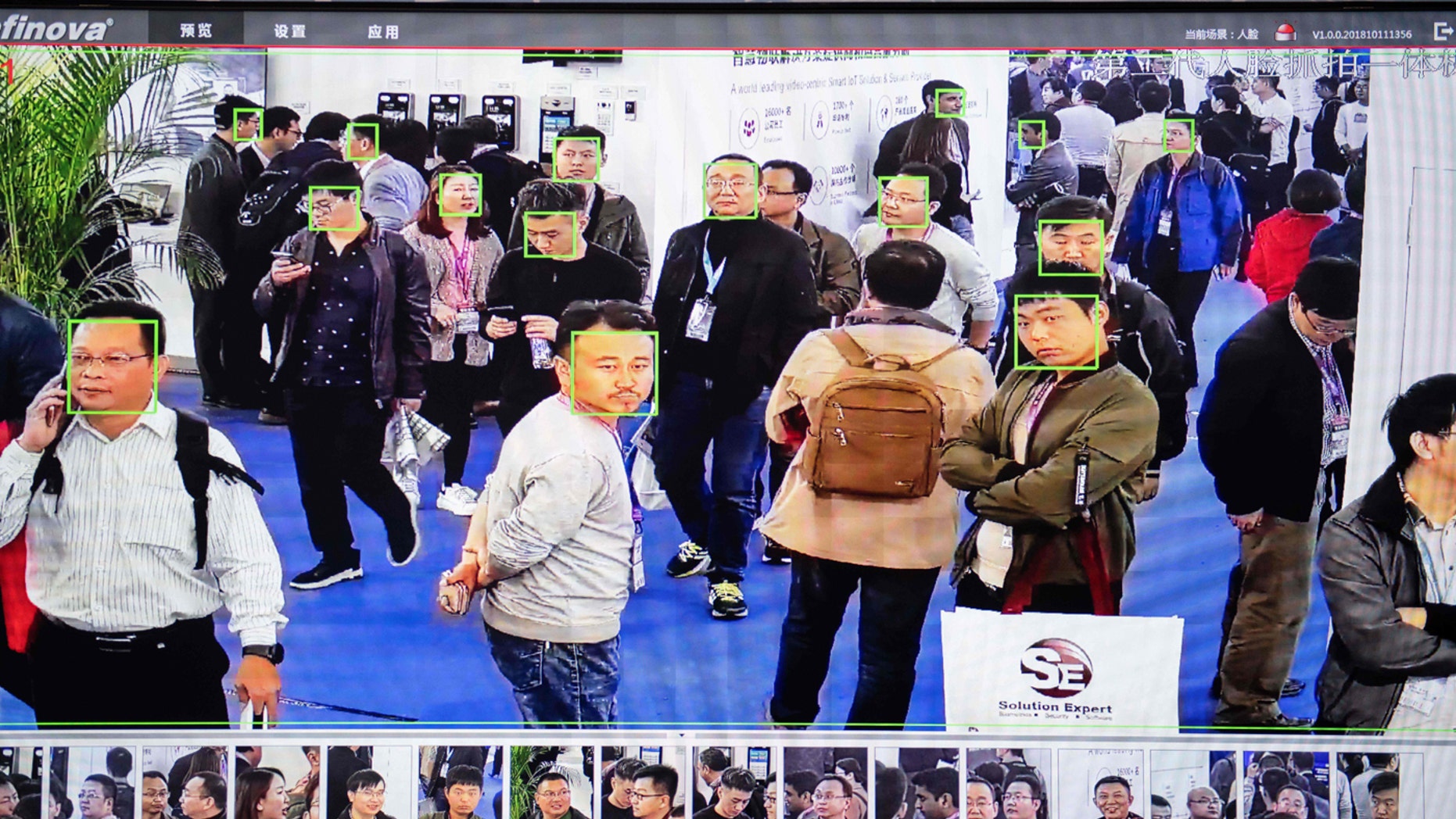
A screen shows visitors being filmed by AI (Artificial Intelligence) security cameras at the 14th China International Exhibition on Public Safety and Security at the China International Exhibition Center in Beijing on October 24, 2018. (Getty Images)
China has blocked millions of travelers from purchasing train or plane tickets as part of the Communist country's controversial "social credit" system, which has drawn the ire of privacy advocates who fear the surveillance-based system could lead to dystopian outcomes.
The Guardian reports that Chinese courts banned travelers from buying flights 17.5 million times by the end of last year, and that citizens put on blacklists for so-called social credit offenses were prevented from purchasing train tickets 5.5 million times. The report said: "Once discredited, limited everywhere."
The social credit system, which is still being built and now exists more as a patchwork of local and regional systems, purports to incentivize trustworthy behavior through various penalties when Chinese citizens commit a range of offenses, including not paying taxes, jaywalking, smoking on a train, walking their dogs without a leash or taking drugs.
Although a wide range of countries, including the U.S. and the U.K., already use data to judge a person's creditworthiness when it comes to applying for a mortgage or a credit card, the Chinese system aims to expand these practices to all areas of life.
Experts fear the system will lead to a crackdown on anyone who challenges China's government.
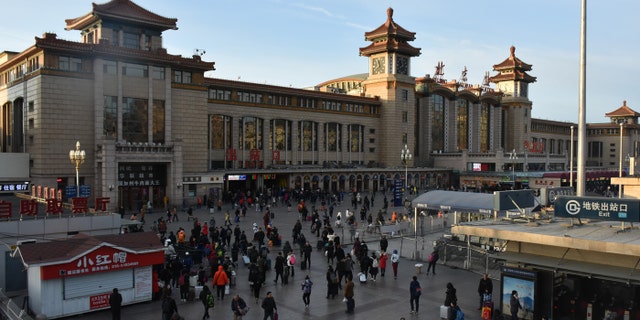
General view of passengers at the Beijing rail station. (Getty Images)
For instance, journalist Liu Hu, who writes about censorship and corruption in China, has been arrested and fined because of his work. According to Wired, Liu found that his name was placed on a list of "dishonest persons" who is "not qualified" to buy a plane ticket, buy property or take out a loan.
"There was no file, no police warrant, no official advance notification. They just cut me off from the things I was once entitled to," he told The Globe and Mail. "What's really scary is there's nothing you can do about it. You can report to no one. You are stuck in the middle of nowhere."
According to The Guardian, Chinese citizens can also be prevented from buying insurance, real estate or investment products if they run afoul of the credit system. The British news site also reports that 3.5 million people or companies paid taxes or debts they owed because of the credit system.
Experts have said that Western countries should not look to mimic the Chinese system.
"Often comparisons are drawn between private applications like Uber and its rating system for customers and drivers. While these private company systems are extremely problematic in my view, they are fundamentally different," Samantha Hoffman, a non-resident fellow at the Australian Strategic Policy Institute, told Wired. "The People’s Republic of China is an authoritarian country, the Chinese Communist Party is responsible for gross human rights violations for decades... There is nothing any liberal democratic society should even think about copying in the social credit system."
How Chinese-style monitoring could come to the United States By Casey Newton@CaseyNewton Dec 7, 2018, 6:00am EST SHARE Alex Castro
The Interface is a daily column about the intersection of social media and democracy. Subscribe to the newsletter here.
Sophisticated facial-recognition technology is at the heart of many of China’s more dystopian security initiatives. With 200 million surveillance cameras — more than four times as many in the United States — China’s facial-recognition systems track members of the Uighur Muslim minority, block the entrances to housing complexes, and shame debtors by displaying their faces on billboards.
I often include these stories here because it seems inevitable that they will make their way to the United States, at least in some form. But before they do, a coalition of public and private interests are attempting to sound the alarm.
AI Now is a group affiliated with New York University that counts as its members employees of tech companies including Google and Microsoft. In a new paper published Thursday, the group calls on governments to regulate the use of artificial intelligence and facial recognition technologies before they can undermine basic civil liberties. The authors write:
Facial recognition and affect recognition need stringent regulation to protect the public interest. Such regulation should include national laws that require strong oversight, clear limitations, and public transparency. Communities should have the right to reject the application of these technologies in both public and private contexts. Mere public notice of their use is not sufficient, and there should be a high threshold for any consent, given the dangers of oppressive and continual mass surveillance.
The AI Now researchers are particularly concerned about what’s called “affect recognition” — and attempt to identify people’s emotions, and possibly manipulate them, using machine learning.
”There is no longer a question of whether there are issues with accountability,” AI Now co-founder Meredith Whittaker, who works at Google, told Bloomberg “It’s what we do about it.”
We believe it’s important for governments in 2019 to start adopting laws to regulate this technology. The facial recognition genie, so to speak, is just emerging from the bottle. Unless we act, we risk waking up five years from now to find that facial recognition services have spread in ways that exacerbate societal issues. By that time, these challenges will be much more difficult to bottle back up.
In particular, we don’t believe that the world will be best served by a commercial race to the bottom, with tech companies forced to choose between social responsibility and market success. We believe that the only way to protect against this race to the bottom is to build a floor of responsibility that supports healthy market competition. And a solid floor requires that we ensure that this technology, and the organizations that develop and use it, are governed by the rule of law.
The ACLU says that the current test seems appropriately narrow, but that it “crosses an important line by opening the door to the mass, suspicionless scrutiny of Americans on public sidewalks” — like the road outside the White House. (The program’s technology is supposed to analyze faces up to 20 yards from the camera.) “Face recognition is one of the most dangerous biometrics from a privacy standpoint because it can so easily be expanded and abused — including by being deployed on a mass scale without people’s knowledge or permission.”
Perhaps Americans’ enduring paranoia about big government will prevent more Chinese-style initiatives from ever taking root. But I can also imagine a scenario in which a populist, authoritarian leader, constantly invoking the twin specters of terrorism and unchecked illegal immigration, rallies popular support around surveillance technology.
Automated license plate readers are collecting and sharing tons of data across state lines, according to records from nearly 200 police departments nationwide.
Over the last decade, cities have increasingly embraced the crime-fighting potential of automated license plate reader (ALPR) technology. These camera systems are now ubiquitous at malls and train stations; they appear on street signs and perch on the dashboards of police cars. ALPRs can snap up thousands of geotagged photos per minute, and can help construct an incredibly detailed picture of a driver’s whereabouts over time.
For law enforcement, ALPR represents a powerful tool that can track suspects in real time. Let’s say the police are pursuing a robber fleeing in a vehicle. They can add the suspect’s license plate to a “hot list” and receive alerts whenever an ALPR camera in their city snaps a picture of it. Using what’s essentially a real-time map, the police can track and intercept the suspect.
But critics of the technology—including civil liberties and privacy groups—argue that license readers gather too much sensitive information about people who have nothing to do with crime, and it’s not always clear with whom it is being shared and to what end.
“In a nutshell, it’s like face recognition—except every single face comes in a standard format and is directly linkable to a government identity record,” Alvaro Bedoya, the executive director of the Center on Privacy and Technology at Georgetown Law, said via email. “It allows mass tracking and because plates are issued by the government, we’re a bit desensitized to the idea that they’ll be tracked. It’s powerful stuff, and it’s not under control.”
This year, the Electronic Frontier Foundation (EFF), a digital rights organization, filed hundreds of Freedom of Information Act (FOIA) requests via Muckrock, a government transparency platform. The organization was looking for information on deals local and federal agencies have made with Vigilant Solutions, the largest private company selling ALPR technology and data. Recently, EFF released results from 200 responses.
“We found a staggering amount of data that agencies are collecting on people—very little of which is of public interest,” said Dave Maass, senior investigative researcher at EFF.
A total of 173 entities (largely police departments and sheriff’s offices, but also some federal agencies) in 23 states scanned a total of 2.5 billion license plates in 2016 and 2017. On average, 99.5 percent of scans belonged to cars that weren’t associated with crimes.
This information was widely shared. EFF also found that, on average, each agency was directly sharing this information with 160 other jurisdictions at various levels of government. These could be police departments, university police units, airports, or Customs and Border Protection (CBP), for example. In addition, several agencies on the list also subscribed to Vigilant Solutions’ central database, which pools its own trove of ALPR data with that collected by various local agencies with which it has agreements, and sells access to this dataset to an undisclosed list of entities. What that means is even if your plates were shot in Georgia, your location data may be accessible to cops in say, Illinois. Or it may be bought by private companies or Immigration and Customs Enforcement (ICE).
The Burr Ridge Police Department in Illinois, which sought to install ALPR and facial recognition technology in their squad cars back in 2016, now shares this data with 851 other agencies—the highest of any other in this dataset.“It sounds futuristic,” city board trustee Janet Ryan Grasso said in support of the technology at the time the department proposed the program. “It would provide cutting edge technology for our patrol officers to protect residents. I like the idea.”
Cities are changing fast. Keep up with the CityLab Daily newsletter.
Although heavily redacted, records provided by the U.S. Forest Service suggest that the federal agency, too, shares information—with around 390 entities, according to EFF.
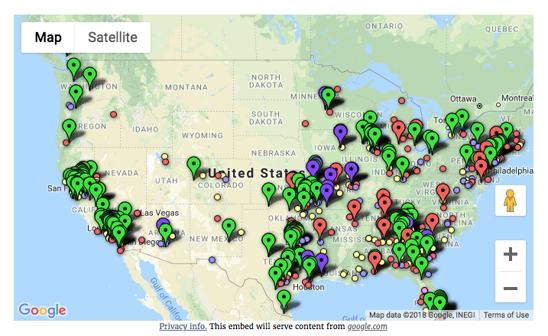
Below is a map of all the agencies EFF has requested information on. You can click through to explore the map, or look up your local police department in the data here.
A map of all the agencies EFF has requested data from on their deals with Vigilant Solutions. (EFF)
So, if you’re a law-abiding motorist, how worried should you be about this technology—and what exactly should you be worried about?
One big concern, says EFF’s Maass, is data security. Sharing such sensitive information across state lines makes it harder to conduct appropriate oversight because the data and privacy laws in one place may differ from another. It also makes that information more susceptible to breaches. “Every time you create an access point to your data, that’s another vector where it can be used gain information on people,” Maass said. “If you’re the city of Sacramento and you’re sharing with 800 agencies, that’s 800 points of vulnerabilities.”
If hackers get a hold on what is essentially a geotagged map of your movements, they could sell that stalkers, robbers, or other individuals who wish you harm. Or, a large trove of that data for multiple people—law enforcement officials or political leaders, for example—could fall in the hands of foreign adversaries.
Vigilant Solutions advertises this technology to law enforcement as a much-needed modern upgrade to scribbling down license-plate numbers by hand. “The technology in use today basically replaces an old analog function—your eyeballs,” Chris Metaxas, then-chief executive of Digital Recognition Network, a subsidiary of Vigilant Solutions, said in 2014. “It’s the same thing as a guy holding his head out the window, looking down the block, and writing license-plate numbers down and comparing them against a list. The technology just makes things better and more productive.”
Law enforcement officials seem convinced. But how effective is this tool? The “hit ratio”—the total number of “hot list” license plates detected per the total number of scans—is one useful metric. This number has been minuscule in past examinations—often less than 1 percent. In this new trove of data, too, EFF found that on average, the hit rate was 0.5 percent. In other words, law enforcement cast a very wide dragnet, for a very tiny catch of suspects.
The exact number of crimes ALPR technology has helped solve is unclear. Vigilant believes it’s a lot. “[T]he success stories are so frequent, I can’t even keep up with them all,” writes Tom Joyce, a retired NYPD officer who works at Vigilant Solutions, on the conpany’s website. Police officials who defend this technology despite the low hit ratio also highlight individual cases that were assisted by ALPR investigations: a shooting suspect in Cincinnati, Ohio; a U.S. postal service robber in Alexandria, Virginia;
In the dataset, the Kansas City Police Department in Missouri stood out with an abnormally high hit ratio—7.6 percent of the 37 million license plates it scanned in 2017. Maass doesn’t know what’s going on there, but guesses that it may be because they keep a large hot list based on very broad criteria. “I can only speculate that it could be related to court fines or proof of insurance,” he said. “It’s alarming that they’re keeping such close tabs on so many people.”
That itself raises a huge red flag about hot lists: Police departments have wide discretion in creating them, which may leave a lot of room for abuse. EFF has previously found that Vigilant has been incentivizing localpolicedepartments in Texas to focus on debt collection. Free Vigilant technology would alert police when people with pending court fines drive by. After they pulled the driver over, they could offer two choices: Go to jail, or pay the fine … plus a 25 percent “processing fee” that Vigilant largely pockets. In 2016, Buzzfeed found that Port Arthur’s sheriff used similar technology to shake down black and brown motorists who owed the city money. Remember that exploitative practice of squeezing the poor for municipal revenues that came to light after the Justice Department’s investigation of Ferguson, Missouri? These practices were high-tech variations on the same idea.
Then, there’s also the fact that ordinary citizens with potentially nefarious motives can often obtain this license-tracker data through a public records requests in some places, or by having the police give it to them as favors or in exchange for bribes. They may then use it to target violence survivors, political organizers, journalists, or abortion-seekers.
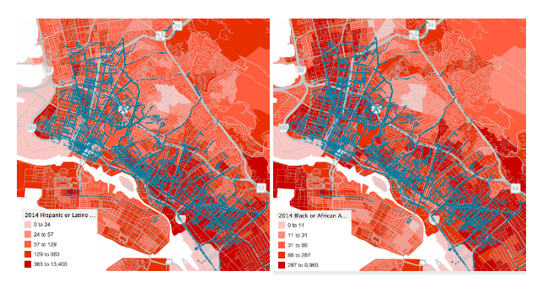
Police and other government agencies have a long track record of disproportionally surveilling populations of color, immigrants, and the poor, and ALPR offers another means of pursuing that practice. In 2015, EFF mapped how ALPR was used in Oakland. Police cars equipped with cameras would patrol low-income neighborhoods, snapping up more plates in these areas. That meant the residents of these neighborhoods were more likely to end up in the ALPR system—even though their neighborhoods weren’t necessarily correlated with higher crime.
ALPR scans (blue) correlated with Hispanic and African-American population (red). (EFF)
Surveillance tools like ALPR are often first used against vulnerable communities. But those who aren’t used to being singled out because of their skin color might want to remember that every driver on the road is fair game for this technology.To reduce the potential for abusing ALPR, advocates suggest purging the scans that do not generate a match on the hot list immediately, or at least after a few days. But underlying it all is the question: Should police have access to this kind of data at all?
”The government makes us put license plates on our cars,” Maass said. “They have a responsibility not to exploit it.”
55 Savushkina Street, last known home of the Internet Research Agency.CreditJames Hill for The New York Times
The Agency From a nondescript office building in St. Petersburg, Russia, an army of well-paid “trolls” has tried to wreak havoc all around the Internet — and in real-life American communities.
Around 8:30 a.m. on Sept. 11 last year, Duval Arthur, director of the Office of Homeland Security and Emergency Preparedness for St. Mary Parish, Louisiana, got a call from a resident who had just received a disturbing text message. “Toxic fume hazard warning in this area until 1:30 PM,” the message read. “Take Shelter. Check Local Media and columbiachemical.com.”
St. Mary Parish is home to many processing plants for chemicals and natural gas, and keeping track of dangerous accidents at those plants is Arthur’s job. But he hadn’t heard of any chemical release that morning. In fact, he hadn’t even heard of Columbia Chemical. St. Mary Parish had a Columbian Chemicals plant, which made carbon black, a petroleum product used in rubber and plastics. But he’d heard nothing from them that morning, either. Soon, two other residents called and reported the same text message. Arthur was worried: Had one of his employees sent out an alert without telling him?
If Arthur had checked Twitter, he might have become much more worried. Hundreds of Twitter accounts were documenting a disaster right down the road. “A powerful explosion heard from miles away happened at a chemical plant in Centerville, Louisiana #ColumbianChemicals,” a man named Jon Merritt tweeted. The #ColumbianChemicals hashtag was full of eyewitness accounts of the horror in Centerville. @AnnRussela shared an image of flames engulfing the plant. @Ksarah12 posted a video of surveillance footage from a local gas station, capturing the flash of the explosion. Others shared a video in which thick black smoke rose in the distance.
Dozens of journalists, media outlets and politicians, from Louisiana to New York City, found their Twitter accounts inundated with messages about the disaster. “Heather, I’m sure that the explosion at the #ColumbianChemicals is really dangerous. Louisiana is really screwed now,” a user named @EricTraPPP tweeted at the New Orleans Times-Picayune reporter Heather Nolan. Another posted a screenshot of CNN’s home page, showing that the story had already made national news. ISIS had claimed credit for the attack, according to one YouTube video; in it, a man showed his TV screen, tuned to an Arabic news channel, on which masked ISIS fighters delivered a speech next to looping footage of an explosion. A woman named Anna McClaren (@zpokodon9) tweeted at Karl Rove: “Karl, Is this really ISIS who is responsible for #ColumbianChemicals? Tell @Obama that we should bomb Iraq!” But anyone who took the trouble to check CNN.com would have found no news of a spectacular Sept. 11 attack by ISIS. It was all fake: the screenshot, the videos, the photographs.
In St. Mary Parish, Duval Arthur quickly made a few calls and found that none of his employees had sent the alert. He called Columbian Chemicals, which reported no problems at the plant. Roughly two hours after the first text message was sent, the company put out a news release, explaining that reports of an explosion were false. When I called Arthur a few months later, he dismissed the incident as a tasteless prank, timed to the anniversary of the attacks of Sept. 11, 2001. “Personally I think it’s just a real sad, sick sense of humor,” he told me. “It was just someone who just liked scaring the daylights out of people.” Authorities, he said, had tried to trace the numbers that the text messages had come from, but with no luck. (The F.B.I. told me the investigation was still open.)
The Columbian Chemicals hoax was not some simple prank by a bored sadist. It was a highly coordinated disinformation campaign, involving dozens of fake accounts that posted hundreds of tweets for hours, targeting a list of figures precisely chosen to generate maximum attention. The perpetrators didn’t just doctor screenshots from CNN; they also created fully functional clones of the websites of Louisiana TV stations and newspapers. The YouTube video of the man watching TV had been tailor-made for the project. A Wikipedia page was even created for the Columbian Chemicals disaster, which cited the fake YouTube video. As the virtual assault unfolded, it was complemented by text messages to actual residents in St. Mary Parish. It must have taken a team of programmers and content producers to pull off.
And the hoax was just one in a wave of similar attacks during the second half of last year. On Dec. 13, two months after a handful of Ebola cases in the United States touched off a minor media panic, many of the same Twitter accounts used to spread the Columbian Chemicals hoax began to post about an outbreak of Ebola in Atlanta. The campaign followed the same pattern of fake news reports and videos, this time under the hashtag #EbolaInAtlanta, which briefly trended in Atlanta. Again, the attention to detail was remarkable, suggesting a tremendous amount of effort. A YouTube video showed a team of hazmat-suited medical workers transporting a victim from the airport. Beyoncé’s recent single “7/11” played in the background, an apparent attempt to establish the video’s contemporaneity. A truck in the parking lot sported the logo of the Hartsfield-Jackson Atlanta International Airport.
On the same day as the Ebola hoax, a totally different group of accounts began spreading a rumor that an unarmed black woman had been shot to death by police. They all used the hashtag #shockingmurderinatlanta. Here again, the hoax seemed designed to piggyback on real public anxiety; that summer and fall were marked by protests over the shooting of Michael Brown in Ferguson, Mo. In this case, a blurry video purports to show the shooting, as an onlooker narrates. Watching it, I thought I recognized the voice — it sounded the same as the man watching TV in the Columbian Chemicals video, the one in which ISIS supposedly claims responsibility. The accent was unmistakable, if unplaceable, and in both videos he was making a very strained attempt to sound American. Somehow the result was vaguely Australian.
Who was behind all of this? When I stumbled on it last fall, I had an idea. I was already investigating a shadowy organization in St. Petersburg, Russia, that spreads false information on the Internet. It has gone by a few names, but I will refer to it by its best known: the Internet Research Agency. The agency had become known for employing hundreds of Russians to post pro-Kremlin propaganda online under fake identities, including on Twitter, in order to create the illusion of a massive army of supporters; it has often been called a “troll farm.” The more I investigated this group, the more links I discovered between it and the hoaxes. In April, I went to St. Petersburg to learn more about the agency and its brand of information warfare, which it has aggressively deployed against political opponents at home, Russia’s perceived enemies abroad and, more recently, me.
Seven months after the Columbian Chemicals hoax, I was in a dim restaurant in St. Petersburg, peering out the window at an office building at 55 Savushkina Street, the last known home of the Internet Research Agency. It sits in St. Petersburg’s northwestern Primorsky District, a quiet neighborhood of ugly Soviet apartment buildings and equally ugly new office complexes. Among the latter is 55 Savushkina; from the front, its perfect gray symmetry, framed by the rectangular pillars that flank its entrance, suggests the grim impenetrability of a medieval fortress. Behind the glass doors, a pair of metal turnstiles stand guard at the top of a short flight of stairs in the lobby. At 9 o’clock on this Friday night in April, except for the stairwell and the lobby, the building was entirely dark.
This puzzled my dining companion, a former agency employee named Ludmila Savchuk. She shook her head as she lifted the heavy floral curtain to take another look. It was a traditional Russian restaurant, with a dining room done up like a parlor from the early 1900s, complete with bentwood chairs and a vintage globe that showed Alaska as part of Russia. Savchuk’s 5-year-old son sat next to her, slurping down a bowl of ukha, a traditional fish soup. For two and a half months, Savchuk told me, she had worked 12-hour shifts in the building, always beginning at 9 a.m. and finishing at 9 p.m., at which point she and her co-workers would eagerly stream out the door at once. “At 9 p.m. sharp, there should be a crowd of people walking outside the building,” she said. “Nine p.m. sharp.” One Russian newspaper put the number of employees at 400, with a budget of at least 20 million rubles (roughly $400,000) a month. During her time in the organization, there were many departments, creating content for every popular social network: LiveJournal, which remains popular in Russia; VKontakte, Russia’s homegrown version of Facebook; Facebook; Twitter; Instagram; and the comment sections of Russian news outlets. One employee estimated the operation filled 40 rooms.
Every day at the Internet Research Agency was essentially the same, Savchuk told me. The first thing employees did upon arriving at their desks was to switch on an Internet proxy service, which hid their I.P. addresses from the places they posted; those digital addresses can sometimes be used to reveal the real identity of the poster. Savchuk would be given a list of the opinions she was responsible for promulgating that day. Workers received a constant stream of “technical tasks” — point-by-point exegeses of the themes they were to address, all pegged to the latest news. Ukraine was always a major topic, because of the civil war there between Russian-backed separatists and the Ukrainian Army; Savchuk and her co-workers would post comments that disparaged the Ukrainian president, Petro Poroshenko, and highlighted Ukrainian Army atrocities. Russian domestic affairs were also a major topic. Last year, after a financial crisis hit Russia and the ruble collapsed, the professional trolls left optimistic posts about the pace of recovery. Savchuk also says that in March, after the opposition leader Boris Nemtsov was murdered, she and her entire team were moved to the department that left comments on the websites of Russian news outlets and ordered to suggest that the opposition itself had set up the murder.
Savchuk told me she shared an office with about a half-dozen teammates. It was smaller than most, because she worked in the elite Special Projects department. While other workers churned out blandly pro-Kremlin comments, her department created appealing online characters who were supposed to stand out from the horde. Savchuk posed as three of these creations, running a blog for each one on LiveJournal. One alter ego was a fortuneteller named Cantadora. The spirit world offered Cantadora insight into relationships, weight loss, feng shui — and, occasionally, geopolitics. Energies she discerned in the universe invariably showed that its arc bent toward Russia. She foretold glory for Vladimir Putin, defeat for Barack Obama and Petro Poroshenko. The point was to weave propaganda seamlessly into what appeared to be the nonpolitical musings of an everyday person.
In fact, she was a troll. The word “troll” was popularized in the early 1990s to denounce the people who derailed conversation on Usenet discussion lists with interminable flame wars, or spammed chat rooms with streams of disgusting photos, choking users with a cloud of filth. As the Internet has grown, the problem posed by trolls has grown more salient even as their tactics have remained remarkably constant. Today an ISIS supporter might adopt a pseudonym to harass a critical journalist on Twitter, or a right-wing agitator in the United States might smear demonstrations against police brutality by posing as a thieving, violent protester. Any major conflict is accompanied by a raging online battle between trolls on both sides.
As Savchuk and other former employees describe it, the Internet Research Agency had industrialized the art of trolling. Management was obsessed with statistics — page views, number of posts, a blog’s place on LiveJournal’s traffic charts — and team leaders compelled hard work through a system of bonuses and fines. “It was a very strong corporate feeling,” Savchuk says. Her schedule gave her two 12-hour days in a row, followed by two days off. Over those two shifts she had to meet a quota of five political posts, 10 nonpolitical posts and 150 to 200 comments on other workers’ posts. The grueling schedule wore her down. She began to feel queasy, she said, posting vitriol about opposition leaders of whom she had no actual opinion, or writing nasty words about Ukrainians when some of her closest acquaintances, including her own ex-husband, were Ukrainian.
Employees were mostly in their 20s but were drawn from a broad cross-section of Russian society. It seemed as if the agency’s task was so large that it would hire almost anyone who responded to the many ads it posted on job boards, no matter how undereducated or politically ignorant they were. Posts teemed with logical and grammatical errors. “They were so stupid,” says Marat Burkhardt, who worked for two months in the department of forums, posting 135 comments a day on little-read message boards about remote Russian towns. “You see these people with a lot of tattoos. They’re so cool, like they’re from New York; very hip clothing, very hip tattoos, like they’re from Williamsburg. But they are stupid.” In office conversation, they used gay slurs to refer to Petro Poroshenko and called Barack Obama a monkey. Management tried to rectify their ignorance with grammar classes. Others had “politology” classes to outline the proper Russian point of view on current events.
Yet the exact point of their work was left unclear to them. The handful of employees I spoke with did not even know the name of the company’s chief executive. They had signed a nondisclosure agreement but no official contract. Salaries were surprisingly high for the work; Savchuk’s was 41,000 rubles a month ($777), or as much as a tenured university professor earns. “I can’t say they clearly explain to you what your purpose there is,” Savchuk says. “But they created such an atmosphere that people would understand they were doing something important and secretive and very highly paid. And that they won’t be able to find a job like this anywhere else.”
Savchuk is 34, but her taste in clothes runs toward the teenage: The night of our dinner she wore a plaid dress and a billowing neon yellow jacket, and her head was swaddled in a fuzzy hood with animal ears. She credits her innocent appearance for allowing her to infiltrate the Internet Research Agency without raising alarms. While employed there, she copied dozens of documents to her personal email account and also plied her co-workers for information. She made a clandestine video of the office. In February, she leaked it all to a reporter for Moi Raion, a local newspaper known for its independent reporting. The documents, together with her story, offered the most detailed look yet into the daily life of a pro-Kremlin troll. Though she quit the agency the day the exposé was published, she was continuing her surveillance from the outside. She brought a camera to our dinner in hopes of documenting the changing of the shifts, which she planned to post to the VKontakte page of Information Peace, the group she founded to fight the agency. Her ultimate goal is to shut it down entirely, believing that its information warfare is contributing to an increasingly dark atmosphere in Russia. “Information peace is the start of real peace,” she says.
But at 10 minutes after 9 p.m., still no crowd had entered or left 55 Savushkina. Finally, around 9:30, a group of five young people approached the building and walked inside. Savchuk perked up, grabbed the camera and began to film the scene. Now more started filtering in, each of them stopping at the guard desk to check in. I counted at least 30 in all. Savchuk told me with pride that she believed the agency had changed its schedule to confound journalists, who began to stake out the place after her exposé.
Savchuk is accustomed to antagonizing powerful people. She has been a longtime environmental activist in the town of Pushkin, the suburb of St. Petersburg where she lives; her main cause before the troll farm was saving forests and parks from being paved over by well-connected developers. Last year she even ran for a seat on her municipal council as an independent, which in Russia requires a level of optimism bordering on delusion. On Election Day, she told me, state employees — health care workers, teachers, law enforcement, etc. — came to the polls wielding lists of candidates they had been “encouraged” to vote for, all of them associated with United Russia, the governing party of Vladimir Putin. (She lost her race.) Savchuk has filed a lawsuit against the Internet Research Agency for violating labor rights laws, citing the lack of official contracts. She has enlisted the help of a well-known human rights lawyer named Ivan Pavlov, who has spent years fighting for transparency laws in Russia; he took on Savchuk’s case in hopes that it would force the agency to answer questions about its business on the record.
Several Russian media outlets have claimed that the agency is funded by Evgeny Prigozhin, an oligarch restaurateur called “the Kremlin’s chef” in the independent press for his lucrative government contracts and his close relationship with Putin. When a reporter from the opposition paper Novaya Gazeta infiltrated the agency posing as a job seeker, she discovered that one of the team leaders was an employee of Prigozhin’s Concord holding company. (The reporter was familiar with her because the woman was famous among journalists for having been deployed by Prigozhin to spy on Novaya Gazeta.) The suspicion around Prigozhin was bolstered when emails leaked by hackers showed an accountant at Concord approving payments to the agency. If the speculation is accurate, it would not be the first time that Prigozhin has used his enormous wealth to fund quixotic schemes against his enemies: According to Novaya Gazeta, a documentary he backed, which later ran on the Kremlin-controlled NTV, claimed that the protesters who participated in the enormous anti-Putin demonstrations of 2011 were paid agents provocateurs, some of them bribed by United States government officials, who fed them cookies. “I think of him as Dr. Evil,” says Andrei Soshnikov, the reporter at Moi Raion to whom Savchuk leaked her documents. (My calls to Concord went unreturned.)
Savchuk’s revelations about the agency have fascinated Russia not because they are shocking but because they confirm what everyone has long suspected: The Russian Internet is awash in trolls. “This troll business becomes more popular year by year,” says Platon Mamatov, who says that he ran his own troll farm in the Ural Mountains from 2008 to 2013. During that time he employed from 20 to 40 people, mostly students and young mothers, to carry out online tasks for Kremlin contacts and local and regional authorities from Putin’s United Russia party. Mamatov says there are scores of operations like his around the country, working for government authorities at every level. Because the industry is secretive, with its funds funneled through a maze of innocuous-sounding contracts and shell businesses, it is difficult to estimate exactly how many people are at work trolling today. But Mamatov claims “there are thousands — I’m not sure about how many, but yes, really, thousands.”
The boom in pro-Kremlin trolling can be traced to the antigovernment protests of 2011, when tens of thousands of people took to the streets after evidence of fraud in the recent Parliamentary election emerged. The protests were organized largely over Facebook and Twitter and spearheaded by leaders, like the anticorruption crusader Alexei Navalny, who used LiveJournal blogs to mobilize support. The following year, when Vyascheslav Volodin, the new deputy head of Putin’s administration and architect of his domestic policy, came into office, one of his main tasks was to rein in the Internet. Volodin, a lawyer who studied engineering in college, approached the problem as if it were a design flaw in a heating system. Forbes Russia reported that Volodin installed in his office a custom-designed computer terminal loaded with a system called Prism, which monitored public sentiment online using 60 million sources. According to the website of its manufacturer, Prism “actively tracks the social media activities that result in increased social tension, disorderly conduct, protest sentiments and extremism.” Or, as Forbes put it, “Prism sees social media as a battlefield.”
The battle was conducted on multiple fronts. Laws were passed requiring bloggers to register with the state. A blacklist allowed the government to censor websites without a court order. Internet platforms like Yandex were subjected to political pressure, while others, like VKontakte, were brought under the control of Kremlin allies. Putin gave ideological cover to the crackdown by calling the entire Internet a “C.I.A. project,” one that Russia needed to be protected from. Restrictions online were paired with a new wave of digital propaganda. The government consulted with the same public relations firms that worked with major corporate brands on social-media strategy. It began paying fashion and fitness bloggers to place pro-Kremlin material among innocuous posts about shoes and diets, according to Yelizaveta Surnacheva, a journalist with the magazine Kommersant Vlast. Surnacheva told me over Skype that the government was even trying to place propaganda with popular gay bloggers — a surprising choice given the notorious new law against “gay propaganda,” which fines anyone who promotes homosexuality to minors.
All of this has contributed to a dawning sense, among the Russian journalists and activists I spoke with, that the Internet is no longer a natural medium for political opposition. “The myth that the Internet is controlled by the opposition is very, very old,” says Leonid Volkov, a liberal politician and campaign manager to Alexei Navalny. “It’s not true since at least three years.” Part of this is simple demographics: The Internet audience has expanded from its early adopters, who were more likely to be well-educated liberal intelligentsia, to the whole of Russia, which overwhelmingly supports Putin. Also, by working every day to spread Kremlin propaganda, the paid trolls have made it impossible for the normal Internet user to separate truth from fiction.
“The point is to spoil it, to create the atmosphere of hate, to make it so stinky that normal people won’t want to touch it,” Volkov said, when we met in the office of Navalny’s Anti-Corruption Foundation. “You have to remember the Internet population of Russia is just over 50 percent. The rest are yet to join, and when they join it’s very important what is their first impression.” The Internet still remains the one medium where the opposition can reliably get its message out. But their message is now surrounded by so much garbage from trolls that readers can become resistant before the message even gets to them. During the protests, a favorite tactic of the opposition was making anti-Putin hashtags trend on Twitter. Today, waves of trolls and bots regularly promote pro-Putin hashtags. What once was an exhilarating act of popular defiance now feels empty. “It kind of discredited the idea of political hashtags,” says Ilya Klishin, the web editor for the independent television station TV Rain who, in 2011, created the Facebook page for the antigovernment protests.
Russia’s information war might be thought of as the biggest trolling operation in history, and its target is nothing less than the utility of the Internet as a democratic space. In the midst of such a war, the Runet (as the Russian Internet is often called) can be an unpleasant place for anyone caught in the crossfire. Soon after I met Leonid Volkov, he wrote a post on his Facebook wall about our interview, saying that he had spoken with someone from The New York Times. A former pro-Kremlin blogger later warned me about this. Kremlin allies, he explained, monitored Volkov’s page, and now they would be on guard. “That was not smart,” he said.
The chain that links the Columbian Chemicals hoax to the Internet Research Agency begins with an act of digital subterfuge perpetrated by its online enemies. Last summer, a group called Anonymous International — believed to be unaffiliated with the well-known hacktivist group Anonymous — published a cache of hundreds of emails said to have been stolen from employees at the agency. It was just one hack in a long series that Anonymous International had carried out against the Kremlin in recent months. The group leaked embarrassing photos of Putin allies and incriminating emails among officials. It claimed to have hacked into Prime Minister Dmitri Medvedev’s phone, and reportedly hacked his Twitter account, tweeting: “I’m resigning. I am ashamed of this government’s actions. Forgive me.”
Martin Luther King, Jr. is an unparalleled figure in the civil rights movement, but less well-known are the civil liberties lessons of his life and activism.
As King came to national prominence half a century ago, the pre-digital technology of the era did not stop the federal government from prying into his private life with the goal of undermining his civil rights work.
King’s heroic advocacy of equality and opposition to the war in Vietnam put him on all kinds of government watchlists. The FBI called him the “most dangerous Negro of the future of this nation,” assessing him in terms that sound more reminiscent of a terror threat than a pastor leading nonviolent protests against institutionalized racism.
That “most dangerous” phrase is from an FBI memo penned immediately after King’s “I Have a Dream” speech. That memo also concluded that “it may be unrealistic to limit ourselves as we have been doing to legalistic proof or definitely conclusive evidence.” In other words, the FBI had decided that King was a dangerous communist, and it was determined to proceed with illegal efforts to discredit his movement regardless of the fact that there was no actual proof to justify its actions.
The agency discussed “how best to carry on our investigation [of King] to produce the desired results without embarrassment to the Bureau,” including “the avenues of approach aimed at neutralizing King as an effective Negro leader.”
And a few months after the dream speech, the FBI began, in Director J. Edgar Hoover’s words, to “intensify our coverage of communist influence on the Negro.” That took the form of wiretapping King’s phones and bugging his hotel rooms. The agency further disgraced itself by sending King a letter trying to badger him into suicide and harassing King’s wife, Coretta Scott King, in an attempt push her towards divorce.
The NSA spied on King, too, under a program called Minaret. Originally introduced as a way to keep track of terrorists and drug traffickers, Minaret evolved into a project for monitoring Vietnam War critics like King.
This appalling civil liberties history demands attention today more than ever. Indeed, as Alvaro M. Bedoya argues inan excellent piece at Slate today, “We now find ourselves in a new surveillance debate—and the lessons of the King scandal should weigh heavy on our minds.”
Bedoya documents a pattern of federal surveillance being unequally applied to racial and ideological minorities in America—Japanese Americans during World War II, for example, and Muslim Americans in the wake of 9/11. Mass spying is an affront to all Americans’ right to privacy, but as King’s story demonstrates, it’s far more likely to victimize some types of people:
There is a myth in this country that in a world where everyone is watched, everyone is watched equally. It’s as if an old and racist J. Edgar Hoover has been replaced by the race-blind magic of computers, mathematicians, and Big Data. The truth is more uncomfortable. Across our history and to this day, people of color have been the disproportionate victims of unjust surveillance; Hoover was no aberration. And while racism has played its ugly part, the justification for this monitoring was the same we hear today: national security.
The way our government spied on MLK and other civil rights leaders must not be forgotten as we continue the modern surveillance debate.
The fears that we civil libertarians raise are based in a concrete history of government abuse that targeted those who challenged its status quo at home and abroad. And in the 50 years since MLK was wiretapped, we only have more reason to believe that similar abuses continue.
Behold, Salt Lake City Police Det. Jeff Payne arresting Nurse Alex Wubbels in July for refusing to violate an unconscious—comatose, actually—man's rights by drawing his blood for the police without any sort of warrant whatsoever:
What Payne did here is patently, inescapably wrong in just about every possible way. Just one year ago the Supreme Court ruled that police must get a warrant or consent in order to draw a person's blood. It's utterly inconceivable that Payne, who is a trained phlebotomist with the police, did not know this. According to coverage from the Salt Lake Tribune, Payne acknowledged that he didn't have probable cause to get a warrant, but nevertheless insisted he had the authority to demand Wubbels draw blood.
But Payne did not have the authority to demand the blood draw and Wubbels was not "interfering" with a police investigation as they insisted at the time. Unsurprisingly, she was released later at the hospital and was not charged with any crime.
In fact, the claim that this blood draw was part of an "investigation" at all adds another layer of revulsion to Payne's behavior. The unconscious man Payne wanted blood from was not suspected of any crime and had done nothing wrong. He was, in fact, a victim of a crime.
The patient, William Gray of Idaho, was driving a semi truck in Northern Utah when he was struck head-on by a man who veered into oncoming traffic on a highway in Wellsville on July 27. That driver, who died in the crash, was fleeing from the police in a high-speed chase. Utah Highway Patrol officers were responding to calls about an erratic driver, and the man, Marco Torres, 26, led police on a chase rather than get pulled over and detained.
So Gray's terrible injuries were a consequence of a police chase that he had absolutely nothing to do with. He was in the wrong place at the wrong time. According to the coverage of the arrest, Payne said that he wanted to draw blood from Gray to check for drugs in order to "protect" him in some fashion, not to punish him, and that he was ordered to go collect his blood by police in Logan. It is not made clear in any coverage what exactly the police would protecting him from by drawing his blood without his consent while he was unconscious. Payne also said it was his watch commander, Lt. James Tracy, who told him to arrest Wubbels if she refused to draw blood.
Payne has been suspended from the police's blood draw program but remains on duty. He needs to be shown the door. It doesn't matter if he was just following orders, he should have known he didn't have the authority. For that matter, Wubbels herself was just following orders. She served the hospital, which had strict guidelines for drawing blood that the police were attempting to bully her into ignoring.
Tracy needs to be shown the door, too. We don't see Tracy in the video acting the way Payne did, but it's very clear from the Tribune's coverage that the lieutenant did also insist that he had the authority to force Wubbels to draw blood, even though he most assuredly did not.
In fact, here's a longer video from Deseret News that shows toward the end what appears to be Tracy being a condescending jerk to Wubbels while she's being detained, even though he's completely in the wrong:

/cdn.vox-cdn.com/uploads/chorus_image/image/62640560/acastro_180226_0001.0.jpg) Alex Castro
Alex Castro
 55 Savushkina Street, last known home of the Internet Research Agency.CreditJames Hill for The New York Times
