Wednesday, January 13, 2021

Monday, January 11, 2021
Sunday, January 10, 2021
Marin Voice: Housing rules allow corporate raiders to attack communities
Marin Voice: Housing rules allow corporate raiders to attack communities
Scaffolding surrounds homes under construction at the Atherton Place development in Novato, Calif., on Tuesday, Oct. 27, 2020. (Alan Dep/Marin Independent Journal)
Most agree that meeting state housing needs shouldn’t take away local control. Yet this is the trend driven by corporate raiders with their sights on accumulating community housing wealth.
In the 1980s, a ruthless type of corporate greed emerged. Corporate raiders took advantage of lax regulations to target “undervalued” companies. Using hostile takeovers, corporate raiders acquired and broke up companies, stripped assets and drained capital reserves. While companies and communities suffered, the raiders walked away with profits. The abuses are documented in books like “Barbarians at the Gate: : The Fall of RJR Nabisco,” by Bryan Burrough and John Helyar.
During that time leading up to the financial crisis of 2008, predatory bankers were the raiders. They created a housing crisis by alluring first-time home-buyers with no-money-down loans and deceptively low initial interest rates. Inevitably, when balloon payments came due, banks initiated an avalanche of foreclosures that shattered thousands of American dreams.
Like the 1980s, individuals and communities suffered while the wealthy thrived. Author Aaron Glantz documents this shameful story in “Homewreckers: How a Gang of Wall Street Kingpins, Hedge Fund Magnates, Crooked Banks, and Vulture Capitalists Suckered Millions Out of Their Homes and Demolished the American Dream.”
The corporate-induced 2008 housing meltdown started a downward trend. California’s average ownership rate dropped from 60.7% in 2006 to 54.8% in 2019.
Today’s raiders are aided by California state legislators and “Yes, in my backyard” cheerleaders who back a national YIMBY bill. This time, corporate housing raiders, with buy-in from legislators, have targeted single-family homes, the airspace and land the homes sit on. These are the new “undervalued assets.”
A New York Times magazine article published March 4 describes a $60 billion housing grab by Wall Street whereby hundreds of thousands of single-family homes are now in the hands of giant companies who squeeze renters and wreck the dreams of home ownership.
The brazen housing raiders of today put the home-owning middle class, those who aspire to join it and communities at risk. The crisis we face is mistakenly called a housing crisis, but the real crisis is legislation that elevates developer/investor rights over the rights of constituents and community.
In California, not everyone agrees we have a housing crisis. Research by the Embarcadero Institute shows the state’s claim we need to produce 3.5 million housing units is wrong. They also show that the regional housing need allocation (RHNA) quotas assigned to each jurisdiction are inflated, prompting 60% of Orange County cities (21) to formally challenge the allotments.
Legislators’ failure to address fair wages and taxes, income disparity and wealth distribution has created the “affordability” crisis. The 64 housing bills passed in the past four years don’t address affordability, nor do they provide funding to build housing.
When legislators accelerate corporate raiders’ opportunities to buy homes and build density, the scales can tip from a middle-class society of homeowners to a disenfranchised society of renters and increased homelessness. Corporate landlords profit while communities struggle to provide safety, water, sewers and parks.
Legislators like Toni Atkins, Lorena Gonzales, Nancy Skinner and Scott Wiener elevate the rights of developers over community wellbeing. In December, Wiener introduced State Bill 10, which would allow cities to change the zoning of single-family neighborhoods to accommodate 10 units of housing on a single-family lot.
Wiener calls it “gentle density.”
There’s nothing gentle about it. The inflated RHNA numbers set cities up for failure, mandating hundreds of housing units in cities with nowhere to build and no money to subsidize building. If cities fail to meet the unrealistic RHNA numbers, a heavy-handed law passed in 2017 (SB 35) will kick in that dismisses community values and voices so developers’ projects “pencil out.”
Empowered communities provide housing. Misguided legislation that allows developers to set the housing rules adds another dark chapter of corporate raiders confiscating community wealth.
Locally elected city councils, homeowner and neighborhood associations, as well as community groups, are the bulwark that protect caring communities against unhealthy density.
In 2021, stand up to legislators who support corporate raiders and work to protect caring communities.
Susan Kirsch, of Mill Valley, is a community organizer who was 2020 chair of the Nix-the-Nine Campaign. Email susan@susankirsch.com.
Saturday, January 9, 2021
Wednesday, December 9, 2020
How to Build Steps on a Slope
Use pea gravel and wood posts to build steps in your yard.
Cost
Skill Level
Start to Finish
½ Day
Tomas Espinoza

Tomas Espinoza
Excavate Area
Remove any large rocks or the current steps using a shovel and sledgehammer as needed. Make sure to wear eye protection.
STEP 2

Tomas Espinoza
Grade Area
Flatten out the area where each step will be located using a shovel, and tamp down with a hand tamper to level it out. As you do this, keep in mind each step will be around 4-6 inches high or the width of your post at minimum.
STEP 3

Tomas Espinoza
Cut Posts
Measure, mark and cut each post into three pieces: one at 30" and two at 19" for each step.
STEP 4

Tomas Espinoza
Assemble Frames
Pre-drill holes where the spikes will go using a 3/8" bit. Hammer in spikes to attach three posts together, creating the step's frame. Repeat process as needed to build more steps.
STEP 5

Tomas Espinoza
Position Bottom Step
Starting with the bottom step, place it in the desired position and level it up with dirt or stones. Check with a level.
STEP 6

Tomas Espinoza
Secure Frame
Pre-drill 1/2" pilot holes, then hammer in a 24" rebar on either side. This will help keep the steps in place over time.
STEP 7

Tomas Espinoza
Secure Next Step
Place and level the next step's frame on top of the bottom step. Hammer in galvanized spikes through the top of the frame and into the step below. Repeat this process until each step is installed and securely fastened to the step below.
STEP 8
Tomas Espinoza
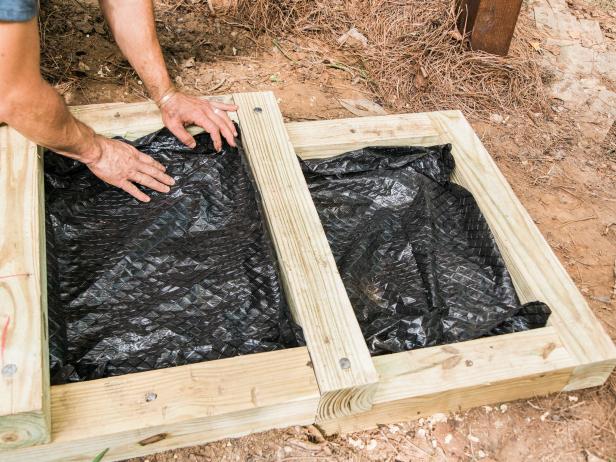
Lay Weed Block
Trim weed block material with scissors or a utility knife to fit within each frame, and lay inside.
STEP 9


Fill With Gravel
Add pea gravel on top of the weed block material, and level out by hand.
Tuesday, December 8, 2020
Wednesday, November 25, 2020
Who cares about providing a safe entrance to Marinwood Park? Not the CSD.
For this we pay our Marinwood CSD manager and Marinwood Parks manager a generous compensation to restrict access to our parks!?. So maddening.
A private citizen even OFFERED TO PAY FOR THE RAMP but this was refused. Listen how this matter is discussed at the 11/24/2020 Marinwood Parks and Recreation meeting after Anne brings up the topic. Jon Campo, a commissioner and professional with Marin County parks department agrees that it would be feasible and not costly but John Tune, Commissioner and Eric Dreikosen, General Manager disagree claiming that it would require a major project.
Jon Campo, was responsible for the creation of the new bike trail and is well versed in trail construction. He knows how simply it is to create a gentle slope entrance to the park. It is no more complicated than a retaining wall commonly found in many backyards. It is too bad he is leaving the Commission. We need common sense on the commission.
Bill Shea, Marinwood CSD board member sat silently as always neither offering an opinion nor a solution for dangerous access on Quietwood Drive West Entrance
Marinwood Park is a MAJOR walking path especially for people with mobility issues. It is preferred because it is flat and provides easy access along a beautiful natural area. During the pandemic park use has DOUBLED as people have been locked out of their gyms and other recreational activities.
Friday, November 13, 2020
Conspiracy to steal the presidential election?
Joe Oltmann (now banned on Twitter) exposes pro-Antifa, cop hatred-inciting rants of #EricCoomer, VP of strategy/security of Dominion Voting Systems. "What if I told you he is a major shareholder" in Dominion & "owns patents associated with other voting systems?"
Editor: This is the most amazing tale, that if correct, is a conspiracy of historic proportions. 2020 is proving to be an amazing year.