Thursday, January 3, 2019

How Should Facebook (and Twitter, and YouTube, and...) Decide What Speech To Allow?

How Should Facebook (and Twitter, and YouTube, and...) Decide What Speech To Allow?

Social media platforms have every right to do whatever the hell they want, but they shouldn't really do much speech policing at all.


YouTubeYouTubeEverywhere you turned in 2018, Facebook, Twitter, and other social media platforms were in the news for policing speech in ways that either delighted or infuriated users. YouTube refused to host certain sorts of videos altogether and "demonetized" others (meaning the channels couldn't run ads and earn revenue). Patreon, a service that allows people to pay creators directly, recently deplatformed Sargon of Akkad, a controversial anti-feminist, which sparked a public exodusby a number of "Intellectual Dark Web" folks, such as Jordan Peterson, Sam Harris, and Dave Rubin.
As a legal and practical matter, there seems to be no question that such services are free to disallow pretty much whatever content they choose. Earlier in the year, YouTube (owned by Google, which is in turn part of Alphabet) won a lawsuit brought by Prager U that charged the site was minimizing the reach of conservative points of view, if not outright censoring them. The crux of that case turned on whether YouTube should be treated as the equivalent of a government-licensed broadcast radio or television network and thus have to provide equal distribution to all participants. The ruling was unequivocal that YouTube (and, by extension, other social media services) are private businesses. From The Hollywood Reporter's writeup of the ruling:
Since the First Amendment free speech guarantee guards against abridgment by a government, the big question for U.S. District Court Judge Lucy Koh is whether YouTube has become the functional equivalent of a "public forum" run by a "state actor" requiring legal intervention over a constitutional violation.
Koh agrees with Google that it hasn't been sufficiently alleged that YouTube is a state actor as opposed to a private party.
"Plaintiff does not point to any persuasive authority to support the notion that Defendants, by creating a 'video-sharing website' and subsequently restricting access to certain videos that are uploaded on that website, have somehow engaged in one of the 'very few' functions that were traditionally 'exclusively reserved to the State,'" she writes. "Instead, Plaintiff emphasizes that Defendants hold YouTube out 'as a public forum dedicated to freedom of expression to all' and argues that 'a private property owner who operates its property as a public forum for speech is subject to judicial scrutiny under the First Amendment.'"


That settles the large legal issue: The platforms can decide what stays and goes. But most peeks into how they actually make those decisions are troubling. In August, The New York Times sat in with Twitter's "safety team" as it wrestled with banning Alex Jones and Infowars. (They eventually got bounced, albeit later than from Facebook, YouTube, and Spotify.) All agreed that "dehumanizing language" should not be tolerated, but the devil is in the details; accounts often get suspended or banned in ways that seem arbitrary or simply wrong. A few days ago, the Times reported on "Facebook's secret rule book for global political speech." The platform has about 7,500 moderators that make decisions, often about situations about which they are mostly ignorant and often using autotranslate services because they don't speak the languages being used.
The Times was provided with more than 1,400 pages from the rulebooks by an employee who said he feared that the company was exercising too much power, with too little oversight—and making too many mistakes.
An examination of the files revealed numerous gaps, biases and outright errors. As Facebook employees grope for the right answers, they have allowed extremist language to flourish in some countries while censoring mainstream speech in others....
The Facebook employees who meet to set the guidelines, mostly young engineers and lawyers, try to distill highly complex issues into simple yes-or-no rules. Then the company outsources much of the actual post-by-post moderation to companies that enlist largely unskilled workers, many hired out of call centers.
Those moderators, at times relying on Google Translate, have mere seconds to recall countless rules and apply them to the hundreds of posts that dash across their screens each day. When is a reference to "jihad," for example, forbidden? When is a "crying laughter" emoji a warning sign?
It's easy to sympathize with the in-house censors since the work they are tasked with is both unending and overwhelming. And there seem to be more and more calls to police speech, both from social justice warriors on the left and conservative trolls on the right (who are quick to say they'll report speech they find offensive even as they deride progressives as snowflakes who need to toughen up).
This is a disturbing development, and I think it should bother all libertarians. Yes, these services have the right to ban people or treat them unequally, and yes, in many cases, Facebook, Twitter, et al are responding to consumer demand by shutting down this or that person, page, or account. But I think basically any speech short of true threats should be tolerated. Even discerning what counts as a legitimate call for violence will create more than enough work for all the censors in the world. But the public sphere of debate, discussion, and disagreement works better in a setting that is more open rather than more closed. That holds true for the internet as a whole, but also on specific social-media platforms.
There's a doctrinaire market-friendly case to be made that if the platforms become too constrained and stultified, disgruntled users will create compelling alternatives. (The late, not-great, right-wing site Gab is one attempt limping alongafter being refused service by web-hosting company GoDaddy and online payment service PayPal.) I buy that argument to a large degree, but we're losing a larger culture of free speech, pluralism, and tolerance with every purge of accounts on every platform. This month it's Sargon of Akkad or Alex Jones, but in 2019, who knows who it will be? The initial beauty of most of these services was precisely that they allow users to tailor their experience so you don't need to bump up against the Alex Joneses of the world unless you want to. Individuals can mute, block, and ignore people that bother them. We now seem to be at a place culturally where people think that just isn't enough anymore. A decade-plus ago, one of the big fears about user-controlled newsfeeds was precisely that individuals would create what MIT's Nicholas Negroponte called "The Daily Me," a completely personalized newspaper full of content that you actually wanted. Critics such as Cass Sunstein fretted that such a turn of events would undermine the "neglected requirements of a system of free expression: unanticipated, unchosen encounters and a range of shared experiences."
It was only a few years ago that such services were rightly celebrated for the roles they played in facilitating and enablingthe Arab Spring: "We use Facebook to schedule the protests" an activist was quoted by Mic, "and [we use] Twitter to coordinate, and YouTube to tell the world." That seems like a different planet, doesn't it? As we slide into 2019, Sunstein's fears are more likely to be true at the platform level rather than the individual one.
Related: Prior to celebrating Reason's 50th anniversary in November, we hosted a debate that asked, "Should Facebook and Twitter Censor Themselves?" The participants were Renegade University founder Thaddeus Russell and lawyer and blogger Ken White of Popehat. Take a look or a listen:


    Nick Gillespie is the editor at large of Reason and the co-author, with Matt Welch, of The Declaration of Independents: How Libertarian Politics Can Fix What's Wrong With America (2011/2012).

    Wednesday, January 2, 2019

    Marin’s state senator drafting ‘strategic’ housing bill

    Sacramento Senators will be pushing new housing bills for the Housing Industry in 2019

    Marin’s state senator drafting ‘strategic’ housing bill


    State Sen. Mike McGuire, whose district includes Marin, and Sen. Jim Beall, D-San Jose, plan to introduce a bill this month to address California’s critical shortage of workforce affordable housing while also differentiating between the needs of rural, suburban and urban communities.

    “Senate Bill 4 will take a strategic approach to infill, workforce affordable housing throughout California without taking a one-size-fits-all approach,” McGuire said in an interview with the Independent Journal.

    “In the past,” he added, “I have had serious concerns with housing bills that are taking a one-size-fits-all approach for urban, suburban and rural communities.”

    One of the bills McGuire, D-Healdsburg, probably had in mind was SB 827, which was introduced by state Sen. Scott Wiener, D-San Francisco, a year ago. That bill would have exempted all new housing built within half a mile of a train stop or within a quarter of a mile of a frequent bus stop from most local zoning rules. It would have permitted apartment buildings up to five stories tall and freed exempted housing projects from parking requirements.

    “We also know we’re beyond the point where we can deny there is a workforce affordable housing crisis,” McGuire said. “It is boiling over and the strategy of ‘no’ no longer works, which means we need to advance a strategic approach.”

    McGuire expects a number of competing housing bills to be introduced in the next legislative session, many of which won’t differentiate between communities of different population size. Wiener has already introduced SB 50, a scaled-back version of SB 827.

    “If a workforce affordable housing bill is passed by the Legislature, it will most likely be signed by Gov.-elect Gavin Newsom,” McGuire said, “which means the North Bay must be at the table negotiating on workforce affordable housing that works for everyone.”

    To some degree SB 4 is still a work in progress, since the final language of the bill is yet to be crafted, but McGuire was able to provide the legislation’s basic framework.

    Like SB 827, SB 4 would facilitate denser development near mass transit; but there most of the similarities end.


    “On land that is already zoned for housing, SB 4 will allow for strategic infill focused on workforce affordable housing,” McGuire said.

    SB 4 will allow taller developments with reduced parking requirements; but only certain properties will be eligible for these incentives.

    To qualify, the property will have to be located in a city with more than 50,000 residents within a half mile of a fixed passenger rail line or ferry terminal, and the city must have produced fewer housing units than jobs and failed to have met all of its Regional Housing Needs Allocation goals.

    State law requires all Bay Area counties and municipalities to periodically update the housing elements of their general plans to demonstrate that there are sufficient sites available for the jurisdiction to provide its fair share of regional housing needs. The housing elements must identify sites with appropriate zoning densities to meet the needs of all income levels. The current planning period for housing elements ends in 2023.

    Properties that meet all of these requirements would be entitled to build one story above what the current zoning allows.

    In addition, projects built within a quarter mile of a passenger rail line or ferry stop in cities with a population of more than 100,000 would not be required to provide any parking — or .5 spaces per unit if between a quarter and half mile from an eligible transit stop. Projects within a half mile of a passenger rail line or ferry stop in a city under 100,000 would also be required to provide .5 spaces per unit.

    In cities with a population of more than 50,000, ministerial permitting of residential buildings containing four separate units would be allowed as long as they meet other local requirements that applied to the parcel on Jan 1, 2018.

    SB 4 would not, however, pave the way for projects larger than 20 units per acre, the state’s default density number for counties classified as suburban. There would also be exemptions for historic districts, coastal zones, high fire hazard zones and floodplains.

    McGuire said the legislation will have language to prevent displacement of existing affordable workforce housing, and it will require that new housing meet 30 percent inclusionary requirements for affordability.

    In early December, McGuire and Beall introduced SB 5, which would allow municipalities, counties, joint powers agencies and certain other entities to use some of the property tax revenue they currently are required to send to the state to support education to build housing instead. That bill also has a 30 percent inclusionary requirement for projects funded through this means.

    Contacted Monday, Wiener said, “Some people called me when Mike introduced SB 4 and said, ‘Oh McGuire is trying to compete with your bill.’ I said no that is the wrong attitude. My perspective is it’s great that Mike is also interested in this area. The more the merrier.”

    Wiener said he didn’t know enough about SB 4 to comment on its specifics.

    See the Full Article HERE

    Tuesday, January 1, 2019

    Bay Area property brokers find angle amid exodus


    Bay Area property brokers find angle amid exodus

    Brisk business in moving people out of the Bay Area


    Myron Von Raesfeld, a Santa Clara real estate agent, has sold 30 homes in North Carolina in the last six months. (Randy Vazquez/Bay Area News Group)


    By LOUIS HANSEN | lhansen@bayareanewsgroup.com | Bay Area News Group


    PUBLISHED: January 1, 2019 at 6:49 pm | UPDATED: January 1, 2019 at 7:00 pm


    SANTA CLARA – Real estate agent Myron Von Raesfeld sold 30 homes in North Carolina in the last six months, making him one of the top agents in the Raleigh-Durham market — from his desk 2,778 miles away in Santa Clara.


    Von Raesfeld, CEO of Windermere Silicon Valley, is advising homeowners and investors to sell high in California and move their assets outside the state. The payoff: more cash in hand, and a better quality of life.


    “It’s a great time to sell in California,” he said. “This makes a lot of sense.”


    Even as the Bay Area real estate market cools, agents specializing in moving people out of the region report very brisk business. They’re becoming experts on everything from economic forecasts for Memphis, Tennessee to annual snowfall in Boise, Idaho.


    The outward migration from the Bay Area has accelerated, with more people leaving the region than any other spot in the country.


    Driven by a strong economy, the region’s overall population continues to grow. But the number of residents leaving hit its highest point in more than a decade last year, according to a report by Joint Venture Silicon Valley. Residents between the ages of 18 and 24, and between 45 and 64 were most likely to leave.


    Bay Area agents say sellers found a market peak in the first six months of the year to maximize sale prices. The median home sale price for the nine-county region set a record in May at $935,000, according to real estate data firm CoreLogic.


    A move to cheaper regions appeals to older residents on fixed incomes, as well as bargain-seeking investors, agents say. Realtors have even set up classes to help clients figure out their next move and ease the transition.


    Los Gatos agent Brian Schwatka has been advising clients with a workshop called Stay or Go Homeowner for about 15 years. He set a personal record for relocation sales this year.


    Schwatka focuses on older homeowners, typically those nearing or in retirement. Many clients come with similar complaints, he said. “They say there’s too much traffic, too many tents on the side of the road,” he said. And it’s too expensive for those relying on social security and retirement savings, he said.


    Many long-term residents are perplexed by the complex process of buying and selling a home, managing taxes and embracing a new life. But finances often demand a move, he said. “They’re house rich and cash poor,” Schwatka said.


    One woman had been stuck in a two bedroom, one bath house in San Jose for 20 years. She was in her early 70s, Schwatka said, and struggled to pay her monthly bills as Silicon Valley prices rose.


    She sold her house for more than $1 million and bought a newer home outside Sacramento for $420,000, he said. “She was completely broke for 20 years,” Schwatka said. “Now, she’s set for life.”


    Pleasanton agent Tina Hand had a similar story: She had clients who sold several properties in the East Bay and bought even more single family homes and apartments in Memphis. “They’re setting themselves up for a nice, early retirement,” she said.


    Other agents say they’ve seen an uptick in baby boomers seeking to leave the rat race of Silicon Valley. Younger professionals move more often than their parents, particularly in the fluid tech and science industries.


    Michi Olson, vice president of global business development and relocation at Alain Pinel, said a few major companies have chosen to move headquarters from the Bay Area to Texas and Colorado. The big moves reflect the high price of doing business here, but Olson does not think it signals a massive exodus.


    Von Raesfeld, a fourth generation Santa Clara County resident and son of former Santa Clara city manager Don Von Raesfeld, visited friends in North Carolina a few years ago and saw something he recognized — Silicon Valley in the 1970s.


    The nice weather, relaxed pace, growing economy and energy provided by university students and faculty at nearby Duke, North Carolina and North Carolina State reminded him of his childhood in Santa Clara. Neighbors wave and get to know each other. And the real estate is relatively cheap — the median home value is about $270,000, according to Zillow.


    Since June, Von Raesfeld has sold 30 properties around Raleigh, N.C. to family and investors. He’s purchased several properties, too.


    The rental income from his North Carolina apartments has more than doubled the returns he received from his Santa Clara County apartments, he said. For example, Von Raesfeld sold a Bay Area duplex for $1.5 million, and reinvested the money into three apartment buildings in North Carolina. The $5,800 monthly income in California grew to $14,000 from many more units in North Carolina.


    Von Raesfeld and his wife even decided to move to Raleigh, buying a 4,800-square-foot home on a golf course. They plan to spend most of their time there.


    “I love this area,” he said of Silicon Valley, but added that times have changed. He really likes how strangers in Raleigh strike up conversations at his neighborhood Cracker Barrel. “It’s about quality of life.”

    Monday, December 31, 2018

    Nextdoor Is Betting a Social Network Can Still Be a Platform for Politics


    Nextdoor Is Betting a Social Network Can Still Be a Platform for Politics


    Nextdoor bills itself as a “private social network” that limits membership by address. It has increasingly become a place where people discuss politics and other civic issues.CreditNextdoor


    ImageNextdoor bills itself as a “private social network” that limits membership by address. It has increasingly become a place where people discuss politics and other civic issues.CreditCreditNextdoor


    By Laura M. Holson
    July 13, 2018

    When Hala Hijazi wanted her friends to meet London Breed, then a candidate for mayor of San Francisco, she invited the whole neighborhood.

    Ms. Hijazi, a community organizer and consultant, lives in the city’s Marina District and is a member of Nextdoor, the neighborhood social media site.

    She planned the meet-and-greet on the Marina’s bustling Chestnut Street and posted it on Nextdoor. One neighbor said he wouldn’t vote for Ms. Breed. She said another called the candidate “the worst.” Still others decided to vote for Ms. Breed after meeting her in person.

    “Nextdoor is organic and, sometimes, it is going to be raw,” Ms. Hijazi said.

    Ms. Breed won the mayoral election in June.


    “People feel like only wealthy donors get access to politicians,” Ms. Hijazi said, adding, “I am doing this as a service to my community.”

    Nextdoor, the neighborhood social media site, is partnering with local and state public agencies to bring voting information to more Americans. Here, the District of Columbia Board of Elections advises citizens on polling and where to vote.


    Nextdoor, the neighborhood social media site, is partnering with local and state public agencies to bring voting information to more Americans. Here, the District of Columbia Board of Elections advises citizens on polling and where to vote.CreditNextdoor


    Nextdoor has a reputation for being a home for cranky neighbors, people trying to find a reliable plumber, and frantic pet owners looking for their lost dogs.


    But, as the saying goes, all politics is local. And with political engagement at an all-time high, Nextdoor is gearing up for the 2018 political primaries and beyond, partnering with public agencies and local governments, and encouraging civil political discourse in an increasing partisan America.

    [Sign up here for First Draft, The Times’s politics newsletter | Here’s what’s coming up next on the primary calendar]

    Fights between supporters of President Trump (and their nonsupporting neighbors) have driven some Nextdoor users away. To address those concerns, the San Francisco-based company is creating separate forums for neighbors who want to discuss national politics. Some cities, too, are frustrated with the service, saying there is no mechanism for local politicians to have a dialogue with constituents on the site.

    Nextdoor bills itself as a “private social network” that limits membership by address, making it difficult for people not in a neighborhood network or, in some cases, an adjoining area, to participate. (A neighborhood can be as small as a few blocks.)

    The company was founded in 2010 and said it is active in 175,000 neighborhoods, or about 85 percent nationwide. It is particularly prominent in San Francisco and, according to the company, especially popular with homeowners.

    With so many users, Nextdoor sees a big market in voter registration and education. In March, it teamed up with Alex Padilla, California’s secretary of state, to provide voter information in five counties that adopted the California Voter’s Choice Act, which makes it easier for citizens to vote. The company, too, recently partnered with the District of Columbia Board of Elections, one of about 3,000 public agencies that distribute voter and community information via Nextdoor.

    “It gives us an opportunity to communicate with real people, not bots or trolls,” said Sam Liccardo, the mayor of San Jose, Calif., and an early advocate for the site. “That makes it a powerful tool.”

    Polls are popular on Nextdoor, a neighborhood social media site. Members of local forums are welcome to share comments with other residents who live nearby.


    Polls are popular on Nextdoor, a neighborhood social media site. Members of local forums are welcome to share comments with other residents who live nearby.CreditNextdoor


    Steve Wymer, Nextdoor’s vice president of policy, said the company has little interest in the political grandstanding that sometimes takes place on the site. “That is not what we think builds community,” he said.

    Instead, Nextdoor wants to help public agencies reach their constituents. Agencies that partner with the company set up a special page, and access to information — like where to vote or when to register for a primary — is targeted to the relevant area where a person lives.

    Still, users are interested in more than polling places. After President Trump won the 2016 election, Nextdoor saw an increase in disputes about national politics. Isaac Gonzalez, a volunteer forum moderator for the Tahoe Park neighborhood in Sacramento, Calif., said he had to mediate virtual fisticuffs between liberal-minded neighbors and the Trump supporters who lived next door.


    ADVERTISEMENT


    Nextdoor has strict guidelines about what can be discussed. Public service announcements, postings about events and “civil debate” are allowed. Telling neighbors how to vote or offensive comments are not.

    “After the election there were a lot of sobering posts about where the country was headed, and people felt emboldened to share their true beliefs,” Mr. Gonzalez said. “People learned their neighbors weren’t as progressive as they thought they would be.”

    He said he has been approached by neighbors who told him they quit using Nextdoor because there was too much political talk. “They had to stop looking at it,” Mr. Gonzalez said.

    To address this, the company has begun testing a new service in 12 markets, including the Bay Area and Dallas, to offer users a political forum separate from their neighborhood feeds.

    “The idea was to create a place where people could share information without offending others who don’t want to talk about politics,” Mr. Wymer said. “Our biggest concern is not to divide.”

    Nextdoor has an incentive to keep its discourse civil. In 2015, it came under fire when it was suggested that reports and comments left by users in Oakland, Calif., amounted to racial profiling. The company met with city officials, police officers, neighborhood groups and made changes to the social media site.

    At the same time, Nextdoor wants to be ready for the flush of interest in the primaries later this year.

    “We know a big election cycle is coming up,” Mr. Wymer said. That is why it is focused on helping public agencies educate and register voters.

    Rachel Coll, a spokeswoman for the District of Columbia Board of Elections, said her agency reached out to Nextdoor. “We definitely wanted to facilitate a line of information we didn’t have before,” she said.

    Still, there are impediments to the free flow of information users of social media have come to expect. Last year, Long Beach, Calif., disabled comments on its postings because city officials, who were not part of specific neighborhood forums, could not access them. Comments from residents, too, were overwhelming. They became frustrated when their concerns were not addressed.

    Kevin Lee, a spokesman for Long Beach, said it is impractical to open up posts on its city pages to comments. “A lot of cities are having difficulties,” he said. “We’ve been trying to work with Nextdoor. But how do you have a dialogue when you have such an overwhelming response?”

    Mr. Wymer said the company will continue to work with partners, while respecting the privacy of Nexdoor’s community. He also said the company has no plans to sell political ads and users do not widely share political articles. The targeting of political ads and the proliferation of false or misleading articles has tripped up Facebook.

    Mr. Gonzalez said he lets some political commentary slip by. Recently, though, he had to draw the line. One man kept asking his neighbors to meet him at a nearby Denny’s to discuss the United States Constitution.

    “Everyone was flagging it as inappropriate,” Mr. Gonzalez said. “He was very aggressive about it.”

    Mr. Gonzalez said he took the post down. And he politely asked the man to stop pestering his neighbors.

    Editor's Note:  Nextdoor Lucas Valley/Marinwood can be a toxic place.   I have been frequently attacked on that platform that I have no way to respond.  My posts were censored and like many others, I was eventually booted off despite being within the guidelines.  Unpopular opinions can be the target of relentless personal attacks. The neighborhood lead has the power to take down posts as it has recently over the Dixie School name change issue.   

    Why should such a nakedly biased and censorious platform be involved in voter registration.   This is a clever tool for political hacks to burrow down into districts house by house to create a sociographic profiles on each individual for political manipulation.

    Nextdoor is the dream tool for the Technocrats who are deeply suspicious of the "commoners" and their access to democracy.  

    Although I regret not being able to make local announcements about special events and giveaways,  I do not miss the nasty attacks and censorship. 

    16 Tons of Debt

    Sunday, December 30, 2018

    THE MONKEY AND THE CAT

    THE MONKEY AND THE CAT

    [54] ONCE upon a time a Cat and a Monkey lived as pets in the same house. They were great friends and were constantly in all sorts of mischief together. What they seemed to think of more than anything else was to get something to eat, and it did not matter much to them how they got it.

    One day they were sitting by the fire, watching some chestnuts roasting on the hearth. How to get them was the question.

    "I would gladly get them," said the cunning Monkey, "but you are much more skillful at such things than I am. Pull them out and I'll divide them between us."

    Pussy stretched out her paw very carefully, pushed aside some of the cinders, and drew back her paw very quickly. Then she tried it again, this time pulling a chestnut half out of the fire. A third time and she drew out the chest nut. This performance she went through several times, each time singeing her paw severely. As fast as she pulled the chestnuts out of the f ire, the Monkey ate them up.


    [Illustration]

    Now the master came in, and away scampered the rascals, Mistress Cat with a burnt paw and no chestnuts. From that time on, they say, she contented herself with mice and rats and had little to do with Sir Monkey.

    The flatterer seeks some benefit at your expense.

    On the Internet, Nobody Knows You're a Bot

    On the Internet, Nobody Knows You're a Bot

    Less than 60 percent of online traffic is actually generated by humans. But is that really a problem?

    Nick GillespieNick GillespieWriting at New York magazine's Intelligencer, Max Read drops some uncomfortable statistics about online traffic:
    How much of the internet is fake? Studies generally suggest that, year after year, less than 60 percent of web traffic is human; some years, according to some researchers, a healthy majority of it is bot. For a period of time in 2013, the Times reported this year, a full half of YouTube traffic was "bots masquerading as people," a portion so high that employees feared an inflection point after which YouTube's systems for detecting fraudulent traffic would begin to regard bot traffic as real and human traffic as fake. They called this hypothetical event "the Inversion."
    Read makes a compelling case that the fakery is particularly strong when it comes to audiences for stuff that's being sold. You can be relatively certain that when you tweet at or email your (IRL) friends, they actually exist (although to be honest, I find myself using Gmail's automated responses more and more and nobody seems to notice...) but many businesses that are trying to reach potential consumers are being royally scammed.
    These days, the Times found, you can buy 5,000 YouTube views—30 seconds of a video counts as a view—for as low as $15; oftentimes, customers are led to believe that the views they purchase come from real people. More likely, they come from bots. On some platforms, video views and app downloads can be forged in lucrative industrial counterfeiting operations. If you want a picture of what the Inversion looks like, find a video of a "click farm": hundreds of individual smartphones, arranged in rows on shelves or racks in professional-looking offices, each watching the same video or downloading the same app.
    Read runs through how businesses, content, politics, and even people are "fake" in one way or another (Facebook is currently being sued by advertisers who claim the tech giant inflated watch times of videos by as much as 900 percent).
    His article is a sobering and obvious revelation that much of what we browse, engage, and interact with is in some fundamental way, total bullshit running the gamut from automated accounts on Twitter to clickbait content that is never really "authored" or read by anyone, to the burgeoning world of "deep fakes" (including but not limited to slapping your favorite pol or movie star in a porn scene).
    I'm not sure the solution is to seek out some pre-Inversion authenticity—to red-pill ourselves back to "reality." What's gone from the internet, after all, isn't "truth," but trust: the sense that the people and things we encounter are what they represent themselves to be. Years of metrics-driven growth, lucrative manipulative systems, and unregulated platform marketplaces, have created an environment where it makes more sense to be fake online—to be disingenuous and cynical, to lie and cheat, to misrepresent and distort—than it does to be real. Fixing that would require cultural and political reform in Silicon Valley and around the world, but it's our only choice. Otherwise we'll all end up on the bot internet of fake people, fake clicks, fake sites, and fake computers, where the only real thing is the ads.
    This is a roundabout way of saying that we're living not in the disintermediated, utopian world chronicled in the early days of Louis Rossetto and Jane Metcalfe's Wired, but something closer to the endlessly creative, weird, off-kilter, semi-insane world imagined by Philip K. Dick and, later, Neal Stephenson. Which is to say, we're actually living in the world dreamed by Edgar Allan Poe in The Narrative of Arthur Gordon Pym, in which "it becomes harder and harder for [the eponymous protagonist] to trust his senses about the most basic facts, such as what side of a piece of paper has writing on it."
    As Max Read suggests, the result of this needn't be nihilism or a complete rejection of reality. But he's wrong to think that there will ever be the sort of "cultural and political reform in Silicon Valley and around the world" that will banish fakeness from the web and allow us to get on with our lives in less-complicated, straightforward ways. That's partly because much of what is "fake" online—beyond the obvious automated scams and traffic and apparent lying by companies such as Facebook—is a reflection of the epistemological plenitude that is enabled and empowered by the good and glorious internet. The exact same thing happened when the printing press was invented, especially when various forms of licensing laws went out the window and any nutbar could publish and disseminate his or her version of the truth as they saw it. Finally we could worship god (or not) as we saw fit and start to live however the fuck we wanted to! When the crown and the church were replaced not by no rules but a proliferation of new, opt-in, voluntary rules about how best to live, the modern world started.
    It turns out that we truly do see the world in very different ways and we can express those differences and build world views and communities and coalitions and movements based on that. Our realities do, in fact, differ in serious and significant ways that will never and should not be subjected to any sort of final adjudication or ruling. Who is going to convince Alice Walker, say, that lizard-theorist David Ickes is batshit crazy? Who needs to, ultimately, as long as nobody is forced to go along for the ride?
    Certainly we know that most attempts, especially if they are done with the force of law, to designate fake news from real news, hate speech from worthy speech, etc., will be poorly applied, repressive, and ultimately arbitrary. Laws against fraud are good things and will always remain in force, even if fraud is not always obvious and sometimes a matter of opinion. If you're selling shit as 100 percent Shinola, your dupes have a right to their money back! If you're selling shit as a supplement that will fix what ails you, I'm not so sure that caveat emptor isn't the right approach.
    As heirs to Enlightenment, libertarians especially should prize and honor the use of rational discourse and analysis in the public sphere. But we should also recognize the limits of knowledge and all the ways that top-down controls run toward hubris. We should cheer all the overlapping ways that people are creating different opt-in ways of authenticating the truth and reality of what we read, buy, and believe. Let a thousand Good Housekeeping Seals of Approval bloom and let them cover everything from financial transactions to software being virus-free to this author actually existing as a living, breathing human being!
    But in the end, the only solution to the great explosion of everything that the internet enables is for each of us to do constant hardware, firmware, and software upgrades on our bullshit detectors. The truth is out there, but so is truthiness, and total horseshit, too. It's up to each of us to bring our A game if we're ever going to find the pony buried underneath.
      Nick Gillespie is the editor at large of Reason and the co-author, with Matt Welch, of The Declaration of Independents: How Libertarian Politics Can Fix What's Wrong With America (2011/2012).

      America is moving toward an oligarchical socialism


      America is moving toward an oligarchical socialism


      In this April 12, 2016, file photo, Facebook CEO Mark Zuckerberg speaks during the keynote address at the F8 Facebook Developer Conference in San Francisco. On Thursday, Sept. 21, 2017, Zuckerberg said that Facebook will provide the contents of 3,000 ads bought by a Russian agency to congressional investigators. The move comes as the company has faced growing pressure from members of Congress to release the content of the ads. Facebook had already released the ads to federal authorities investigating Russian interference in the 2016 U.S. presidential election. (AP Photo/Eric Risberg, File)

      By JOEL KOTKIN | Orange County Register
      PUBLISHED: September 1, 2018 at 6:15 pm | UPDATED: September 1, 2018 at 6:16 pm


      Where do we go after Trump? This question becomes more pertinent as the soap opera administration seeks its own dramatic demise. Yet before they can seize power from the president and his now subservient party, the Democrats need to agree on what will replace Trumpism.

      Conventional wisdom implies an endless battle between pragmatic, corporate Clintonites on one side, and Democratic socialists of the Bernie brand. Yet this conflict could resolve itself in a new, innovative approach that could be best described as oligarchal socialism.

      Oligarchal socialism allows for the current, ever-growing concentration of wealth and power in a few hands — notably tech and financial moguls — while seeking ways to ameliorate the reality of growing poverty, slowing social mobility and indebtedness. This will be achieved not by breaking up or targeting the oligarchs, which they would fight to the bitter end, but through the massive increase in state taxpayer support.


      Conflicting visions

      Historically, liberals advocated helping the middle class achieve greater independence, notably by owning houses and starting companies. But the tech oligarchy — the people who run the five most capitalized firms on Wall Street — have a far less egalitarian vision. Greg Fehrenstein, who interviewed 147 digital company founders, says most believe that “an increasingly greater share of economic wealth will be generated by a smaller slice of very talented or original people. Everyone else will increasingly subsist on some combination of part-time entrepreneurial ’gig work‘ and government aid.”

      Numerous oligarchs — Mark Zuckerberg, Pierre Omidyar, founder of eBay, Elon Musk and Sam Altman, founder of the Y Combinator — have embraced this vision including a “guaranteed wage,” usually $500 or a $1,000 monthly. Our new economic overlords are not typical anti-tax billionaires in the traditional mode; they see government spending as a means of keeping the populist pitchforks away. This may be the only politically sustainable way to expand “the gig economy,” which grew to 7 million workers this year, 26 percent above the year before.

      Handouts, including housing subsidies, could guarantee for the next generation a future not of owned houses, but rented small, modest apartments. Unable to grow into property-owning adults, they will subsist while playing with their phones, video games and virtual reality in what Google calls “immersive computing.”

      The socialist challenge

      Particularly since Donald Trump’s election, the leaders of corporate America — especially in tech and finance — have merged with the Democrats. They appeal to progressives by advocating politically correct views on immigration, gender rights and climate change, while muzzling conservatives both inside and outside their companies.


      But now the socialists have raised the ante for progressive credibility. Going beyond green and identity issues, they are raising issues that impact most families. Arguably their strongest case can be seen in health care, now the top issue with voters, according to Gallup. In some states, notably California, socialists are also backing a drive for rent control to help families cope with high rents and low wages.

      A focus on such basic issues could reorder not just the Democratic Party but the country itself. Faced with limited future prospects, more millennials already prefer socialism to capitalism and generally renounce constitutionally sanctioned free speech — not something you like to see in what will soon be the largest voting bloc in the country.

      A New Deal for oligarchs

      Theoretically, the Democrats moving to the left should terrify the oligarchs. Yet increased income guarantees, nationalized health care, housing subsidies, rent control and free education could also help firms maintain a gig-oriented economy since these employers do not provide the basic benefits often offered by more traditional “evil” corporations in energy, manufacturing and basic business services.


      RELATED ARTICLES
      Ron Hart looks back at 2018
      And peace online
      A ban on airbrushing?
      Resist calls for regulating social media giants
      Voters should get to decide 2020 criminal justice ballot measure Such subsidies would help millions of gig workers, as well as the vastly underpaid production workers at Amazon’s warehouses, erratically paid workers at the Tesla car factory or the contract labor who clean the tech firms’ buildings and provide security. As historian Jeff Winters has pointed out, the oligarchy, representing basically the top .01 percent of the population, are primarily interested not in lower taxes but in protecting their market shares and capital; they have been at least as brilliant in avoiding taxes as developing innovative products. He points out the very rich have maintained their share of assets even in welfare states such as Sweden and Finland.


      The losers here will be our once-protean middle class. Unlike the owners of corporations in the past, oligarchs have no interest in their workers become homeowners or moving up the class ladder. Their agenda instead is forever-denser, super-expensive rental housing for their primarily young, and often short-term, employees.

      There’s surely a compelling logic for oligarchic socialism. The tech moguls get to remain wealthy beyond the most extreme dreams of avarice, while their allies in progressive circles and the media, which they increasingly own, continue to hector everyone else about giving up their own aspirations. All the middle and upwardly mobile working class gets is the right to pay ever more taxes, while they watch many of their children devolve into serfs, dependent on alms and subsidies for their survival.

      Joel Kotkin is the R.C. Hobbs Presidential Fellow in Urban Futures at Chapman University in Orange and executive director of the Houston-based Center for Opportunity Urbanism (www.opportunityurbanism.org).

      Friday, December 28, 2018

      California’s late votes broke big for Democrats. Here’s why GOP was surprised

      California’s late votes broke big for Democrats. Here’s why GOP was surprised

      John Wildermuth and Tal Kopan Nov. 30, 2018 Updated: Nov. 30, 2018 8:55 a.m.

      Paul Ryan called California’s election system “really bizarre.” Late “harvested” votes led to GOP losses around the state.Photo: Cliff Owen / Associated Press
      California Democrats took advantage of seemingly minor changes in a 2016 law to score their stunningly successful midterm election results, providing a target for GOP unhappiness that is tinged with a bit of admiration.

      Some Republicans have cast a skeptical eye on Democrats’ use of “ballot harvesting” to boost their support. The idea’s backers say it’s just one of several steps California has taken to enable more people to vote.

      Few people noticed when Gov. Jerry Brown signed the changes in AB1921 into law two years ago. In the past, California allowed only relatives or people living in the same household to drop off mail ballots for another voter. The new law allowed anyone, even a paid political campaign worker, to collect and return ballots — “harvesting” them, in political slang.


      The change was strictly a public service, said Assemblywoman Lorena Gonzalez, D-San Diego, author of the bill. The old rules, she said, “simply provide yet another obstacle for individuals attempting to vote.”

      Republicans didn’t agree, and the measure passed the Legislature on a largely party-line vote.

      They felt the hit on Nov. 6 — and in the days after, as late-arriving Democratic votes were tabulated and one Republican candidate after another saw leads shrink and then evaporate. This week, a seventh GOP-held congressional seat flipped to the Democrats, leaving Republicans controlling a mere seven of California’s 53 House districts.

      In Orange County alone, where every House seat went Democratic, “the number of Election Day vote-by-mail dropoffs was unprecedented — over 250,000,” Fred Whitaker, chairman of the county Republican Party, said in a note to supporters. “This is a direct result of ballot harvesting allowed under California law for the first time. That directly caused the switch from being ahead on election night to losing two weeks later.”


      Some national Republicans expressed befuddlement with what was happening to their party in California. In an interview with the Washington Post, House Speaker Paul Ryan of Wisconsin called California’s election system “really bizarre” and said he couldn’t even begin to understand what ballot harvesting is.

      “We were only down 26 seats (nationally) the night of the election and three weeks later, we lost basically every California race,” he said. “Point being, when you have candidates that win the absentee ballot vote, win the day of the vote, and then lose three weeks later because of provisionals, that’s really bizarre.”

      However, this was no spur-of-the-moment effort by the Democrats, said Shawn Steel, the California GOP’s delegate to the Republican National Committee.

      “This was not done at the last minute,” he said. “It started the day after Jerry signed” the bill.


      Rep. Jeff Denham of Turlock (Stanislaus County), one of the House Republicans who saw victory slowly turn to defeat after election day, agreed with Ryan Thursday that California’s count should go more quickly. “Counting ballots two weeks after the vote is something that Californians shouldn’t have to put up with,” he said.

      But in an earlier interview after it was clear he’d lost, Denham said the GOP had been slow to adapt to changes in California’s election system.

      “One of the lessons that the GOP needs to learn out of this election cycle is how to work within all of the new rules, same-day voter registration, motor voters,” Denham said. “There have been a lot of changes in laws that I think have caught many in the Republican Party by surprise. You can’t just run a traditional campaign as you did before.”

      He added, “If one party’s harvesting ballots, both parties need to do it.”


      Across the state there were reports of groups collecting ballots and dropping them off at polling places and election offices.

      “We certainly had that going on here, with people dropping off maybe 100 or 200 ballots,” said Neal Kelley, Orange County’s registrar of voters. “We also had voters calling and asking if it was legitimate for someone to come to their door and ask if they could take their ballot” and deliver it to the polls.

      For Democrats, the ballot harvesting was all part of a greater effort to get out the vote from their supporters, particularly from occasional voters.

      “We beat Republicans on the ground, fair and square,” said Katie Merrill, a Democratic consultant deeply involved in November campaigns. “Many of the field plans included (ballot harvesting) as an option to deliver voters or their ballots” to the polls.


      Those efforts involved identifying voters who might support Democratic candidates and ignoring those who wouldn’t.

      In one Orange County household, for example, both the husband and wife were longtime Republicans, said Dale Neugebauer, a veteran Republican consultant. Democratic volunteers came by the house four times, each time asking to speak only with their 18-year-old daughter, a no-party-preference voter, and asking if she wanted them to pick up her signed and completed ballot.

      That’s a perfect example of the “thorough and disciplined” ground game the Democrats used, said Merrill.

      “We were not wasting time talking to people who weren’t going to vote for Democrats,” she said.


      Many of those harvested ballots arrived in the waning days of the election, adding to the flood of votes that couldn’t be counted on election day. And those late ballots broke heavily for the Democrats.

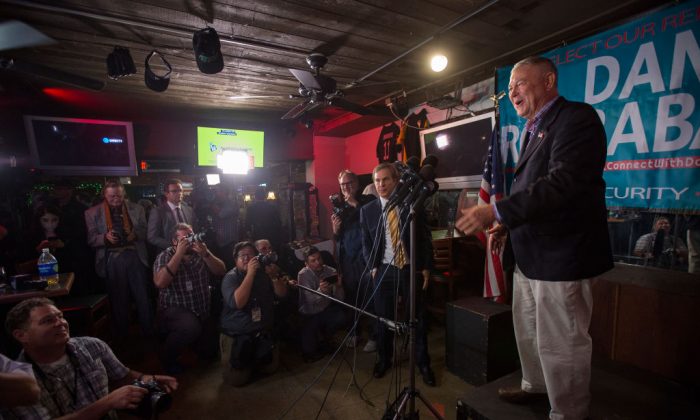
      “Absolutely, ballot harvesting played a very significant role,” said Neugebauer, who worked most recently for Orange County Rep. Dana Rohrabacher, another Republican who lost his seat. Democrats had “a huge advantage by executing a plan to gather ballots from voters.”

      “I have a little bit of professional admiration for how well the Democrats executed their plan,” Neugebauer admitted.

      While the late vote tally typically favors Democrats, the partisan advantage this year was staggering.


      Editor's Note:   Maybe this is the explanation of the weird results with late returns in Marin County elections.  If so, "voter harvesting" is a cheap trick that undermines the democratic process.

      ‘Ballot Harvesting’ Helped Flip Seven US House Races in California After Election Day

      ‘Ballot Harvesting’ Helped Flip Seven US House Races in California After Election Day

      December 4, 2018 Updated: December 4, 2018
      Recent changes to state election law have transformed California’s election system into one that’s no longer decided on Election Day, but in the weeks after.
      The changes, specifically to mail-in ballots, led to Democrats flipping seven U.S. House seats after Nov. 6, and Republicans crying foul over the newly legalized practice of “ballot harvesting.”
      Speaking to the Washington Post on Nov. 29, outgoing House Speaker Paul Ryan (R-Wisc.) said the string of lost elections “defies logic.”
      “We had a lot of wins that night, and three weeks later, we lost basically every contested California race. This election system they have, I can’t begin to understand what ballot harvesting is,” Ryan said.
      In 2016, the California Legislature passed AB-1921, a measure that altered the state’s vote-by-mail procedures to allow any third party to collect and turn in another person’s completed ballot. Previously, only close relatives or someone living in the same household could collect and return someone else’s ballot.
      The seemingly slight adjustment allowed for activists and political parties to deliver ballots to targeted would-be voters, solicit a completed ballot, and return it to a voting site without a secure chain of custody. While the upside is increased voter participation, the risk of fraud and coercion is more than a partisan concern.
      At least 16 states expressly regulate ballot harvesting, or ballot collection, according to the National Conference of State Legislatures. Some states limit who can turn in another person’s ballot, while others ban the practice entirely.
      In 2016, Arizona passed a law making the collection of early voting ballots by political operatives a felony after it led to voter fraud. In 2012, a presidential election year, a political advocacy group—not directly affiliated with a campaign—was collecting ballots while its members were posing as election workers.
      The Ninth Circuit Court of Appeals overturned the Arizona ban, but it was later upheld by the U.S. Supreme Court.
      In the single-party run state of California, unlimited ballot harvesting, combined with other post-Election Day ballot-counting provisions, revolutionized the state’s midterm elections with the results skewing exclusively for Democrats.
      Those additional provisions included allowing mail-in ballots to be counted up to three days after Nov. 6, loose guidelines for accepting provisional ballots, and extended deadlines for absentee voters to be notified of mismatching signatures on ballots and voter-registration records so they could be fixed. Mismatching signatures also can be a telltale sign of fraud.
      According to election returns, more than 40 percent of the state’s 12.5 million total votes were counted after Nov. 6—a striking development, considering mail-in ballots were once intended to assist those who couldn’t physically vote in a polling booth due to disability, infirmity, or residing out of state, such as overseas military personnel.
      Ron Nehring, former chairman of the California Republican Party, characterized the development as an abuse.
      “Mail voting has completely warped California elections. We don’t have Election Day. We have two election months: the month ballots are out in the field, and the month after, while they’re all sorted out. No courage to fix this,” Nehring tweeted Nov. 26.
      In one case, two-term incumbent California GOP congressman David Valadao was firmly ahead of his Democratic opponent, T.J. Cox, by 6,000 votes, or 8 percent, after polls closed Nov. 6. The Associated Press declared Valadao the winner of the rural District 21 race, but later retracted the announcement. After Election Day, ballots continued pouring in for Cox until he finally defeated Valadao by 843 votes–three weeks later.
      On Nov. 29, Ryan said, “when you have candidates that win the absentee-ballot vote, win the day of the vote and then lose three weeks later because of provisionals, that’s really bizarre. And so I just think that’s a very, very strange outcome.”
      Alex Padilla, California’s secretary of state, responded on Twitter, “in California, we make sure every ballot is properly counted and accounted for. That’s not ‘bizarre,’ that’s DEMOCRACY.”
      Ground zero for California was Orange County, where Republicans lost every incumbent seat in the longtime Southern California conservative stronghold.
      After polls closed Nov. 6, Orange County Republican Mimi Walters was ahead of Democrat Katie Porter by 6,200 votes. But Porter ended up winning the race after a tidal wave of post-Election Day ballot-counting. The same fate befell GOP Rep. Jeff Denham in District 10. Other Republican House losses included Steve Knight, Dana Rohrabacher, and Diane Harkey.
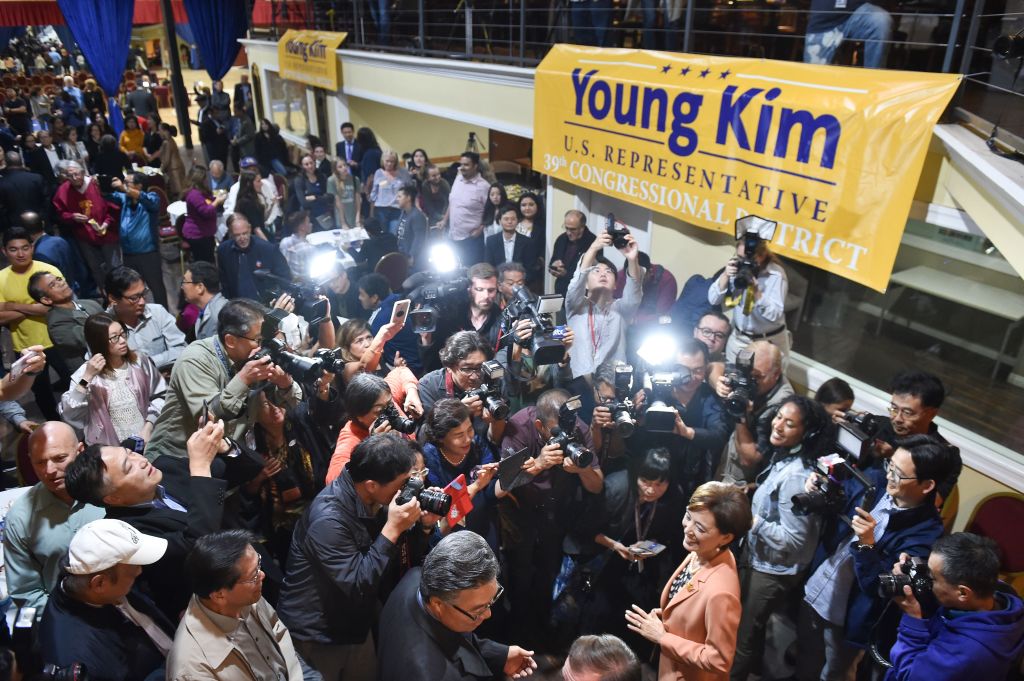
      One of the more curious results occurred in District 39, where Orange County hopeful Young Kim, who would have been the first Korean-American woman elected to Congress, saw her sizable Election Day lead morph into a 3.2 percent loss after Nov. 6.
      Young Kim (R) is surrounded by supporters
      Republican Congressional candidate in California’s 39th District Young Kim (R) is surrounded by supporters and media as she arrives at an election night event in Rowland Heights, Calif., on Nov. 6, 2018. (Robyn Beck/AFP/Getty Images)
      Shawn Steel, California’s committeeman for the Republican National Committee, reacted to Kim’s stunning loss in a Nov. 27 editorial.
      “How does a 14-point Republican lead disappear?” Steel asked. “Merciless and unsparing, California Democrats have systematically undermined California’s already-weak voter protection laws to guarantee permanent one-party rule.”
      But ballot harvesting isn’t just a suspicious tactic for California’s Democratic political machine to use against Republicans. According to the investigative news website Washington Babylon, California Democrats have been harvesting ballots against each other in primary elections.
      In a Dec. 28, 2017, interview, long before the November midterms, Democratic state assembly candidate Ron Birnbaum said he was the victim of ballot harvesting conducted by his Democratic primary opponent, Wendy Carrillo.
      “Third parties, such as campaigns or paid field operations, can now bother or cajole or potentially intimidate voters into giving them their ballots. The most susceptible to this intimidation are those least likely to know how to report it or protect themselves from it. There is very little to stop tampering with ballots, vote-buying or even discarding of ballots,” Birnbaum said.
      “Ultimately, this is a non-partisan issue in that it helps candidates with more resources have an easier time winning elections, regardless of affiliation. That said, the [vote-harvesting] bill was passed on virtually a party-line vote in the legislature,” he added.