
Monday, May 4, 2015

Grady Ranch Is All Wrong (A Smart Growth Advocate's take on Grady Ranch)
Grady Ranch Is All Wrong
DECEMBER 6, 2012 10 COMMENTS

A great place for some infill development. Photo by Skywalker Properties.
George Lucas’s great foray into affordable housing is wrong for Marin, wrong for affordable housing, and wrong for the people that would live there. The Grady Ranch development plan needs to be scrapped.
After the collapse of LucasFilm’s Grady Ranch studio proposal, then-owner George Lucas promised to build affordable housing on the site instead. Many observers, including me, saw it as payback to the Lucas Valley anti-development crowd that killed the studio project, but few thought George was serious.
Yet Lucas and his partners at the Marin Community Foundation are charging ahead with 200-300 units of affordable housing anyway. While it does present an opportunity to build affordable homes, the site couldn’t be worse.
Grady Ranch is located out on Lucas Valley Road, far from any downtown, commercial center, or regular transit line. It’s right at the edge of the North San Rafael sprawl line – a car-oriented area even where it’s already built up.
Lucas Valley Road itself is essentially a limited-access rural highway, with cars speeding along at 50 miles per hour. There’s no development on the south side, and the north side only has entrances to the neighborhoods. No buildings actually front the road. Yet, it’s the only access to the Highway 101 transit trunk line, to nearly any commercial or shopping areas, or between neighborhoods.
Development here would be bad by any measure. Car-centric sprawl fills our roads with more traffic, generates more demand for parking, and forces residents to play Russian roulette every time they want to get milk. It takes retail activity away from our town centers, weakening the unique Marin character embodied in downtowns.
The infrastructure, too, is inefficient. Grady Ranch would need to be covered by police service, fire service, sewage, water, electricity, and some modicum of transit, but those costs are based on geography, not population. Serving a square mile with 300 homes is a lot more expensive per home than a square mile with 1,000.
Yet the fact that this will be affordable housing makes the project even more egregious. Driving is expensive, with depreciation, gas, maintenance, insurance, and parking costs all eating up scads of money. On a population level, you can add in the cost of pollution, as well as injuries and deaths in crashes. A home in Grady Ranch would be affordable, but the cost of actually living there would be quite high.
The nonprofit aspect of the project would mean no taxes could be raised to cover its infrastructure and services. Building affordable housing in a mixed area means they’re covered by preexisting services. Though usage is more intense, there is typically enough spare capacity to take on more residents. Building something beyond current development means new infrastructure and services need to be built specifically for that project but without any existing residents to pay for it. It would be a massive and ongoing drain on county coffers.
This is the worst possible place for affordable housing. Grady Ranch, if it’s not going to be a film studio, needs to remain as open space. An affordable housing project out at the exurban edge of Marin cannot be affordable because car-centric development is fundamentally unaffordable.
I respect the efforts of George Lucas and Marin Community Foundation to find a place for the low-income to live, but Grady Ranch is not it. Lucas and MCF need to look at urban infill sites and focus on building up in those areas that are transit-accessible and walkable, places that are actually affordable. Replicating the discredited drive-‘til-you-qualify dynamic in Marin is not the answer; it’s just recreating the problem.
[Editors Note: The Greater Marin is a blog published by David Edmunson from Washington D.C. who spent his formative years in Marin and considers it his family home. While I seldom agree with his point of view about the desirability of urbanizing Marin, I find his analysis and honesty compelling. Essentially we are in agreement with many things such as the desirability of walkable, bikable, communities. We simply disagree at the degree and manner which this Smart Growth utopia shall emerge. He favors efficiency of central planning. I favor market forces that allow individual choice and freedom. I read his blog regularly because it is full of fresh ideas and good writing.]
Sunday, May 3, 2015
The Truth for Journalists and Citizens of the FREE society
“The simple step of a courageous individual
is not to take part in the lie.
One word of truth outweighs the world.”
— Alexander Solzhenitsyn

Saturday, May 2, 2015
Study finds S.F.’s ethnic diversity dwindling
Study finds S.F.’s ethnic diversity dwindling
By C.W. Nevius
April 24, 2015
Ethnic diversity is in San Francisco’s DNA. Isn’t it?
 |
| Diversity and choice are delicious. But when choices are forced, the outcomes only serve the few. |
Walk down virtually any street in the city and you’ll not only see a wide range of people of color, but chances are good that you’ll hear any number of non-English languages. This is a city that is proud of its diversity and has done what it can to encourage it.
To take it further, the organization projects that by 2040, there will be more white residents in San Francisco than people of color. That’s a big change from today, when 42 percent of the city’s residents are white.But a recent study says that if trends continue, San Francisco is headed in the opposite direction. In fact, the report from PolicyLink, a research and advocacy organization in conjunction with a University of Southern California program, says the white population in San Francisco is on a steady increase.
That’s striking because the study also predicts that in the same time period, the four adjoining counties (Alameda, Contra Costa, San Mateo and Marin) will become more than 50 percent diverse — which reflects the census projection that the United States will be a majority people-of-color nation by 2044.
So is San Francisco headed for a time when it becomes an affluent, white enclave surrounded by an ethnically diverse population?
“I saw that in the report, and it was definitely eyebrow raising,” says Fred Blackwell, CEO of the San Francisco Foundation, a community advocacy organization. “We may be entering into a kind of community crisis.”
Bucking a trend
What’s really striking is to look at a demographic map from 1980. Back then, San Francisco was an island of diversity, surrounded by white-majority counties. The PolicyLink projection for 2040 reverses that: The four other counties will have a majority of citizens of color, while San Francisco will be an island where more than half the residents are white.
Sarah Treuhaft, a PolicyLink director, admits that projecting trends 25 years in the future can be tricky. But by becoming more white, San Francisco is definitely bucking the national trend
“You don’t see that in many places,” she said. “We looked at all the counties in the country, and in only 25 did the people of color decline.”
But Egon Terplan, regional planning director for the San Francisco Planning and Urban Research Association, says there’s no reason to panic.
“Lots of things can happen over time,” Terplan said. “There’s a lot we can do with policy.”
Treuhaft doesn’t disagree. What she does point out, however, is the trend among younger residents.
“You can see the future by looking at the demographics of the youth population,” she said. In 1990, whites 18 and under were 22 percent of the youth population. Today, they are 33 percent.
Meanwhile, Asians under 18 are a significant part of the youth population — over 30 percent. But instead of increasing, that number is gradually sliding down: It was 36 percent in 1990, and 32 percent in 2007.
You will not be surprised to hear that the major cause of the demographic changes is affordability. Not only are housing costs rising, but wages have plateaued.
Blackwell says his group has been tracking the trend.
“You have people who have grown up in a specific area in San Francisco and have a very strong connection with those communities,” he said. “They want to make them stronger, so they work in nonprofits or as a teacher. What they end up with are salaries that don’t allow them to live in a community they care so much about. It’s kind of heartbreaking.”
'Concerning’
Meanwhile, the African American population continues to decline. In 1970, San Francisco was 13 percent black. Now it is 8 percent, and PolicyLink predicts it will be just 5 percent by 2040.Unfortunately, we’re still waiting for that awesome plan that finds a way to fund housing for the lower-middle class, which in San Francisco can mean families earning $50,000-$75,000.
A less diverse city “is not necessarily a self-fulfilling prophecy,” Blackwell said. “But it is concerning.”
 |
| "San Francisco is so much better since Plan Bay Area. Thank you for all of the new Smart Growth housing " |
[Editor's Note: Plan Bay Area is displacing communities of all races and ethnicity through crony development policies. We think planning should be about the existing communities, not displacing communities for an imagined future. Every community is a home to someone. We should respect rights to live free without being forced from our community we love.]
Friday, May 1, 2015
How George Lucas’ bid for a Presidio museum misfired
How George Lucas’ bid for a Presidio museum misfired
By John KingApril 29, 2015 Updated: April 29, 2015 8:16pm

Photo: Erik Castro, Special To The Chronicle
Filmmaker George Lucas tried for three years to build a museum for his collection of digital and populist art before the plan combusted.
IMAGE 1 OF 5
Filmmaker George Lucas tried for three years to build a museum for his collection of digital and populist art before the plan combusted.
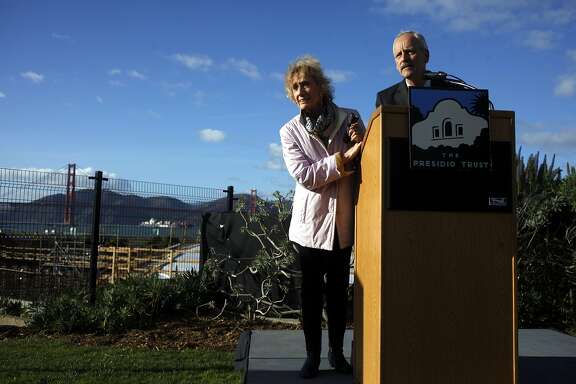
When the Presidio Trust announced last year that it was rejecting George Lucas’ bid to build a museum at Crissy Field, its leaders didn’t reveal that three days earlier they had been prepared to grant the “Star Wars” creator the land he sought.
Three members of the trust’s board of directors had met with Lucas at his office on Jan. 31, 2014, and the talking points prepared for them by Executive Director Craig Middleton included an offer to Lucas of “exclusive negotiations” for the 8 acres facing the bay if he agreed to change the look of his desired museum, a mock-classical temple that at one point had four ceremonial domes.
That revelation is among the previously undisclosed details of the strained relationship between the trust and the billionaire filmmaker found in several thousand pages of documents released to Lucas supporters this week in response to a Freedom of Information Act request signed by such luminaries as football legend Joe Montana, Twitter founder Biz Stone and Ron Conway, a venture capitalist with close ties to Mayor Ed Lee. The Presidio Trust also provided the documents to The Chronicle.
RELATED
 George Lucas proposal out of place in Presidio
 Major players in standoff over Crissy Field's future
 Presidio Trust shoots down George Lucas' plan, 2 others
 Chicago beats out S.F. for George Lucas' museum
Instead, Lucas rejected the offer. He complained about how he had been treated by the trust during his three-year quest to build a home for his collection of digital and populist art. On Feb. 3, 2014, the trust formally ended the competition, and five months later, Lucas was bound for Chicago.
Lucas first approached the trust “early in 2010,” according to an in-house review toward the end of the Crissy Field competition done for Middleton by senior staffer Tia Lombardi.
The land he sought was covered by a parking lot and a former commissary. It sits across from the marsh at Crissy Field, one of San Francisco’s most popular open spaces, with drop-dead views of the Marin Headlands and the Golden Gate Bridge. It also had been identified as a potential museum site as far back as the 2002 master plan for the Presidio, a 1,491-acre enclave within the Golden Gate National Recreation Area.
The initial design presented by Lucas is not part of the public record. But Lombardi’s later report described it as “very similar to the one in his final proposal. Some board members expressed tremendous enthusiasm, some were more ambivalent and some were perplexed.”
Instead of giving Lucas a yes or no, the trust waited until November 2012 before announcing a “request for concept proposals” with a March 1, 2013, deadline. During that time, the trust completed its design guidelines for the site while telling the Lucas team “two things,” Lombardi wrote: “that the building was not suitable for the site and that the trust would undertake a public process before determining the site’s use.”
Thursday, April 30, 2015
An Update on the MCA legal action on the SEIR.

Dear MCA Supporters:
Yesterday morning, Attorney Michael Graf (for Plaintiff MCA) and David Zaltzman (for Respondent County of Marin) appeared before Marin County Superior Court Judge Roy Chernus to present oral arguments and responses to the Court’s specific questions of the Tentative Ruling. The Court Hearing, which lasted nearly two hours, was well attended by members of the public. At the conclusion, Judge Chernus announced that the Court would render its Decision at a future date.
A Court Decision will be available on an unspecified date, sometime within thin the next 90 days.
Highlights:
Michael Graf expertly answered Honorable Judge Chernus’ questions and gave compelling argument in support of this lawsuit, which is outlined in his Opening Brief and Reply Brief (posted on www. alliancemarin.org).
I was particularly amused by the animated debate David Zaltzman gave on two points. First, he suggested that MCA conceded our claim against the county’s up zoning of 5000+ acres. We did not. This highlights though one of many egregious actions of the county and particularly the board of supervisors (BOS) in certifying their Countywide Plan (CWP) Amendment of 2012. This amendment up zoned over 5000 acres of land all over Marin without proper notice nor CEQA review. The county called it a “technical correction” but it was a most egregious and illegal action by the BOS to approve it. Citizens should REMEMBER that when they go to the ballot box next time they vote.
Second, he said citizens of Marin should be grateful George Lucas is building affordable housing in Grady Ranch, soon after he conceded that the maximum units studied under the master plan for the George Lucas Film Complex was only 40 not 240 units. Grady Ranch was never studied for 240 residential units in the CWP Environmental Impact Report (EIR), which they tiered off for the Housing Element Supplemental EIR. Thus one of the reasons MCA challenged the validity of the BOS certified SEIR. If you recall the judge’s tentative ruling, this issue was the only question Mr. Zaltzman was asked.
Mr. Zaltzman himself singled out George Lucas, one citizen out of 260,750 Marin residents affected by the actions of the county, as someone Marin should be grateful for?
We will keep you informed!
Thank you for all of your support, and thank you to all those who were able to attend this important Court Hearing yesterday! Have good thoughts for MCA that the Lady Justice will do what she does best.
Yesterday morning, Attorney Michael Graf (for Plaintiff MCA) and David Zaltzman (for Respondent County of Marin) appeared before Marin County Superior Court Judge Roy Chernus to present oral arguments and responses to the Court’s specific questions of the Tentative Ruling. The Court Hearing, which lasted nearly two hours, was well attended by members of the public. At the conclusion, Judge Chernus announced that the Court would render its Decision at a future date.
A Court Decision will be available on an unspecified date, sometime within thin the next 90 days.
Highlights:
Michael Graf expertly answered Honorable Judge Chernus’ questions and gave compelling argument in support of this lawsuit, which is outlined in his Opening Brief and Reply Brief (posted on www. alliancemarin.org).
I was particularly amused by the animated debate David Zaltzman gave on two points. First, he suggested that MCA conceded our claim against the county’s up zoning of 5000+ acres. We did not. This highlights though one of many egregious actions of the county and particularly the board of supervisors (BOS) in certifying their Countywide Plan (CWP) Amendment of 2012. This amendment up zoned over 5000 acres of land all over Marin without proper notice nor CEQA review. The county called it a “technical correction” but it was a most egregious and illegal action by the BOS to approve it. Citizens should REMEMBER that when they go to the ballot box next time they vote.
Second, he said citizens of Marin should be grateful George Lucas is building affordable housing in Grady Ranch, soon after he conceded that the maximum units studied under the master plan for the George Lucas Film Complex was only 40 not 240 units. Grady Ranch was never studied for 240 residential units in the CWP Environmental Impact Report (EIR), which they tiered off for the Housing Element Supplemental EIR. Thus one of the reasons MCA challenged the validity of the BOS certified SEIR. If you recall the judge’s tentative ruling, this issue was the only question Mr. Zaltzman was asked.
Mr. Zaltzman himself singled out George Lucas, one citizen out of 260,750 Marin residents affected by the actions of the county, as someone Marin should be grateful for?
We will keep you informed!
Thank you for all of your support, and thank you to all those who were able to attend this important Court Hearing yesterday! Have good thoughts for MCA that the Lady Justice will do what she does best.
The Housing Revolution Will Not Be Televised
The Housing Revolution Will Not Be Televised
The housing revolution will not be televised: You will wake up in your Eichler or single family home to find the single family home in the lot next door being replaced by an apartment block.

The Housing Revolution Will Not Be Televised
The housing revolution will not be televised - if developers have anything to do with it there will be no communications occurring at all. You will wake up in your Eichler or single family home to find the single family home in the lot next door to you being demolished, to be replaced by an apartment block. You will say in exasperation "no one ever told me" and "how do I complain?" but all modes of communication and channels of input will have been cut off.
Yes. We have a perfect storm. Developers are joining forces with transportation advocates fixated on "transit oriented development" (apartment blocks near transit) and the social equity lobby (everyone has the right to a home in Marin). Then there's HUD - the US Department of Housing and Urban Development which is looking at counties like Marin and Westchester, NY with an aim to address a perceived racial imbalance caused by over-building of single family homes (amongst other factors).
Why is this Happening?
Yes. We have a perfect storm. Developers are joining forces with transportation advocates fixated on "transit oriented development" (apartment blocks near transit) and the social equity lobby (everyone has the right to a home in Marin). Then there's HUD - the US Department of Housing and Urban Development which is looking at counties like Marin and Westchester, NY with an aim to address a perceived racial imbalance caused by over-building of single family homes (amongst other factors).
Subscribe to:
Posts (Atom)