A blog about Marinwood-Lucas Valley and the Marin Housing Element, politics, economics and social policy. The MOST DANGEROUS BLOG in Marinwood-Lucas Valley.
The County wants millions for a new radio system without paying for the old system. Would you give up your iPhone 4 halfway through the contract and get a new iPhone 6? County should plan predictable expenses like radio equipment and pensions. Stop the madness. Vote "No" on measure A.
Maria Rodriguez and others in the Fresno Bee story below ask the question, “How could leaders not anticipate the Third World-like calamity unfolding in the San Joaquin Valley?”
The Central Valley is enduring a man made drought caused by Sacramento/Federal politics. Like in the great depression, it is always the small farmer and worker that suffers most.
We agree. How could they not see it coming? The Valley ag community has been telling political decision makers for decades that we need more water storage, but they’ve said we could conserve our way out of the water problem. Conserve, conserve, conserve, that’s all we’ve heard over the years. Were they right? Obviously and absolutely not!
Now, their solution is to regulate groundwater, because they’ve forced farmers to pump it after taking all the other water away. Instead of investing a billion or so a year in desalination or new dams or increasing the height of existing dams, or whatever we can do to increase the supply, they’ve kicked the can down the road until we got where we are now, in crisis. It is time our leaders quit listening to the folks who say not to build a bigger pie, just slice smaller pieces on the pie that has obviously been too small for years, and then admit what Maria and the rest of us have known for years. So, we’re with Maria. How could they let this happen? How could they not see? And what’s their solution? They still don’t have a comprehensive plan for water, instead deciding to spread the pain around equally by limiting how much we can all use. Forced conservation won’t solve the problem and will lead to a shrinking economy in California. There is no reason we shouldn’t all have enough water. This crisis is all man-made. They were wrong with their conserve message and we were right with our message of creating more storage and supply. And they still don’t get it. What’s really sad is that it looks like they’ve convinced most of the people in the state that the real problem isn’t the politics of water, but their next door neighbor.
Valley’s summer without water: ‘How can they let this happen?’
By Mark Grossi The Fresno Bee Growing up in Mexico, Maria Rodriguez remembers hauling water from a stream to the shack where her parents and their nine children lived. Indoor plumbing was not an option. Decades later, she lives in a modest home, nestled amid lush peach orchards and vineyards in northern Tulare County. It is the dream she shared with the love of her life, Manuel, and their three children.
But her private well went dry in May. Suddenly, Maria, 64, is reliving her childhood, hauling water from barrels outside.
It’s really not so bad, she says, living without a well for the summer. Her grown children bring her water. Her orange trees and succulents are dying, but Maria isn’t going anywhere, she says in Spanish.
She glances at the small cross next to the driveway — the spot where Manuel collapsed and died of a heart attack 10 years ago. This place is filled with meaning. “I’m not leaving my home,” she says.
She’s not getting a new well soon, either. She can’t afford the $15,000, and the government has not been able to help. It’s a familiar sad story this year in the San Joaquin Valley, one of the largest and most drought-impacted groundwater basins in the country.
For residents and farmers alike, this is the cruelest summer in memory for the nation’s most productive farm belt. And for many, it provokes serious questions about public neglect of California groundwater.
Tens of thousands of people from Kern to Stanislaus counties daily live in fear of losing their wells. The most recent example: East Porterville, where nearly 290 homes went dry, leaving 1,000 residents with no water.
On an even larger scale, the $37.5 billion ag industry is suffering economic mayhem from dry wells and lack of river water. Cropland with a footprint larger than Los Angeles has been left to tumbleweeds.
Those who can pump water to save their crops are doing it furiously. Some are drilling wells 2,000 feet deep or more on the Valley’s west side.
For drilling companies, the summer is a blur of long days without a prayer of keeping up with demand. Some buy new equipment to drill deeper. Many are juggling the media — every outlet from local television stations to National Geographic to The New York Times. “I talked with ’60 Minutes’ out at a job in Pixley,” says Steve Orum of Arthur and Orum Well Drilling Inc. in Fresno. “Lesley Stahl stepped out of a limo to interview me. This summer is different.”
The water pumping creates grotesque changes in the ground, making parts of the landscape sink several inches in just a few months. Experts say roads will crack and buildings will lean. Canals and dams will lose some capacity to hold water as they sink. Short of a storm bonanza this winter, easing this pain won’t happen quickly — nor will sorting out the right and wrong in this panic.
That’s aggravating for people such as Chowchilla resident Jean Wilson, whose well went dry months ago.
She and others are asking tough questions about California, which has the eighth-biggest economy in the world and a $2 trillion gross state product. How could leaders not anticipate the Third World-like calamity unfolding in the San Joaquin Valley?
Wilson fears the worst for some elderly residents who do not know what to do when their well goes dry.
“Sooner or later, you’re going to find someone has died in their home without water,” she says. “How can they let this happen?”
Biggest groundwater resource in state
Nobody knows how much groundwater overdrafting is going on. Nobody knows how many wells have been drilled. Nobody knows with any real precision how much water lies in the layers of soil underfoot.
California is one of the few states that has not regulated its underground water, but that appears to be changing.
A landmark groundwater law, known as the Sustainable Groundwater Act of 2014, was pushed through the Legislature in late August and now awaits Gov. Jerry Brown’s signature.
Of the more than 400 groundwater basins in California, the law is pointed at 127 as high- or medium-priority targets for regulation. Many have overdraft and contamination problems.
None is larger than the Central Valley, the combined San Joaquin and Sacramento valleys. And the San Joaquin Valley is the heart of groundwater pumping in California. No other area in the state even comes close in groundwater use.
“The amount of groundwater pumping in the Valley is among the highest in the country — among the highest in the world,” says Fresno engineer and water authority Ken Schmidt, who has worked on groundwater issues for more than four decades.
Schmidt says the overdraft is staggering, somewhere between 1 million and 2 million acre-feet of water a year.
An acre-foot is 326,000 gallons of water, which would last 12 to 18 months for an average Valley family. One million acre-feet would supply Fresno for eight years.
Without some regulation to share the underground water, farmers have been drilling deeper and deeper for water as wells go dry.
The new law should help to bring that under control, say legislators. But it will take five years just to come up with plans to manage groundwater basins in the state. That’s a long wait for Maria Rodriguez, Jean Wilson or any resident with a dry well.
Meanwhile, some newly drilled farm wells are going dry in less than a month, drillers say. Farmers have no choice but to keep going deeper for water.
“It’s a disaster out here,” says Jim Schrack, owner of Schrack Drilling Co. in Selma.
Farm opposition to the new law
Groundwater law makes Valley farmer Ted Sheely nervous. Sheely moved to California from Arizona back in the 1970s, before Arizona passed a groundwater law. He said the regulation hurt his relatives who remained in Arizona.
“It started with metering water,” Sheely says. “Then they taxed it. Soon, they were putting more money in state coffers that didn’t necessarily go to groundwater protection. I don’t know what the new law here will do, but you will not like it. Nobody will.”
Sheely monitors every drop of well water used on his 10,000-acre farm near Lemoore in the Westlands Water District. He installed stingy drip irrigation years ago. Farmers have to be conscientious about water, he says.
He and many in the agricultural community say the solution to the overdrafting of groundwater on the Valley’s west side has been importing Northern California river water and turning off the well pumps.
But dying fish species have needed more of the river water in recent years. Three years of drought have made it worse. Farmers say only the groundwater is preventing a crippling meltdown.
“If these farms ago away,” Sheely says, “they won’t be coming back.”
The new groundwater law threatens water users who have little or no overdraft, say a group of 35 lawmakers, including the Valley’s legislators. They wrote a letter urging Brown to veto three groundwater bills, Senate Bills 1168 and 1319 as well as Assembly Bill 1739. The legislators say they want to take another crack at this effort later this year. The governor is expected to sign the bills into law anyway.
The bills would require regions to form their own groundwater agency by Jan. 1, 2017. Three years later, the agency would have to present the state with a plan to manage, restore and protect the groundwater.
Each plan would designate improvement targets every five years for 20 years.
What’s the hammer for resisting or backsliding? The state eventually could step in and limit pumping. That doesn’t go down well among farmers, but some growers and water leaders say it would give control to local entities.
“We would have the wheel of the ship,” said Dave Orth, general manager of the Kings River Conservation District. “There doesn’t have to be any state intervention.”
Orth helped negotiate the language in the bills, but his district wound up opposing the legislation.
“People don’t like the idea of possible state action or fees or extraction limits,” he says. “Expect a lawsuit over this.”
In Arizona, groundwater regulation isn’t perfect, but it works, says University of Arizona law professor Robert Glennon.
He calls unregulated pumping in California a classic “tragedy of the commons,” in which people acting rationally for their own self-interest deplete a common resource.
Glennon’s latest book is called “Unquenchable: America’s Water Crisis and What To Do About It.” He says California needs the courage and political will to regulate groundwater. “Right now, you have a right to pump water underneath your own land in California until someone comes along with a deeper well or a bigger motor and sucks the water from under your property,” he says.
“It’s an outrage.”
Giant slush below
There is no big bath tub or lake underground. It’s more like layers of an enormous slush filled with more water than every reservoir in California combined.
In fact, it’s probably many times more water than reservoirs store altogether, hydrologists say.
The water table within the slush usually rises and falls with the seasons as pumping takes place in warm months and rain accumulates in cooler months, says Graham Fogg, a University of California at Davis professor and hydrogeologist for the last 40 years. In general, groundwater is the biggest unseen treasure of water all over the globe. “People are surprised to hear 95% of all the fresh water on Earth is in groundwater,” he says.
“Why don’t we just use it all? Because bad things happen as you overdraft. Pumping costs rise, the ground subsides and before you empty all the water, you find there is salt water at great depths.”
For millions of years, rivers have swept out of the soaring Sierra Nevada, carrying sediment and snowmelt to deposit in the Valley’s deep trough. These days, the sediments are thousands of feet deep in some places along the Valley, Fogg says.
The water soaks into the soil below and remains under pressure. Sink a well pipe, and the pressure forces water into it.
Rivers and streams are the source of the groundwater, Fogg says. In California, the river water is tracked relentlessly. Flows on most rivers are posted daily on the Internet. Arguments erupt over the smallest nuances.
By comparison, groundwater is a mystery.
“Think of it as two bank accounts, one for surface water and one for groundwater,” says Fogg, who has long studied the Valley’s underground water.
“The balance in the underground account is like a secret. You siphon from the surface account into this underground account. How can you manage it if you don’t know what’s there?”
The U.S. Geological Survey tracks the water table and the sinking landscape in some places around the Valley. Some wells show a 200-foot drop in the water table this summer.
Land subsidence is happening at a record pace in some parts of the Valley. USGS hydrologist Michelle Sneed says she is monitoring a section of land along the Delta Mendota Canal where the sinking has sped up.
“It was subsiding about a half inch a year from 2008 to 2010,” she says. “It’s about a half inch a month now.”
The USGS documented a 28-foot decline in the ground around Mendota between 1925 and 1977. Federal scientists noted the sinking slowed as river water was imported from Northern California in the 1970s and 1980s.
River water and underground water must be considered together, not separately, says Fresno engineer Schmidt. The underground is a storage place, not a source of water, like a river or a stream.
“You have to look at the overall consumptive use of water,” he says. “You need surface water as the source to balance the groundwater. The term for it is conjunctive use.”
Life without water
In Tulare County, Maria Rodriguez’s son, Jose, 39, rigged a 275-gallon tank and small, electric motor to pump water into her home through the plumbing that had been hooked up to the dry well.
“She uses it mostly to flush the toilets,” says daughter Nydia Rodriguez-Karreras, 37, who works in Fresno. “I come by the house all the time to help her. We worry a lot about her.” They tried to secure money from the U.S. Department of Agriculture to help her replace or redrill the well, but she didn’t qualify. The federal money can’t be used for wells in places zoned for agriculture, the rejection letter says.
Nydia says her mom lives about a mile outside the Dinuba city limit, close enough to hope for city water but far enough to prevent her from getting it anytime soon.
“We’re here in the United States — in California,” Nydia says. “You shouldn’t have to go without water here.”
In Chowchilla, Jean Wilson, 63, and her husband, Garland, 71, have decided to forget about a well.
They bought tanks that hold 4,000 gallons of water, hooked them to the plumbing and installed an electric pump. It lasts a couple of months, Jean says.
They pay about $425 for water hauled by truck from Fresno. A new well would cost between $20,000 and $40,000, according to estimates she received.
“Do we have a lawn? No,” she says. “We have a couple of bushes we like, so we throw our dishwater on them. Believe me, we know how to conserve.”
When they sell their home, maybe the next owner will want to drill a well, she says. “We’re talking about leaving California now,” Jean says. “People fled the Dust Bowl and came to California in the 1930s. Now I think we need to go the other direction.”
Malicious Polling Alert
In recent days, many of our friends have received calls from a Florida
company that is conducting a survey that we consider to be biased and
malicious.
The calls originate from 1-800-251-5850. The “survey” is
purportedly about affordable housing but asks many leading questions
prompting respondents to define the ideal community as one with high
density affordable housing proximate to transit, and to associate
opposition to that ideal as coming from NIMBY’s and worse who don’t
want neighbors who look different than themselves and increase
crime.
The “poll” also asks about political leanings, income, and views of
various organizations, and more unusually even asks for your full
name. Many people report having been hung up on when they asked
who was sponsoring the survey, gave the “wrong” answer, or in any way
questioned the interviewer. The 800 number traces to a dubious
firm that advertises “advocacy” polling as one of its services. These
tactics are commonly referred to as a “push poll” used to convince
people to embrace the views of its anonymous sponsor.
This survey clearly has an agenda, which we think is (1) To collect
data to show that a “majority” in Marin supports building more housing
and to marginalize those opposed to that agenda; and (2) to collect
information about how better to market a pro-growth agenda in
Marin.
It also appears that this is not a legitimate poll gathering responses
from a random sample, but rather a fishing expedition to gather
information about the make-up of anti-density movement
individuals.
A surprisingly large number of residents who have been opposed high
density developments have been contacted. If this were a bona fide
random sampling of Marin residents, the odds of that happening would be
miniscule unless this was a very large survey costing many tens of
thousands of dollars.
For these reasons we suggest using your judgment as to whether to
participate in the survey if you are called, and to point out questions
you feel are biased or leading, and ask about how the information will
be used. If you do choose to participate, we encourage you
take notes on the questions you are asked (and your answers), and email
your notes and comments to us for the record at MarinAgainstDensity@gmail.com
We love to talk about Millennials. In headlines today, for example, there's talk about how Millennials prefer cash over credit and how they're the absolute worst in the office (except when they're not). But we could stand to spend more time talking about Baby Boomers. With their ranks marching steadily toward retirement, the nation faces an unprecedented challenge in meeting their needs, especially when it comes to housing. No amount of wearable tech can put off this crisis.
A new report by Harvard University's Joint Center for Housing Studies shows how quickly the nation is moving toward its golden years. By 2030, one in five Americans will have hit the retirement age (65, if the current age stands). Census projections show that the population aged 50 to 64 will remain steady (and high) over the next three decades. The number of Americans ages 65 to 79 will climb dramatically, more than doubling between 2010 and 2030. And by 2040, there will be more than three times the number of Americans age 80 and older than there were in 2000.
Just compare the share of U.S. county population age 50 or over in 1990: The lightest areas indicate counties where less than 30 percent of the population is age 50 or over; the darkest shades indicate counties with 50 percent or more. (Joint Center for Housing Studies) to that of 2010: The lightest areas indicate counties where less than 30 percent of the population is age 50 or over; the darkest shades indicate counties with 50 percent or more. (Joint Center for Housing Studies) (See the interactive map to toggle between censuses for county-level data.)
Where are all these old folks going to go? They'd like to stay at home. Today, most older residents live in single-family homes that they own: More than 70 percent of residents in their 50s own their homes, and homeownership figures rise for populations into their early 70s. A survey conducted by the AARP finds that 73 percent of respondents ages 45 and older would strongly prefer to stay in their homes.
They may not have much choice. As Emily Badger explained last year, senior Boomers looking to sell the detached single-family homes that characterized the overwhelming majority of housing construction between 1990 and 2010 may have a hard time selling to Millennials. Many young renters who can afford mortgages just can't get them; others prefer new options in the city to single-family homes in the suburbs, including condos. (Joint Center for Housing Studies)Increasingly, the housing stock built by and for Baby Boomers doesn't meet anyone's needs—neither a younger generation looking for starter homes that don't exist, nor an older generation confronted by accessibility challenges. And a growing share of older households is struggling with high housing costs and mortgage debt, challenges usually associated with Millennials and Gen-Xers. More than twice as many seniors age 65 and older carried mortgage debt in 2010 than did in 1992. Some 21 million older adults are renters.
While affordability is a problem on the horizon for some older residents, accessibility challenges are virtually guaranteed for all. While increased life expectancy and a factor that the U.S. Department of Housing and Urban Development cites as "compression of morbidity" means that older generations (even beyond the Baby Boomers) are living actively later into life, disability eventually affects almost everyone. One of the great equalizers in life, disability arrives without any deference to income or race. (Privilege in these realms often makes it easier for people to adjust to disabilities, of course.) (Joint Center for Housing Studies)The housing stock built for Baby Boomers largely wasn't designed with accessibility in mind. There are five universal-design housing features that tend to address a variety of disabilities that residents face as they age: no-step entries; single-floor living; switches and outlets set at lower heights; extra-wide hallways and doors; and lever-style doors and faucets. Nearly 90 percent of existing homes have one of these features, according to the report—but just 57 percent have two. (Joint Center for Housing Studies)Homes built more recently are more likely to accommodate all five universal-design features. Among these universal-design features, the one that's most common in homes today is the single floor. More than 86 percent of homes in non-metro areas features single-floor living. These figures for cities and suburbs are high as well: 74 and 72 percent, respectively.
Yet these detached, single-floor, single-family homes—and the automobile-centric society that comes with them—are only going to fall further out of step with the needs of residents over time. And sooner rather than later. Homes can be retrofitted with lever-style handles and no-step entries (albeit at great expense). It's much harder to turn exurban and rural communities where older Americans live into places that nurture seniors rather than isolate them
The proponents of currently fashionable planning doctrines favouring density promulgate a variety of baseless assertions to support their beliefs. These doctrines, which they group under the label of “Smart Growth”, claim, among other things, that from a health and sustainability perspective, the need to increase population densities is imperative.
With regard to health these high-density advocates have seized upon the obesity epidemic as a reason to advocate squeezing the population into high-density. This is based on a supposition that living in higher densities promotes greater physical activity and thus lower levels of obesity. They quote studies that show associations between suburban living and higher weight with its adverse health implications. But the weight differences found are minor – in the region of 1 to 3 pounds. Nor do the studies show it is suburban living that has caused this.
The suburbs, after all, have been with us for 70 years and reached its mature development over 40 years ago. Obesity, on the other hand, is a much more recent phenomenon and is primarily due to people eating too much fattening food.
Less discussed, however, are other facets to human health and it is important to consider the results of research on the association with high-density living of mental illness, children’s health, respiratory dsease, heart attacks, cancer and human happiness.
A significant health issue relates to the scourge of Mental Illness. There is convincing evidence showing adverse mental health consequences from increasing density.
A monumental Swedish study of over four million Swedes examined whether a high level of urbanisation (which correlates with density) is associated with an increased risk of developing psychosis and depression. Adjustments were made to cater for individual demographic and socio-economic characteristics. It was found that the rates for psychosis (such as the major brain disorder schizophrenia) were 70% greater for the denser areas. There was also a 16% greater risk of developing depression. The paper discusses various reasons for this finding but the conclusion states: "A high level of urbanisation is associated with increased risk of psychosis and depression".
Another analysis, in the prestigious journal Nature, discusses urban neural social stress. It states that the incidence of schizophrenia is twice as high in cities. Brain area activity differences associated with urbanisation have been found. There is evidence of a dose-response relationship that probably reflects causation.
There are adverse mental (and other) health consequences resulting from an absence of green space. After allowing for demographic and socio-economic characteristics, a study of three hundred and fifty thousand people in Holland found that the prevalence of depression and anxiety was significantly greater for those living in areas with only 10% green space in their surroundings compared to those with 90% green space.
High-density advocates seem most oblivious to the needs of children. Living in high-density restricts children’s physical activity, independent mobility and active play. Many studies find that child development, mental health and physical health are affected. They also find a likely association of high-rise living with behavioural problems.
An Australian study of bringing up young children in apartments emphasizes resulting activities that are sedentary. It notes there is a lack of safe active play space outside the home – many parks and other public open spaces offer poor security. Frustrated young children falling out of apartment windows can be a tragic consequence. Children enter school with poorly developed social and motor skills. Girls living in high-rise buildings are prone to increased levels of overweight and obesity.
A British study found that 93% of children living in centrally located high-rise flats had behavioural problems and that this percentage was higher than for children living in lower density dwellings. Anti-social behaviour often results. An Austrian study showed disturbances in classroom behaviour higher for children living in multiple-dwelling units compared to those living in lower densities.
There is also evidence of other potential health impacts on children living in higher density housing. These include short-sightedness due to restricted length of vision, and diminished auditory discrimination and reading ability due to exposure to noise.
Air pollution increases with density. This results from higher traffic densities together with less volume of air being available for dilution and dispersion. Nitrogen oxides in this pollution have adverse respiratory effects including airway inflammation in healthy people and increased respiratory symptoms in people with asthma. There is consistent evidence that proximity to busy roads, high traffic density and increased exposure to pollution are linked to a range of respiratory conditions. These can range from severe conditions (such as a higher incidence of death) to minor irritations. Moreover, these respiratory health impacts affect all age groups.
Several studies relate low birth weight to air pollution. A South Korean report, for example, found the pollutants carbon monoxide, nitrogen dioxide, sulfur dioxide, and total suspended particle concentrations in the first trimester of pregnancy pose significant risk factors for low birth weight.
Air pollution particulates are associated with killing more people than traffic accidents. Pollutants such as those emitted by vehicles are significantly associated with an increase in the risk of heart attacks and early death.
Cancer is a major health scourge and a relationship between increased colon cancer, breast cancer and total cancer mortality with population density has been found.
There is an association between overall Human Happiness and density. Professor Cummins’ Australian Unity Wellbeing Index reports that the happiest electorates have a lower population density. A United States study finds the satisfaction of older adults living in higher density social housing reduces as building height increases and as the number of units increases. By contrast, in lower densities there are higher friendship scores, greater housing satisfaction, and more active participation. This does not apply only to single family houses: Residents of garden apartments have a greater sense of community than residents of high-rise dwellings.
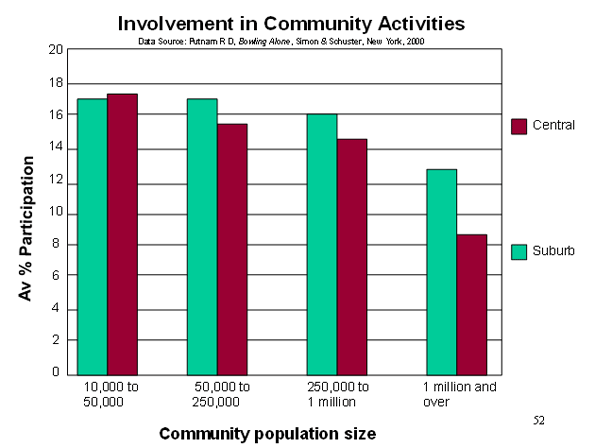
An example of misinformation on this issue can be found in R.D. Putnam’s famous book “Bowling Alone”. Putnam states that "suburbanisation, commuting and sprawl" have contributed to the decline in social engagement and social capital. However I have shown that data from charts in his book indicate quite the opposite:
Adapted from Figure 50, Putnam R D, Bowling Alone, Simon & Schuster, New York, 2000
This shows that involvement in these social activities are more common in the suburbs than in the denser centres of cities (and that they become more common as the community size and density decreases).
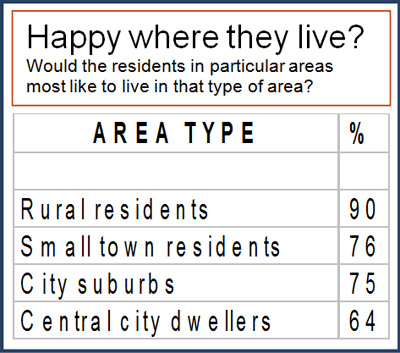
Community contentment relating to the density of surroundings is revealed by a study in New Zealand that asked people if the type of area they would most prefer to live in is similar to the area they currently live in. The responses are shown in this table.
So 90% of rural residents would prefer an area similar to their current area but only 64% of central city dwellers would prefer an area similar to their current surroundings. It can be seen that satisfaction decreases as density increases.
Thus evidence from a variety of sources points to greater human happiness and better health in lower densities --- the exact opposite of the theories of the advocates for “cramming” people into ever small places.
(Dr) Tony Recsei has a background in chemistry and is an environmental consultant. Since retiring he has taken an interest in community affairs and is president of the Save Our Suburbs community group which opposes over-development forced onto communities by the New South Wales State Government.