Monday, May 7, 2018

Proposals to ban internal combustion engines in California are a bad idea


Proposals to ban internal combustion engines in California are a bad idea


Friday rush hour traffic along the eastbound 91 exits to the northbound 71 on April 13, 2018. The $117 million makeover of the 71/91 interchange in west Corona might be finally built. (Photo by Cindy Yamanaka, The Press-Enterprise/SCNG)

By JON COUPAL |
PUBLISHED: May 5, 2018 at 7:48 pm | UPDATED: May 5, 2018 at 7:48 pm


The latest battle in Sacramento’s war on California’s middle class is the push to ban the internal combustion engine.

Luckily, the effort has stalled.

The legislation that would have imposed the ban, Assembly Bill 1745, died last month, but bad ideas in California have a way of recurring like nightmares. We will see this proposal again, either as legislation next year or perhaps even as a ballot initiative. A number of so-called progressive candidates on the ballot this year have publicly stated they embrace this foolish idea.

The bill that was stopped, AB1745, would have prohibited the Department of Motor Vehicles from registering a new vehicle unless it was a zero emissions vehicle, beginning on January 1, 2040. Under the proposed law, a new car with an internal combustion engine could not legally be driven in California after that date.

A ban on internal combustion engines would certainly limit mobility and transportation options for millions of California families and businesses. And it would arbitrarily limit the development and use of advanced and efficient vehicle technologies, the kind that have already achieved great success in squeezing extra miles out of a gallon of gas.

Today, despite the availability of ZEVs, a substantial publicly funded rebate program and access to HOV lanes, ZEVs accounted for only 1.9 percent of the over 2,000,000 new passenger vehicles sold in California in 2016. And many of these sales are repeat sales to the same households, according to the UC Davis Institute of Transportation, raising the question of whether plug-in vehicles are experiencing widespread consumer rejection, outside of a limited group of true believers.

A ban on internal combustion engines is an attempt to force consumers into buying vehicles that they have decided are not best suited to their needs.

The better alternative is leveraging all available vehicle technologies, including efficient internal combustion engines, so that California can reach its environmental goals without banning or discouraging any technological innovations.

California’s current regulatory mandates have resulted in the state having the highest gas prices in the nation. That has burdened average Californians with a higher cost of living, yet it has not been enough to overcome the significant obstacles to driving a zero-emission vehicle — including the purchase price, the limited range, and the inadequate number of charging stations.
The better option for most California drivers is an increase in the efficiency of internal combustion engines. But a ban on those engines in California would suffocate the market for these new technologies and stop innovation dead in its tracks.

Despite the increased use of renewable energy — mostly solar and wind power — fossil fuels will remain the dominant energy source in America well beyond the target date of California’s proposed ban. Even more than a quarter of a century from now, the Department of Energy forecasts that fossil fuels will still be the dominant energy source, providing 79 percent of our energy needs in 2050. Far from being “energy sources of the past,” fossil fuels will continue as the dominant energy source to power our vehicles, heat and light our homes, and fuel the growing economy.

The production of the batteries on which the majority of ZEVs rely is not free from severe environmental consequences. It’s a dirty secret of the high-tech world that lithium battery production involves heavy mining operations and that the cobalt required in those batteries is sometimes mined in Africa using child labor.

Closer to home, a ban on the registration of new cars with internal combustion engines would mean millions of Californians who can’t afford ZEVs will be unable to buy a new car and drive it legally in the state. While the wealthy may be able to get around the inconvenience of the ban, once again, average Californians will bear an unreasonable burden for the fashionable whims of Sacramento politicians.

Jon Coupal is president of the Howard Jarvis Taxpayers Association.

Is the ‘crack cocaine of real estate financing’ here to stay?

Is the ‘crack cocaine of real estate financing’ here to stay?

As the EB-5 investor program’s expiration nears, experts weigh its pros and cons amid recent scandals

By Erin Hudson | March 01, 2018 10:00AM


Based on recent headlines, it might sound like the EB-5 visa program is akin to a kiss of death for some developers. In January, it became known that the U.S. Securities and Exchange Commission was investigating Kushner Companies’ use of the EB-5 program following a fundraising trip to China last May. At the time, Nicole Kushner Meyername-dropped her
brother in the White House, Jared Kushner, during a pitch to investors from whom the company was hoping to raise $150 million for the One Journal Square project in Jersey City.

Meanwhile, up in Vermont, the Miami developer behind the Jay Peak resort project was ordered to pay $81 million back to 800 foreign investors who poured $450 million into what has been dubbed the largest ever fraudulent use of the program. To top it off, state officials are also being accused of being involved in the scandal. (None other than Harry Macklowe has offered up his condominium project 1 Wall Street if the beleaguered investors are looking to redeploy their money.)

Despite the recent scandals, the program, which allows for foreigners to invest up to $1 million in job-creating projects in exchange for a green card, has a been a huge financing source for projects in Manhattan. As Congress deliberates the reauthorization of the program, which expires March 23, one of the main points of contention is that the funds are often directed toward major cities, while rural areas aren’t receiving nearly as much of the capital. There’s also a 10-year backlog in applications, and developers are returning investors’ money before they can obtain green cards — an unwelcome occurrence in the eyes of immigration authorities. That’s resulted in $16.6 billion in capital that investors need to redeploy into real estate or other businesses to remain in good standing with the program, according to EB-5 servicer NES Financial. (It should be noted that subsequent projects receive less oversight and require no job-creation.)

So, all considered, is EB-5 — referred to by some as the “crack cocaine of real estate financing” — really a reliable source of capital? According to the four experts The Real Deal spoke to, the answer varies from a resounding yes to a shrug. But, to them, it’s clear the program is not in jeopardy, despite red flags to the contrary.

Russell Barr
Founder and Managing Partner, Barr Law Group

You’re representing EB-5 investors in a class-action lawsuit against the state of Vermont for officials’ role in the Jay Peak resort fraud. What’s the status of that case? We filed an opposition to the state’s motion to dismiss our complaint [in late January] that we believe took the state to task. Our complaint was filed at 80-odd pages, and it’s very detailed. It’s one of the only complaints in the history of my practice where about 90 percent of every allegation is supported by documentary evidence, and it ties the state of Vermont to this fraud. I think we’re going to prevail, no question, but the state won’t dig out of this for 10 or 20 years. The program is, in effect, dead up here.

Do you think there are aspects of the EB-5 program that could be amended to prevent such a fraud from occurring again? I don’t think this was a program-wide problem. This was outright fraud. What made it so big, so long-standing and so widespread was that a few actors within the state government were involved in it. That just needs to get prosecuted.

The only issue I see is that this program was designed to help rural America or high-unemployment areas, and what’s happened is EB-5 has been a little maneuvered so that major cities are benefiting from the program. Just the term itself, TEA, does not to me suggest Wall Street or Hudson Yards. Target employment areas suggest to me Newport, Vermont, or northern parts of New York State, New Hampshire or Maine. Just pick your big state, but it should not be Manhattan.

Why do you feel Manhattan developers’ use of EB-5 precludes the success of the program in rural areas? Because, as an example, imagine a Chinese foreign national from Beijing has a choice to invest in a Wall Street project in Lower Manhattan or a ski area in northern Vermont; I think nine out of 10 times they would go with Manhattan simply because they know New York and they don’t know northern Vermont. I think that’s a completely unfair competitive advantage for no real economic reason — because you can substitute capital in Manhattan a lot easier than you can substitute capital or capital stacks in northern Vermont. That part of the program needs to get cleaned up and rethought.

Nick Mastroianni II
Chairman and CEO, U.S. Immigration Fund

What changes have you seen in EB-5 investors? There’s been an addition of countries that really weren’t active. China is still the most active, [and] always will be the most active, followed by Vietnam and Korea, but India has become active. There’s a very simple [reason] why: The Chinese waiting list for a visa right now is six to eight years. Last year, the Chinese probably filed 10,000 to 12,000 petitions; the Indians filed about 150. So [in India], it’s very much underutilized. We as an industry, and I as a company, have opened up in countries like India, South America [Brazil and Columbia], South Korea, Taiwan and Vietnam.

Do you expect changes to the program this year? I think 2018 holds changes that have long been coming, and I believe those changes will be driven by the White House — the president and his immigration advisors. Sen. Chuck Grassley [R-Iowa] and Sen. Patrick Leahy [D-Vermont] have been against urban areas being able to use the program on a level playing field as rural areas. But now that the president has taken on the challenge of comprehensive immigration reform, I think something is going to happen.

What are you hoping to see? Everyone agrees the amount should be increased, so that’s going to happen — we’re sure of that. Everyone agrees that there should be more integrity measures as part of the program guidelines, so that’s going to happen.
Other changes that may happen will be whether or not to adopt commuter patterns as a method to determine target employment area, so areas where workers don’t live in the area of the projects but commute to them. The next hot button is the amount of visas that are allowed. We need more capacity, more visas.

Some developers say if EB-5 becomes too rigorous, they might abandon the program. Are you worried about that? I don’t see regulations deterring developers. I see the regulations deterring projects from being eligible for the program. If there’s a large advantage for ski resorts and rural projects and a big disadvantage for urban projects, which have been the lifeblood of the program, then, of course, the program is going to be very much underutilized.

Reid Thomas
Executive Vice President and General Manager – EB-5, NES Financial

You were just at the 2018 Las Vegas EB-5 & Global Investment Immigration Convention. What’s the word on the street? On the one hand, you’ve got the retrogression for Chinese investors. The program has been so popular that the waiting time for a Chinese investor is longer that it’s ever been, so that has slowed the number of investors coming in from China. On the other hand, it’s increased dramatically the number of investors coming from other countries. So there’s this shift, and that has an impact on where issuers go to raise capital. You’ve [also] got the legislation emerging. [This year] is going to be a year with some big changes.

What is being said about the legislation? From what I know, all the foundations of what’s going to be in the legislation are already worked out. So it’s really not a question of if the program gets extended longer, it’s when. One of the key things is an increase in the investment amount — it hasn’t increased since 1992 — and then these things called integrity measures.

What would integrity measures do? Integrity measures will frankly be good for our business because our purpose is to really provide security, transparency and compliance to stakeholders. What we’re seeing is a move toward more institutional-caliber offerings by issuers which use companies like NES to do independent oversight and third-party fund administration — the kinds of things you see in traditional financial services markets. Those things are becoming a prerequisite in EB-5 financing.

Would legislation address backlogs or increase the current limit of 10,000 visas allocated per year? I wish it would, but I don’t think it will — not in this go-around. I do think that the possibility for additional capacity as it relates to infrastructure or disaster relief could make the program bigger. It may not be part of this legislation, but look at what the Trump government is trying to do: They need to get capital to do their infrastructure plan. Well, EB-5 would be a good source. I’m not sure anybody would ever do that, and there’s no proposal I’ve seen for them to do that, but I’m optimistic that that will be a vehicle to increase investment like this.

Have incidents, notably with Kushner Companies fundraising for their Jersey project, thrown the program into a questionable light?The incidents like the Kushner thing get a lot of media play and, unfortunately, it’s negative. With respect to our business, that actually ends up being good. It’s a good reminder for folks in the industry that they need to embrace best practices and operate in compliance with the different regulations and laws.

Daniel Lundy
Partner, Klasko Immigration Law Partners

What do you see as the future of EB-5?We’re waiting. Our understanding is that there is a deal [among lawmakers] on EB-5, and we’ve seen a framework. Nobody that I know has actually seen a bill or language.
Since you’ve seen the legislative framework, what are some the proposed changes? Defining a targeted employment area would be substantially more difficult that it is today. The plan is to have 3,000 visas set aside for rural projects and “urban distressed” projects, which essentially become your TEAs. So there’s going to be 1,500 visas available every year for rural areas and 1,500 for urban distressed areas — all allocated before projects in other areas. What this means for people from China, who are subject to a visa backlog, is that if they invest in a rural or urban distressed project, they would essentially get moved to the front of the line.

How do you see these changes playing out? Demand is going to cool a little bit. Except, if these rural and urban distressed projects allow people to basically jump to the head of the line, they’re going to sell out extraordinarily quickly. If this law passes, then there’s going to be a mad rush to find these projects, and they’re going to do very well for a period of time.

Are rural or urban distressed projects riskier? I don’t think the location changes the risk if the fundamentals are there. But there are not a lot of projects in these areas. We have one or two.

Do you see any new markets overtaking China? Other markets are increasing, but they’ll never get to the level of China. You won’t be able to raise $100 million in six months like you used to in China. There’s no infrastructure in other places, there’s no mass-marketing apparatus to find investors and to push investors, and there also aren’t as many of the push factors. In a lot of places in the world, if you have a lot of money, you’re living very nicely and you may not necessarily need, or want, to pay to emigrate to the United States.

Do you think the China market could recover? If we were to somehow get more visa capacity, I think the Chinese market would continue — but I don’t see it ever coming back up to the 2015 levels.

Sunday, May 6, 2018

THE URBAN HUMANISM MANIFESTO: PUTTING COMMUNITIES FIRST

tHE URBAN HUMANISM MANIFESTO: PUTTING COMMUNITIES FIRST

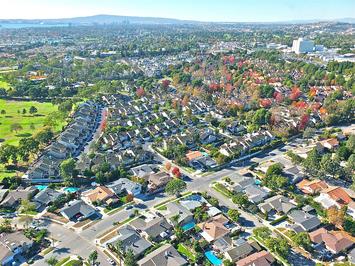
content_Univ_Park_aerial__2_.jpg
Urban planning exists to serve people and communities, not the other way around. Unfortunately, urban planners these days, perhaps under the influence of academic arrogance as well as the lure of developer dollars, seem to forget this simple truism.
A particularly invidious form of planning orthodoxy involves certain adherents of so-called “new urbanism,” which looks at density, more density and only density as the hallmark of the (for them) only acceptable form of urban living.
Without considering that people of all colors, stripes and ethnicities might like to have gardens, these urban planning densifiers support policies whose main aims are to eliminate low-density housing, without regard to preservation of the integrity of communities or without acknowledging that community character means anything.
The new urbanist density hawks also use other “arguments” apart from social justice to make their moral case for high-density, including, importantly, environmental considerations. Never mind the fact that even studies done by density advocates show that the supposed benefits of increased density on the environment would be marginal, at best. But that doesn’t dampen the rhetoric. Far from it. Some of the most strident density fetishists decry single-family neighborhoods as “the enemy” and proclaim homeowners to be nothing less than “zoo animals” and “bloodthirsty dinosaurs,” who are “angry, entitled, immoral, classist and racist.”
While new urbanist Yimbys make claims that low-density housing is immoral for numerous reasons, many social justice groups and environmental groups take issue with policies they aggressively (and sometimes obnoxiously) push, such as California state senator Scott Wiener’s SB827, which would have used public transportation as an alibi to allow developers to densify cities by pre-empting municipalities’ general plans.
While Yimbys are evidently great at chanting, they aren’t as skillful in appreciating the irony of their dehumanizing policy goals. The contradictions and outright hypocrisy in their density fetishism is sometimes so extreme, that the cognitive dissonance should cause heads to explode. The density fetishists can’t seem to help treating people like widgets, stats or marks. They don’t seem to understand that communities are made up of people. They can’t recognize that communities are dynamic extensions of people, that they are extensions of families – however one chooses to define “family.”
Some of the most strident pro-density new urbanists and Yimbys are militant about their own personal right of self-definition, as they well should be. Whether it is a matter of how one defines “family,” LGBTQ rights, religious beliefs, ethnicity or any other seemingly trivial or crucial personal characteristic that helps people to define themselves, the right of self-definition is paramount when it comes to people’s abilities to unfold their own unique potential and to live a fulfilled life.
So is it with communities. But such self-definition for individuals and communities demands respect and tolerance, two qualities seemingly in short supply with the Yimbys and academic master planners.
Cities in many ways are like human beings themselves. Communities made up of living, breathing humans need the same right of self-definition as individuals. Like people, communities have their own unique character, their own DNA, their own aspirations which arise from the individuals who make them up.
Urban humanism, in direct opposition to new urbanist Yimbyism’s cult-like intolerance, respects that communities are made up of dynamic people and that one-size-fits-all mandates aren’t suitable for them any more than imposing a single definition of “family” would be for the individuals that make up these communities.
Density fetishism itself negates the notion that while ultra-dense urban living may be a lifestyle choice for some individuals (a choice which might, incidentally, change as people get older), so is the desire to live within a human-scale, low-rise community. Both choices are legitimate, as is everything else in between.
Yet in their unflinching dogmatism, new urbanist Yimbys seem unwilling to dispense the kind of tolerance they take for granted when it comes to many of their own personal lifestyles. The unwillingness to recognize and respect the uniqueness of communities can have a similar effect as the unwillingness to recognize and respect the uniqueness of individual people.
The new urbanist de-humanizing view towards cities and communities often tends to repeat the misguided narrative that cities themselves are to blame for the housing crisis in California. While CEQA needs to be fixed to ensure that cities don’t act irresponsibly, the Yimby blame-game towards cities doesn’t take into account Sacramento’s role in pushing cities to prioritize commercial development above housing, including abolishing re-development agencies.
New urbanist Yimbys would rather blame cities than look at the issue of income inequality or the role corporations play in having created the housing crisis. Tech CEO’s brag about their “insane margins,” and the Yimbys just harrumph and glibly move on to their next pro-density rant. Perhaps this shouldn’t be so surprising, considering that the Astro-Turf Yimby groups are largely funded by Silicon Valley tech billionaires, including Trump-buddy Peter Thiel.
Urban humanism, in direct contrast to new urbanist Yimbism, understands that corporations are not people and that money is not speech. Urban humanism, which favors a bottom-up approach as opposed to the top-down approach favored by new urbanist Yimbys, puts communities over corporations, people over profits and does not try to make political hay out of housing policy.
Strangely enough, the new urbanist Yimbys fail to see the contradictions resulting from their ideological alignment with corporate interests. Self-defined “progressive” Democrats find themselves spouting the Reaganomic trickle-down theories of Laffer and Mundell, as well as defining “property rights” in a way which, glossing over income inequality, would make hardliner objectivists nod their heads in agreement. Instead, they choose to focus on what they perceive to be the insuperable inconsistencies of those who oppose their corporatist agenda.
In politicizing the housing crisis, density advocates suggest that there is an unnatural alliance between affluent communities and poor ones. They think, on the other hand, that there’s a natural alliance is between Yimbys and tech billionaires, corporations and developers because they “all want housing.”
True, yimbys, tech billionaires and corporations “all want housing” for reasons which would seem to be diametrically opposed to urban humanist policy. The commonality amongst these groups is the profit motive (or willingness to accept the profit motive “for the greater good”). Perhaps more importantly, low-income and affluent communities are not “unnatural allies.”
One alliance is driven by the profit motive while the other is driven by elective affinities and empathy. Communities have the capacity to understand each other at the most basic level because of the underlying human element which is at their core. It is the capacity for empathy at its most elemental: if I have a child whom I love, I should be better able to comprehend and internalize the depth of feeling of others for their own children and to bond with them because of it.
As former LA County supervisor Zev Yaroslavsky said:
Every member of every community cares deeply about where they live and work. Whether you live in Echo Park or Beverly Hills, in Chatsworth or Wilmington, your community is your community. Businesses, residents, and other stakeholders fight to maintain a community’s values—and its value. That doesn’t make them NIMBYs; it makes them the responsible citizen stakeholders who make a city what it is.
With all the Big Money behind their attempts at urban Gleichschaltung, the Yimbys have shown urban humanists and communitarians the pressing need to change the calculus of how policy gets set in Sacramento. With all the Big Money pushing for policies which would place profiteering over people, it’s clear we need a state government based upon the principles of subsidiarity, regional cooperation and de-centralized self-government that has the capacity to put communities over corporations.
The dual goals of livability and sustainability can best be achieved by letting communities try to develop into the best versions of themselves, as decided upon by the residents. And this means respecting the individuality of communities, instead of the Bến Tre school of urban planning, espoused by the new urbanist Yimbys who would impose their rigorous versions of density upon communities throughout the state.
Far from “destroying communities to save them,” we need to allow communities to adapt even better to the ever-changing world, while empowering them to maintain the characters which make them unique. In a world of corporate profiteering über alles, in a world in which the academic elite thinks it should be able to dictate how people live, the time has come within urban planning to stop treating human beings like widgets, stats or marks.
Urban humanism, a humanistic approach to urban planning and urban policy is an idea whose time has come. Now more than ever, it’s time to put people first. Communitarians of California, unite! You have nothing to lose but Sacramento overreach.
Vice Mayor John Mirisch has served on the Beverly Hills City Council
since 2009, including as mayor in 2013-2014 and 2016-2017. He created the City's Sunshine Task Force in 2013 to increase transparency and public participation in local government.

Saturday, May 5, 2018

Marinwood Annual Budget presented for Approval. Highest spending ever. NEW Draconian Policy to Squelch Public Participation and Videotaping of Meetings.


The Marinwood CSD Board of Directors will conduct their next regular board meeting on Tuesday, May 8 at 7:30 PM at the Marinwood Community Center. Please note, the final proposed District operating budget for fiscal year 2018-2019 will be presented for formal approval of the Board. The complete agenda packet, as well as prior meeting agenda packets, can be viewed and downloaded from the Marinwood website at: 

http://www.marinwood.org/sites/default/files/5-8-18_board_meeting_packet.pdf

The board is planning to spend the highest amount in the history of the Marinwood CSD and will have no money set aside for reserves.  Does this seem responsible to you?

Also in this meeting, a new policy attempting to challenging the right of the public to participate in open meeting will be proposed in clear violation of speech and the Brown Open Meetings Law.  Such policies are contemptuous of free speech provisions and ignore the abusive, bullying behavior of the board such as demonstrated below by Leah Green, CSD Board President.  

The board has regularly requested the presence of a police officer at meetings to intimidate the public.  No violations of the law were encountered. It appears that this latest attempt is to create rules to ban certain individuals like me from attending and recording their proceedings. 


Stop Calling Us NIMBYs


Stop Calling Us NIMBYs


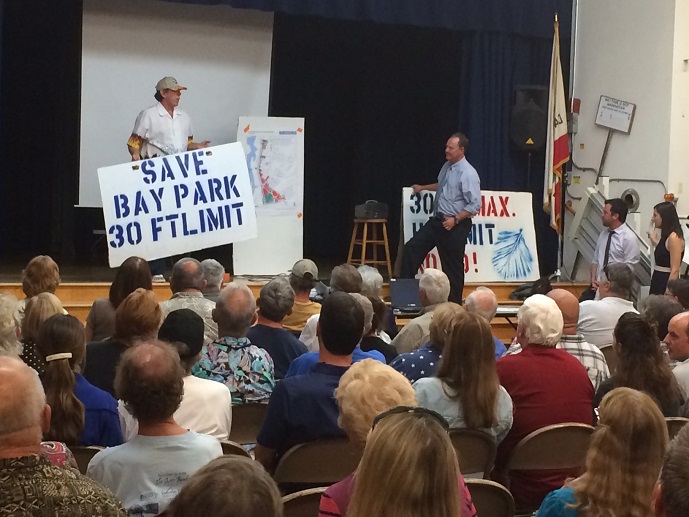
More than 300 Bay Park and Clairemont residents packed Bay Park Elementary in 2014 to oppose a city proposal to increase development in their neighborhood. / Photo by Andrew Keatts
NIMBY, the acronym for “not in my backyard,” has become a pejorative accepted into the cannon of elite planning professionals and government housing agency documents as a touchstone of all that’s gone wrong in development permit approvals. It is an unfair characterization of anyone opposing development proposals located near them, and it’s offered regardless of whether the development proposed is good or bad.
Voice of San Diego Commentary
San Diego County’s 2015 Regional Analysis of Impediments to Fair Housing Choice [1] describes NIMBYism as a “syndrome” that is:
widespread, deeply ingrained, easily translatable into political actions, and intentionally exclusionary and growth inhibiting. NIMBY sentiment can reflect concerns about property values, service levels, community ambiance, the environment, or public health and safety. It can also reflect racial or ethnic prejudice masquerading under the guise of a legitimate concern. NIMBYism can manifest itself as opposition to specific types of housing, as general opposition to changes in the community, or as opposition to any and all development.
Despite the city and county’s insistence in other planning manuals that community members should also feel encouraged to offer input, opposition is often dismissed under the moniker of NIMBY. To get around this opposition, California lawmakers briefly considered SB 827, which would have made building near transit stations easier [2] but would take local control away from local jurisdictions and force all to live with the prescription.
Since the 1960s and the rise of the city’s 52 community planning groups, which make recommendations about proposed developments, it’s been a tradition to include public participation in the process. It is, after all, their future community, so residents should have a say in the planning as “stakeholders.”
As a term, “stakeholders” is a more adequate description of the community members involved in those discussions, who might have the largest actual stake in the outcome of a project. The city’s use of the term in their community plan preparation manual [3] ostensibly sets the tone for what they want from the citizenry.
That said, regardless of the local project being proposed these days, the discourse quickly becomes a larger dialogue about our statewide housing crisis. This is an important debate, but it should be a fair fight if we want to maintain any hope of solving it.
It may be difficult for officials, planners and architects to deal with residents who don’t believe building luxury apartment towers [4] will solve our lack of housing, or that housing the chronically homeless [5] in the neighborhood without providing them full health care services could be a recipe for disaster. But these are just some of larger issues that need to be mitigated when approving new developments and projects.
NIMBY is a convenient label if your goal is to ignore pushback from residents on development proposals. But these residents are the first to push back precisely because they are located nearest the proposal and must live with it, good or bad.
Residents are neither sick nor diseased, as the county housing report suggested, because they are concerned about impacts to public services, insufficient infrastructure, environment and public health and safety. YIMBY, the acronym for “yes in my backyard,” was coined in contrast [6] to the “NIMBY syndrome.” YIMBY with its “Y” or “yes” connotes a positive. To frame debates over project approvals with the over-simplification of “yes” or “no” doesn’t help to reach solutions that are much more complex.
The debate over a proposal does not need to descend into questions of racial prejudice, but the power of using NIMBY as a pejorative is that it can shut down conversation. Zoning and deed restrictions were, in the past, used to as a method to prevent minorities from purchasing property in all-white communities, a sick and disgusting practice. But using that awful history, in the county’s Impediments to Fair Housing Choice report, to condemn or pre-judge a neighborhood’s opposition to proposed development is unwarranted, unfair and discriminatory itself.
Look closer at community opposition to the many project proposals in San Diego and you will see legitimate concerns regarding public safety, not attempts to exclude a class of people from a neighborhood.
James LaMattery is a Realtor and resident of Bay Park.

Friday, May 4, 2018

Swarming Insects at Marinwood Park

California’s Cap-and-Trade Scheme Adds Financial Insult to Environmental Injury

Thursday, May 3, 2018

What Marinwood CSD Employees Earned in 2016

Job Title Base Pay Overtime Pay Other Pay Benefits Total Pay & Benefits
Firefighter, Captain 95509 58720 5166 34788 194183
Firefighter 86300 43049 7787 33567 170703
Firefighter 82952 27706 11604 37962 160224
Firefighter 81342 28323 10585 37475 157725
Firefighter 84708 34028 11895 25969 156600
Firefighter, Captain 96052 16662 4674 34797 152185
Fire Chief 107432 0 0 40347 147779
Recreation Director 98321 0 0 30281 128602
Firefighter, Captain 95407 0 1971 26113 123491
Firefighter 67588 18803 4594 29137 120122
Firefighter 74914 8018 4092 31674 118698
District Manager 97011 0 0 16225 113236
Firefighter 65407 26339 4589 16502 112837
Senior Admin. Assistant 64750 0 0 22883 87633
Recreation Supervisor 59176 0 0 27294 86470
Maintenance Worker 57179 0 0 27141 84320
Maintenance Worker 54246 0 0 26917 81163
Admin. Assistant 43698 0 0 25979 69677
Maintenance Worker 53175 0 0 13036 66211
Recreation Supervisor 53664 0 0 12489 66153
Firefighter 34400 6893 1354 14527 57174
Preschool Teacher 41970 0 0 0 41970

TAM pitches Marin Board of Supervisors for more Sales Taxes

Wednesday, May 2, 2018

Nearly one million signatures collected to repeal the gas tax hike

Nearly one million signatures collected to repeal the gas tax hike


The 12-cent-a-gallon gas tax hike recently approved by California’s legislature will take effect Nov. 1.

By SAL RODRIGUEZ | letters@ocregister.com | Orange County Register
PUBLISHED: April 30, 2018 at 6:30 pm | UPDATED: April 30, 2018 at 10:24 pm


Editor’s note: Breaking views are thoughts from individual members of the editorial board on today’s headlines.

On Monday, April 30, proponents of a measure to repeal gas tax increases rammed through the California Legislature last year with Senate Bill 1 submitted 940,000 signatures in an effort to place the measure on the November ballot.

The move comes weeks ahead of a May 21 filing deadline and with hundreds of thousands more signatures than the 585,407 required to qualify the measure for the ballot, perhaps reflecting the strength of the movement to repeal the 12 cents per gallon gas tax hike.

The measure, backed by former San Diego councilman Carl DeMaio and gubernatorial candidate John Cox, calls for the repeal of the 12 cents per gallon increase and would require any future gas tax increase to be approved by voters.

View image on Twitter

WOW - 940,000 signatures submitted today on the Gas Tax Repeal Initiative! Thank you to all who helped! Join us at http://www.ReformCalifornia.org #tcot

Polling by the Public Policy Institute of California in January found likely voters to be split on repealing the gas tax hike, with 47 percent of likely voters indicating support for repeal and 48 percent opposed. But subsequent polling by PPIC has also found that most Californians believe they pay more taxes than they should.

Whether gas tax opponents can tap into that latter sentiment enough and drive out voters to repeal the gas tax increase remains to be seen, but the circumstances and reality of the gas tax hike shouldn’t be forgotten.

Millions of commuters, especially the poor and middle class, have seen and felt the effects of higher taxes and higher car registration fees, all thanks to the inability of Sacramento to prioritize what California really needs.

Rather than resolve inefficiencies in Caltrans (like the 3,500 excess positions reported by the Legislative Analyst’s Office), or stop wasting so much money on the bullet train or show some evidence of fiscal restraint, the Legislature and Governor Brown voted to throw tens of billions of dollars in new taxes on the backs of Californians.

Worse, they did this with backroom deals.

Nearly $1 billion in giveaways were used to “buy” votes in the Legislature for the passage of the gas tax, including those of Sen. Richard Roth, D-Riverside, and Assemblywoman Sabrina Cervantes, D-Corona, who received hundreds of million of dollars in giveaways, including $18 million in park funding in Cervantes’ district, with the money coming from SB1 itself.

Roth and Cervantes for their part have only patted themselves on the back for selling out the poor and the middle class in exchange for some pork, something that could end up costing Cervantes in November. Republican challenger Bill Essayli has made a point of highlighting Cervantes’ vote for the gas tax since the launch of his campaign, apparently to great effect as his campaign has raised more money than Cervantes so far this year.

Here’s to hoping the repeal measure gets on the ballot so Californians can finally have a say one way or another.

Sal Rodriguez is an editorial writer and columnist for the Southern California News Group. He may be reached at salrodriguez@scng.com

Vote No on Measure B.

San Rafael voters not rushing on Dixie tax measure

The old Dixie School House is on the property of Miller Creek Middle School in Marinwood. The district also includes three elementary schools: Mary E. Silveira, Dixie and Vallecito. (IJ photo/Alan Dep)
The old Dixie School House is on the property of Miller Creek Middle School in Marinwood. The district also includes three elementary schools: Mary E. Silveira, Dixie and Vallecito. (IJ photo/Alan Dep) 
Voters in the Dixie School District in north San Rafael are waiting a bit to mail in their ballots for next week’s Measure B parcel tax election on May 8.
As of Monday, only 2,600 ballots out of 13,666 registered district voters had been returned in the all-mail-in election, said Marin County Registrar of Voters Lynda Roberts. The mail-in registration deadline was April 23, Roberts said.
District residents may still register and vote — but they will need to fill out and submit their mail ballots in person at the Marin County Elections Department office at the Marin County Civic Center, 3501 Civic Center Drive, San Rafael.
“They can still register online, but for the actual voting, they will need to come in to the department,” Roberts said.
Measure B would extend the parcel tax for 12 years and add an $118 increase to the district’s existing $352 annual parcel tax — or a total of $470 a year. The rate would increase annually by no more than 3 percent — with the exact amount of the increase to be decided each year by public board of trustees’ vote. That is in contrast to most of the other parcel taxes in Marin that have automatic increases, also called “escalators.”
Nicki Mullen, co-chair of the “Yes on Measure B” group ForDixieStudents.org, said the community’s support has been “amazing.”
“Endorsements keep rolling in — we ran out of lawn signs because so many people wanted them — and the amount of volunteer support has been wonderful, both from parents at the schools and others in the community who realize the importance of Measure B,” Mullen said in an email.
Measure B critic Stephen Nestel, however, maintains he is in favor of a different tax system than the uniform flat rate parcel tax. The latter, he says, is unfair when it comes to large apartment complexes because they would only pay one flat tax per lot — even if they have multiple units.
“Our Marinwood Community Service District parks parcel tax is based on units and our fire tax is based on square footage,” Nestel, a Marinwood resident, said in an email. “It is very disappointing that Measure B supporters are telling people that (per square footage) is illegal.”
Nestel, meanwhile, is working with Mimi Willard, of the Coalition of Sensible Taxpayers, which is advocating a per-unit or a per-square-foot tax for area school districts instead of the flat rate parcel tax. As to the legal question, Nestel said he would not be backing a different tax system if he thought it might put the district in legal jeopardy.
“It is my wish that people carefully read the arguments and check the facts,” Nestel said. “Our position was not opposition to the tax, but to the fairness of the apartment loophole. Shouldn’t children in apartments have school funding too?”
According to Willard, both the fown of Fairfax and Ross Valley Paramedic Authority taxes are per-living-unit taxes, not parcel taxes.
“Fairfax’s special tax is $195 per living unit — so an apartment building owner pays by the number of units — a fourplex owner pays four times $195 — $780 — and a 20-unit complex owner pays 20 times $195, or $3,900,” she said in an email. “RVPA tax is $69.50 per living unit. A 10-unit building’s owner pays $695.”
But proponents say Measure B, as fashioned, is the best way to maintain school programs. That includes attracting and retaining top teachers, keeping smaller class sizes, funding the district’s strong music program and providing elective courses at Miller Creek Middle School. The money also goes for providing French and Spanish classes and for technology programs.
“Speaking with voters has made it clear how thankful people are for the great schools in our community, whether they have children in them or not,” For Dixie Students volunteer Juliet Starrett said. “It has been great to work alongside so many motivated volunteers.”
Measure B requires a two-thirds majority for passage.

Tuesday, May 1, 2018

California not the model for America it thinks it is

California not the model for America it thinks it is

Sitting in front of a tent pitched on a sidewalk, Daniel Shawn, a 48-year-old homeless man, is silhouetted against the street lights Wednesday, Sept. 6, 2017, in downtown Los Angeles.

By JOEL KOTKIN | Orange County Register
April 28, 2018 at 8:59 pm


In the past, wrote historian Kevin Starr, California “was a final frontier: of geography and of expectation.” Today in the Trump era, California remains a frontier, but increasingly one that appeals largely to progressives. “California,” recently suggested progressive journalists Peter Leyden and Ruy Teixeira, “today provides a model for America as a whole.”

To them, California remains the “harbinger” of “new America” and “the most active front” in the battle to exterminate Trumpism. Yet this enthusiasm should be curbed somewhat by paying attention to what is actually happening on the ground here.

Economically, our state retains unquestioned areas of remarkable strength, notably in Silicon Valley as well as parts of coastal Southern California. But often overlooked are vast areas of underdevelopment, poverty and searing inequality, particularly in the interior. Overall, after a strong recovery from the recession, California’s GDP growth is now about the national average, well below that of prime competitors like Texas, Washington state, Ohio and even New York.

California as ideological avatar


At the end of his long career, Jerry Brown has spent much time vamping in western Europe, Russia and China as the visionary leader of a de facto green nation-state. Yet it is rarely noticed that California’s greenhouse gas emissions are not dropping more rapidly than most places. In fact, according to the Energy Information Agency, the state since 2007 has reduced emissions by 10 percent, below the national average of 12 percent, meaning the state ranks a measly 35th in reduction.

Immigration and diversity is another defining aspect of the California model. This will be front and center in the effort to nominate the telegenic Kamala Harris for the White House. Harris claims multicultural California represents “the future” being created by very diverse millennials in comparison with Trump’s white and aging base.

Yet on the ground level, the progressive regime has been far less friendly, at least economically, to minorities than most may suspect. Many live in deplorable conditions, with a rate of overcrowding roughly twice the national average. Minority home ownership is plunging well below other states, and economic prospects, particularly for those without college education, are increasingly dismal.

Will America buy this model?


Brown’s successor, notionally former San Francisco Mayor Gavin Newsom, will someday have to confront the reality in places — South Los Angeles, Santa Ana, San Bernardino and Fresno — where the wealth of Facebook, Google, Apple and Disney barely reaches. The state is home to a remarkable 77 of the country’s 297 most “economically challenged” cities based on levels of poverty and employment, suffering the highest poverty rate of any state, well above the rate for such historically poor states as Mississippi.


Today, according to the Social Science Research Council, California now has the greatest income inequality in the nation, suggestive of a disappearing middle class. In the past many people dreamt of moving here. Now it attracts less newcomers per capita than virtually any state; only four states — Michigan, Ohio, Wisconsin and Illinois — fared worse in bringing in new taxpayers.

Today, domestic net out-migration, even after declining in the early years of the recession, has more than doubled between 2013 and 2016. Even worse, according to a recent UC Berkeley study, over a quarter of Californians are considering a move, half of them out of the state, with the strongest proclivity found among people under the age of 50. And contrary to some progressive commentary, those leaving are not necessarily old or losers; according to IRS data, out-migrant households had a higher average income than those households that stayed, or of households that moved in to the state.

Paragon, cure thyself


Rather than serving primarily as a role model, California today should be seen as much a cautionary tale. We certainly produce great wealth, but also far too much poverty. To be sure, California is now home to four of the 15 richest people on the planet and 70 percent of the 56 billionaires under 40; the Bay Area remains the most prodigious producer of high wage tech-related jobs.

But for much of the middle and working classes, more serious has been the erosion of higher-wage blue collar jobs, which have dropped by 500,000 since 2000 and by over 300,000 since the Great Recession alone. In contrast, minimum or near-minimum wage jobs accounted in 2015-16, notes the state’s Business Roundtable, for almost two-thirds of the state’s new job growth.


None of this suggests that California is doomed, or has descended into the hell suggested by some conservatives. But before recommending our policies to the nation, we need to address the issues that threaten to tear our society apart.

Of course, even in the light of the Facebook scandals, much of the country will continue to admire our innovators and embrace our stylishness and multi-cultural creativity. But much of the rest of the country is unlikely to buy the California model until it starts to address fundamental issues such as class mobility, affordability and education. Until then, we may be first in the hearts of progressive activists, but not so much for everyone else.

Joel Kotkin is the R.C. Hobbs Presidential Fellow in Urban Futures at Chapman University in Orange and executive director of the Houston-based Center for Opportunity Urbanism (www.opportunityurbanism.org).