Interesting video about the use of computerized "adaptive testing" and its potential for manipulation of testing outcomes and personality profiling of your children. What happened to learning skills, acquiring knowledge, and developing intellect? What is the true purpose of Common Core?
See this article in the Huffington Post about Pearson Company, a huge multi-national corporation that has been involved in every aspect of the Common Core curriculum.
HERE
Thursday, April 10, 2014

Wednesday, April 9, 2014
The Truth about Common Core (3 minutes)
There are some legitimate questions every parent should ask about Common Core.

Planned Parenthood gets $250,000 County Grant sponsored by Supervisor Susan Adams
Should the Marin County Board of Supervisors provide $250,000 in tax dollars to Planned Parenthood, a national non profit which had an "excess" of $60,000,000 last year? The issue is not whether you support abortion, it is the appropriateness of the Supervisors underwriting a national non profit that can do well without our support.
That $250,000 should have been used in Marin on local services or paying down our pension debt. Susan Adams donated an additional $50,000 from her Supervisor trust fund which was meant to fund local small charities and good works.
Not surprisingly, Planned Parenthood is a big campaign supporter for Susan Adams recall defense fund and re-election campaign.
It's time to end the slush fund once and for all. Vote June 3rd for change.
Tuesday, April 8, 2014
Atkins pushes bill so 30% of your neighbors can redevelop you ! UPDATE
See the Article in the San Diego Reader
Atkins pushes bill so 30% of your neighbors can redevelop you
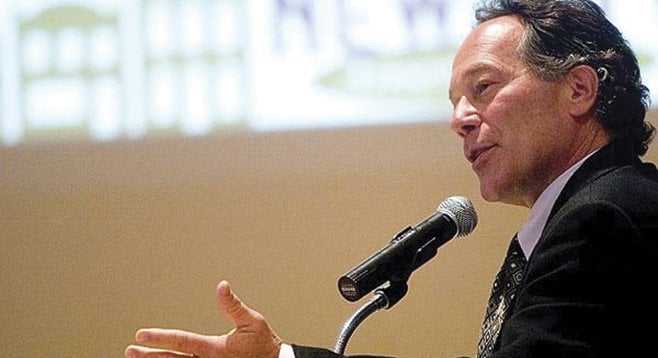
Marco Li Mandri wants to change city law to make it easier to form assessment districts. He’s helped start 61 such districts around the country.
Marco LiMandri weeps elephant tears over end of assessment districts.
By Dorian Hargrove, April 1, 2014
Assembly Speaker-elect Toni Atkins [Editor's Note: That's right folks, she is now Speaker of the Assembly with the power to force bills through the Assembly! This Bill was withdrawn but it is still disturbing that it was even so tried. See the updated article HERE. Governor Brown wants his own redevelopment bill passed called JEDI] wants to make it easier for property owners to levy assessments on their neighbors property tax bills to pay for community improvements.
Last month, on February 21, Atkins introduced legislation aimed at tweaking California's Property and Business Improvement District Law by introducing Community Benefit Districts.
Community Benefit Districts are nearly identical to Property and Business Improvement Districts except for three major changes: The bill would reduce the number of property owners needed to establish an improvement district from 50 percent to 30 percent, as well as extend the life of the district from ten years to twenty years. Lastly, if passed the legislation would turn San Diego County into a testing ground for the Community Benefit Districts, meaning the law would not apply to any other county in California.Atkins' proposal is not a new idea. In fact, former-assemblymember Juan Vargas introduced similar bills in 2002 and 2005 and an identical bill which Vargas later pulled from consideration in 2012.
None have gone over so well.
In 2002, then-governor Gray Davis vetoed Vargas's first attempt, saying the "bill offers no compelling reason why the assessment period should be extended so significantly, or for why the percentage of property owners signing a petition in support of such a [Business Improvement District] is reduced from 50 [percent] to 30 [percent]. I am committed to the principles of smart growth and urban revitalization, but I do not believe that this bill provides the proper balance between these principles and those of fair and just taxation.”Ten years later Vargas still had trouble finding support for the law. In 2012 he pulled the bill amid complaints from lobbyist groups and labor unions who believed the law was unneeded and could potentially tarnish California's Property and Business Improvement Law.
The bill’s unreasonably low petition threshold of just 30 percent (as opposed to the 50 percent required for PBID formation) would allow a small number of property owners to initiate the district proceedings without obtaining consensus support from even a bare majority of impacted businesses," read a letter opposing Community Benefit Districts from a number of lobbyist groups including the California Business Properties Association, the California Building Industries Association, the California Retailers Association and others.Opposition to Vargas's law even came from nonprofit organizations which represent assessment districts. "The concern is that if you lower the petition threshold to 30 percent, you could foster a situation where a few large parcel owners could band together and force a district through the process without support of many small owners," wrote Kerry Morrison, executive director for Hollywood's property-based improvement district, in an April 2012 letter to Vargas.
"What the proponents do not reveal, however, is that the number of ballots typically returned is relatively small; hence the initial petition threshold is actually the more challenging hurdle in [business improvement district] formation."But the legislation, once thought dead, has risen again.
Maintenance assessment district-guru Marco Li Mandri came up with the concept of Community Benefit Districts and served as an adviser to Vargas and Atkins in writing the legislation.
Li Mandri says the legislation will correct flaws in the property and business improvement district law.
First and foremost, he says, the name is wrong. "It implies only 'business improvement' when in fact, all of our downtown and commercial areas are becoming mixed use and the majority of new development is not business oriented."
Other flaws says Li Mandri: "The five-year term, particularly in light of the end of redevelopment is far too short. Districts should last as long as property owners received tangible benefit. It should be their choice instead of a full employment act for formation consultants."
"Finally, the 50 percent petition threshold is unreasonably high and only favors districts with high concentration of property ownership. The petition doesn’t create the district, the balloting does. But many areas never get to balloting because they could not reach the petition threshold. The argument that it builds 'community support' is a farce. The high petition threshold forces districts into smaller boundaries and lower budgets because the threshold is so high. It makes no sense to require 50 percent of the weighted property owners to trigger a balloting when only 55 to 65 percent of property owners will even return their mail ballots."
Assemblywoman Toni Atkins' office did not reply in time for publication. The bill, since the amendment, is now headed back to the local government committee of the State Assembly.
----------------------
Atkins elected Assembly speaker
UTSanDiego

Summary SACRAMENTO San Diego Democrat Toni Atkins was elected Assembly Speaker Monday afternoon. She will be the first San Diegan and only the third woman to hold the post. "She has impressed me as someone with a true servant's heart - willing to take on the causes she believes in, fighting for the poor, the disenfranchised and the marginalized."
Law Enforcement Professional explains why "New Urbanist Design" attracts Crime
Experienced Crime expert explains why "Smart Growth" design concepts encourage crime due to lack of privacy and "controled space".
Monday, April 7, 2014
Kevin Haroff , Attorney for www.AllianceMarin.org speaks about CEQA and politics (3 minutes)
Full Luncheon Speech.
Political Rivals Find Common Ground Over Common Core
Political Rivals Find Common Ground Over Common Core
by ERIC WESTERVELT
January 28, 2014 5:00 AM
LISTEN to the Story

Silver Lake Elementary School in Middletown, Del., has begun implementing the national Common Core State Standards for academics. The GOP largely backs the standards that are rolling out in 45 states, but Tea Party conservatives have bSteve Ruark/AP
Supporters of the new Common Core education standards adopted by 45 states say the standards hold American students to much higher expectations, and move curriculum away from a bubble-test culture that encourages test preparation over deeper learning.
But there's growing backlash to Common Core, and conservatives and liberals increasingly are voicing similar concerns: that the standards take a one-size-fits-all approach, create a de facto national curriculum, put too much emphasis on standardized tests and undermine teacher autonomy.
The mainstream business wing of the Republican Party strongly backs Common Core, arguing that raising standards is vital to creating the next-generation American workforce. But in an echo of the rifts in the GOP nationally, the Tea Party branch has been critical of the new standards.
Conservative broadcaster Glenn Beck has often led the push. On his show The Blaze, he often charges that Common Core will undermine student individuality and teacher autonomy, and that it marks a dangerous takeover of local control by federal bureaucrats pushing a leftist agenda.
“From the conservative side, there is an understanding of the dangerousness of standardization. And from sort of a libertarian perspective, there's suspicion of government control of what students learn that really resonates with me as a teacher who wants some autonomy. "- Anthony Cody, Network for Public Education co-founder and former teacher
"This is a progressive bonanza, and if it's allowed to be in our schools in any form and become the Common Core of America's next generation, it will destroy America and the system of freedom as we know it," Beck told his audience last year.
A small but growing number of liberal reformists have joined conservatives, agreeing on some of the key criticisms.
"It's fundamentally flawed because it was fundamentally undemocratic in the way that it was defined, rolled out, financed," says Stan Karp, a former high school teacher now with New Jersey's Education Law Center and the liberal reform group Rethinking Schools. He sees Common Core as the ideological stepchild of President Bush's No Child Left Behind Act: another high-stakes testing program, he says, imposed from Washington with big help from wealthy foundations and little help from teachers, parents and local communities.
"This is a set of standards that does not reflect the experience of many groups of students served by public education, does not reflect the concerns that many parents have for what they want to see in their education, and that really doubles down on a testing-and-punish regime that has proven to be the wrong approach to improving public education," Karp says.
The mutual criticism of Common Core extends to potential uses and abuses of data collectionunder the new standards. Both sides also say Common Core represents an end-run around federal prohibition against a national curriculum. And both argue that the new standards were not really state-driven. They say the Obama administration all but forced states into it by requiring adoption of the new standards in order to be eligible for more than $4 billion in federal "Race to the Top" grant money.
Anthony Cody, co-founder of the liberal reform group Network for Public Education, says he sees growing common-ground opposition to Common Core. He taught for nearly 20 years at a high-poverty middle school in Oakland, Calif.
"From the conservative side, there is an understanding of the dangerousness of standardization. And from sort of a libertarian perspective, there's suspicion of government control of what students learn that really resonates with me as a teacher who wants some autonomy," Cody says. "I don't want to be so tied to filling their heads with this predetermined list of things."
Worries about Common Core's content and accompanying tests also cross ideological lines. In one example, Cody points to Common Core's idea of emphasizing "close reading" of literature and nonfiction. Students will be given short passages of text to try to uncover "layers of meaning" and to encourage "deep comprehension." That sounds better than the bubble test world of No Child Left Behind. But Cody worries that it will stifle free-flowing discussion by pushing teachers to prep kids for tests.
"These standards were built to be tested. ... I want to have some autonomy as a teacher to do open-ended investigations, to explore things [the students] are curious about," he says. "And the more tightly this is tied to a predetermined list of outcomes and testing, the harder it is for me to do that as a creative teacher."
Advocates of Common Core reject the notion that it creates a national curriculum. They point out that teachers can pick their own materials as long as students know what the standards ask them to know by the end of the school year. Common Core, they argue, will do a lot to promote critical thinking and collaborative problem-solving while significantly raising the bar on what every student should know.
"I would encourage your listeners to take a hard look at the standards before they start believing some of the critics," says Dane Linn, vice president for education and workforce at the Business Roundtable. With the U.S. Chamber of Commerce, the Business Roundtable is rolling out a new national ad campaign to support Common Core.
Linn worked on Common Core when he directed the education policy arm of the National Governors Association and says the idea that it's a stalking horse for federal intrusion into local education is ludicrous.
"I was at that first meeting in Chicago with the state's governor's offices, state superintendents of schools, members of state boards of education. It was a state decision," Linn says. "Clearly, some of those critics of the standards have chosen to base their arguments on fallacies about both the development of the standards and the intention of the standards."
Meantime, many parents and teachers feel caught in the middle as they work to train up on and implement the new standards. Megan Franke, an education professor at UCLA, says her big worry is "that we're not going to support people and then we're going to say, 'See, the Common Core doesn't work.' "
And Education Secretary Arne Duncan has taken political heat and criticism, first for dismissing Common Core critics as fringe and then for suggesting the backlash was largely from embittered "white suburban moms."
It all goes to show that at the very least, the standards have a serious image problem. Tea Party conservatives, calling it "Obamacore," are planning a big march on Washington this summer to oppose the new standards.
But the growing number of liberal critics of Common Core aren't likely to join hands with them and march. They fundamentally disagree about how to reform public education and are alienated by marchers' other calls to abolish teacher tenure and the federal Education Department.
Sunday, April 6, 2014
Watchdog: EPA human test subjects not always told about lethal risks of studies
Environment
Watchdog: EPA human test subjects not always told about lethal risks of studies

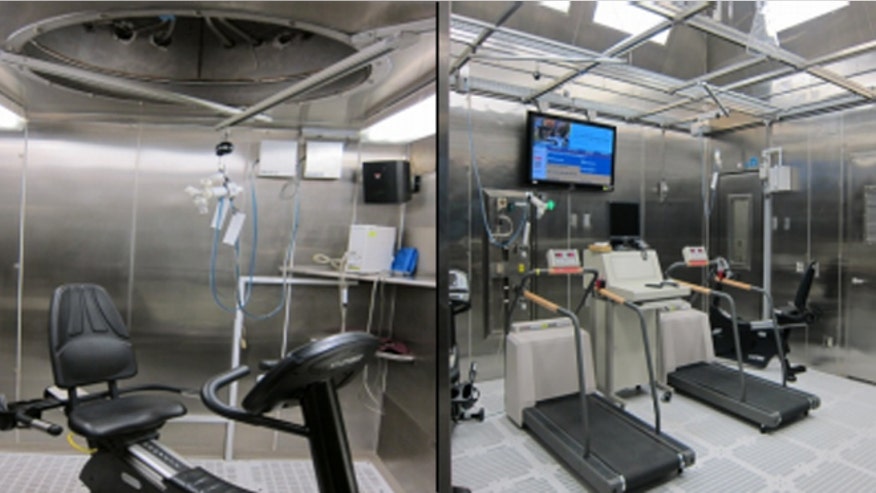
Shown here are EPA labs used to test the impact of pollutants on human subjects.EPA OIG
The findings were included in a newly released EPA inspector general report, which urged the agency to overhaul its guidelines to make sure test subjects understand all the risks before signing up.
The EPA is authorized under federal law to perform human testing, as part of its ongoing effort to regulate potentially harmful pollutants. The agency has spent millions of dollars on this research.
The IG report looked at five studies conducted in 2010 and 2011, at a University of North Carolina facility. It determined that, overall, the agency "followed applicable regulations" when it exposed 81 test subjects to "concentrated airborne particles or diesel exhaust emissions."
However, the IG's office found "inconsistencies" in the consent forms -- which only sometimes told test subjects about the full range of risks.
Before the subjects were brought into the labs to be exposed to pollutants, the forms compared the experience to visiting a big city on a smoggy day.
Only one of the studies, though, gave information on the "upper range of the pollutant" they would be exposed to, and only two alerted the subjects about the "risk of death for older individuals with cardiovascular disease," according to the report.
Further, the report said consent forms for two studies testing the impact of diesel exhaust "did not include the potential cancer effects of long-term exposure."
In response, the EPA said that it would "enhance" the language to include better information on potential risks.
In a written statement, though, the agency defended its work and noted the IG report confirmed it follows "all laws and regulations" concerning human testing "and has internal guidelines in place that exceed those normally required by universities, industry and other government agencies conducting human studies research."
The statement said: "EPA concurs with and is adopting the OIG's recommendations to ensure its policies and procedures are strengthened even further. ... All human exposure studies conducted by EPA scientists are independently evaluated for safety and ethics, and the results are peer-reviewed. EPA is committed to ensuring the protection of study participants."
A separate blog from the agency also said its studies are "highly controlled" and that the EPA is "embracing" the IG recommendations -- in part to share "even more information about exposure risks with study volunteers, even when these risks are minimal."
According to the IG report, the reason the agency gave for not informing subjects about the cancer risks was the risks associated with two-hour exposures "would be minimal." One manager said those risks are typically calculated over a lifetime exposure of 40 years.
The EPA reports that no one has died as a result of these tests.
However, several "adverse" events were reported over the testing period. This included subjects experiencing conditions ranging from a migraine to cardiac arrhythmia to decreased lung function. All those subjects were treated for those conditions.
Though the agency had argued that the more severe risks in all these cases were minimal, the IG report said the EPA should tell people about potential long-term risks so that subjects "can make the most informed decision possible."
The report also went into detail about the little-known testing that is conducted by the environmental agency. This testing is based out of the UNC campus, at a facility that allows researchers to pump "gaseous pollutants at precise concentrations" into enclosed chambers.
In the five studies the IG looked at, test subjects were offered payment ranging from $950 to $3,700.

New Parcel Tax for Dixie School District? How else are we going to pay for it?

No one would blame you if you missed this little article about the parcel tax increase in Tiburon/Mill Valley/Corte Madera. It is important to point out a trend and a huge danger to the taxpayers supporting Dixie School district. They are already dipping into reserves to pay for huge student body growth. It appears that a new school may be needed at a huge cost to tax payers. In years past, this was not a problem because more taxpayers entered the district.

This time it is different. With 71% of all affordable housing identified for the Dixie School District, hundreds of new school children may be coming into the district WITHOUT supporting tax revenue. The non-profit affording housing developers pay virtually no tax and only a small stipend that will not even pay for enough portable classrooms let alone books, furniture and teacher's salaries.
If Susan Adams, Judy Arnold and the rest of the Marin County Board of Supervisors have their way with the proposed affordable housing MILLIONS OF DOLLARS will need to be levied from parcel taxes.
It doesn't seem fair. Vote June 3rd!

Reed schools seeking parcel tax increase
Looking for ways to accommodate its continually rapid growth, the Reed Union School District is seeking to increase its parcel tax income.
The election is mail-in only. Ballots will be sent out Monday, and must be received by the county elections office by May 6, said Registrar of Voters Elaine Ginnold. Ballots can be dropped off in the council chambers at Tiburon Town Hall, 1505 Tiburon Blvd.
The measure needs a two-thirds majority to pass.
"Our growth in enrollment is really pushing this, especially since our property taxes have been flat the last five years," said Reed Superintendent Steven Herzog. "We're just having less resources to provide the programming we have in place."
While most school districts receive state funding, Reed does not, due the Tiburon Peninsula's high property values. The district is primarily funded by local property taxes, so "more kids (moving into the district) don't translate to more money," Herzog said.
The increase would put the per-parcel assessment at $508 in its first year, with a 3 percent increase each year. That remains lower than the roughly $1,000 Mill Valley School District receives per parcel, Kentfield School District's $940, and Ross School District's $750.
Herzog said the district arrived at the proposed increase value through polling to see how much more local residents would be willing to pay.
"We think we're pushing the envelope on how much is tolerable," he said.
The district currently receives $1.4 million annually in parcel taxes. Measure B would bump that to $1.9 million. District officials said the extra money is needed to help the district maintain its level of programming, as its classrooms continue to fill up.
Reed, which draws students from Belvedere, Tiburon and part of Corte Madera, has grown from about 1,000 students to more than 1,500 in the last decade.
Residents 65 years or older who live within the district's borders have an optional exemption. There are about 5,000 parcels within the Reed district, of which 1,000 residents invoke the exemption.
The tax increase will not likely alleviate all the pressures created by the bulging enrollment, so district officials are talking about floating a bond in the next couple years, possibly to rebuild on the old Granada school site, which currently houses six private pre-schools.

One California for me, another for thee
One California for me, another for thee
 |
| Yosemite Valley; Tobias Müller |
by Victor Davis Hanson // Tribune Content Agency
No place on the planet is as beautiful and as naturally rich as California. And few places have become as absurd.
Currently, three California state senators are either under felony indictment or already have been convicted.
State Sen. Leland Yee (D-San Francisco) made a political career out of demanding harsher state gun-control laws. Now he is facing several felony charges for attempting to facilitate gun-running. One count alleges that Lee sought to provide banned heavy automatic weapons to Philippines-based Islamic terrorist groups.
State Sen. Ron Calderon (D-Montebello), who had succeeded one brother, Thomas, in the state Assembly and was succeeded by another brother, Charles, now faces felony charges of wire fraud, bribery, money laundering and falsification of tax returns.
State Sen. Roderick Wright (D-Inglewood), originally entered politics as a champion of social justice. Not long ago, the Democratic leaders of the California Senate in secretive fashion paid $120,000 in taxpayer funds to settle a sexual-harassment suit against Wright. But this time around, not even his fellow senators could save Wright, who was convicted earlier this year on eight felony counts of perjury and voter fraud.
What is the common denominator with all three California senators — aside from the fact that they are still receiving their salaries?
One, they are abject hypocrites who campaigned against old-boy insider influence-peddling so they could get elected to indulge in it.
Two, they assumed that their progressive politics shielded them from the sort of public scrutiny and consequences that usually deter such deplorable behavior.
Criminal activity is the extreme manifestation of California’s institutionalized progressive hypocrisy. Milder expressions of double standards explain why California has become such a bizarre place.
The state suffers from the highest combined taxes in the nation and nearly the worst roads and schools. It is home to more American billionaires than any other state, but also more impoverished residents. California is more naturally endowed with a combination of gas, oil, timber and minerals than any other state — with the highest electricity prices and gas taxes in the nation.
To understand these paradoxes, keep in mind one common principle. To the degree a Californian is politically influential, wealthy or well-connected — and loudly progressive — the more he is immune from the downside of his own ideology.
Big money is supposed to be bad for politics. But no money plays a bigger role in influencing policy than California’s progressive cash, from Hollywood toSilicon Valley. Billionaire hedge-fund operator Tom Steyer is canonized, but he is on track to rival the oft-demonized Koch brothers in the amount of money spent on influencing policymakers and getting his type of politicians elected.
Nowhere are there more Mercedes and BMWs per capita than in California’stony coastal enclaves. And nowhere will you find more anti-carbon activism or more restrictive laws against new oil production that ensure the highest gasoline prices in the continental United States for the less well off.
California’s reserves of natural gas exceed those of nearly every other state. And in California, electricity prices are the highest in the nation. The cost falls on those in the interior and Sierra who suffer either from scorching summertime temperatures or bitterly cold winters. Those who set energy policies mostly live in the balmy coastal corridor where there is no need for expensive air conditioning or constant home heating.
In drought-stricken California, building new Sierra Nevada dams and reservoirs was long ago considered passé, but not the idea of diverting precious stored water from agricultural use to help out fish.
Yet the waters of the Sierra Nevada Hetch Hetchy reservoir are exempt from such fish diversions, apparently because they supply 80 percent of San Francisco’s daily water supply. Those who wish to either stop more dam construction or divert dammed reservoir water from its original intended use draw the line on restricting their own quite unnatural water sources.
High-speed rail is billed as the transportation of the future in California. But its progressive coastal boosters believe that it should first be tried out on farmers in sparsely settled rural areas rather than in their own precious high-density Bay Area or Los Angeles.
In California, open borders and non-enforcement of existing immigration law are also popular progressive causes. But the immediate impact of illegal immigration on public schools is circumvented for the elite by the growing number of private prep schools along the coast.
Professing that you are progressive can be wise California politics. It means you sound too caring ever to do bad things, while the costly consequences of your ideology usually fall on someone else. And that someone is usually less hip, less wealthy and less powerful.
No place on the planet is as beautiful and as naturally rich as California. And few places have become as absurd.
Currently, three California state senators are either under felony indictment or already have been convicted.
State Sen. Leland Yee (D-San Francisco) made a political career out of demanding harsher state gun-control laws. Now he is facing several felony charges for attempting to facilitate gun-running. One count alleges that Lee sought to provide banned heavy automatic weapons to Philippines-based Islamic terrorist groups.
State Sen. Ron Calderon (D-Montebello), who had succeeded one brother, Thomas, in the state Assembly and was succeeded by another brother, Charles, now faces felony charges of wire fraud, bribery, money laundering and falsification of tax returns.
State Sen. Roderick Wright (D-Inglewood), originally entered politics as a champion of social justice. Not long ago, the Democratic leaders of the California Senate in secretive fashion paid $120,000 in taxpayer funds to settle a sexual-harassment suit against Wright. But this time around, not even his fellow senators could save Wright, who was convicted earlier this year on eight felony counts of perjury and voter fraud.
What is the common denominator with all three California senators — aside from the fact that they are still receiving their salaries?
One, they are abject hypocrites who campaigned against old-boy insider influence-peddling so they could get elected to indulge in it.
Two, they assumed that their progressive politics shielded them from the sort of public scrutiny and consequences that usually deter such deplorable behavior.
Criminal activity is the extreme manifestation of California’s institutionalized progressive hypocrisy. Milder expressions of double standards explain why California has become such a bizarre place.
The state suffers from the highest combined taxes in the nation and nearly the worst roads and schools. It is home to more American billionaires than any other state, but also more impoverished residents. California is more naturally endowed with a combination of gas, oil, timber and minerals than any other state — with the highest electricity prices and gas taxes in the nation.
To understand these paradoxes, keep in mind one common principle. To the degree a Californian is politically influential, wealthy or well-connected — and loudly progressive — the more he is immune from the downside of his own ideology.
Big money is supposed to be bad for politics. But no money plays a bigger role in influencing policy than California’s progressive cash, from Hollywood toSilicon Valley. Billionaire hedge-fund operator Tom Steyer is canonized, but he is on track to rival the oft-demonized Koch brothers in the amount of money spent on influencing policymakers and getting his type of politicians elected.
Nowhere are there more Mercedes and BMWs per capita than in California’stony coastal enclaves. And nowhere will you find more anti-carbon activism or more restrictive laws against new oil production that ensure the highest gasoline prices in the continental United States for the less well off.
California’s reserves of natural gas exceed those of nearly every other state. And in California, electricity prices are the highest in the nation. The cost falls on those in the interior and Sierra who suffer either from scorching summertime temperatures or bitterly cold winters. Those who set energy policies mostly live in the balmy coastal corridor where there is no need for expensive air conditioning or constant home heating.
In drought-stricken California, building new Sierra Nevada dams and reservoirs was long ago considered passé, but not the idea of diverting precious stored water from agricultural use to help out fish.
Yet the waters of the Sierra Nevada Hetch Hetchy reservoir are exempt from such fish diversions, apparently because they supply 80 percent of San Francisco’s daily water supply. Those who wish to either stop more dam construction or divert dammed reservoir water from its original intended use draw the line on restricting their own quite unnatural water sources.
High-speed rail is billed as the transportation of the future in California. But its progressive coastal boosters believe that it should first be tried out on farmers in sparsely settled rural areas rather than in their own precious high-density Bay Area or Los Angeles.
In California, open borders and non-enforcement of existing immigration law are also popular progressive causes. But the immediate impact of illegal immigration on public schools is circumvented for the elite by the growing number of private prep schools along the coast.
Professing that you are progressive can be wise California politics. It means you sound too caring ever to do bad things, while the costly consequences of your ideology usually fall on someone else. And that someone is usually less hip, less wealthy and less powerful.
 |
| Starting at $101,500 this Tesla electric car is not for "the masses" |
Subscribe to:
Posts (Atom)