Wednesday, January 10, 2018

California Bill Would Allow Unrestricted Housing by Transit, Solve State Housing Crisis
California Bill Would Allow Unrestricted Housing by Transit, Solve State Housing Crisis

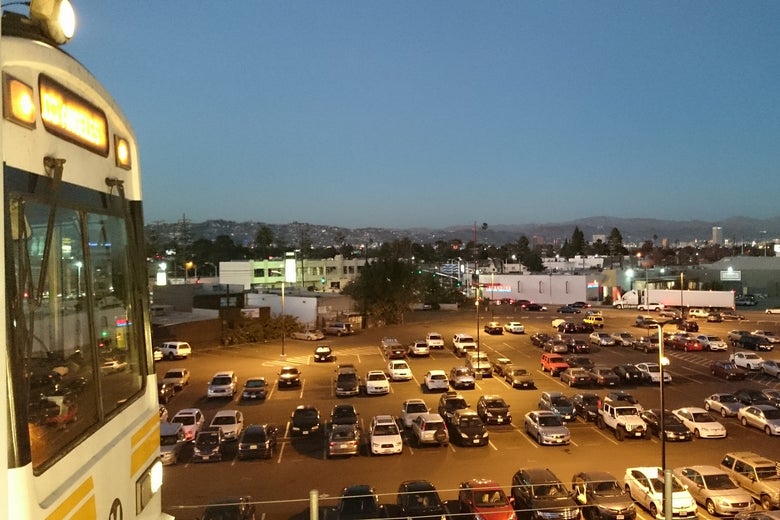
A parking lot near the Los Angeles Expo Line.
Is this the best use for land around the Expo Line in Los Angeles?
Payton Chung via Flickr
San Francisco’s state senator, Scott Wiener, has introduced a bill that would all but abolish the city’s famously strict land use controls—and virtually every other residential zoning restriction in California’s urban neighborhoods. It’s just about the most radical attack on California’s affordability crisis you could imagine.
Wiener’s bill, SB-827, flies in the face of every assumption Americans have held about neighborhood politics and design for a century. It also makes intuitive sense. The bill would ensure that all new housing construction within a half-mile of a train station or a quarter-mile of a frequent bus route would not be subject to local regulations concerning size, height, number of apartments, restrictive design standards, or the provision of parking spaces. Because San Francisco is a relatively transit-rich area, this would up-zone virtually the entire city. But it would also apply to corridors in Los Angeles, Oakland, San Diego, and low-rise, transit-oriented suburbs across the state. It would produce larger residential buildings around transit hubs, but just as importantly it would enable developers to build those buildings faster.
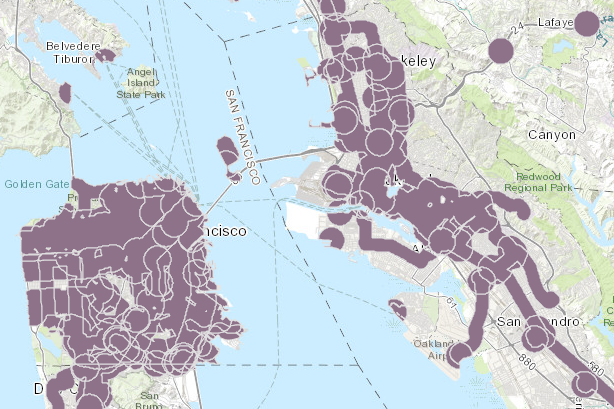
Purple areas show plots within a half-mile of train stations or high-frequency bus routes.
Purple areas correspond to “transit-rich” zones under Wiener’s bill.
Almost everyone agrees California needs more housing. The state is home to 6 of the country’s 10 most expensive metro areas, in part because of decades of under-building. New building permits are hard to come by thanks to balkanized power structures within and between cities, in addition to various structural incentives not to approve new housing units. Ironically, because transit access is an amenity people pay for and then hoard, even some areas around commuter rail or subway stops are required to hold only houses with big front yards.
Of course, transit hubs are exactly where more housing can be built with the least effect on traffic, so that’s the practice Wiener’s bill tries to promote. It would establish a minimum height (45 to 85 feet, depending on street with and distance) for new buildings sitting on the valuable land that abuts transit corridors. It would end parking minimums and pave the way for skyscrapers around every subway stop in California, and along many big avenues as well.
In a Medium post announcing SB-827, Wiener pointed to a McKinsey study that shows the tremendous potential of transit-oriented development in California. The state currently has 1.16 million housing units that can be considered transit-oriented. The law could open the door to as many as 3 million more.
At first glance, the bill is too radical to pass; California homeowners would revolt, or at least use their remaining local power to shut down a whole lot of bus routes. At least one advocate for equitable development in South L.A. has compared the bill to Andrew Jackson’s Indian Removal Act. Like most attempts to build more housing, it will likely be crushed between homeowners seeking to preserve property values and renters fearful of the resultant tear-downs and evictions.
Still, it represents a reassuring trend in California politics: the rising tide in the statehouse to overwhelm local restrictions on housing construction. In September of 2016, for example, Gov. Jerry Brown signed a law that eased the approval of accessory dwelling units, or granny flats, across the state. The result has been a bona fide housing boomlet in the backyards of cities like Los Angeles, whose byzantine permitting process had stymied would-be builders.
Wiener’s transit-oriented development bill, if it passed, would have the most radical impact of any California law since Prop 13, the 1978 resolution that permanently lowered the state’s property taxes (and dealt a blow to state finances that continues to this day). But even if it doesn’t, it puts some smaller good ideas on the table. If anyone were in a position to get some part of this passed, it would be California Gov. Jerry Brown, who is in the final year of his well-received second stint in charge of the country’s most populous state.

Monday, January 8, 2018

Without Prop 13, Marin County could see 100% tax increases like Mattoon Township.

Mattoon Township businesses see over 100 percent property tax hike in one year


By Cole Lauterbach | Illinois News Network
Jan 3, 2018


Downtown Mattoon, IllinoisPhoto from Wikimedia


A federal lawsuit alleges that a central Illinois county’s assessor has been appraising property based on what the county needs to spend, not what the business is worth.

Business owners in a Coles County township say they were taxed at very unfair rates compared to their neighbors elsewhere in the county. Their lawsuit, which was appealed in federal court last week, says some of the businesses there saw property tax bills rise drastically one year. The hike didn't come from an increase in local levies but in significant appraisal increases.

Their lawyer, Erick Kaardal, said the assessor simply raised the value of their properties to match what the county needed to get around state laws limiting big hikes like that.


“They’re basically using the assessment procedures to increase valuations on the property for the purpose of borrowing and spending rather than having the valuations be linked to market value,” he said.

The businesses in question reside in Mattoon Township, where they paid 97 percent of the newly raised taxes that the county received in tax year 2016, according to the suit. They contend that this is a breach of the 14th Amendment’s Equal Protection Clause.

The county assessor's office would not respond to active cases but Brian Bower, Coles County State’s Attorney, said that previous Supreme Court rulings have said the appropriate venue for the challenge is in a local court. “We’re hopeful the Seventh Circuit sees it the same way,” he said.

Kaardal said that the federal court has jurisdiction if the state courts don’t provide “an adequate remedy.”

Property tax extension limit laws, or P-TELL, limit the amount of a property tax hike to either 5 percent or the last year’s Consumer Price Index, whichever is less. Kaardal says the implications of the case would affect every county in Illinois with tax limits. According to the Illinois Department of Revenue, 39 counties in Illinois have property tax extension limitation laws and could be affected by this lawsuit.

Six Insane California Laws That Went Into Effect last Monday


For most Americans, the first moments of the new year are ones of celebration and excitement.
In California, it’s also a time to take stock of which new laws from the Democrat-controlled Legislature will make our lives just a little (or a lot) more frustrating. Here are six:
  1. The entire state will now ignore U.S. immigration law: Because it’s worked so well in San Francisco, California Democrats decided that the entire state should ignore federal immigration law. SB 54 forbids law enforcement officials from asking someone’s immigration or holding them for Immigrations and Customs Enforcement agents — unless they’ve been convicted of a crime. AB 291 prohibits landlords (you know, like, private citizens who own private property) from reporting renters who are in the U.S. illegally.
  2. The DMV is raising vehicle registration fees: This is a minor blip in California’s war on cars, but it’s a frustrating one, because, really, this is the only thing that could make the DMV experience even worse. SB 1 increases vehicle registration fees between $25 and $175, depending on the vehicle’s value.
  3. Employers can’t ask applicants about their salary history: Private employers — yes, private employers — can’t ask people who want money from them silly questions like how much money they’ve made in the past or are making at their current job. It will be interesting to see the inevitable unintended consequences of AB 168. It will be at least a little more difficult for a company to gauge what a reasonable offer looks like without knowing what an applicant is currently making or recently made. Sure, employers will ask questions like, “What would you like to make?” and smart applicants will clarify their expectations at some point in the interview process. But, really, it’s not the government’s business how an employer and an applicant work out any mutually beneficial agreement.
  4. Low-skilled workers will have a harder time finding work: That’s just a fancy way of saying, “The minimum wage will increase from $10.50 an hour to $11 an hour.” Under SB 3, the minimum wage will increase each year until it hits $15 an hour in 2022. For people who already have jobs, this is no big deal. For people making below the minimum wage who keep their jobs and get a pay increase, it’s great. But for low-skilled workers who need a job, this is bad news. A company is not going to pay a 20-year-old $11 an hour if he’s only bringing $9 an hour worth of value to the company. It will either make do without that position, automate, or move to a state whose legislature has some grasp of basic economics. But, really, as with #3 above, it’s not the government’s business how an employer and employee work out a mutually beneficial wage. If an applicant wants to make $9 an hour, and an employer wants to pay $9 an hour, how is it not a bad thing for the government to say that’s illegal?
  5. You can make up your gender on official state IDs: California will abolish its requirementthat a person must undergo “clinically appropriate treatment for the purpose of gender transition” if they want to change the sex on their birth certificate, which means that men can say they’re women, and vice-versa, on state IDs like driver’s licenses. Beginning in 2019, driver’s licenses will have three options for sex: male, female, and nonbinary.
  6. Schools will no longer be allowed to decide whether or not they’re “gun-free zones”:Because the legislature has decided for them. AB 424 says school administrators can no longer permit employees with concealed carry permits to conceal and carry firearms on campus. Which means the only people with guns on campus will be criminals and campus police, who more often than not can only respond to shootings, not prevent them.
Has reading this list spiked your heart rate? Then you’ll be calmed by AB 64, which legalizes the sale and cultivation of recreational-use marijuana.
Happy 2018!

Sunday, January 7, 2018

Happy Songs from the South.

"Zip-A-Dee-Doo-Dah" Sing-Along
"Everybody Has A Laughing Place"

Trump. How did it Happen?


Proposition 13 isn’t the problem, pensions and spending are

Proposition 13 isn’t the problem, pensions and spending are


FILE PHOTO/GETTY IMAGESProposition 13 isn’t the problem, pensions and spending are
61 COMMENTS
By THE EDITORIAL BOARD | opinion@scng.com |
PUBLISHED: January 1, 2018 at 8:00 pm | UPDATED: January 2, 2018 at 11:01 am


Not for the first time, an effort is underway to persuade voters to “reform” Proposition 13 and raise property taxes.

“The California Schools and Local Communities Funding Act of 2018” was filed in mid-December with the attorney general’s office. It aims to raise $11 billion per year by removing Prop. 13 protections from industrial and commercial properties, reassessing them based on the unrealized, paper profits from rising real estate values.

However well-intentioned the backers of this initiative may be, it is reckless to impose a massive tax increase on nearly all California businesses, simultaneously and repeatedly.

If raising taxes was the solution to every problem, California would have no problems. The Golden State boasts the nation’s highest income tax rate and sales tax rate, and we’re within an eyelash of defeating Pennsylvania for the title of highest gas taxes.

Only property taxes fail to lead the nation in taxpayer pain. That’s because in 1978, the people of California used the initiative process to stop the escalating tax assessments that were tracking the rapid rise in property values and literally taxing people out of their own homes and businesses.

Under Prop. 13, taxes are limited to 1 percent a year of the assessed value of any property — residential, commercial or agricultural. Properties are reassessed to market value when sold.

This acquisition-value system protects longtime property owners from unaffordable tax increases while also bringing in revenue at a brisk pace when values are rising. Although California’s average effective property tax rate is under 1 percent, among the lowest in the nation, the state ranks 22 of 50 in per-capita property tax collected, according to the Tax Foundation’s data for 2014.

Proponents of the new initiative argue that California’s schools need more funding, but they are silent on the reason that California’s record spending on education is insufficient.

In March, officials of the California State Teachers’ Retirement System announced that CalSTRS’ unfunded liability increased to $97 billion in the fiscal year ended June 30, a $21 billion increase from the previous year.

But what effect will that tax increase have on California businesses?

In an apparent maneuver to limit opposition, proponents of the measure exempted residential rental property, agricultural property and commercial property owned and occupied by a business with 50 or fewer employees. So the tax hike would be borne by small businesses that rent space in a commercial building and large businesses that, incidentally, provide the jobs many Californians rely on to pay their bills.

California’s business climate is already abysmal by every measure. A massive and recurring tax increase on virtually all California businesses, simultaneously, will only accelerate the exodus to other states with more reasonable taxation.

And then what?

With growing pension costs continuing to draw funds away from classrooms and basic city services, will this measure’s proponents return to demand an end to Prop. 13 protections for everybody else?

Don’t bet the ranch that they won’t.

California needs pension and spending reform. Prop. 13 isn’t the problem.

Saturday, January 6, 2018

The Risks of Buying a Home That’s Too Big

Thoreau's Cabin at Walden Pond was 10' x 14'

The Risks of Buying a Home That’s Too Big


The larger the house, the more you’ll pay in utility bills, property taxes, insurance and repairs (and the more you’ll have to clean).


By Robyn A. Friedman

Dec. 27, 2017 11:02 a.m. ET


Tempted to buy the largest house you can afford? More square footage typically means more money—and that means higher mortgage payments, taxes, utilities and maintenance.

Young couples buying a starter home are often coached to get something bigger than they need to anticipate a growing family. Others think large homes have better resale value.

“The biggest house isn’t necessarily the best house or even the best investment,” says Mari Adam, a certified financial planner in Boca Raton, Fla. “An older, smaller home with a shorter commute, bigger lot or greater remodel potential may appreciate more,” she says. “In fact, many fancy new homes can lose value quickly if a developer builds newer homes nearby, while older areas may have more enduring land value.”

While it’s OK to plan for future needs, the ultimate decision should be based on what you can realistically afford.

Allow yourself some extra room—a spare bedroom and bath for guests or for a parent who might move in if necessary in the future—but don’t pay for extra rooms that you will never use, says Ray Rodriguez, regional mortgage sales manager for the Metro New York Market for TD Bank. “You want enough space to live comfortably, but you don’t want to heat, clean and pay taxes on space you aren’t utilizing,” he says.

According to the National Association of Realtors, a real-estate trade group, the median size of an existing single-family home purchased in 2017 was 1,930 square feet, down from 1,950 square feet in 2016.

‘Rather than purchasing the largest home you can afford, think about how that home fits into your lifestyle.’

For new construction, the National Association of Home Builders reports that the median square footage of a new single-family home in 2016 was 2,419, a slight decrease from 2,473 in 2015.

But while home sizes may be trending down—likely due to affordability issues—home buyers aren’t particularly fond of the “tiny-house” trend. An online survey conducted in October of 1,019 Americans age 18 and older by ValueInsured, a Dallas-based firm that offers home buyers a product called down-payment insurance, found that 36% of those surveyed think people who purchase tiny homes are likely to regret their decision.

Purchasing a house that’s too big can also get in the way of your retirement. Once your children leave home, you could end up living in—and paying for—a McMansion that’s largely empty. That will cost you more in utility bills, property taxes, insurance and repairs. Ms. Adam, the certified financial planner, estimates that a moderately high-end home in South Florida could cost $100,000 or more to maintain each year, even with no mortgage. A homeowner would need $2.5 million in assets to generate that income every year, she says.

Here are a few things to consider when shopping for a home:
• Consider trade-offs. Rather than purchasing the largest home you can afford, think about how that home fits into your lifestyle. “People like to travel more, and they may decide they don’t necessarily need a massive house if it comes at the expense of them being able to go out and travel,” says Patrick Ryan, senior vice president and managing broker of Related Realty in Chicago.

• Think small—and remodel. Another option is to purchase an older or smaller house and then create the home of your dreams through renovation. Mr. Rodriguez purchased a 2,000-square-foot home built in the 1960s that was located in a desirable neighborhood. “We knew going in that we would have to renovate because it didn’t have modern amenities,” he says. He saved money for two years and eventually added 1,400 square feet to the house, ultimately achieving the size home he originally wanted but couldn’t afford.

• Long-term returns. The money saved in buying a right-size home could pay dividends in the future—literally. A $20,000 savings each year over the life of a 30-year mortgage could result in a nearly $1.2 million nest egg if invested in a stock market portfolio earning 4% a year, Ms. Adam says. The annual savings, when compounded over time, is likely to exceed the appreciation in your home’s value over the term of the mortgage.

Friday, January 5, 2018

Senator Wiener, has another ridiculous Housing Bill that could lead to the massive urbanization of Marin County

Senator Wiener, has another ridiculous Housing Bill.  

ALERT: This bill will affect ALL HOMEOWNERS near the Highway 101 Corridor.

 In suburban Mill Valley California, essentially ALL of the homes in the flat lands will have no density requirement and a height limit of 55 feet.  In a word, it will force the redevelopment of a quaint town into a high density urban area.


California bill would mandate denser, taller housing near transit

7

San Francisco senator and assemblymember push for “transit-rich housing bonus”

Andre M
A new bill introduced in the California state legislature Wednesday by San Francisco Assemblymember Phil Ting, San Francisco Senator Scott Wiener, and East Bay Senator Nancy Skinner would cede developers a transit-housing bonus for taller denser developments near major transit hubs.
SB 827 would spare new housing developments from certain restrictions if they qualify as “transit-rich housing.” The initial version of the bill defines such housing as “parcels [...] within a one-mile radius of a major transit stop or a one-male radius of a high-quality transit corridor.”
California law defines a “major transit stop” as:
A site containing an existing rail transit station, a ferry terminal served by either a bus or rail transit service, or the intersection of two or more major bus routes with a frequency of service interval of 15 minutes or less during the morning and afternoon peak commute periods.
For new housing built near such a hub, the bill lays out a variety of potential shortcuts through the permitting process, including:
The bill would exempt a project [from] maximum controls on residential density or floor area ratio, minimum automobile parking requirements, design standards that restrict the applicant’s ability to construct the maximum number of units consistent with any applicable building code, and maximum height limitations.
Patricia Chang
Via a press release, Sen. Wiener called the bill—and two other housing-related bills introduced today, one of which would mandate that cities keep more strict track of population growth and adjust housing requirements accordingly and another that would make it easier to build housing for farm workers—a necessary tool for speeding housing construction.
“After nearly 50 years of bad housing policy—policy designed to make it incredibly hard and expensive to create housing—we began the long process of righting the ship,” said Sen. Wiener.
The proposed law first goes to the State Senate’s fiscal committee for consideration.

Los Angeles County is being AMBUSHED by Huge Development in Residential Areas. Marin is next.

Who Approved That?   (Link to KCET Website for full screen)


California State Senator Wiener is proposing a radical new law that mandates high density development in Marin. Citizens will have no recourse. Here is an important video published by KCET Public Television in Los Angeles. to show you what we can expect.

The crane mutiny: how Sydney's apartment boom spun out of control

The crane mutiny: how Sydney's apartment boom spun out of control


Building apartments along transport routes in Sydney was meant to create a more sustainable city. But only developers seem happy with the results
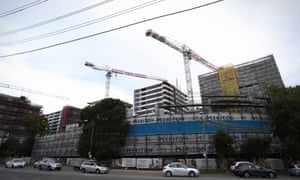
Reserve Bank figures show 78,000 new units were approved between 2012 and 2015, an increase of 18% on existing apartment stock. Photograph: Mike Bowers for the Guardian


Mike Ticher

Wed 3 Jan ‘18 13.00 ESTLast modified on Wed 3 Jan ‘18 13.01 EST


Across the road, a giant crane has been working on a new block of apartments on the site of a former service station. Another is going up down the road, where the bank used to be. More units are planned for the local RSL site and for two factories within a few hundred metres, and on dozens of other sites in my inner-western Sydney suburb that were previously industrial buildings, commercial premises, car parks or waste ground.

Go a bit further afield and the pace of medium- and high-density redevelopment is mind-boggling. Across Sydney’s inner and middle-ring suburbs, from Rockdale and Wolli Creek in the south, through the inner west, out to Parramatta, up to Ryde and on to the suburbs along the north shore train line, the city is changing before our eyes.

All Australia’s state capitals have seen versions of the same phenomenon but the pace and scale of change in Sydney is exceptional. On the face of it, creating more densely populated neighbourhoods along existing transport corridors makes perfect sense – it has been the policy of successive state governments for the best part of 30 years, in various guises. The downsides of encouraging the city to sprawl across an ever larger area are obvious. Bringing more people within reach of the city, with greater density around local hubs, should in theory be more environmentally sustainable, reduce car dependence, alleviate property price pressures and help create the diverse, vibrant neighbourhoods most residents want.


Sign up for Guardian Today Australian edition: the stories you need to read, in one handy email

Read more

But that theory is not working out.

A poll published in Fairfax Media in October found 66.4% of residents agreed that Sydney was “full” and development should be pushed outside the metro area. Across the suburbs, local groups are fiercely resisting plans for more building. In the south the proposed development of the Sydenham-to-Bankstown rail corridor has become a lightning rod for discontent. A plan to build 2,600 units in towers of up to 28 storeys in the inner west has run into outraged opposition under the slogan “Marrickville, not Mirvacville”. In October an even larger proposed development at Rhodes East, on the Parramatta river, was savaged by the local Liberal state MP, John Sidoti, who said some of what was proposed was “just plain wrong”.

It seems nothing can stop the building, short of an economic downturn. But how have governments failed so dismally to persuade Sydneysiders of the benefits of higher-density living? And is it too late to rescue the benefits of a more compact, less car dependent, more sustainable city?
The density push

Australian cities have long been among the least dense in the world. According to weighted calculations by the blog chartingtransport.com, Sydney had a density of 36 people for every hectare in 2011, compared with 80 in London, 133 in Paris and an astonishing 246 in Barcelona. No one wants Sydney to emulate the less attractive features of the most tightly packed European cities (lack of green space, for example) but there has been a consensus among planners and politicians at least since the 1980s that increasing density in established suburbs makes much more sense than continuing to expand outwards.

Planning is only one factor behind the apartment-building boom. Years of low interest rates and the incentives for investing provided by negative gearing and capital gains tax arrangements underpin every aspect of the Australian property market. But in Sydney successive state governments have encouraged the rezoning of industrial and commercial sites near transport routes, and since 2014 the New South Wales Department of Planning and Environment has identified “priority precincts” for high-density development – 28 at the last count – described as having “good access to existing or planned public transport connections” and “suitable for rejuvenation with new homes and jobs”.

Figures from the Australian Bureau of Statistics show monthly building approvals for apartments in Sydney topped 3,000 for the first time in September 2013, then 4,000 in December 2014 and 5,000 in July 2016, before falling off last year. That meant 78,000 units were approved between 2012 and 2015, RBA figures show, an increase of 18% on the existing apartment stock. In November 2016 the then planning minister, Rob Stokes, announced plans for a further 184,000 homes by 2021, to win “the war against sprawl” with “a real focus on apartments, on terrace houses and on medium-density developments in established areas”.

As a result, by the end of last year, more than 350 cranes were at work in Sydney, more than half of the total in the whole of Australia, of which 85% were involved in residential construction. And in contrast to other Australian cities, they are spread throughout the suburbs rather than concentrating in the central business district. In 2016, for the first time, more apartments than houses were built in Australia, and Sydney, where flats now account for 28% of housing, is well ahead of the average.
The community protest

Public hostility to increasing density comes in many forms and is far from uniform. Research by the Centre for Urban Transitions at Swinburne Universitysuggests that residents of established inner and middle suburbs in both Sydney and Melbourne have “a growing capacity to accept change but at present it is grudging and not strongly endorsed”.


Where is the world's densest city?

Read more

Some grounds for that unhappiness are obvious. Higher density development has not yet fulfilled the hopes of those who claim lack of supply is the key to taming rampant property prices, despite recent signs of the market weakening. But it has contributed to ever greater inequality, according to three reports produced last year for Shelter by the City Futures Research Centre at the University of NSW.

The quality of construction is a further concern. In 2015 Engineers Australia warned that the building system in NSW had “broken down” and a major incident was inevitable as units were being built by developers who were “totally inexperienced”. Hazel Easthope, a senior research fellow at the City Futures centre, says her research has uncovered “an incredibly high incidence of building defects”, including fire safety non-compliance, major leaks and structural cracking in new buildings.
FacebookTwitterPinterest The Eixample district in Barcelona, Spain, is characterised by its strict grid pattern, octagonal intersections and apartments with communal courtyards. Photograph: Daily Overview/DigitalGlobe/REX Shutterstock

But emotions run highest over more existential questions about what higher densities are doing to indefinable qualities such as the “character” of suburbs, and the stresses brought by a dramatic influx of residents without a corresponding expansion of services.


In December the premier, Gladys Berejiklian, told Fairfax she wanted the best of all worlds.


“I for one … don’t want communities to lose their local character,” she said. “I want people to feel they are living in good urban environments with greenery and green space. But also we have to look at opportunities where we can increase supply. People do want to downsize, upsize, have choice of housing.”

Sometimes that circle simply cannot be squared. There is a tension here that to some extent mirrors the broader housing divide between baby boomer property owners and those locked out of the market. Campaigners against development – particularly those arguing for the preservation of “heritage” in leafy suburbs where freestanding houses command astronomical prices – inevitably leave themselves open to the charge that they simply want higher densities pushed into poorer and more distant areas.

In July the chief executive of the Committee for Sydney, Tim Williams, accused north shore residents of “high-octane nimbyism” in rejecting plans for more housing. And some opposition to development has been explicitly hostile to greater density under any circumstances.

On the northern beaches, an unlikely coalition of the former Labor premier Barrie Unsworth and the former federal Liberal MP Bronwyn Bishop held forth at a public meeting last April about the threats to the beaches lifestyle, Fairfax reported. “High-density living is what most people who live here have come to escape,” Bishop told the meeting. Unsworth attacked the controversial new B-Line bus service along the peninsula – not for its deficiencies as a transport project but as “a Trojan horse” for development.

But most opponents of the current strategy vehemently deny they are against densification in itself.
FacebookTwitterPinterest The Greens fear ‘block after block of cookie-cutter apartment blocks’ will fill the horizon. Photograph: Mike Bowers for the Guardian

The Sydenham to Bankstown Alliance highlights the threat to the character of suburbs such as Hurlstone Park and Dulwich Hill from the priority precinct plans associated with construction of the metro line that is scheduled to replace the train line from Sydenham to Bankstown, eventually linking the south-west suburbs with Chatswood on the north shore.


“The level and scale of development proposed is random, arbitrary and brutal in its approach, resulting in suburbs that will be left with little of the charm, heritage and character which attracted residents to the area in the first place,” the alliance’s website says.

Its spokesman, the former Marrickville Greens councillor Peter Olive, says defence of heritage is only part of the alliance’s case.

“I don’t think that’s overly controversial or a sign necessarily of nimbyism, it’s just saying there are historical buildings here that need to be preserved, historical streetscapes, townships, villages if you like, that should be given some sort of greater consideration rather than having the broad brush of a 400-metre or 800-metre radius circle drawn over it for densification.”

He cites the “very strong reservations” of the fomer administrators of both the Inner West council and Canterbury-Bankstown council (appointed after the government forcibly merged elected local councils), who pointed to shortfalls in open space, impacts on local traffic and inadequate provisions for schools and healthcare in the plans.

“Neither of those two persons are nimbys – they are both state government appointees,” Olive says.

It is the failure to provide infrastructure and services to keep pace with population growth that has really fuelled public discontent, says Hazel Easthope of the City Futures Research Centre.

“One of the things that makes me mad is when I hear people saying in the media, ‘This is just nimbys who don’t want apartments in their area,’” Easthope says.
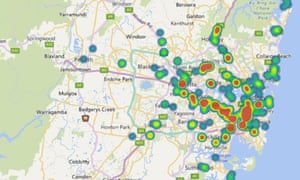
A heatmap of cranes in Sydney in the fourth quarter of 2017. Photograph: Rider Levett Bucknall

She believes many people would accept more density if it meant they also got more frequent transport services, more school places, a better choice of shops and services and improved housing affordability.

“That’s pretty much the narrative we’re getting. It’s not that people are saying they’re against density. It’s that they don’t believe that all the things they’ve been told are going to come with it are actually going to come with it.”

Corinne Fisher represents the Better Planning Network, an umbrella group for more than 400 local organisations. She says hostility to development stems ultimately from “a complete failure of process” in consulting residents before large projects are announced.

“If you’re going to ask people to accept, in the case of the Sydenham to Bankstown corridor, tens of thousands of new homes, then you need to come out upfront with a financial commitment for the … infrastructure that you are going to contribute to this development. And that really hasn’t happened anywhere.

“Densification can be done well … but you need to respect what people are telling you they love about their neighbourhood and to work with them to protect these features. And that may be that you don’t build so high. At the moment, the people driving the developments, and the heights of the units within any particular precinct, they are not the residents, they’re the developers. There is only one category of people driving the government’s decision making.”

The planning minister, Anthony Roberts, denies that claim, saying collaboration with local councils and early engagement with the community is a “fundamental element” of the planned precincts program.

“This ensures a planned approach to creating new homes and jobs located close to public transport, shops and services, while retaining and enhancing local character.”


Roberts cites the provision of 2.4 hectares of open space and a commitment of $22m in transport upgrades to support redevelopment around North Ryde station as an example of the government’s response to community consultation.

But both Easthope and Fisher say the government has relaxed its control of the densification strategy.


WestConnex: bitter battles mark the road to Australia's urban future

Read more

“If you look back at the 2005 metropolitan strategy, it was quite prescriptive about where the new development would occur,” Easthope says. “And then it didn’t occur in those locations – because the market didn’t support development in those areas. And then if you look at the 2014 metropolitan strategy, it’s much more pragmatic about the fact that delivery of apartments is largely market-led.”

Fisher blames wholesale rezoning and the “outrageous” ad hoc nature of the precinct designations for undermining the Greater Sydney Commission, the body that is meant to coordinate planning for the city.

“The public has no idea how the government is coming to these decisions and they also have no input as to where those priority precincts appear – suddenly there’s an announcement and, the next thing you know, they’re slapped with a proposal for thousands of new homes in their neighbourhood,” Fisher says. “And they basically have to accept the situation.

“It’s farcical, because the Greater Sydney Commission can’t keep up with the announcements.”

The commission declined to comment.
FacebookTwitterPinterest A poll found 66.4% of residents agreed that Sydney was ‘full’ and development should be pushed outside the metro area. Photograph: Mike Bowers for the Guardian
Winds of change?

Politically, the winds are blowing against the pace and scale of development. Labor has promised to tear up the precincts plan if it wins the next state election, due in March 2019. The party positioned itself strongly against “over-development” in Kristina Keneally’s campaign for the federal seat of Bennelong, which covers middle-ring suburbs in the north-west. At the launch of her byelection campaign with Bill Shorten, Keneally twice referred to the Liberal state government having “presided over thousands of unit developments in this area”.

As well as Sidoti, at least three Liberal MPs have expressed unhappiness at developments planned for their electorates. David Elliott, the member for Baulkham Hills in north-west Sydney, was so agitated by the plan for 8,200 new homes in Bella Vista and Castle Hill that he admitted using “unparliamentary terms” while making his case to the planning minister.

And the Greens have been at the forefront of opposition to many proposals for greater density. In a statement their NSW planning spokesman, David Shoebridge, painted an apocalyptic picture of the city’s future if present trends continued.

“Soon cranes litter the skyline, trees are lost and block after block of cookie-cutter apartment blocks fill the horizons. There’ll be no investment in public infrastructure like schools, green space and public transport. There’ll be no place for kids to play, for people to exercise. You won’t be able to get a seat on the train, schools will be so overcrowded they’ll have to stagger play times.”


I think we’ll see some changes as the 2019 elections get closerCorinne Fisher

Whether discontent will translate into more policy changes may become clearer as the election approaches. There are some straws in the wind, such as announcements that new schools will be built to accommodate the growing populations in Ultimo, Surry Hills and Green Square, which will become Sydney’s most densely populated suburb when the massive apartment complexes built there are filled. The huge unmet demand for schools was “essentially the result of assumptions on the part of state government that families with children wouldn’t live in apartments”, Easthope says. “Which were incorrect.”


Olive says the election is the only realistic chance to halt the current strategy and move towards a plan for rail corridors that do not simply duplicate the pattern that brings all lines into the city.

“There needs to be a direct link between any priority planning precinct and new rail lines, services and corridors. The emphasis is on the new – not conversions … If they want to densify a suburb, they need to link it by new rail services, that’s the crucial nexus between a 30-minute city and planning.”

Corinne Fisher says the government will be under increasing pressure to take the heat out of the protests by addressing the infrastructure deficit, particularly in light of its budget surplus and willingness to spend more than $2bn to knock down and rebuild Allianz and ANZ stadiums.

“I think we’ll see some changes as the 2019 elections get closer,” Fisher says. “There’s absolutely no doubt that [overdevelopment] will be a major election issue and the NSW government has lost an incredible amount of credibility and trust among communities. It will have to address this issue. If it doesn’t, I would say that would have a very big impact on how people will vote.”

Thursday, January 4, 2018

Making housing more expensive to build won’t make it more affordable

Making housing more expensive to build won’t make it more affordable


(Photo by David Crane, Los Angeles Daily News/SCNGA woman holds up a sign during a committee meeting at Los Angeles City Hall on the linkage fee.

By SUSAN SHELLEY | |
PUBLISHED: January 2, 2018 at 8:00 pm | UPDATED: January 3, 2018 at 12:31 pm


Only a politician could believe that making housing more expensive to build will create more affordable housing.

But in Los Angeles, that’s what Mayor Eric Garcetti and the City Council are asserting. In December, they approved a new “linkage fee” on new development aimed at raising $100 million per year toward a goal of building 1,500 units of new affordable housing annually.

Don’t bother with the math. They didn’t.

The idea of a linkage fee, which exists in some other cities, is to get money from developers whose projects will displace residents in existing housing or generate a need for additional housing, something that could happen if a new workplace was built.

Hardly anybody is building a new workplace in Los Angeles unless it has a drive-through, but play along.

The “linkage fee” in Los Angeles won’t specifically be linked to the impact from a project. It’s simply a new fee for building in the city.

The early draft of the linkage fee, which has been on Mayor Garcetti’s wish-list since 2015, would have imposed the same fee for similar developments regardless of where they were located in the city. But some council members objected to the one-size-fits-all charge.

So the final version divides the city into “high-market” areas like downtown, Venice and Brentwood, and “low-market” areas like South Los Angeles.

The linkage fee for office, hotel, retail and other commercial buildings is $3 per square foot in low-market areas, $5 per square foot in high-market areas.


For residential developments, the fee is even higher: $8 per square foot in a low-market area, $15 per square foot in a high-market area.

The money will go into the city’s Affordable Housing Trust Fund, and city officials say they’ll spend it to build hundreds of units of affordable housing.

Unfortunately, the number of Los Angeles residents who are in need of affordable housing is in the tens of thousands, and those are just the people sleeping on the sidewalks.

Meanwhile, the cost of all other new housing will go up, because developers have to pay these huge new linkage fees just to be allowed to build it.

There are two ways that residential developers can avoid the fees. One is by reserving a percentage of units in their projects for low-income renters. The other option, which is also available to developers of commercial projects, is to get out of Los Angeles and build somewhere else.

Many cities in the Southern California region don’t have linkage fees and don’t treat the construction of a commercial or residential building as a sin that requires some sort of political or financial penance.

In some places, local governments even offer incentives for developers and businesses, to encourage building and hiring.

That’s rare in Los Angeles, where the breathtaking decay of the city is considered incentive enough.

The state Legislative Analyst’s Office has done extensive research into the problem of housing affordability in California, including a detailed report released in the spring of 2016 titled, “Perspectives on Helping Low-Income Californians Afford Housing.”

“The scope of the problem is massive,” the report said, “Millions of Californians struggle to find housing that is both affordable and suits their needs. The crisis also is a long time in the making, the culmination of decades of shortfalls in housing construction. And just as the crisis has taken decades to develop, it will take many years or decades to correct. There are no quick and easy fixes.”

The LAO concluded that while “affordable housing programs are vitally important to the households they assist, these programs help only a small fraction of the Californians that are struggling to cope with the state’s high housing costs.”

To build public-subsidized affordable housing for the 1.7 million low-income California households that spend more than half their income on rent would cost more than $250 billion, by the LAO’s estimate.

But the problem is not just math, it’s logic. When it becomes more expensive to build housing, then less housing is built, and what is built is more expensive.

The LAO report said the real solution is more housing construction, and the scale of the problem can only be matched by privately built, market-rate housing.

“Doing so will require policy makers to revisit long-standing state policies on local governance and environmental protection, as well as local planning and land use regimes,” the report concluded.

So there really is something the government can do about housing affordability. It can get out of the way.