Tuesday, September 25, 2018

Utopianism: One of the Biggest Obstacles to Progress


What are the biggest obstacles to continued progress and to maintaining an open and free society?


One of the biggest obstacles is, broadly speaking, utopianism. Progress is neither guaranteed nor irreversible. The institutions and values that helped bring about the progress humanity has achieved are increasingly under attack by extremists on both sides of the political spectrum. Many nationalist populists on the right and self-proclaimed socialists on the left reject the Enlightenment values of reason, science, and open discourse, as well as free enterprise.


A realistic picture of the human condition should compare the imperfect present with a much more imperfect past rather than with an imagined utopia in the future, as well as acknowledge the truly incredible progress that humanity has already made. Unfortunately, instead of viewing the present as a vast improvement on the past, many people see the present as failing to live up to some sort of ideal world and deny the progress that has been achieved.


It is important to remember that living conditions remained remarkably constant throughout 99.9 percent of homo sapiens’ existence: poverty was ubiquitous. Then economic growth started to accelerate in Great Britain and the Netherlands, the rest of Western Europe and North America, and then the rest of the world. Markets globalized and the Industrial Revolution took productivity to new heights, causing the acceleration in economic growth and ultimately leading to widespread prosperity.


Modern society based on the rule of law, global exchange, and social tolerance, is an extremely recent phenomenon. It may also be more fragile than it seems.


The greatest travesties of the 20th century were carried out in the name of the utopian ideologies of communism and fascism. There is always the danger that new utopian demagogues will emerge.


Utopia will always be out of reach and the world will never be a perfect place. But by building on and learning from past successes it is possible to strive to make each day better than the last. Mankind has proven again and again that it is capable of rising to great challenges and solving problems that once seemed insurmountable. As my colleague Marian Tupy once wrote, “The danger lies in turning our backs on the means by which problems can be solved – reason, science, open discourse, thirst for knowledge, etc. The values of the Enlightenment are under assault from the far Left and the far Right. Both extremes believe that our world has been corrupted beyond repair. They want to blow it up and start anew. ‘What,’ they ask us, ‘do you have to lose?’ A lot, actually, should be our response.”


This first appeared on Quora.


Chelsea Follett is managing editor of HumanProgress.org.

Monday, September 24, 2018

On Government "Charity"


California must stop trying to stomp out suburbia

California must stop trying to stomp out suburbia


Photovoltaic panels like these would become standard on new California homes starting in 2020 under a proposed new energy code up for review in Sacramento on May 9. Currently about 15 percent to 20 percent of new houses in the state have solar power systems, a state building industry officials said. Here a SunPower Corp. employee finishes up installation of new solar panels at KB Home’s Terramor development in Riverside County. (Photo by Will Lester- The Press-Enterprise/SCNG)

By JOEL KOTKIN | Orange County Register
PUBLISHED: September 22, 2018 at 7:10 pm | UPDATED: September 22, 2018 at 7:10 pm

We may be celebrating — if that’s the right word — the tenth year since the onset of the financial crisis and collapse of the real estate market. Yet before breaking out the Champagne, we should recognize that the hangover is not yet over, and that a new housing crisis could be right around the corner.

This is particularly true in California, which took one of the biggest hits in 2008 as its sky-high prices collapsed, causing enormous problems in areas including the Inland Empire, where incomes are lower and the economy was largely built around new housing construction. The urbanist punditry helpfully came out in force to declare such areas as “the next slums”.

The unsurprising slowdown in housing after the Great Recession was further hampered, once the economy began to recover, in large part due to tough regulations. By 2017, California metros like Los Angeles-Orange and even the Bay Area were producing housing at half to one-third the rate, on a per capita basis, of places such as Nashville, Dallas, Houston, Orlando and even Indianapolis and Columbus. The shortfall in single-family home production, greatly discouraged by state policies, lagged even further. Stronger land-use regulations have been associated with higher land cost and regulatory delays driving house prices well beyond historic norms, as recent research indicates.

Toxic realities

Due to lack of affordable new product, prices have remained high, absurdly so in some areas. New state legislation, seeking to expand Jerry Brown’s climate jihad, including new mandates for solar roofs for new houses, promise to raise prices by at least $20,000 and without doing much for the environment, warns environmentalist Mike Shellenberger.

This is all part of a toxic regulatory overreach that led California housing prices, relative to incomes, to grow at three times the national rate since 2010. By one recent calculation by howmuch.net, California, with the exception of Hawaii, has by far the highest statewide gap — almost $50,000 — between the salary needed to buy a house and its price.

With more of the economy built around low paid “gig” and service workers, the pool of potential buyers is shrinking. California home sales overall are falling — down over 12 percent in the largest market, Los Angeles-Orange County. The biggest losers have been minorities and the young. Already barely 25 percent of people 25 to 34 in California own their own home compared to 37 percent nationally.

Ways toward a new bust?

We could be setting the stage for a new kind of housing debacle — and not only here. Higher interest rates tend to undermine the viability of high-priced markets in particular. There are other clear disturbing signs, such as the rising percentage of buyers paying 45 percent of their income on mortgages; the number is four times the percentage in 2010. Then there’s the return of the home equity loan market back to its pre-recession level.

The rising cost and declining sales also reflect to some extent the inability of governments and developers to catch new demographic trends. Instead of flocking permanently into dense cities, more millennials are following in the footsteps of previous generations by locating on the periphery of major metropolitan areas and sunbelt cities, most of which are simply agglomerations of suburbs. Over the last year, according to the Census, the ranks of renters decreased while homeownership increased 1.8 million. A recent National Homebuilders Association report shows more than two in three Millennials, including most of those living in cities, would prefer a house in the suburbs, findings confirmed as well by the Conference Board and Nielsen.

By trying to stamp out suburbia, California is playing fire with its own future. Already the price differences between our state and the rest of the country are greatest, notes demographer Wendell Cox, at the lower, “starter” end of the market. The state, sadly, seems to have little interest in meeting the demand of young families, posing a long-term demographic threat.

A different kind of debacle?

Instead, we may be overbuilding small expensive apartments. Already many analyses show that the apartment markets here, and elsewhere, including places like New York and Seattle, are doing worse than before, with rents stagnating or even declining.

Other factors such as the gradual withdrawal of Chinese buyers, in large part due to Beijing’s own financial problems, could play a role, particularly in places like California and New York. Now, for the first time in recent memory, there are more Chinese sellers than buyers as sales falter. Ironically new measures to address the housing shortfall, notably rent control and inclusionary zoning, may help some people, but will likely further slow new construction.


So what would a new bust look like? Some of the same people — middle- and working-class families as well as minorities — would be hurt. But the biggest pain may be felt more in expensive speculative markets like Manhattan, San Francisco, West Los Angeles or downtown rather than in the distant, and disdained, outer suburbs. To borrow from the late Yogi Berra, it could be “déjà vu all over again,” but with a somewhat different cast of victims.


Joel Kotkin is the R.C. Hobbs Presidential Fellow in Urban Futures at Chapman University in Orange and executive director of the Houston-based Center for Opportunity Urbanism

Sunday, September 23, 2018

FABLE: THE DOGS AND THE HIDES

THE DOGS AND THE HIDES

 SOME hungry Dogs saw a number of hides at the bottom of a stream where the Tanner had put them to soak. A fine hide makes an excellent meal for a hungry Dog, but the water was deep and the Dogs could not reach the hides from the bank. So they held a council and decided that the very best thing to do was to drink up the river.

All fell to lapping up the water as fast as they could. But though they drank and drank until, one after another, all of them had burst with drinking, still, for all their effort, the water in the river remained as high as ever.

Do not try to do impossible things.


[Illustration]

How to Buy a House the Wall Street Way

How to Buy a House the Wall Street Way

Institutional investors, using algorithms built to scoop up large volumes of rental properties, are becoming more Americans’ landlordsA house in Katy, Texas, sold by Martin Kay, whose company, Entera, is among the technology firms enabling Wall Street investors to buy large volumes of homes, shifting longstanding patterns in residential real estate. DANIEL KRAMER FOR THE WALL STREET JOURNAL

By
Ryan DezemberSept. 16, 2018 9:00 a.m. ET


To help Wall Street buy tens of thousands of houses, Martin Kay and his colleagues taught a computer to spot a sunny kitchen.

Ever since last decade’s foreclosure crisis, institutional investors have been gobbling up single-family houses and becoming landlords. They have criteria just like individual buyers: three or more bedrooms, two baths, a garage, good schools, low crime, high rental yields—and bright, sunlit kitchens. Unlike them, investors buy in volume and don’t have time to go to thousands of showings.


Enter Mr. Kay’s computers.


On any given day, there are tens of thousands of properties available for sale in each of the booming markets where these investors are active, including Atlanta, Charlotte and Nashville. They have many places to look: the multiple listing services that Realtors compile, online sellers, lists of nonperforming bank loans, foreclosure auctions.

Data scientist Martin Kay founded Entera Technology after using machine learning to comb through home listings to identify plum properties. “Going from 40,000 houses to 12 is a machine problem,” he said. “Going from 12 to one is a human problem.” PHOTO: DANIEL KRAMER FOR THE WALL STREET JOURNAL

Mr. Kay, who had built data platforms for the U.S. Energy Department and ConocoPhillips, started buying rental properties in Texas in 2010 at the depths of the housing crash. He used machine learning to mine mountains of home listings for those that might attract the type of tenants he wanted. For Mr. Kay and like-minded investors, that typically meant families seeking suburban lifestyles.

“Going from 40,000 houses to 12 is a machine problem,” he said. “Going from 12 to one is a human problem.” Rivals noticed Mr. Kay’s knack for snapping up plum rental properties and some asked for help. The company he and his partners created to work with them, Entera Technology LLC, is now one of several racing to apply sophisticated technology to Wall Street’s house hunt.
Bulk BuyersEstimated number of single-family housespurchased by institutional investors.Source: Amherst Holdings LLCNote: 2018 data through June
2010’12’14’16’18020,00040,00060,00080,000100,000

Progress Residential, which has built the third-largest pool of rental homes in the U.S., says its proprietary technology can find properties fitting its investment criteria within minutes of their listing. Following the housing crash, Amherst Residential, which has purchased and manages about 20,000 rental houses, adapted its existing system for valuing mortgage-backed securities to churn out acquisition leads, estimate renovation costs and predict rental yields. A.J. Steigman, a former child chess champion and investment banker, won funding and a prominent business-school competition this spring for a plan to use pattern-recognition software to identify mispriced homes.

“The financial crisis created a catalyst for a lot of institutional capital and minds to tackle the opportunity, but technology is what really transformed this into a business,” said Drew Flahive, Amherst Residential’s president.

In Amherst’s Manhattan office, employees search screens showing available homes in each ZIP Code. At the click of a mouse, the projected rental yields pops up above each property on a map. The estimates arise from a multitude of inputs, including renovation costs, which machine-learning tools constantly adjust to account for the outcomes of completed jobs on similar properties. Amherst has invested more than $100 million in the system, which has helped the firm pin renovation estimates to within about 5% of actual costs, down from the 20% overruns that were routine a few years ago, executives said.

For Entera, the technology became the business. Mr. Kay and his partners have been selling the Texas homes they bought after the crash to fund Entera’s transition to a software company, reasoning that their specialty was big data, not collecting rent. Plus, their rivals had much more to spend, and there is a potentially huge market of smaller investors for the company’s services.

Early customers included American Residential Properties Inc. and Colony American Homes Inc., which are now part of American Homes 4 Rent and Invitation Homes Inc.,respectively. Entera continues to be among the technology providers to Invitation, which owns more than 80,000 houses.

Like a dating app, Entera starts by asking clients what they want. Besides screening for easily quantifiable characteristics like age, number of rooms, square footage, school district, property taxes and flood-zone status, it also attempts to measure qualitative

AMERICAN MIGRATION: EXPLORING WHERE PEOPLE MOVE ACROSS AMERICA

AMERICAN MIGRATION: EXPLORING WHERE PEOPLE MOVE ACROSS AMERICA

Clark_County,_NV,_USA_-_panoramio_-_yesid_ferney_patiño_….jpg
Just a few years ago, experts indicated Americans (especially young Americans) were more interested in a different lifestyle than previous generations. Instead of owning a house in the suburbs, the new American dream consisted of renting an apartment in the city.
Recently, though, Americans of all ages have begun to leave major metropolitan areas like New York City and Los Angeles. Over the last five years, population growth in big cities has shrunk, and people are packing up and moving again.
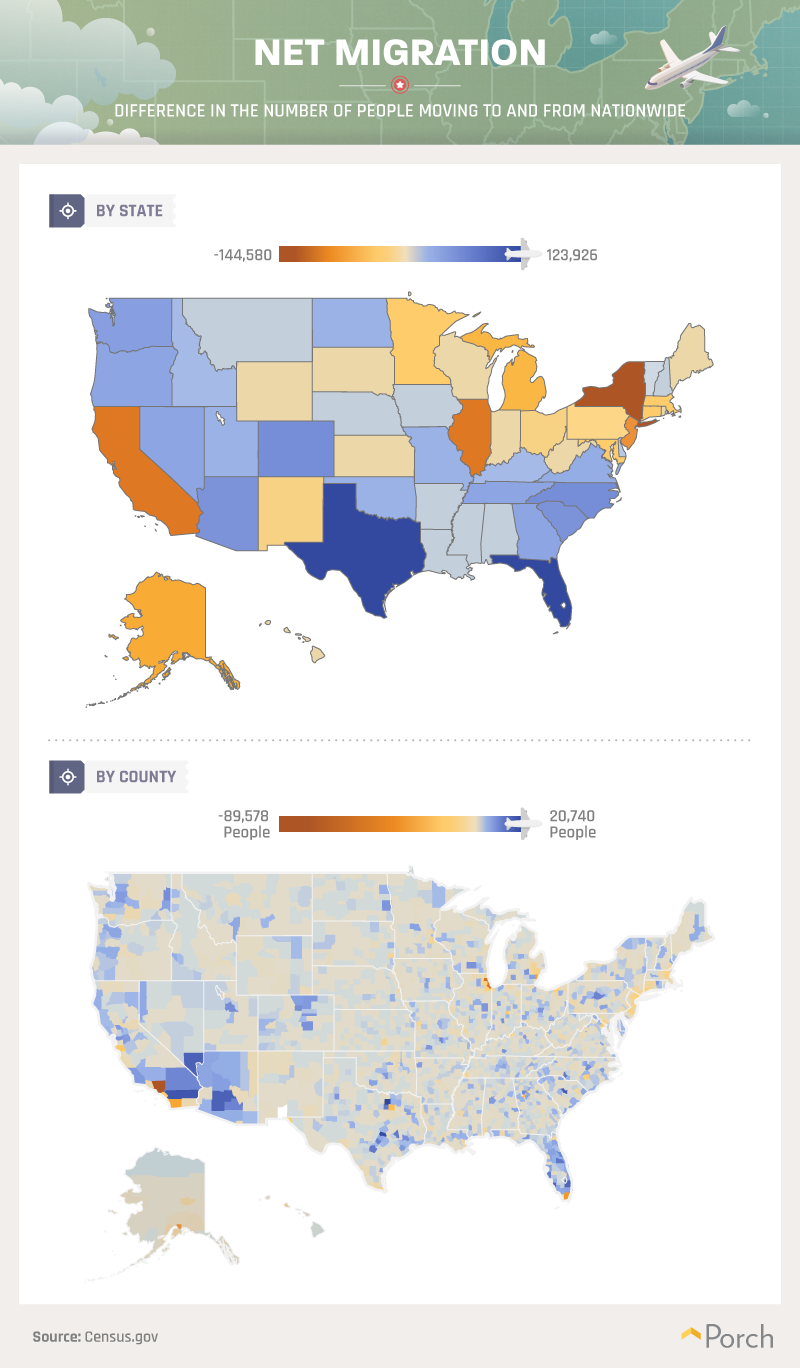
But where are they going now? We analyzed census data from the last five years to explore the counties and states where the most people are putting down roots. Let's take a look.


Living just a train ride away from Manhattan or a few hours from the Santa Monica Pier or Golden Gate Bridge might sound like the life—and for some people, it is—but people may now be looking elsewhere to settle down.
This graphic helps illustrate which U.S. states have seen the highest net migration, both in and out, between 2011 and 2016. As you can see, states in the Northeast saw a larger negative net migration, while Southern states had a strong influx of newcomers.
Additionally, states with some of the most popular metropolitan areas, including New York, California, and Illinois, had substantial negative net migration as well.


"There's no place like home" is meant to convey that even when you live somewhere else, you'll always have a certain fondness for your home. That is unless you can find someplace better.
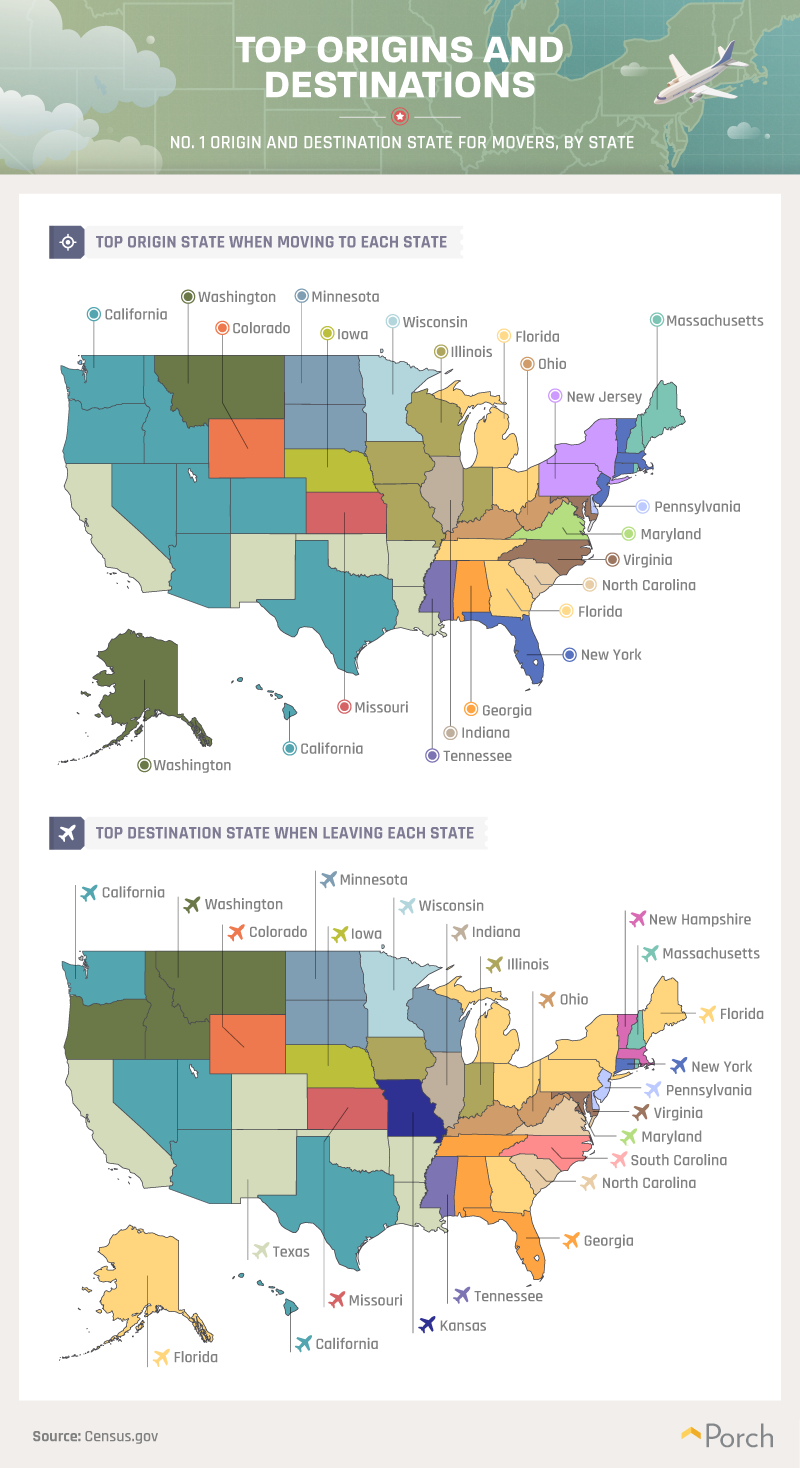
From the data, we learned there was actually quite a lot of back and forth between state borders. While a majority of people moving to the West Coast (including Utah, Washington, and Oregon) came from California, people from these states typically relocated to California as well. Similarly, people living in states like New Mexico, Oklahoma, and Louisiana generally moved from Texas, but people from these same states were also more likely to relocate to Texas.
It's no wonder, though, states like Texas and California continue to be popular destinations considering their successful employment rates. Of course, some states also come with a fairly hefty price

Saturday, September 22, 2018

Marin Voice: The name ‘Dixie’ is a throwback to the days of human suffering

Marin Voice: The name ‘Dixie’ is a throwback to the days of human suffering

By NOAH GRIFFIN |
September 21, 2018 at 10:00 am


The fight to strike the name “Dixie” from a Marin County school district is as old as the Republic and as young as the memory of those unmindful of the past. The arguments against the name change are straight out of the civil rights resistance playbook.

One of the arguments is that the people advocating change don’t live in the district. But of the 23 speakers at the last Dixie School District board meeting, 18 live in the district. Other longtime veterans who initiated the struggle still live in the county and were asked to participate. Similar “outside agitator” labels were leveled at Martin Luther King Jr. when he left Atlanta to go to Alabama. He answered them in his “Letter from the Birmingham Jail” — “Injustice anywhere is a threat to justice everywhere.”

Truth is no less true because of who says it or where they live. Some whites claim not to have witnessed racism in the district. To tell minorities what to be offended by, when to feel offended and under what circumstances is a refutable presumption. As Abraham Lincoln said, “Only he who wears the shoe knows how tightly it fits.”

Alums of Marin County high schools such as Tina Mitaine had to endure Slave Day in 1988 when white students came to school in black face. Others withstood Mexican Day, when wearing sombreros and bandoleros was thought funny. Sally Matsuishi, on the anniversary of Pearl Harbor, found “Jap” painted on her locker at a Marin County school. Her counselor excused the slur with another, explaining that it might have just meant she “was spoiled.”

In the past two years the painted “N” word greeted the newly arrived principal at Tamalpais High School. The same word was recently spray-painted at Redwood High with the name of a long-time counselor attached.

Tam High faced its own moment of truth in 1988 when it changed its mascot from the Indians to the Red-Tailed Hawks. San Rafael barbershop owner Tino Wilson told me recently he started the school as an “Indian,” finishing as a “Hawk.”

Researching history clearly shows nothing is new. The arguments then were against political correctness, the desire to maintain history and tradition. Basically, their view? Get over it. Dixie area residents may soon find themselves up Miller Creek without a paddle.

Think back to the resistance to Muhammad Ali changing his name from Cassius Clay. Or Pittsburgh Pirates outfielder Roberto Clemente demanding to be called by his given name and not Bob, as the sportscasters insisted.

“Dixie” is an anachronistic throwback to an era of slavery, bondage and human suffering. By maintaining the name, we do a disservice to the district, the county and the children we seek to educate. It is disingenuous to maintain that Dixie is anything but synonymous with the Confederacy. That was acknowledged in the Dixie School Foundation’s application for landmark status.

See the full article HERE

Editor's Note: I do not know anyone who associates the name of the Dixie School District with the Confederacy but still I feel this issue should be discussed.  Unfortunately, the rhetoric has gotten very heated.  Let's listen to each other anyway and try to sort this out as neighbors.

Calpers, Pensions and the Managers Fiscal Report


Friday, September 21, 2018

CSD meeting on 9/11/2018 Full Video


Marinwood CSD approves to "Rent a Fire Chief" from San Rafael for $98,000


After lamenting how expensive the contract is with San Rafael, the Marinwood CSD board votes unanimously to approve a $98,000 contract that is already covered in our shared services agreement. Irv Schwartz wants to revisit this soon.  

Marinwood Fire Department spends 66% of all emergency calls responding to the City of San Rafael and we receive little in return.  In the past we were paid $300k annually.  In addition we have been paying a paramedic tax for SEVEN years to San Rafael and still do not have a paramedic on staff in Marinwood as promised. 

Clearly, neither the CSD board, or our staff is up to the task of negotiation.  We need to find a new approach to our fire service that does not exploit Marinwood taxpayers.


Tuesday, September 18, 2018

CSD Maintenance Compound parking lot FAIL


The Marinwood CSD Maintenance Compound is designed only to store vehicles at night. During the day, vehicles will park in front of the facilty.  The dump truck, trailer, landscaping debris and bulk
materials will remain outside permantly as before.  Due to the "drive through" design and poor soils at the Eastern end of the building, vehicles will be forced to turn around in the meadow 300' to the east.

This is simply unacceptable. The unusual design is expensive and inefficient for material storage and vehicle movement. A conventional side access garage like the one below allows easy access to
vehicles, tools and equipment.  Unfortunately, the architect does not like garage doors for aesthetic reasons and is forcing his design on the workers and the people who object to the excessive size.

Side access garages allow easy access to vehicles and equipment. A narrow garage like this will not block the walking path.

We can build a Small Amphitheater in Marinwood Park

As everyone in Marinwood  knows, Marinwood Park is a popular place for picnics and music.   A small steel amphitheater like the ones below are inexpensive and very functional.  In addition to providing a small outdoor theater, the space can function as a shaded picnic area, drama stage and outdoor classroom.  It will provide an attractive focal point for the community at a very low cost.  Many manufacturers have stock designs, ready to ship starting around $7500.