Monday, August 29, 2016

And Now, Habitat III, the Olympics of Urbanization


And Now, Habitat III, the Olympics of Urbanization

The UN summit, coming in October, happens only every 20 years and aims to chart the path of global cities in the 21st Century.
An aerial view of a slum in Caracas, Venezuela. (Carlos Garcia Rawlins/Reuters)
The summer Olympics in Rio are fading into memory, but the world’s attention did focus, however fleetingly, on urban conditions in the Brazilian city—the challenges of life in the favelas, the specter of crime both real and imagined, and the future uses of new infrastructure that made the games possible.
Now comes another international event that most people aren’t aware of, also in a South American city, that has an even greater mandate: to set an agenda for the world’s rapidly urbanizing metropolitan areas. There won’t be any medals awarded at Habitat III, the United Nations-led global cities summit set for Quito, Ecuador, in October. But organizers are hoping for a similar zeitgeist: calling attention to the urgent need to better plan the planet’s cities, particularly in the developing world.
This summit only happens every 20 years. Habitat I was held in Vancouver in 1976, followed by Habitat II in Istanbul in 1996. Those meetings established a basic framework for wrestling with the challenges facing the world’s cities, but never quite set an implementable set of policies or goals concerning urbanization. With Habitat III, the United Nations agency charged with guiding sustainable urban policies worldwide—the UN Human Settlements Programme, also known as UN-Habitat—recognizes this may be the last best chance to chart a course for the rest of the 21st century.
It’s hard to get the countries of the world to agree on anything. But organizers, led by UN-Habitat executive director Joan Clos, a former mayor of Barcelona, are hoping for the global urban policy equivalent of the COP-21 consensus on limiting greenhouse gas emissions, forged in Paris last December. The sense of urgency is palpable—that it’s now or never.
Why all the heavy breathing? As readers of CityLab well know, more than half the world’s population, currently some 7 billion souls, now lives in cities. By 2050, two-thirds of the planet’s projected population of nearly 10 billion are expected to inhabit metropolitan areas. The rapid increases now are mostly attributed to rural migrants streaming in, in search of a better life; future generations will be born in the metropolis. The most growth will occur predominantly in the developing world, in sub-Saharan Africa and Asia.
The problem is that on the whole, this extraordinary process of urbanization isn’t going particularly well. The UN estimates that nearly 1 billion people are currently living in informal settlements, or slums, without access to basic services such as sanitation and clean water. Two-thirds of rural migrants in Africa are believed to be moving straight into shantytowns.
Analysis of satellite data from a forthcoming revision of the Atlas of Urban Expansion, a project led by my employer, the Lincoln Institute of Land Policy, shows an incredible sprawl of slums, expanding outward at the far periphery of the urban core, from Accra to Dhaka. At current rates, this unplanned growth worldwide will eat up land equivalent to the entire country of India. This vast consumption of land comes coupled with a poor quality and character of growth. It’s inefficient, willy-nilly, bad for ecosystems, bad for food security, and above all, bad for billions of poor people. Such inhumane conditions, in many cases exacerbated by the impacts of climate change, will be a tinderbox, increasing instability for the entire world.
What’s been clear is that the cities accommodating this unprecedented population growth have been woefully unprepared. It’s a little like driving a bus with a fraction of the capacity for riders, with no schedule and no route. The conceit of Habitat III is to suggest that there must be a better way. Improving the future growth of the world’s cities entails basic urban planning, inclusive economic growth, and principles of sustainability, both fiscal and environmental. UN-Habitat seeks to help cities grow more sensibly and humanely, and give them the tools and policy frameworks to achieve that mission. Simple enough.
The summit is supposed to conclude with an agreed-upon document of policies, commitments, and principles for 21st century city-building, ambitiously called the New Urban Agenda. This manifesto contains high-level language recognizing the central role of cities in the planet’s future, detailed statements about gender equality, disaster risk reduction, the financing of basic services and infrastructure, and also phrases such as: “Leave no one behind, by ending poverty in all its forms and dimensions, including the eradication of extreme poverty.” They’re not kidding around.
For the New Urban Agenda to be official, UN member states have to agree to it, which is the major challenge. In what might be described as typical parliamentarian wrangling for the international organization, the members have found it hard to reach consensus. Part of the problem is that the members are nations, while the New Urban Agenda is all about cities—local or “sub-national” governments in the parlance. Different countries have different ideas about what’s important, and resist being held accountable—to the extent they would be—on things they don’t agree with. There are turf and power issues riddled throughout.
The document was actually supposed to be finalized at a pre-Habitat III meeting in Surabaya, Indonesia, in July, but negotiators couldn’t resolve major differences, including where or whether to use the word “commitment.” Some even questioned whether UN-Habitat should be the entity in charge of the implementation of the New Urban Agenda.
It’s all not exactly what organizers had in mind heading into Quito. But something good can still come out of Habitat III. Negotiators are planning to meet in New York City next month to try to finalize the New Urban Agenda document, so the summit itself can focus more on implementation.
And while it is important to have a bold and firm United Nations statement on the future of the world’s cities, there are parallel global efforts related to cities that have more teeth. Chief among these are the aforementioned Paris climate agreement and the UN’s Sustainable Development Goals, a 17-point game plan for the planet through 2030. One of those goals, referred to in revered tones by Habitat III insiders, is Goal 11, which sums things up pretty nicely: “Make cities inclusive, safe, resilient and sustainable.” Member states have already agreed to be held accountable, as much as that is possible, for achieving those goals.
The New Urban Agenda, never conceived as a binding charter, might benefit from being more flexible: making it a living, evolving document, where stakeholders can get together and add initiatives or frameworks when it becomes apparent they would be useful. That approach could also allow for advances in technology and smart infrastructure. A clean energy source or sanitation system that hasn’t yet been invented could reshuffle priorities.
Throughout, the Habitat III hopeful have also been mindful of accentuating the positive. The focus shouldn't be just triage to avert dystopia, but how cities are solutions that can do enormous good for the world. An important component here is enabling a two-way North-South dialogue, where successful cities share pro tips, but emerging economies also showcase innovations and experimentation. It could even be fun.
When up to 30,000 dedicated urbanists converge in the nearly two-mile high Ecuadorean capital in a little more than seven weeks, some sort of positive action is very likely. The summit seems poised to serve as a catalyst, promoting ferment among non-profit and civic institutions, and potentially enabling all kinds of partnerships focused on sustainable city-building initiatives. This is utter bias on my part, because I’m part of one of those institutions. It may also be the shared optimism of all those who have been involved in Habitat III, because at the end of the day, this is all about an organized effort to improve life for billions of people. Like the planet of cities the conference is focused on, it’s too big to fail.

Sunday, August 28, 2016

Saturday, August 27, 2016

Freedom for Liberland

Marin Organizing Committee at Marin County Board of Supervisors 8/23/16


Thomas Gable, pastor of Marin Lutheran Church and member of the Marin Organizing Committee asks Marin Board of Supervisors for help finding an expanded , year round shelter for Ritter House. The homeless population increased 40% from 2013 to 2015 as reported by Marin Health and Human Services. Homeless clients from Berkeley, San Francisco and Out of State come to San Rafael to receive generous assistance. The Ritter house program for the Homeless has expanded rapidly. A new "low barrier" shelter operating 24 hours a day and 7 days a week will require massive public funding and a 24 hour professional staff. The current program is run with volunteers. The last location proposed by Ritter House would have TRIPLED the size of its current facility. While most people are generally supportive of the core mission of Ritter House, most believe that it must be managed properly and should be serving the local population.

Baltimore Police Secretly Running Aerial Mass-Surveillance Eye in the Sky

Baltimore Police Secretly Running Aerial Mass-Surveillance Eye in the Sky


By Jay Stanley, Senior Policy Analyst, ACLU Speech, Privacy, Technology Project
AUGUST 24, 2016 | 11:30 AM


Baltimore from air by aa440 credit.jpg


Bloomberg Businessweek reported late Tuesday that the Baltimore police have been subjecting that city to a vast and powerful aerial surveillance system since January, without telling, let alone asking, the public that they serve. This is a big deal.

This system, known as “wide-area surveillance” and run by an Ohio company called Persistent Surveillance Systems, involves the deployment of megapixel cameras on a Cessna aircraft, which circles over a city for up to 10 hours at a time, continuously photographing a 30-square-mile area and giving police the ability to retroactively track any vehicle or pedestrian within that area. It is the ultimate Big Brother “eye in the sky.”

I have been warning against this technology since early 2013, and wrote about it again a year later after Persistent Surveillance president Ross McNutt gave me a presentation on it. Then, in 2015, we learned that Cessna aircraft were circling over Baltimore in the wake of protests following the police killing of Freddy Gray, and immediately feared that this kind of wide-area surveillance was involved. Further reporting revealed that these flights, which were also spotted over many other American communities, were being run by the FBI, which told the AP that its fleet was “not equipped, designed or used for bulk collection activities or mass surveillance.” At the time, we were relieved to hear that.

Now we learn that wide-area surveillance is being conducted over Baltimore. And despite all the public questioning and statements of concern by us and others, and our freedom-of-information requests, and the extensive press coverage the FBI’s Baltimore flights received, the Baltimore police did not see fit to ask the public's permission to use this startling new technology on the city’s population. Instead, it arrogated unto itself in secret the decision to deploy this technology. It continues to be stunning that American police forces feel that they can use deeply radical and controversial surveillance systems, which raise the most profound questions about our society and its values, without telling the public that will be subject to these technologies—the public they are supposed to be serving.

In fact, the Baltimore police went out of their way to avoid telling the public what they were doing. As Businessweek reports, they refused to comment on the program for the story, and the city has not even acknowledged that it exists. When photos from the system led the police to believe that a man was involved in a high-profile shooting, the police didn’t answer questions from the community about why they suspected the man in question. (To give credit where credit is due, McNutt, unlike the police and unlike other surveillance companies such as the makers of Stingray cell phone tracking equipment, was forthcoming about his company and technology with Businessweek, as he was with me, and said that he believes the technology should be used in a transparent, publicly acknowledged manner.)


#TAKECTRL OF YOUR DATA

JOIN TODAYWhen the police in Dayton, Ohio presented a proposal to use persistent aerial surveillance, community members strenuously objected, and the city's political leaders dropped their attempt. But because of the secrecy in Baltimore, residents there never had that chance.


It is all the worse given the Department of Justice’s recent scathing report of rampant, long-running and pervasive racial bias in the Baltimore Police Department and an almost total lack of accountability for wrongdoing.

The Baltimore program, Businessweek reports, has been funded by a private Texas philanthropist. As we so often see with surveillance technologies, from license scanners to Stingrays to drones, this outside grant functioned to short-circuit democracy, because it meant the police did not need to bring a funding request to the city council or other elected officials, who might have brought up the significant values questions that this technology raises, and asked what checks and balances were in place to govern such a powerful surveillance system.

Several other points about this technology from the article:
One of Ross McNutt’s arguments for why this system is not overly intrusive is that the photographic resolution is very low. He emphasized to me that the system “can’t tell who a person is,” and as Businessweek describes, a pedestrian surveillance subject appeared as “little more than a faint, grainy dot with no identifying characteristics.” Analysts also can’t tell the make or model of the cars they can follow around a city. However, Businessweek also makes clear that this is a hollow argument. In several instances described in the story, police were able to match an aerial “pixelated dot” pedestrian to one of the more than 700 street-level police cameras installed around Baltimore, and obtain clear ground-based photographs of a subject. Surveillance systems never stand in isolation; there are always synergies at work. And as the article also notes, the “pixelated dots” can be followed forward and backward in time as they enter and exit homes and other buildings, and even without any other technology, that simple fact can be used to identify people. Indeed, the entire purpose of the system is to identify particular individuals.

McNutt assured me in 2013, “We only do major crimes; it's all we have time for.” But Businessweek describes a Persistent Surveillance analyst working (“for practice”) on a case involving the “illegal dumping of wood,” and how the system is used for other, less-than-major crimes, such as the driving of illegal off-road motorcycles on city streets. At one point Businessweek describes McNutt, eager to show how his technology can deal with serious crimes, exclaiming, “I’m tired of these little hit-and-runs.” Furthermore, the article portrays McNutt as using his system to “monitor[] the city’s reaction to the Goodson verdict,” in which an officer charged in the death of Freddy Gray was acquitted. Such a mission not only goes far beyond the serious-crime scope that McNutt describes in his presentations, it touches on the sensitive area of citizens exercising their First Amendment rights to protest. Later in the article, one of McNutt’s employees is described talking about being alert for the possibility of disruptions by Black Lives Matter activists. All of which is a major reminder of what Americans can expect if they swallow this technology: it will likely undergo mission creep and expand across numerous dimensions once deployed.

The operation of this system as observed by Businessweek is quite labor-intensive, from the operation of the plane to the somewhat laborious manual analysis of imagery. Yet we can expect that eventually the Cessna will be replaced by a far cheaper drone, the attached cameras will become even more powerful, and the analysis will be automated by every-smarter AIs. (Those AIs might even go from responding to police reports of crime to pro-actively watching the movements of everyone in an attempt to detect “suspicious” activity such as aimless movements.) All of which will mean the technology becomes cheaper, more widespread, used for an ever-widening set of purposes (bank robbers today, jaywalkers tomorrow).

Businessweek details how this technology is a direct import into American cities from the overseas battlefields of the last 15 years: it is a domestic adaptation of a technology that McNutt first developed for the Pentagon to use in Iraq. This is an all-too-typical pattern when it comes to surveillance technologies.

It’s unclear what the retention period or policy is for the imagery captured by this system. The article mentions that analysts can review footage “weeks” after it’s captured, but is no more specific than that. In my talk with him, McNutt indicated that he would leave such policy questions up to his individual police department clients.

People sometimes ask how this technology differs from ground-based cameras. Baltimore, like some other cities, has a lot of ground based cameras, but those cameras do not cover every square inch of the city, and their feeds are not stitched together with an artificial intelligence agent that is capable of using them in a coordinated fashion to follow individuals around anywhere within a 30-square-mile area. Make no mistake: this technology is a big leap toward an unknown surveillance future.

McNutt describes this technology as “Google Earth with Tivo.” But another description might be giving the government a virtual time machine, which allows them to go back and retroactively surveill any of us at any time. It is the technological equivalent of having a GPS attached to each and every one of us every time we walk out of our door. This is a technology that promises to do for our physical movements what the NSA has aimed to do with our communications: collect it all. Simply put, that is an enormous amount of power to give to a government agency. We Americans (as well as the residents of other countries) are going to need to decide whether we are willing to accept the potentially sweeping changes this could bring to our society.


Editor's Note:  Marin County is increasing its surveillance technology everywhere in Marin. Virtually every major intersection and highway is monitored by cameras and tracking devices.  Know that most "random traffic stops" are not random at all.

Can we be far behind Baltimore?

Camera at Las Gallinas and Lucas Valley Rd in Marinwood(San Rafael)

Friday, August 26, 2016

Cannibal Corpse - Evidence in the Furnace (Ukulele cover w/ Sarah Longfield)

Marin Supervisor Kinsey wants to tax YOUR home equity!


Supervisor Steve Kinsey wants to tax home equity at the time of sale to create a massive fund to build tax subsidized apartments. The chief benefactors of his scheme are affordable housing developers, financiers and the poor. He would take from literally EVERY retiree and investor in Marin to pay for this housing scheme. The middle class homeowner and retiree would be hurt the most since few have outside investments and do not receive a guaranteed government pension. Video from the 8/23/2016 Board of Supervisors  meeting. See link in video for full meeting.

So what if Marin is "Unaffordable"?

Editors Note: So what if your hometown is "unaffordable"? Isn't this a good thing for the rest of America? Thought provoking article in Bloomberg.

So What If New York Is Unaffordable? That Helps the U.S.

AUG 22, 2016 9:00 AM EDT
By Conor Sen

There's no real national debate when it comes to housing policy.

Journalists and pundits on one side shout: "We need more development and density so cities will be affordable and livable." For good measure they add: "People who don't support more development and density are heartless and just defending their own property values."

The other side … is probably a bit daunted and chooses not to pipe up.

Well, I'm piping up.

The pro-development pundits tend to live in expensive and hemmed-in cities like New York and San Francisco. I do not. As an Atlantan, I see many benefits of density limits in highly desirable communities.


When housing demand in one area exceeds supply, the obvious benefit is for people who already own homes there, as their properties become more valuable. But this rising price also benefits the communities to which people move if they cannot afford the first area. This is a wealth transfer from the most desirable communities to the upwardly mobile ones. The tens of thousands of people who leave New York and California every year act as sources of new demand in the places to which they move, like Florida, Texas and Colorado.


But sure. I get it. New Yorkers and San Franciscans see those departures as a failure of policy and would prefer to build, baby, build. I complained in unison with them when I lived in San Francisco. No longer.
Here in Atlanta, as in the rest of the Sun Belt, job migration is the driving force of the economy. Corporate relocations and expansions are celebrated here the way billion-dollar tech startups are celebrated in Silicon Valley. The "New South" would not have developed were it not for people looking to flee the crowded and expensive cities of the Northeast.

Some economists argue that this migration from high-cost to low-cost cities acts as a drag on productivity and national output, because less dense cities are less productive than more dense cities. This theory is running up against a new reality, however. If you think of wages as a proxy for productivity, the numbers back this up: San Francisco tech workers have less and less of a salary advantage over tech workers in other cities.

Even if the productivity argument holds, there are economic equality and civil rights benefits to migration from coastal metros to less-developed ones like those in the Sun Belt. Job convergence between metros "spreads the wealth," ensuring that tech workers in Raleigh and Atlanta and manufacturing workers in South Carolina and Alabama have access to good jobs too.

This logic applies even within state lines. Urbanist Pete Saundersmakes the point about Chicago in particular: Most cities don't have a shortage of housing, just a shortage of housing in the neighborhoods where wealthy young people want to live. Policies that constrain development in the more-developed parts of cities can facilitate development in less-developed neighborhoods. Here in Atlanta, upper-middle-class workers who can't quite afford Buckhead or Brookhaven have created a development boom in Chamblee, a city with a military and manufacturing legacy. Rising land prices in Midtown have led to increasing amounts of activity in long-neglected neighborhoods to the south surrounding Downtown.

Over the past 50 years, Southern communities with more-developed business interests have made progress on civil rights before those with less interdependence with the national economy. One of the reasons Atlanta made more progress on civil rights in the 1960s than Birmingham was the local business community was afraid of losing access to Northern capital. Similarly, when "religious freedom" bills and other measures seen as anti-gay arose in Indiana, North Carolina and Georgia, national business interests like Apple and Pfizer (not to mention Nascar) pressured politicians to stand by gay rights. Donald Trump's shrinking electoral map is in part due to the spread of well-educated professionals to Virginia, Colorado and North Carolina.

Those facts all reflect economic relationships that would not exist, or would not be as strong, without housing constraints in coastal communities that accelerate the migration of talent and jobs to these communities. Density limits in leading cities fuel the economies of rising cities like Atlanta. The new economies of rising cities like Atlanta fuel economic equality and civil rights.

Housing constraints in some cities accelerate economic development in emerging parts of the country. They decrease economic inequality between metro areas and lead to economic interdependence that drives civil rights. And they offer some promise to ease the pain of waning communities in the Rust Belt, Appalachia and beyond. A country where the vast majority of talented people move to one or two cities might be an economist’s idea of utopia, but a nightmare to those of us concerned about equality of economic opportunity.

New Yorkers and San Franciscans can be forgiven for wishing for more and more development to bring down their housing costs. But if you zoom out, the current constraints are benefiting the nation as a whole.

It has an effect similar to the transfer in federal tax revenue every year from New York and California to poorer rural states like Mississippi and Arkansas. Yet pundits don't seem scandalized by this movement of money; they dwell on the movement of people.

Thursday, August 25, 2016

African cities are starting to look eerily like Chinese ones

African cities are starting to look eerily like Chinese ones

WRITTEN BY
Lily Kuo


August 16, 2015 Quartz Africa

It’s easy to see China’s footprint in Africa. On the outskirts of Nairobi, a new highway built by a Chinese firm is crowded with bumper-to-bumper traffic, many of the cars set on tires imported from China. The landscape is dotted with construction sites and, every so often, the logo of another Chinese construction firm. Across the continent, Chinese companies are building highways, railways, sports stadiums, mass housing complexes, and sometimes entire cities.

But China isn’t just providing the manpower to fuel quickly urbanizing African cities. It is exporting its own version of urbanization, creating cities and economic zones that look remarkably similar to Chinese ones. Journalist Michiel Hulsof, based in Amsterdam, and architect Daan Roggeven in Shanghai, began visiting the continent in 2013 to document and investigate whether China’s model of urbanism can work in Africa.

Beijing Road in Nairobi.(Michiel Hulshof and Daan Roggeveen)

Their conclusion? Doubtful. “Simply put, political and economical realities in Africa and China differ too much for a straight forward ‘copy and paste’ approach,” they wrote in an essay about their project, Facing East: Chinese Urbanism in Africa. “All in all, there seems to be no one single answer to the question of the Chinese urban model ‘working’ in Africa. Sometimes it does, sometimes it doesn’t. And sometimes it doesn’t yet.”

“Now, Africa is urbanizing at the same pace as China did in the past 30 years, but in a process that is less coordinated and aligned.” Quartz: You interviewed over a hundred Chinese and African architects, politicians, entrepreneurs and citizens in six African cities. What were you hoping to find?

Daan Roggeveen: Our focus was the influence of China and China’s urban model on Africa’s urbanization, and in particular the way African cities develop. In every city we looked at one or two different research topics—in Nairobi, mass housing, in Addis Ababa, infrastructure and Special Economic Zones, in Lagos, the Special Economic Zone, in Kigali, the idea of Rwanda as the “Singapore of Africa.” For each topic we tried to find people that have a specialist view on these particular subjects, like certain academics, entrepreneurs, journalists, and politicians.


Photos: African cities are starting to look eerily like Chinese ones

Marin County Supervisors on Affordable Housing Fees on August 23, 2016

Wednesday, August 24, 2016

It Looks Like the Soda Tax Paid Off in Berkeley (NOT!)

"Gee,  I wish the "Smart People" made all the decisions for everybody"

Editor's Note:  Did the Marin Soda tax ever pass?   These politicians and activists piss me off.  Don't they have something better to do with their lives?  I don't believe this report in the least.  I'll bet people just buy their soda in a neighboring town.  Idiots! ( and I don't even like soda) 


It Looks Like the Soda Tax Paid Off in Berkeley

Consumption of sugar-sweetened drinks dipped 21 percent after a tax was enacted, a new study finds.

AP Photo/David Goldman

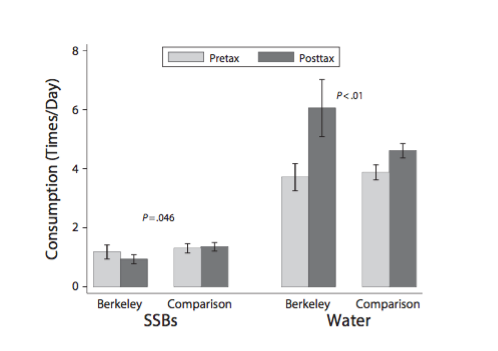
Consumption of sugary drinks has slid by 21 percent in Berkeley since a one-cent-per-ounce tariff was imposed on sweetened beverages, according to a study published today in the American Journal of Public Health.
The tax sailed through in a landslide vote in November 2014 and went into effect the following March. Proponents pointed to sugar as a culprit in chronic conditions such as obesity and diabetes. Intervening to curb consumption, they argued, would lead to a public health windfall.
This new study, the authors write, is the first to evaluate whether or not folks did shun sugary drinks. To gauge residents’ drinking patterns, researchers from UC Berkeley and UC San Francisco conducted two rounds of in-person surveys of approximately 2,500 people aged between ages 18 and 94. The first surveys were performed between April and July 2014, when the tax was still a proposal. 
Follow-up surveys were conducted between April and August 2015, after taxation began.Since poor, minority populations are most acutely impacted by grocery taxes, researchers positioned themselves to intercept foot traffic in low-income areas with high proportions of black and Hispanic residents, based on 2010 census tract data. Participants were asked to describe what sorts of drinks they consumed, and in what quantities.After the tax was imposed, soda intake decreased by 26 percent, and consumption of sports drinks dipped by 36 percent, the researchers found.
And when they rebuffed sugar-sweetened sodas and juices, Berkeley residents turned to the tap; the researchers reported a 63 percent increase in water consumption. “Not only was the drop in sugary drink consumption in Berkeley greater than we expected, the apparent shift to less harmful products like water is a very good sign,” Kristine Madsen, a study author and associate professor of public health at UC Berkeley said in a statement.

The study measured how often participants drank sugar-sweetened beverages and water both before and after the beverage tax went into effect in Berkeley, as well as comparison cities of Oakland and San Francisco, which don’t tax sweetened drinks. (American Journal of Public Health)
The authors couch their findings with a number of caveats. It’s unclear, for instance, whether the tax itself was the main deterrent for consumers who changed their buying habits; it’s possible that the awareness about the health benefits of avoiding sugary drinks actually propelled that choice. Still, it’s worth noting that the nearby cities of San Francisco and Oakland—which voted against similar taxes—saw a 4 percent uptick in consumption over the same period.
While the tax is collected from distributors, the researchers noted in previous work that store owners passed that price hike on to consumers. By November 2015, the cost of soda in Berkeley had crept up by 0.69 cents per ounce, compared to the price in Oakland and San Francisco. Sometimes, as I’ve previously reported, grocery taxes spur residents to take their business elsewhere, to places where the taxes are lower. In this new study, the researchers controlled for that variable, and found that only 2 percent of Berkeley residents surveyed shirked the tax by buying soda in neighboring areas that didn’t levy one.
The authors note that this is one case study, and there’s no guarantee that the results would hold steady elsewhere—though they do echo the downward trends also noted in cities that enacted similar measures in Mexico and France.
The research also offers a road map for future work that adopts a wider lens, especially as other cities continue to eye similar policies. Philadelphia, for instance, imposed a tax on sweetened drinks back in June—not as a way to chip away at the obesity epidemic, but primarily as a way to pad the city’s coffers for public programs. Oakland will put a beverage tax to a vote again this fall.
Berkeley’s tax is projected to net $1.5 million each year; the funds will be allotted to school nutrition programs and public health grants. “While Berkeley is just one small city, this is an important first step in identifying tools that can move the needle on population health,” Madsen said.