A blog about Marinwood-Lucas Valley and the Marin Housing Element, politics, economics and social policy. The MOST DANGEROUS BLOG in Marinwood-Lucas Valley.
Civic Center officials, reflecting on the job of governing Marin County, say they want to nurture a dynamic, creative county workforce, focus on Marin’s environmental heritage, maintain fiscal discipline while proceeding with civic improvements, and work on key issues ranging from climate change to homelessness and social inequity.
County supervisors, convening off site and off camera Tuesday with a handful of administrators for an unusual retreat at the Throckmorton Fire Station to discuss “major trends, organizational business plan and potential focus areas,” agreed informally that the board’s collegial nature is a ticket for success.
“Even when we do disagree, there are no grudges,” Supervisor Damon Connolly said of the board’s five progressive Democrats. “We live to fight another day,” added Connolly, the board’s newest member, who most notably cast a dissenting vote on payments from what he calls the county board’s community “slush fund.”
This week’s session was lead by County Administrator Matthew Hymel, who was joined by two top aides and personnel chief Joanne Peterson. Hymel said it was important “to make sure we’re on the same page going forward ... make sure we’re adopting the best way possible.” In short, he added, “we’re a good team, but how can we get better?”
Although county coffers are filling as property tax revenues rise 5.8 percent, or about 1.8 percent more than expected, expenses are escalating as well, with costs including replacing the Civic Center roof, a job that could range anywhere from $8 million to $20 million. “Should we issue a bond to meet some of these needs?” Hymel wondered. He also noted a need to plug staffing gaps, including county communications activities where “we need to do a better job ... with social media.”
Other expenses include worker’s compensation, which hit an estimated $8.7 million this year, or $2.7 million more than expected, “primarily because of public safety” claims, Hymel said. Retired safety employees generate most costs in light of state law allowing them to claim compensation for ailments years after they leave the workforce. Twenty-three sheriff’s deputies are now on disability leave allowing them to collect full benefits while taking up to a year off.
“Under the rules we have, we are doing the best we can,” Hymel said.
Supervisors raised a number of pressing issues, including homelessness. “We got to do more,” Supervisor Steve Kinsey said, calling for a “meaningful discussion” during county budget deliberations.
One possibility, he said, is pursuing a homeless facility on San Rafael’s St. Vincent’s tract. San Rafael area Supervisor Connolly later said he was “open to all” proposals.
Connolly reported “really making progress” on Marinwood Plaza, with “a number of bidders potentially coming forward” to buy the entire site. He called for a “stronger relationship with our schools” but offered no specifics, and said department heads need to focus on how to execute and “how to succeed” rather than merely “share information” at their weekly meetings.nt
Kinsey raised a shopping list of issues, saying the county needs to push for “equal justice for all,” figure out how “we can really value diversity and build it into our business,” consider how to transform Marin City into a better community, review the budget for curbing pension liability and take action to speed permit approvals.
Supervisor Judy Arnold said shepherding the SMART train program is a key issue, but added preservation of Marin’s rural heritage looms large as well, with critics of housing along the freeway threatening Marin’s fundamental eastern “corridor” development philosophy. “Do we want to see more development in Nicasio?” she asked with an inflection indicating the answer was no way. Connolly said did not think the county housing debate would lead to rural development. “This board isn’t for a moment thinking about abandoning A-60 zoning,” added Supervisor Katie Rice.
“Potholes,” Arnold said at another point. “We really have to stay on top of that,” she added. ”Our roads are in really bad shape.”
Rice urged a “realistic look at what our resources are” and develop creative ways to get things done without depleting the budget. She called attention to the county’s prescription drug abuse epidemic and added she will “stay focused ... on the Ross Valley flood control.”
Supervisor Kate Sears cited climate change as a concern shared by many, praised the board’s ability to work together as a team and said officials have to figure out a sea level rise “partnership that works well” across the county.
Officials expressed support for social equity, with several noting a “strong start” ballot issue campaign is in the works to fund preschool, healthy and child-care programs. All seemed to agree the county workforce needs more training, recognition and opportunities for advancement while developing a “creative problem-solving culture.”
“It’s good to understand where your colleagues are coming from,” Hymel noted. “There are so many areas of common interest” he observed. ”Some boards don’t have that.”
And yet despite consensus, change doesn’t come easily, Kinsey noted, citing a lack of “throughput” on a county pledge to speed permit processing. “Why is it so hard ... to change?” he asked.
Julian Castro is a smiling bundle of energy whose past includes being mayor of San Antonio and whose future may include a spot on a national Democratic ticket—say, as a nicely balanced running mate for a presidential nominee who is a white female from New York. Right now, though, he is secretary of Housing and Urban Development, or what he calls "the Department of Opportunity."
In theory, that is not impossible. But in practice, it seldom works out well. In medicine, the term "iatrogenic" refers to diseases that are caused by doctors or medications. The housing problems that governments decry are often problems that governments create. Liberals devise remedies for ills that are most prevalent where liberals hold power.
Among Castro's priorities is the "affordable housing crisis." He laments that 7.7 million low-income Americans who get no government help either spend more than half their income on rent or occupy substandard housing. One of his curatives is a federal program that "allows public housing agencies to leverage public and private debt and equity in order to reinvest in the public housing stock."
Maybe that will do some good. But when it comes to fostering a larger supply of less expensive housing, as Ronald Reagan would have put it, government is not the solution. Government is the problem.
This is especially true at the local level. One reason red states attract so many migrants from blue states is that they have an abundant supply of relatively inexpensive residential buildings.
You can get a lot more house for your money in Houston or Phoenix than in San Francisco or Boston. A big reason is that it's a lot easier to construct homes and subdivisions in states that engage in less regulation of development—which, being less enamored of regulation, tend to vote Republican.
This pattern is not a matter of speculation. Economist Jed Kolko sorted dozens of cities by how they voted for president in 2012 and found that "none of the 10 reddest markets had a median asking price per square foot above $130 in September of 2014. But nine of the bluest markets did."
The peculiarity is not hard to explain. Residents of liberal places, almost by definition, are more inclined to support tight curbs on development.
Last year, San Franciscans approved a ballot measure requiring voter approval of any new building on a 7-mile stretch of waterfront if it exceeds current (and generally low) height limits—which is a perfect way to block an expansion of residential housing in a large chunk of the city.
They confirmed the observation of Matt Yglesias, who wrote in Slate in 2013 that since the city lacks vacant land, "you either build up or you just don't build. And the preference, apparently, is to not build." That's why San Francisco has the highest housing costs in America. New York is almost as bad, and for similar reasons.
But they are hardly unique. Research by economists Edward Glaeser of Harvard and Joseph Gyourko of the University of Pennsylvania indicated that "homes are expensive in high-cost areas primarily because of government regulation" that imposes "artificial limits on construction."
Not that big cities teeming with Democrats are the only sinners. In many suburbs in red states, Gyourko told me, zoning rules make it easy to build single-family detached houses on small lots. What's not easy is to put up townhouses and apartment buildings—whose construction costs, on a per-dwelling basis, are much lower. Blocking high-density units serves, deliberately or not, to keep out lower-income people by making these areas unaffordable.
The feds are also partly to blame. The biggest federal housing "program" is the tax deductibility of mortgage interest, which effectively has the perverse effect of pushing up home prices in the places that are most expensive already. Ending that subsidy would lower real estate costs in affluent cities, to the advantage of those who have been squeezed out.
The chronic shortage of inexpensive housing is taken by Castro and other liberals to mean that government bodies have to do more. It's really a blaring signal for them to get out of the way.
Marinwood Plaza at 100 Marinwood Ave, San Rafael, CA has been the site of a toxic waste hotspot for at least a decade (maybe much further back). It is alleged that it was a dumping spot of PCE from the Prosperity Cleaners. Instead of promptly ordering a cleanup, authorities allowed the toxic plume to spread. During this time, Marin County Supervisor, Susan Adams with ambitions for US Congress worked furiously to get a housing development on this site. Several candidates were identified but for various reasons withdrew. Could it have been because of the toxic waste liability? The owner of the property let the property fall into disrepair. Tenants moved away and it attracted vandalism, illegal dumping and graffiti. Some speculate that during this time additional "bandit" dumping of toxic waste may have occurred. A cancer "hotspot" emerged at Casa Marinwood, across the street. Part of Casa Marinwood is located down gradient towards Miller Creek watershed as is clear in the first video. In addition to PCE, unhealthy amounts of Benzene, a class one carcinogen was found at the Savemore convenience store. Despite claims by former Supervisor Susan Adams in her 2013 Marin Voice column that the Toxic Plume had be remediated , the toxic plumb remained in the ground despite modest efforts to show that clean up was occuring. On February 12, 2014, the RWQCB issued an immediate order for toxic waste cleanup but Marinwood Plaza LLC objected. Their attorney, reminded the commissioners that "powerful people" were watching, referring to Congressperson Marc Levine and Supervisor Adams who had called regulators on the eve of the hearing. The original staff member who presented on February 12, 2014 suddenly was retired after this hearing and a new team was assigned to the case. It appears that Marinwood Plaza LLC is still delaying the cleanup for financial reasons. The community and Ms. Silveira, representative of the Silveira dairy ranch are still waiting for an earnest clean up to begin. Only the experts from the Regional Water Quality Control Board stand between the Cleanup and the Toxic Waste from causing further harm to the community. We pray they do their job well.
If you’re ever looking for evidence of Chinese startups being able to innovate at the same pace as their US counterparts – apart from, you know, the country’s recent successful soft moon landing – you could do worse than check out Face++, a Beijing-based facial recognition company that appears to making a push for attention in the West.
By the same token, if you’re ever looking for evidence that the future is going to be freaky, you could do worse than check out Face++.
The startup – co-founded by a PhD candidate on leave from Columbia University, a former Microsoft engineer, and someone from Beijing’s Tsinghua University – analyzes 83 points on the human face to help it detect, analyze, and search distinguishing features, emotions, and people you creepily took a photo of in a bar.
It offers free APIs, so developers can embed the face recognition technology into their apps and websites. In one early application of the tech, a Chinese university professor used to Face++ in his research on depression, which included monitoring changes in patients’ facial expressions over time. The tech, for instance, can measure how wide a smile is.
Face++ is also being used by one of China’s leading dating sites, Jiayuan, in the sort of application that would likely never fly in the US. The gist is that you can upload to the site a photo of someone you think is beautiful, and then Jiayuan will try to find a potential date who has a similar face. If you are the type to seek replicas of the partner who just dumped you, then you might find this useful. If you are the type, however, to find such objectification morally objectionable and shallow, you should never visit China.
More prosaically, the startup envisages the technology being used for identity verification, and in fact it already offers and Android app that will let you unlock your smartphone with just your pretty face. But the company apparently also wants to be “the Google of face search,” a vision that would entail letting you take a photo of someone and then hitting “search” to find out who they are. Given that discrete wearable tech such as Google Glass and smartwatches are going to be more common in the years ahead, I think you can quietly start freaking out now. Or at least scrub all your embarassing photos from the Internet.
Face++, of course, is not the only startup playing in this space, but it does appear to be a leading player from China, where it found investment from Kaifu Lee’s Innovation Works and Lenovo. In the US, it competes with Kairos, Cube26, and Snapizzi, among others. So far, the most significant exit for a facial recognition company to date is Face.com, which in 2012 was acquired by Facebook for about $60 million.
I’ve argued at length in my ebook “Beta China,” (which you can buy here or read online here), that China is entering a new generation of innovation, especially in mobile tech. Face++ is just another example of that emergent phenomenon.
And, just for the hell of it, below is a video of that moon landing, just to remind you that shit is getting real in China.
By Vivian Warkentin Friday June 28, 2013 - 11:46:00 AM
Our local media has been dropping broad, confusing hints about something big,
something imminent, coming to the greater Bay Area.
A front page article in the San Francisco Chronicle in March 2013, titled “HardChoices for a growing S.F.” begins, “San Francisco residents will be getting
thousands of new neighbors in the next 30 years, and it’s time to start
figuring out where they will live and work. (??) The article goes on to say
“Combined with the Association of Bay Area Governments’ (ABAG) estimate that
San Francisco’s population will soar from the current 812,000 to at least
964,000 by 2025 it’s clear great change is ahead for the city.”
Tim Redmond, editor of the San Francisco Bay Guardian, lays out similar
predictions in his article, “The Zero-Sum Future”: “Streets may have to be torn
up, and redirected . . . ABAG, according to its most recent projections, would
like to see some 90,000 new housing units in S.F. That’s got plenty of
problems, particularly the likelihood of the displacement of existing
residents.”
East Bay Express editor, Robert Gammon, pulled out all the stops with his
article, “How an Environmental Law is harming the Environment”, arguing that we
need to gut the California Environmental Quality Act (CEQA) because it gets in
the way of “smart growth”.
So thousands of new neighbors are coming to our cities, even though there are
neither jobs nor housing for them. Streets are going to be torn up and residents
will be displaced. Thousands of new housing “units” will be needed. CEQA will
have to be revised to accommodate “smart growth”.
What is going to cause all this upheaval? What are the media outlets softening
up the public for? It’s the Plan Bay Area that has been implemented on July 18, 2013 by a small appointed "executive council" of appointed politicians.
Most people in Berkeley and other Bay Area cities have never heard of Plan Bay
Area and only a miniscule percentage of the seven million residents of the nine
Bay Area counties who will be affected have had any part in the “planning
sessions.” But ABAG and the Metropolitan Transportation Commission (MTC) who
have designed it to address SB-375, the California Sustainable Communities and
Climate Protection Act of 2008, say they are responding to the needs and desires
of Bay Area residents. No vote of the people is planned.
Our Berkeley Mayor, Tom Bates (as an MTC commissioner), along with mayors and
city and county elected officials of the Bay Area, has been attending
public-private meetings alongside non-profit groups who have alliances with
corporations, developers, non-governmental organizations and government
agencies. A conglomeration of locally elected officials should not constitute a
legal governing body when they were not elected for that purpose. ABAG and it’s
partners have effectively created an illegitimate regional branch of government
that trumps city government, diminishing the rights of average citizens to
affect their local environment.
The principle behind the Plan is to restrict future development in the Bay Area
region to redevelopment areas and Priority Development Areas (PDA) only.
Increase public transit to outlying areas? No. It’s a cruel hard world now. By
allocating federal grant money through ABAG and the MTC, the idea is to starve rural
and suburban counties of transportation money and restrict land use of property
owners in order to cause a migration of people to designated city centers close
to mass transit. Construction in cities will be mixed-use, high density “smart
growth” buildings. Wow! The callous disregard for the average person’s property
rights, and rights in general, is breathtaking.
Other policies include a carbon tax which will force us to install GPS
monitoring devices on our cars, eliminating even more parking, and paying for
parking at night downtown. That will be great for local business.
People in other affected Bay Area counties are mighty upset. A Youtube videos
of a hearings in Walnut Creek is available on line at: youtube.com/watch?v=ZkqWvlabnpc.
Some Democrats would have us believe that only anti-government Tea Party types
would object to a plan like this. I wonder if Democrats have lost their minds
over climate change. Is it really environmentalism, or are the usual the
money-bags and land grabbers of the world supplying self-enriching “solutions”?
Democrats, including Loni Hancock, are actually working to gut CEQA, something
developers have only dreamed about until now. Only deep-pocketed developers
have the wherewithal to build giant multi-unit buildings, and are getting rich
off of federal tax dollars doing so. I doubt that our lawmakers will be moving
from their single family homes to stack and pack “smart growth” housing units
any time soon.
If we want to continue to call this a democracy, we in Berkeley will have to
join our compatriots in other Bay Area cities and counties to say “Hell No!” to
the illegitimate, tyrannical Plan Bay Area.
"Something is not right here. They told me high density housing was going to be great for Marin."
Editor's Note: Today, I got an invitation to a professional seminar promising to unlock the secrets of "countering public opposition against development". Of course, we have been under assault by the Board of Supervisors, Planning Commission, Developers, Bankers and Housing activists for several years. Their dream is to turn Marin into a urban "smart growth" Shang-gi-la while most Marinites are happy with the human scale, garden communities close to nature we have today. We are happy to grow when it occurs the "Marin way" with concern for the total community, not just for developer dollars. For your amusement, try to identify all of the techniques being used on us.
Steps to mitigate opposition, build community support By Al Maiorino | May 10, 2012 From Ethanol Producer
You have plans to build a biorefinery. Jobs, tax revenue, and much more are the benefits that will resonate with the community. At the first public hearing, however, opposition arises due to fears of having such an industry in the community. The entitling agency takes notice, and now you must build support, long after you have announced your plans and opposition has solidified
Why? Residents near the proposed site have created an opposition group to fight the project. Despite the fact that the new plant would generate renewable energy for many communities and improve the local economy, the community doesn’t seem to understand these benefits. The residents say the new facility would be too close to their homes and may potentially be hazardous to their health. They say it would create too much noise, pollution, and traffic, and would obstruct their views. You realize the opposition is a roadblock that may halt or even destroy the project. Now what do you do?
This problem is not so uncommon. This practice of communal opposition to development— the “not in my backyard” syndrome, or NIMBYism— blossomed in the 1980s. During that time, community concerns were often reasonable and justified. While those days are gone, the sentiment of opposition remains, and the “backyard” has grown so vastly that NIMBYism affects companies all over the world. With modern technology and strict government regulations, however, the inconvenience caused by any sort of development is usually reduced to a minimum.
Get the Message Out
Very often, the opposition stems from misinformation and poor communication between project representatives and the community. In this case, it is better to play on the offensive. Instead of waiting for the opposition to grow, present it with the facts.
It is necessary to look for local support and build allies to form a supporter coalition. First and foremost, identify and create a database of local residents who are in favor of, against, or undecided about the project. A good way to begin is by carrying out a poll or a phone bank, asking local residents about their view of the renewable energy industry in general and your development plan in particular. The survey results may be published to showcase the positive attitude in the community toward the venture.
Once the database is created, it should be maintained and updated frequently for the campaign management to be aware of changes in local opinion. One way to do this is through a targeted direct mail and/or advertising campaign. A strong social media campaign is modern and necessary to spread your message, reach out to the community, and provide supporters with a communication outlet.
Organization of a database is crucial to the success of a campaign. Whether the identification process is achieved through direct mail, radio, phone calls or email, having an unorganized list of supporters and undecided residents doesn’t do your campaign any good. By inputting your supporters into a database, you can then separate them by town, county and legislative district for effective grassroots lobbying.
Now that you have distinguished supporters from opposition, the next step is to reach out to third-party groups that support the development. These groups could be anything from small businesses to a local decision maker. Companies or groups with whom you have had a positive relationship or who will benefit from your project should be encouraged to participate in the campaign. Do not focus only on third-party groups for support: Third-party groups are critical for your efforts, but often a few dozen “regular citizens” showing up to hearings and meetings can benefit your project tremendously.
Residents should express their support through writing letters to their elected officials or newspapers. Those who are looking to support further can attend public hearings, where they can speak about the benefits of the project. Most likely, an independent pro-group will have emerged by now and will actively participate in all aspects of the campaign.
Grassroots campaigns create a support group of members from the local community that can assist in your efforts. The support group can actively promote your project through social networking. Proactive support groups are also a great source of volunteers and as they volunteer, they’ll feel more committed and supportive of your project.
Campaigns should be designed based on several factors including the size of the population you are targeting, the level of opposition, and the length of the entitlement process. Many of these campaigns should research their territory, identify supporters, code them into a database, not rely solely on email, not focus only on third-party support and always be transparent.
Regardless of the industry or location, NIMBYism always presents itself in an attempt to curb a proposal. It can attack any project no matter how big or small. Employing proper campaign tactics and developing the right grassroots campaign can counter NIMBY opposition to your energy projects.
Be Proactive
Companies frequently wait until opposition arises to hire a public affairs firm. By then residents have solidified their positions on a project, making it all the more difficult for them to change their minds in your favor. While some may feel the “added cost” of a public affairs firm is not worth it to the project budget, think about how much it costs a project to be delayed weeks, months or years, or to be outright denied approval. You may choose to fight NIMBYism on your own. Experience shows, however, that hiring a specialized firm will provide you with the necessary tools and tactics to ensure a victory for your development. Trained professionals from a grassroots firm will make sure that the correct message from your company is being distributed to the community and that the silent majority is heard.
The way you approach the situation will make all the difference. You can choose to ignore the NIMBY fight, avoid communicating with the local community, and take the situation to an unnecessary level of tension. Or, you and/or a specialized team can develop a strategy, engage in conversation with the community, and encourage project proponents to voice their support.
Here is an interesting interview given by George Lucas just before the LucasFilm Studios at Grady Ranch project was pulled due to problems with permitting process with state and federal regulators. The Board of Supervisors did everything they could to intervene on his behalf, lobbying the State and Federal government. We learned last week that George Lucas received an administrative permit to remove 4000 cubic yards of soil at Big Rock Ranch. There was NO notice to any of his adjoining neighbors that we know of. Only a small notice was posted at the Nicasio Post Office. There are no EIR reports, Soil studies, Road impact/Traffic studies. Just a quick rubberstamp approval. Gee Whiz. I wonder is this qualifies as "Special Favors"? From the permit:
. This Design Review Amendment approval authorizes up to 4,000 cubic yards of soil to be
off-hauled to an off-site location. The excess soil is a result of grading activities related to a
previously approved Design Review application. The soil will be transported to either Loch
Lomand Marina, or the Nicasio Rock Quarry. A fleet of “super ten” trucks will be utilized for
transport of the soil. Each truck can carry approximately 10 cubic yards of soil each;
therefore approximately 400 truck trips will be necessary to complete the soil off-haul
operation. Per the application, the 40’ wide by 102” long, four-axle trucks will be either
tarped or filled one foot below the top of the truck bed to reduce dust. The trucks are rated at
66,500 lbs maximum gross vehicle weight when loaded. The truck trips shall be staggered to
avoid truck traffic congestion. The off-haul operation shall take place Monday through
Friday, from 7:30 AM until 4:30 PM.
2. The off-haul operation shall substantially conform to the Design Review Amendment
request, as described in the letter and site plan submitted by Al Cornwall, date stamped
February 13, 2015, and on file with the Marin County Community Development Agency,
except as modified by the conditions listed herein.
3. There shall be no exportation of soil to the Nicasio Quarry. The soil shall be off-hauled to
either Loch Lomand Marina, as proposed, or an alternate off-site location.
4. The applicant/owner hereby agrees to defend, indemnify, and hold harmless the County of
Marin and its agents, officers, attorneys, or employees from any claim, action, or
proceeding, against the County or its agents, officers, attorneys, or employees, to attack, set
aside, void, or annul an approval of this application, for which action is brought within the
applicable statute of limitations.
5. Any changes to the project shall be submitted to the Community Development Agency in
writing for review and approval before the contemplated modifications may be initiated.
Construction involving modifications that do not substantially comply with the approval, as
determined by the Community Development Agency staff, may be required to be halted until
proper authorization for the modifications are obtained by the applicant.
6
VESTING
Unless conditions of approval establish a different time limit or an extension to vest has been
granted, any permit or entitlement not vested within three years of the date of the approval,
March 5, 2018, shall expire and become void. The permit shall not be deemed vested until the
permit holder has actually obtained any required Building Permit or other construction permit
and has substantially completed improvements in accordance with the approved permits, or has
actually commenced the allowed use on the subject property, in compliance with the conditions
of approval. An extension to vest may be granted administratively by the Planning Division for a
maximum period of three years following the original expiration date.
RIGHT TO APPEAL
This decision is final unless appealed to the Planning Commission. A Petition for Appeal and a
$600.00 filing fee must be submitted in the Community Development Agency – Planning
Division, Room 308, Civic Center, San Rafael, no later than March 19, 2015.
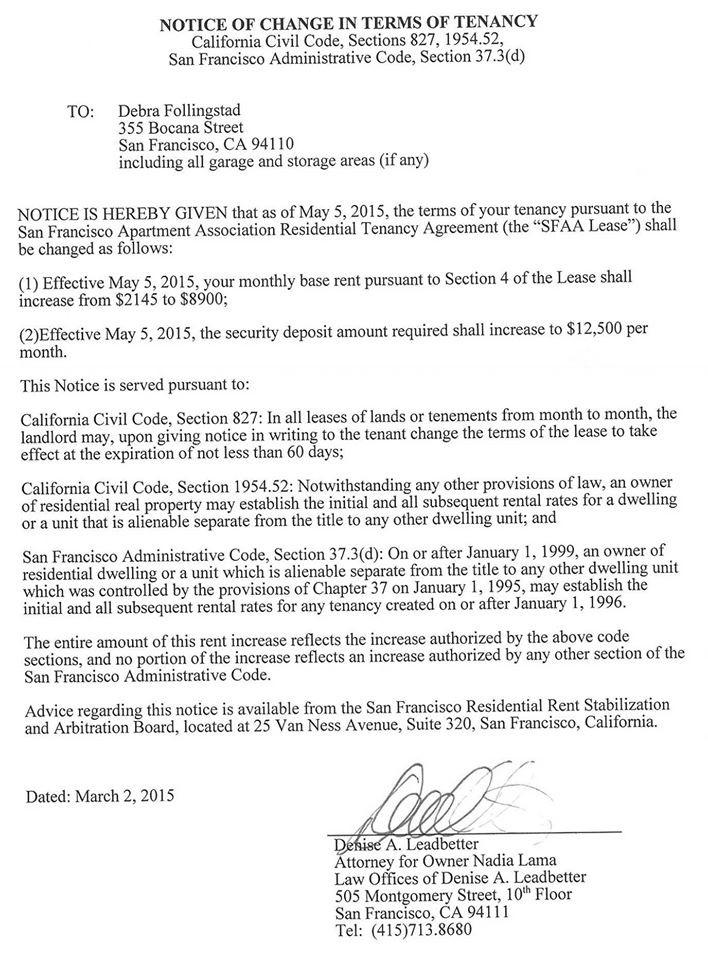
Earlier this month, Debra Follingstad received an alarming notice from her landlord. Or rather, her landlord's attorney. The notice informed Follingstad, a longtime San Francisco resident, that her rent was going up. A lot. More than 400 percent.
"Effective May 5, 2015, your monthly base rent pursuant to Section 4 of the Lease shall increase from $2,145 to $8,900," the notice reads. The 60-day notice also required Follingstad to provide an additional $12,500 as a security deposit.
After Follingstad posted the letter to Facebook, many of her friends, followers, and even strangers had the same question: Can this possibly be legal? The answer may be yes. On her Facebook post about the notice, Follingstad speculates that the landlord is raising the rent in an effort to evict her. She tells me, via text message, that she has lived in the house since 2005 and works as a licensedacupuncturist. (She also says she is unavailable to speak while she is immediately seeking legal counsel and a new place to live. As of press time, CityLab has not been able to obtain or review the full notice beyond the single posted page.)
According to the San Francisco Tenants Union, the maximum allowable annual rent increase is 1.9 percent. Follingstad was served with a 415 percent rent increase, even though the Bernal Heights home that she occupies would appear to be protected by the city's rent-control laws. Per the Housing Rights Committee of San Francisco, a tenants'-rights organization, rent control applies to most any building built before June 1979, including the 1924 house in question.
There are some exceptions to the law—and now, this Bernal Heights house may be one of them, thanks to a technicality in the law. A loophole in a policy designed to protect renters may be enabling some landlords to send their rents soaring.
"It's totally plausible. We're seeing a lot of this right now," says Tommi Mecca, the director of counseling programs at the Housing Rights Committee of San Francisco. "This is just the latest trick these landlords are doing to remove the price controls on the property."
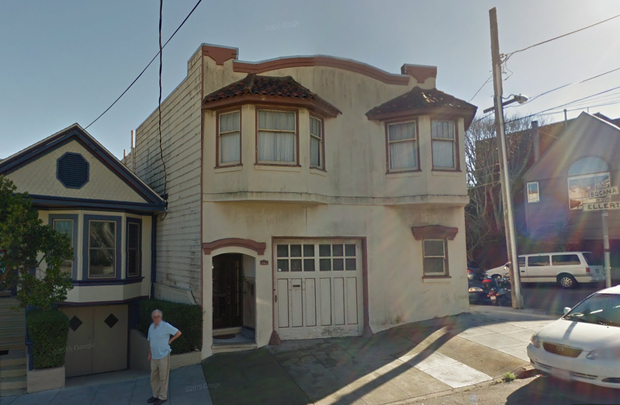
Here's how it might work: On her Facebook post, Follingstad alleges that the landlord recently converted the house's unoccupied downstairs rental unit into storage, following a transfer of the title between family members. In demolishing the downstairs unit—by tearing out its kitchen and bathroom—the landlord reportedly changed the two-unit house into a single-family residence. One whose rent-control status was suddenly void. The property in question: 355 Bocana St., San Francisco, California. (Google Earth)"The situation of a single-family home with an illegal unit—sometimes downstairs, sometimes out back, in what’s called an in-law unit, sometimes it’s an apartment they put in the garage—it’s various scenarios, but it’s all the same situation," Mecca says. "Under rent control, those properties, as long as the single-family house was built before 1979, the illegal unit does not matter. Having that illegal unit puts that property under rent control. Once you remove that illegal unit, technically, you lose rent control. It’s now a single-family dwelling." Records show two title transfers for the address on December 30, 2014, between the owner and other individuals, including another individual with the same last name as the owner. A search for the address on the city's permits database didn't yield any results matching a housing-unit demolition or conversion. The owner's attorney could not confirm these transactions, but did confirm that the notice was legit.
There's a formal procedure for rental housing demolitions and mergers, the process whereby housing units are removed by their owners, according to the San Francisco Tenants Union. In some cases, when landlords demolish units, tenants are liable to receive thousands of dollars in relocation payments. "A landlord must first get the required permits or their ability to do the eviction legally is significantly impaired," the SFTU website reads. "Tenants who face eviction due to such mergers may be able to contest the issuance of such permits."
Illegal or in-law units—the likes of which Follingstad says her landlord converted to storage in order in order to strip the property of its rent-control protection—have been the subject of increased scrutiny in recent years. In April of last year, San Francisco supervisors approved legislation recognizing these in-law units as legal housing, ending a "don't ask, don't tell" approach to a big part of the city's affordable-housing stock.
"There's tens of thousands of units that were legalized. Now they’re on the books," says Sonja Trauss, the founder of the San Francisco Bay Area Renters' Foundation, a grassroots pro-growth organization. "People would have a garage, or a basement, and instead of carefully going through process of filling out firms, they would just finish them. They weren't illegal in the sense that they were uninhabitable, they just weren't permitted."
Granting legal housing status to illegal in-law units was a measure meant to protect renters in San Francisco. However, bringing these units out of the "shadow economy," in a sense, may have stripped renters of an unlikely but powerful protection: legal limbo.
"How are you going to sue your tenants when you’re not supposed to have a tenant there in the first place?" Trauss says. "When you know your landlord’s breaking the law, haven’t you always felt that you're safer than when you’re in a fully permitted building? If Follingstad's accusations are accurate, then her housing situation is a conundrum. The in-law unit adjacent to her own rental unit may have been an illegal unit, one that was not necessarily up to code for rental housing. Nevertheless, thanks to the April 2014 sunshine law giving amnesty to illegal housing units, these in-law units warrant rent-control protections. Does the new rent-control legislation mean that demolishing an in-law unit—potentially an illegal unit not up to code—requires a demolition or merger permit? Does removing an in-law unit from a home, and thereby rendering it as a single-family dwelling no longer subject to rent-control protections, trigger relocation payments—the way any other unit demolition or merger would?
The answer is unclear. Peak eviction in San Francisco arrived in 1998: That's when Ellis Act and owner-move-in evictions reached their highest numbers. Since then, landlords looking to move renters out of rent-controlled properties have used increasingly sophisticated and varied legal mechanisms to do so. Given the legal ambiguity surrounding illegal and in-law units, it may not be a surprise that a landlord could find in them a way to raise the rent astronomically. "Welcome to the San Francisco housing crisis," Mecca says. Top Image: James Gaither/Flickr Creative Commons


 BY