Monday, January 15, 2018

I Have a Dream Speech by Martin Luther King August 28, 1963


Long Version

I am happy to join with you today in what will go down in history as the greatest demonstration for freedom in the history of our nation.
Five score years ago, a great American, in whose symbolic shadow we stand today, signed the Emancipation Proclamation. This momentous decree came as a great beacon light of hope to millions of Negro slaves who had been seared in the flames of withering injustice. It came as a joyous daybreak to end the long night of their captivity.
But one hundred years later, the Negro still is not free. One hundred years later, the life of the Negro is still sadly crippled by the manacles of segregation and the chains of discrimination. One hundred years later, the Negro lives on a lonely island of poverty in the midst of a vast ocean of material prosperity. One hundred years later, the Negro is still languished in the corners of American society and finds himself an exile in his own land. And so we've come here today to dramatize a shameful condition.
In a sense we've come to our nation's capital to cash a check. When the architects of our republic wrote the magnificent words of the Constitution and the Declaration of Independence, they were signing a promissory note to which every American was to fall heir. This note was a promise that all men, yes, black men as well as white men, would be guaranteed the "unalienable Rights" of "Life, Liberty and the pursuit of Happiness." It is obvious today that America has defaulted on this promissory note, insofar as her citizens of color are concerned. Instead of honoring this sacred obligation, America has given the Negro people a bad check, a check which has come back marked "insufficient funds."
But we refuse to believe that the bank of justice is bankrupt. We refuse to believe that there are insufficient funds in the great vaults of opportunity of this nation. And so, we've come to cash this check, a check that will give us upon demand the riches of freedom and the security of justice.
We have also come to this hallowed spot to remind America of the fierce urgency of Now. This is no time to engage in the luxury of cooling off or to take the tranquilizing drug of gradualism. Now is the time to make real the promises of democracy. Now is the time to rise from the dark and desolate valley of segregation to the sunlit path of racial justice. Now is the time to lift our nation from the quicksands of racial injustice to the solid rock of brotherhood. Now is the time to make justice a reality for all of God's children.
It would be fatal for the nation to overlook the urgency of the moment. This sweltering summer of the Negro's legitimate discontent will not pass until there is an invigorating autumn of freedom and equality. Nineteen sixty-three is not an end, but a beginning. And those who hope that the Negro needed to blow off steam and will now be content will have a rude awakening if the nation returns to business as usual. And there will be neither rest nor tranquility in America until the Negro is granted his citizenship rights. The whirlwinds of revolt will continue to shake the foundations of our nation until the bright day of justice emerges.
But there is something that I must say to my people, who stand on the warm threshold which leads into the palace of justice: In the process of gaining our rightful place, we must not be guilty of wrongful deeds. Let us not seek to satisfy our thirst for freedom by drinking from the cup of bitterness and hatred. We must forever conduct our struggle on the high plane of dignity and discipline. We must not allow our creative protest to degenerate into physical violence. Again and again, we must rise to the majestic heights of meeting physical force with soul force.
The marvelous new militancy which has engulfed the Negro community must not lead us to a distrust of all white people, for many of our white brothers, as evidenced by their presence here today, have come to realize that their destiny is tied up with our destiny. And they have come to realize that their freedom is inextricably bound to our freedom.
We cannot walk alone.
And as we walk, we must make the pledge that we shall always march ahead.
We cannot turn back.
There are those who are asking the devotees of civil rights, "When will you be satisfied?" We can never be satisfied as long as the Negro is the victim of the unspeakable horrors of police brutality. We can never be satisfied as long as our bodies, heavy with the fatigue of travel, cannot gain lodging in the motels of the highways and the hotels of the cities. We cannot be satisfied as long as the negro's basic mobility is from a smaller ghetto to a larger one. We can never be satisfied as long as our children are stripped of their self-hood and robbed of their dignity by signs stating: "For Whites Only." We cannot be satisfied as long as a Negro in Mississippi cannot vote and a Negro in New York believes he has nothing for which to vote. No, no, we are not satisfied, and we will not be satisfied until "justice rolls down like waters, and righteousness like a mighty stream."¹
I am not unmindful that some of you have come here out of great trials and tribulations. Some of you have come fresh from narrow jail cells. And some of you have come from areas where your quest -- quest for freedom left you battered by the storms of persecution and staggered by the winds of police brutality. You have been the veterans of creative suffering. Continue to work with the faith that unearned suffering is redemptive. Go back to Mississippi, go back to Alabama, go back to South Carolina, go back to Georgia, go back to Louisiana, go back to the slums and ghettos of our northern cities, knowing that somehow this situation can and will be changed.
Let us not wallow in the valley of despair, I say to you today, my friends.
And so even though we face the difficulties of today and tomorrow, I still have a dream. It is a dream deeply rooted in the American dream.
I have a dream that one day this nation will rise up and live out the true meaning of its creed: "We hold these truths to be self-evident, that all men are created equal."
I have a dream that one day on the red hills of Georgia, the sons of former slaves and the sons of former slave owners will be able to sit down together at the table of brotherhood.
I have a dream that one day even the state of Mississippi, a state sweltering with the heat of injustice, sweltering with the heat of oppression, will be transformed into an oasis of freedom and justice.
I have a dream that my four little children will one day live in a nation where they will not be judged by the color of their skin but by the content of their character.
I have a dream today!
I have a dream that one day, down in Alabama, with its vicious racists, with its governor having his lips dripping with the words of "interposition" and "nullification" -- one day right there in Alabama little black boys and black girls will be able to join hands with little white boys and white girls as sisters and brothers.
I have a dream today!
I have a dream that one day every valley shall be exalted, and every hill and mountain shall be made low, the rough places will be made plain, and the crooked places will be made straight; "and the glory of the Lord shall be revealed and all flesh shall see it together."2
This is our hope, and this is the faith that I go back to the South with.
With this faith, we will be able to hew out of the mountain of despair a stone of hope. With this faith, we will be able to transform the jangling discords of our nation into a beautiful symphony of brotherhood. With this faith, we will be able to work together, to pray together, to struggle together, to go to jail together, to stand up for freedom together, knowing that we will be free one day.
And this will be the day -- this will be the day when all of God's children will be able to sing with new meaning:
My country 'tis of thee, sweet land of liberty, of thee I sing.
Land where my fathers died, land of the Pilgrim's pride,
From every mountainside, let freedom ring!
And if America is to be a great nation, this must become true.
And so let freedom ring from the prodigious hilltops of New Hampshire.
Let freedom ring from the mighty mountains of New York.
Let freedom ring from the heightening Alleghenies of Pennsylvania.
Let freedom ring from the snow-capped Rockies of Colorado.
Let freedom ring from the curvaceous slopes of California.
But not only that:
Let freedom ring from Stone Mountain of Georgia.
Let freedom ring from Lookout Mountain of Tennessee.
Let freedom ring from every hill and molehill of Mississippi.
From every mountainside, let freedom ring.
And when this happens, and when we allow freedom ring, when we let it ring from every village and every hamlet, from every state and every city, we will be able to speed up that day when all of God's children, black men and white men, Jews and Gentiles, Protestants and Catholics, will be able to join hands and sing in the words of the old Negro spiritual:
                Free at last! Free at last!
                Thank God Almighty, we are free at last!3

Martin Luther King was targeted by the NSA

THE RIGHT TO PRIVACY


Martin Luther King was targeted by the NSA


Martin Luther King, Jr. is an unparalleled figure in the civil rights movement, but less well-known are the civil liberties lessons of his life and activism.

As King came to national prominence half a century ago, the pre-digital technology of the era did not stop the federal government from prying into his private life with the goal of undermining his civil rights work.
King’s heroic advocacy of equality and opposition to the war in Vietnam put him on all kinds of government watchlists. The FBI called him the “most dangerous Negro of the future of this nation,” assessing him in terms that sound more reminiscent of a terror threat than a pastor leading nonviolent protests against institutionalized racism.
That “most dangerous” phrase is from an FBI memo penned immediately after King’s “I Have a Dream” speech. That memo also concluded that “it may be unrealistic to limit ourselves as we have been doing to legalistic proof or definitely conclusive evidence.” In other words, the FBI had decided that King was a dangerous communist, and it was determined to proceed with illegal efforts to discredit his movement regardless of the fact that there was no actual proof to justify its actions.
The agency discussed “how best to carry on our investigation [of King] to produce the desired results without embarrassment to the Bureau,” including “the avenues of approach aimed at neutralizing King as an effective Negro leader.”
And a few months after the dream speech, the FBI began, in Director J. Edgar Hoover’s words, to “intensify our coverage of communist influence on the Negro.” That took the form of wiretapping King’s phones and bugging his hotel rooms. The agency further disgraced itself by sending King a letter trying to badger him into suicide and harassing King’s wife, Coretta Scott King, in an attempt push her towards divorce.
The NSA spied on King, too, under a program called Minaret. Originally introduced as a way to keep track of terrorists and drug traffickers, Minaret evolved into a project for monitoring Vietnam War critics like King.
This appalling civil liberties history demands attention today more than ever. Indeed, as Alvaro M. Bedoya argues inan excellent piece at Slate today, “We now find ourselves in a new surveillance debate—and the lessons of the King scandal should weigh heavy on our minds.”
Bedoya documents a pattern of federal surveillance being unequally applied to racial and ideological minorities in America—Japanese Americans during World War II, for example, and Muslim Americans in the wake of 9/11. Mass spying is an affront to all Americans’ right to privacy, but as King’s story demonstrates, it’s far more likely to victimize some types of people:
There is a myth in this country that in a world where everyone is watched, everyone is watched equally. It’s as if an old and racist J. Edgar Hoover has been replaced by the race-blind magic of computers, mathematicians, and Big Data. The truth is more uncomfortable. Across our history and to this day, people of color have been the disproportionate victims of unjust surveillance; Hoover was no aberration. And while racism has played its ugly part, the justification for this monitoring was the same we hear today: national security.
The way our government spied on MLK and other civil rights leaders must not be forgotten as we continue the modern surveillance debate.
The fears that we civil libertarians raise are based in a concrete history of government abuse that targeted those who challenged its status quo at home and abroad. And in the 50 years since MLK was wiretapped, we only have more reason to believe that similar abuses continue.


Ads by Revcontent

Trending Today

6 Tactics to Hijack California’s Suburban Way of Life


6 Tactics to Hijack California’s Suburban Way of Life

Posted by: Richard Hall - January 10, 2018 - 8:20am

Vilification, subversion of language, truisms and California’s one party government are just some of the tools being leveraged to push a developer funded radical rapid housing growth agenda that would dramatically reshape California’s single family home neighborhoods

While Donald Trump is accused of having the attention span of a goldfish, the same accusation could be made of California voters. Few read ballot measures, typically basing their vote solely whether the the “headline” is appealing, or perhaps deferring to the endorsement of the local newspaper - newspapers which are often not without bias. This fact has not gone unnoticed by those who can benefit from it.

This has led to one small but highly vocal minority special interest group hijacking not just state government but local councils and committees to push through their ideology - an ideology called “transit oriented development,”blended with the goal of driving rapid housing growth to address California’s housing crisis, above all other priorities and irrespective of negative, unintended consequences.

This special interest group has successfully hijacked the conversation using 6 key tactics:
Tactic #1: Propagate Opinions As “Truisms”

While Dilbert creator Scott Adams accuses Trump of using hypnosis techniques, the same techniques are being used very effectively by pro rapid-growth groups such as the YIMBYs, and some groups using the pretense of advocating for “sustainable” development (there are many groups that advocate genuine sustainability which the author has great respect for).

This tactic manifests itself at local council meetings, discussions with state government and, of course, in online community discussion forums.

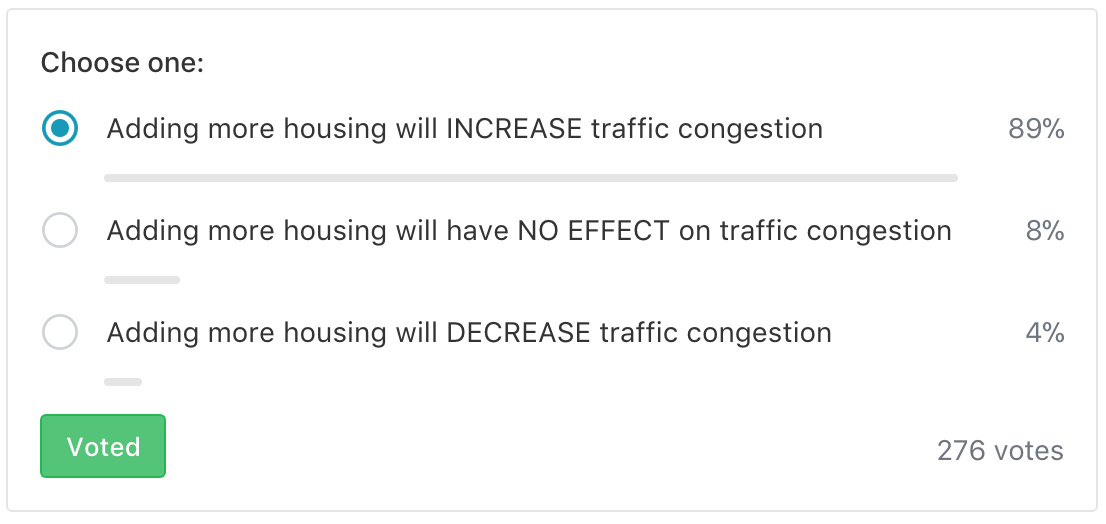
I recently started a poll on Nextdoor.com asking the seemingly simple question, “Will building more housing in our neighborhood increase or decrease traffic congestion?”. I qualified this with “The change in traffic congestion may be on local streets OR on freeways”. For context, our neighborhood, which is primarily single family homes, with a sprinkling of 2-3 story apartments, is next to a newly built, but little used train station. Little did I realize I had set off an explosive conversation.

The poll results demonstrated that by far the majority of residents - 89% of 276 respondents - felt that building more housing would increase traffic congestion. At least two people commented “is this a trick question?”.


However, while the majority equated more housing with more traffic, interesting discussions ensued with some suggesting this might not be the case. Here is a selection of comments supporting the concept that more housing may reduce traffic congestion:

“blocking local development, forces more people to live further out, which is why the Richmond bridge has turned into such a nightmare. Stasis is not an option. “

“New residents, including those who don’t live there yet, are demanding something else. The problem is that these places can’t continue to stay the same.”

“Building around the new train station just makes sense”

It’s important to objectively assess these statements. They contain many suppositions presented seemingly as facts or truisms. The poster, while providing references to opinion articles, did not present data to substantiate that “blocking local development forces people to live further out”. Perhaps limiting local development means that people decide to move to different cities altogether.

One astute commenter pointed out:

“On the TV news last week [they reported that] 17,000 people commute daily from the Sacramento area down to the Bay Area and Silicon Valley because they can make 30-35% more down here.”

So even if development is blocked, high wages will always be a magnetic draw, causing car trips and increasing congestion. These residents may choose to remain in the Sacramento area for many reasons - for instance they want a larger home and are prepared to sacrifice commute time, they have multiple people working in their household in different locations or they choose to live near relatives, friends or preferred schools.

The statement “New residents, including those who don’t live there yet, are demanding something else“ again presents an interesting, but unsubstantiated opinion.

The pro rapid growth advocate stated “The problem is that these places can’t continue to stay the same.“”. This was met with the response from another resident:

“You say that stasis is not an option because the effect of blocking local development forces people to live further out. If I’m understanding, that statement assumes that the needs of the person stuck with the longer commute are greater than the needs of the person who wants to maintain the existing character of his community – including protecting against additional congestion. Maybe you are right, but it is an issue to be debated, not a certainty.”
Tactic #2: Vilify Opponents

A second tactic used by rapid growth advocates is to vilify opponents - accusing them of motivations so stigmatizing - such as supporting zoning because it is exclusionary to communities of color - that it intimidates the opposition, in a form of online bullying. Typically these lines of attack are highly effective at shutting down opposition and thoughtful conversation. I received a number of private direct messages from people intimidated and tired of this form of attack.

While there are some (whose motivations I strongly disagree with and who frankly, make up a very small percentage of the North Bay’s population) who genuinely do oppose development to exclude minorities, there are many valid reasons that for decades have led to zoning decisions that limit development:
Preserving our environment - Large parts of California have been set aside as off limits to development to preserve the environment. For instance, a large planned city was proposed by developers in the Marin headlands called Marincello back in the mid 1960s. Fierce debate ensued but the outcome was the creation of the Golden Gate National Recreation Area, which is a national treasure that has been off limits to development ever since. Today over 80% of Marin County is off limits to development - a testament to a great achievement by environmentalists. It is the primary reason most people visit Marin.

Water supply - California has faced many periods of drought. Residents have seen water rates double and triple in recent years because Marin’s sources of water remain extremely limited. During dry summers, which are increasingly occurring as global warming drives the climate more toward extreme weather, rationing has become the norm even though County residents have adopted water saving appliances and home design at the highest rates in the nation.

While desalination plants have been proposed as one possible solution, they require powerful electric motors to pump seawater through filtration systems: electrical power that is produced mainly by greenhouse gas producing power plants, and their waste output is a concentrated brine solution that is so toxic to wildlife that it cannot be put back into the Bay and must be trucked to secured landfills in other states.

Traffic, which is surprisingly mostly generated by local driving to schools and shopping is a daily challenge for many - and in many locations, especially around the nexus of freeways and arterials, it can result in substantial delays. These delays take their toll - taking away time from family life or work and increasing greenhouse gas emissions and air quality health hazards from slow moving and idling cars and trucks. This congestion has been combined with a noticeable under-investment in maintaining road capacity, despite a steadily increasing population, creating a perfect storm of dysfunctional transportation. However, at the same time Marin’s public transportation options (mostly buses) are woefully inadequate. It would be impractical and an unaffordable burden to the community to provide additional transit achieving a meaningful reduction in traffic.

Parking is another issue that impacts quality of life and more importantly the survival of locally owned and and serving, small businesses in Marin. Small businesses in Marin depend on having convenient parking near stores in order to deal with the increasing competition of big box and online retailing. In addition, it can be difficult for the elderly (a rapidly growing demographic) and the disabled is one cannot park a reasonable distance from ones house or apartment. Allowing new development without providing sufficient parking for the new residents will only exacerbate that. In the Canal District of San Rafael, for example, residents now routinely have to walk many city blocks to their cars and finding spaces when they return from trips saps up needless time.

Health is a major concern for many. Reports from many respected health organizations have identified substantial increased rates of autism, asthma, heart disease and cancer for residents living near freeways or major roads, yet pro rapid growth advocates stress the development of high density next to freeways as a number one priority.

Scale & walkability: Finally many people move into a neighborhood because of its scale and walkability - because it is low rise and low density and easy to get around. For half a century homeowners have purchased homes and invested considerable efforts to improve those homes and their communities in good faith, trusting that zoning laws will prevent radical departures from the current height and density and architectural character of where they live. Had they wanted to live in a high density neighborhood they would have chosen somewhere different. And, contrary to the “truisms” promoted by rapid growth advocates, the vast majority come from humble beginnings and worked very hard to be able to live in the North Bay or other parts of the SF Bay Area. Their home is typically the biggest asset they own. One resident raising this issue on Nextdoor asks “By what right do you determine the change that should be made to the neighborhood and force your idea of the "correct" change on me?”

These are just some of the concerns residents care about.

However, the rapid growth lobby has finessed a strategy of bullying, name calling and vilification at the expense of common sense and economic facts:
Homeowners raising any objections to high density development are immediately dismissed with the stigmatized and vastly over-simplifying label of being NIMBYs, when most are only trying to protect their lifetime investment in community and the environment (which, of course, is why places like Marin are so desirable in the first place).
Residents are accused of being racists and supporting zoning that excludes minorities, even though discriminatory zoning was outlawed decades ago and the historical purposes of zoning have always been predominantly related to rational and beneficial growth and city planning and public and economic benefits.
Residents are routinely labelled as “rich” or “white” or other labels that are not only inaccurate, and only serve to expose the false assumptions and prejudices by those making the accusation. It is significant to note that the vast majority of residents of Marin City’s Golden Gate Village Apartments, a public housing project and home to 700 of Marin’s poorest resident, oppose high density “gentrification” of their community. We see this same opposition in the Mission District of San Francisco,which is home to the City’s most diverse population.
Tactic #3: People Should Be Able to Live Where they Work or Anywhere they Choose

There is a presumption made by some that there is an entitlement to live in a neighborhood because:

A person grew up there
A person has a job there
A person has family there
A person currently lives there
A person just wants to live there and it’s unfair that they can’t

There are two extreme viewpoints that come out here.


At the one end of the spectrum is the opinion that anyone should be able to live wherever they choose. What is not stated here is that in a market economy, if a person cannot afford to live where they choose, then somehow that burden has to be taken on by someone else - typically if not government subsidy, by the existing residents of that community. It is not “free”.

For instance, residents of a 100% affordable apartment block built by a non-profit developer can pay 1/20th of the property taxes of an equivalent market rate home owner. Residents of Below Market Rate units may have their property value suppressed by say 30% and consequently pay 70% of the property taxes of an equivalent market rate unit. In order for a municipality to maintain public services such as police, fire and other services, and the costs of infrastructure upkeep (roads, bridges, public utilities, etc.), existing residents must pay the additional costs through a combination of taxes, bond measure and fees - a subsidy (it is ironic to note that in most cases those addition costs are recaptured through the imposition of highly regressive sales and property taxes and development fees -- which are passed on in the form of higher rents and housing costs impacting those on lower incomes the most).

At the other end of the spectrum is the opinion that people should live within their means, that life is inherently challenging and often unfair, and that it is an individual’s responsibility to adapt to and overcome that. Some parts of California can be expensive. This is not unique to California. In our new global investment economy, housing prices in similarly situated communities in proximity to growing urban centers has risen dramatically in the past 15 years.

If one is living or working in an expensive place but cannot afford it something has to change - and the logical choice many people would make is to move to a location that is more affordable. The outward migration from the SF Bay Area to Oregon, Washington, Texas, Colorado and beyond is well documented. This is not any different from the outward migration from major East Coast cities to the West Coast that occurred in the 1970’s and 1980’s, when the West Coast was comparatively inexpensive.

Personally, I don’t agree with either extreme. I think I, like I suspect many others, land somewhere on a “spectrum” between the two. And, I want there to be a healthy debate to arrive at the right point on this spectrum as the solution.

What needs to happen is a healthy discussion about all the impacts and unintended consequences. How communities can grow in ways that are socially, environmentally and economically sustainable, so that the impositions made on public services, schools, fees and taxes don’t just bring about a vicious cycle that in the long run produces no actual gains for anyone. Unfortunately, it has been made taboo to even raise these concerns.

In a nextdoor.com discussion, posts suggesting that if one cannot afford to live in an expensive location then moving somewhere more affordable is an option, wereflagged as uncivil and offensive. Meanwhile, another poster, enraged by rents rising that they could now barely afford, accused people of being “vile” for “telling them what to do” by suggesting they have the option to move - seemingly not grasping that by implication they were telling others in the community to pay for them to stay. No one flagged that post despite its aggressive language and when I asked a moderator if they found it uncivil they responded “just let it go”.
Tactic #4 Subverting Language to Persuade and Manipulate

It’s been said that the most important aspect in any battle is the territory on which it is being fought. The fast growth special interests groups have been highly effective at changing the language to make what may have been unpalatable become innocuous, or raise the question “whoever would oppose that?”. When this happens in Washington D.C., it is called the “post facts” world. Yet, suggesting that in this case, is considered reactionary.

Consider these examples of the language that has been introduced:
affordable housing: This presumes that a city has the obligation to provide subsidized housing, irrespective of the fact that cities do not actually have the capability or financial wherewithal to build and manage housing. This presumption also obfuscates and conceals the negative impacts that existing residents will have to contribute via subsidies, making it seem as if there is only upside. “Who could possibly oppose affordable housing?”


workforce housing: This presumes that housing must be provided for workers in their employment location, and that workers always choose to live where they work, even though there is no evidence that in our highly mobile, 21st century society that this is the case. The concept is also flawed because there are many reasons people choose not to live near where they work and it is rare that multiple members of households work in the same places. Furthermore, subsidized housing cannot limit new residents to be only from the local workforce. There are very few legal exceptions to this and any development that receives any form of government assistance, even an FDIC backed loan, cannot discriminate in this manner.
“sustainable communities”: This term has effectively become derogatory to single family home neighborhoods, implying that multi-family apartments are the only sustainable solution. This neglects that single family homes can often be self-sufficient in electricity by using solar panels, reducing or eliminating their carbon footprint - this electricity subsistence is harder for multifamily housing to achieve -- and that recent studies conducted by government agencies have indicated that suburban communities are turning “green” and carbon neutral faster than our countries urban centers.
“housing crisis” ;There are certainly serious challenges to providing housing to everyone who needs it and housing prices in desirable locations across the country are at nose-bleed levels. But what is actually the nature and cause of this crisis? What is overlooked here, however, is the fact that we have never built any significant amount of affordable housing in the U.S. without government subsidy, and that since 1980 the amount of federal and state housing subsidies available have decreased to almost nothing on an inflation adjusted basis. What is also overlooked is that the historically widening income inequality we are witnessing is a result of inequitable tax law, again, dating back to the early 1980’s and which has recently gotten even worse. Add to this mix that the new global investment economy has dramatically impacted the cost of housing across the country, particularly since the crash of 2008, which foreign investor and investment banks purchasing rental properties at historic rates.
On top of all this or perhaps because of this, California is actually losing residents and it’s population is shrinking - between 2004 and 2013 it experienced a net loss of 1 million residents. Logically, within California people are moving away from expensive areas such as the Bay Area to Sacramento, Modesto and Stockton where there is a net increase in population. I don’t propose that this is a solution to the high costs of housing and its impacts, but ignoring the fundamental economic factors causing this crisis will not produce a sustainable solution.

Being obligated to use these terms only in politically correct ways, makes for an uneven playing field even before discussion begins..
Tactic #5: Leverage (Infiltrate) a Sympathetic Media to Frame the Conversation

The media is very sympathetic to emotion driven stories and sound bite solutions about the housing crisis. Organizations such as the YIMBYs have a paid, full time professional staff working to promote their agenda, with the financial backing of big real estate investment and development interests. Local homeowners, on the other hand, typically are just going about their business, working long hours, raising their families and contributing to their communities as best they can.

Journalists have also been highly sympathetic and attracted to the “controversy” surrounding YIMBYs causes, but they rarely take the side of taxpaying, single family homeowners - despite the fact they these are often the majority of residents in most SF Bay Area communities.

Most recently, there have been the rise of YIMBY journalists, the most notable of which is Liam Dillon at the LA Times. Here are some excerpts from his recent articles. Notice how he frames the conversation:

In an article about the county of Marin, he writes, “In this affluent enclave of high real estate and rental costs, decades-old patterns of neighborhood segregation remain intact.”

What Dillon fails to convey is that large numbers of Marin residents are older boomers on fixed incomes and financially strapped young couples raising families. There are also sizable enclaves of low income minorities in Marin City and the Canal District of San Rafael. Yet, the author consistently stereotypes the entire county’s population as affluent and elitist

He goes on to write, “In recent years, Marin residents have blocked housing of all kinds,” proceeding to call out the famous denial to George Lucas to build affordable housing at the isolated Grady Ranch location. What he fails to realize is the denial had nothing to do with residents blocking housing but the development. State agencies repeatedly advised Lucas that his plans to divert existing creeks and otherwise transgress environmental regulations would never be approvable. In fact, when one looks at the timeline for the Disney sale of Lucasfilm, one can see that Lucas was already looking to sell his empire as soon as his original plan to build a massive studio complex on the land was denied by the County. This was 18 months before the flare up about his “housing” proposal, and it brings into question if that proposal was ever really a serious possibility.

The entire slant of Dillon’s article, and many like it, is to demonize residents opposing rapid growth. It is hard to find any article by Dillon championing residents for opposing inappropriate development at all (should there be one please alert me).

Tactic #6: Leverage California’s One Party Government

Finally the fast growth brigade has been very effective at pushing radical legislation through the state government, which despite its far reaching implications, is little known to most of the population.

Normally, if a mid-rise development is proposed, every resident within a set distance with sight lines to the development is contacted and made aware by their local planning agency. Meanwhile, Scott Wiener has moved senate bills with far more radical impact and scale, through the state legislature, with barely any of California’s residents even aware of it.

Instead. These bills are presented to a state government with little publicity and the public comment is dominated by a single groups ideology. For one’s political career to advance party whips make it abundantly clear that legislators need to support certain politically correct bills, regardless of how counterproductive or ill conceived they may be.

Campaign finance rules do nothing to prevent donations from real estate and construction interests - interests that Smart Voter shows have paid hundreds of thousands of dollars to Scott Wiener’s campaign funds. While the author believes Wiener may be driven more by ideology than monetary gain, this certainly does nott extend to others in government.
Our State Has Been Hijacked

The reason I became politically engaged was because I witnessed an important committee that was meant to represent my community, arrive after 2 years of meetings at a plan that was almost the diametrically opposed to what the community wanted.

What I see happening is healthy debate based on facts, which is fundamental to an effective democracy, has been dangerously undermined by special interests groups that have finessed what can only be described as bullying and intimidation tactics that are unfortunately becoming the political norm in 2018, nationally and locally.

These techniques are succeeding in bringing about new laws and newly proposed legislation:
The enacted Assembly Bill 2584 shifted the burden of proof for blocking inappropriate development away from the city to any reasonable person - which includes the developer making the proposal. Additionally it empowers developers’ surrogates such as trade groups or advocacy groups such as SF YIMBY to file suit. Where before developers were reluctant to sue as they would be constantly negotiating with cities this stigma is now removed. Furthermore when cities lose such suits they are obligated to pay the petitioner’s legal costs. SF YIMBY (formerly SF Bay Area Renters Foundation) has successfully won 2 suits in Berkeley and Sausalito blocking development of market rate housing.
Senate Bill 827 “Planning and zoning: transit-rich housing bonus” proposed by Scott Wiener on January 3rd 2018 would automatically upzone areas within ½ mile of transit hubs and transit corridors to allow up to 85 feet apartment buildings (on a street with a 45 ft. right of way) with no limits on density or floor area ratio.
Senate Bill 828 “Land use: housing element” also proposed by Scott Wiener on January 3rd 2018 would significantly increase housing quotas from regional governments such as the Association of Bay Area Governments. It would require that cities and counties plan not just to meet that quota but zone so that twice the quota given to them could be built. Prior legislation helps organizations such as Urban Habitat and YIMBY Action or any housing advocate to sue cities that resist - with the cities paying financial penalties and the petitioner’s legal fees.

Together State Senator Scott Wiener’s enacted and newly proposed bills present a perfect storm - shifting California from a largely single family home community to an urban mid or high rise community that supposedly will embrace transit that for all practical purposes in counties such as Marin does not and will not ever exist..
What Can You Do to Stop This?

If you are a resident who cares about the impact these laws will have on your community and you’re concerned (and you should be) that this legislation may pass and 5 or 8 story apartment blocks may spring up after your neighbors sell up, here’s what you can do:

Contact Your State Assembly Representative And State Senator
Ideally ask to speak to their senior staffer in Sacramento responsible for housing policy. Tell them to vote no on Senate Bills 827 and 828.


Use this Find Your Representative tool to obtain the phone number and email address of your senator and assembly representative.
http://findyourrep.legislature.ca.gov/

Web Link

“The State of Transportation in Marin and Why TAM proposes Yes on the $3.00 Bridge Toll increase


“The State of Transportation in Marin”


Speaker: Dianne Steinhauser, Executive Director,

The Transportation Authority of Marin


Many Marin County residents cite increased traffic congestion, lack of public transportation alternatives and the

failure to adequately maintain existing transportation infrastructure as major areas of concern. The ability for

government agencies to help address these issues is crucial to economic health and well-being of the County.

On January 10th, Transportation Authority of Marin (TAM) Executive Director Dianne Steinhauser will discuss the

State of Transportation in Marin. Her presentation will cover current conditions, upcoming improvements and

their status. She will address major transportation issues Marin is facing, and the likelihood of successfully

addressing those issues. Her talk will also provide updates on the Marin/Sonoma Narrows Project, the Richmond

Bridge Third Lane Project, the proposed Highway 101/580 Connector Project, construction of a new San Rafael

Transit Center, and plans to address sea-level rise on Highway 37. TAM’s programs and projects to encourage

use of walking, biking, and transit will also be covered.

In addition, Ms. Steinhauser will speak about the various programs under SB1 (the State’s recent gas tax and

vehicle registration fee increases), the status of RM3 (the proposed bridge toll increase measure), and a

proposed measure to extend or increase Marin County’s half cent transportation sales tax.

The question and answer period of the presentation will give luncheon attendees a chance to provide Dianne

feedback and to ask questions about their concerns on transportation related issues in Marin. Attendees should

expect an informative and interesting discussion of this issue.


Ms. Steinhauser has over 30 years managing transportation in the Bay Area and is the Executive

Director for the Transportation Authority of Marin. For the past 12 years, Dianne has managed Marin’s

1⁄2-cent transportation sales tax, which generates over $25 million per year for Marin. Through Marin’s

sales tax, TAM has enabled substantial growth in local transit services, local street and road

rehabilitation, and has grown its very successful Safe Routes to Schools program including managing

crossing guards, travel plans, School Pool, and student education around walking and biking to school.

Dianne managed the development of Marin County’s $10 Vehicle Registration Fee increase for transportation, which was

successfully passed by voters in November 2010, bringing an annual $2 million to Marin for transportation needs.

She brings a background in funding, finance, consensus building and engineering management. Diane began her career

at Caltrans, where for 20 years she rose from construction inspector to Deputy Director managing the activities in six Bay

Area counties. Prior to taking over as Executive Director of TAM, she spent 5 years as the Manager for Programming

and Allocations for the Bay Area Metropolitan Transportation Commission (MTC). Her work at MTC helped her fine tune

her technical engineering experience with a vast array of knowledge about funding sources, the legislative process and

planning; tools in which she uses in her present position.

Sunday, January 14, 2018

Marinwood CSD honor Mize family Mickey Mouse Xmas house

The Nisja Bear Xmas house gets recognition by Marinwood CSD


Roy Nisja and Family have been hosting the "Bear Xmas house" for 37 years. It is a major area attraction for the holidays.  2017 was its last year in Marinwood and the Marinwood CSD thanks them.

The Death Toll for California's Single Family Neighborhoods


The Death Toll for California's Single Family Neighborhoods

Posted by: Richard Hall - January 10, 2018 - 8:03am

Will State Senator Scott Wiener & Developers Change California’s Single Family Neighborhoods to High Density by State Fiat

Unbeknownst to most Californians, changes to state housing laws are being proposed that substantially shift the balance away from development of single family homes and low density residential (duplex, triplex, etc.) to large scale high density development and they make it almost impossible for residents, councils or mayors to ensure quality development mitigating impacts on existing or new residents’ quality of life

California’s Housing Accountability Act law, enacted in 1982, compels cities to take action on proposed developments. However legislation enacted by Governor Brown in September 2017 shifted the burden of proof that a development conforms to legal and zoning requirements to the local government. Now the judgment of elected city officials is replaced with that of any "reasonable person", which can include the project developer who has a fundamental economic interest in the project.

Should the city reject an undesirable proposal, until recently only the developer could file suit to appeal and overturn the decision. However in September 2016this was also changed so that instead trade or industry groups, or housing advocacy groups could file suit with cities paying their legal fees.

Developers are reluctant to sue cities when development proposals are blocked, because they are constantly negotiating with city officials over their projects. The new legislation allows developers’ surrogates to do the dirty work. There have been two suits filed in Berkeley and Sausalito by the housing advocacy group San Francisco Bay Area Renters Federation (SF BARF, which is now known as SF YIMBY), both for market rate, not affordable housing. In both cases the advocacy groups prevailed with the city paying the advocacy group’s costs.

Effectively, if a new apartment complex is proposed that complies with local zoning and your city rejects the proposal for being poorly designed or creating adverse impact (for instance on traffic or parking), advocacy groups would be able to overturn the decision, with the city paying their legal costs. Effectively the new legislation strips the ability of cities to block inappropriate development.

By themselves these recently enacted state laws start to transform California, but together with two bills proposed on January 3rd this year, Senate Bill 827 and 828, it creates a formidable cocktail likely to accelerate the transformation many of California’s single family neighborhoods into 5 or in many cases 8 story apartments with no FAR (floor area ratio) limits to density (the number of units packed into the apartments).

What Do these Newly Proposed Senate Bills 827 and 828 Do?

Senate Bill 827, if passed, automatically upzones all neighborhoods within a ½ mile radius of a major transit stop or a ¼ mile radius of a high-quality transit corridors to unlimited density and floor area ratio with height limits of:
55 feet high (5 storys) minimum;
85 feet high (7 or possibly 8 storys) if the development is next to a road over 45 feet wide curb to curb AND within ¼ mile radius of a high-quality transit corridor or within one block of a major transit stop.

This would impose dramatic upzoning of multifamily and single family zoned neighborhoods to 5 or 8 story apartment buildings. It would affect most major San Francisco peninsula Silicon Valley arterials, such as El Camino Real and all the wide, east west arterials such as Mary, Lawrence Expressway and San Tomas. In Marin, 8 story apartments could appear throughout quaint, low rise Mill Valley all along Blithedale Boulevard, Camino Alto and Miller Avenue from Tam High to downtown.

Senate Bill 828 takes existing housing quotas assigned to cities by regional governments - such as the Association of Bay Area Governments - and increases these housing quotas.

The Bill hits high growth areas such as Silicon Valley especially hard, stating:

“Communities with high rates of income growth must also have a high rate of new housing production for households of all income levels to ensure equity and stabilize home prices and communities.”

Even though the there is no demonstrable evidence that income growth and housing growth are positively correlated, or housing development and housing prices (in the SF Bay Area market), even low growth areas such as Marin, with zero jobs growth but high housing prices are hit especially hard by the bill, which states:

“Median rent or home prices that exceed median income will be alleviated by rapidly increasing housing supply, particularly housing supply for moderate and above-moderate income households.”

Seemingly, one might presume the bill advocates for more low income housing, but remarkably it pushes market rate housing.

Informed reviewers of SB827 note that the bill would upzone low income neighborhoods with large numbers of ethnic minorities. Damien Goodmon, founder and Executive Director of Los Angeles’ nonprofit Crenshaw Subway Coalition, says:

“Scott Wiener's SB 827 is a declaration of war on every urban community in California - and especially our urban communities of color. “

What Does this Mean for the Average California Homeowner?

The unintended consequences (or maybe they are intended) of these new laws are likely to have dramatic effects on towns across California:

Human nature being what it is, many will hesitate to buy a single family home within a 1/2 mile of any transit lines for fear of having a 5 or 8 story apartment building sprout right next to their property line.

In turn, this will drive people further away, seeking to flee from rapidly growing urban centers where there is an imminent threat of an apartment building next door, to more suburban or rural locations, thereby increasing the pressure on sprawl considerably.

At the same time, the cost of land within 1/2 mile of transit will soar dramatically as property owners realize they can generate far higher rents from a given land area. Rents will soar along with land prices.

Cities and public service agencies will face enormous pressure to increase development fees, entitlement fees, special assessments and taxes to pay for the cost of public services and infrastructure, and bond measures to support local schools. Likewise public transit agencies will seek sales taxes and seek approval for bond measures that will face greater challenges passing for fear of creating new transit routes that open up financially unsustainable development.

Since parking requirements and traffic concerns are removed from consideration by this legislation, local parking and traffic will become even more of a nightmare, further hurting local serving small businesses, which depend heavily on easy parking and access to their stores.. But, what developer will put in adequate parking, encroaching on their profit margin, unless required to, if the ability for cities to set parking requirements is removed?

What Does This All Mean?

Elected officials and city planners in my own town, are furious about this stripping away of local control. Where previously they had been elected precisely to maintain community standards, Wiener’s housing bills removesmost of their authority they had in that review and decision making.


Where will this end up? Cities such as Palo Alto, Orinda, Piedmont, Mill Valley, Corte Madera, Larkspur, Fairfax, Greenbrae, Novato and San Anselmo are pretty much doomed - set to have single family homes replaced with extensive walls of apartment blocks. The same will happen in Malibu, San Louis Obispo, Santa Cruz, Napa, Petaluma,Santa Barbara and La Jolla.
What Can You Do to Stop This?

If you are a property owner and you’re concerned (and you should be) that this new legislation, SB 827, may pass and 5 or 8 story apartment blocks may spring up after your neighbors sell up, here’s what you can do:
Contact Your State Assembly Representative And State Senator

Ideally ask to speak to their senior staffer in Sacramento responsible for housing policy. Tell them to vote no on Senate Bills 827 and 828.

Use this Find Your Representative tool to obtain the phone number and email address of your senator and assembly representative.
http://findyourrep.legislature.ca.gov/
Definitions


Major transit stop means a site containing an existing rail transit station, a ferry terminal served by either a bus or rail transit service, or the intersection of two or more major bus routes with a frequency of service interval of 15 minutes or less during the morning and afternoon peak commute periods.
Source: California Public Code 21064.3

“High-quality transit corridor” means a corridor with fixed route bus service that has service intervals of no more than 15 minutes during peak commute hours.

Web Linkwww.planningforreality.org

Saturday, January 13, 2018

Treat ‘Mental Health’ Talk Against Trump Like The Coup Attempt It Is

Treat ‘Mental Health’ Talk Against Trump Like The Coup Attempt It Is

'Many lawyer groups have actually volunteered, on their own, to file for a court paper to ensure that the security staff will cooperate with us. But we have declined, since this will really look like a coup...'

By Mollie Hemingway
JANUARY 8, 2018


In the second season of the TV show “24,” President David Palmer (Dennis Haysbert) is removed from office for failing to launch a war against three Middle East countries purportedly behind a nuclear attack on U.S. soil.

Palmer has reason to doubt his intelligence agencies’ assurances of who was behind it, and it turns out the attack was orchestrated by a cabal of business and military leaders who want to launch a war for personal gain. The means by which Palmer is removed from office during the 4:00-5:00a hour on Day 2 is the 25th Amendment to the U.S. Constitution, a portion of which reads:


Section 4. Whenever the Vice President and a majority of either the principal officers of the executive departments or of such other body as Congress may by law provide… to the Senate and the…House of Representatives their written declaration that the President is unable to discharge the powers and duties of his office, the Vice President shall immediately assume the powers and duties of the office as Acting President.
Palmer’s chief of staff explains, “it seems there are people, cabinet members, who question whether you’re fit to continue as chief executive.” The conniving vice president says in the cabinet meeting putting the president on trial, “What I intend to show is a pattern of erratic behavior since this crisis started.” Using half-true innuendos and rumors as well as deliberately false information, he convinces enough of the cabinet to depose Palmer. In other words, Palmer is the victim of a bloodless coup.

Now, “24” was so over the top that its dramatic twists became something of a punch line. How preposterous to imagine that a president’s handpicked cabinet would vote to oust him in a palace overthrow! But that fantasy land is precisely what some of the mostly unelected opposition hopes to see happen with President Trump as part of the more-than-a-year-long temper tantrum against the results of the 2016 election.

In the last debate of 2016, Fox News host Chris Wallace asked Trump if he would accept the election results, and he said “I will tell you at the time.” Hillary Clinton responded to Trump by calling his remark “horrifying.” The general media environment was to react with unabashed horror for at least 72 hours.

Trump’s comments were wrong — undermining confidence in the electoral process is unbecoming of a political leader of this great nation. But it’s doubtful that even Trump would have done a tiny fraction what his unelected opposition has done to undermine and overturn the results of the election had he lost. Even if he had thrown a year-long temper tantrum, he would not have been aided and abetted in it by a majority of the media or other members of the establishment.
Since his surprise win, the country has been subjected to attempts to delegitimize Trump’s election by blaming “fake news” for tricking voters into supporting him, or a year-long obsession, still noticeably unsubstantiated, with the idea that he conspired with Russians to steal the election from Hillary Clinton. We’ve heard people desperately attempt to keep the Electoral College from voting for him, been told that damaging information from intelligence agencies would keep him from being inaugurated, and that the cabinet should pull a “24”-style move and oust him via the 25th Amendment.

Among those struggling to accept the fact that the American people elected Donald Trump in 2016, the 25th Amendment has been a go-to fantasy for a while, particularly among those who strongly dislike Trump’s less-interventionist foreign policy. Eliot Cohen reached for it in the very first week of the presidency.

Washington Post columnist Kathleen Parker waited until February 10 to say that the cabinet should use that amendment’s provisions since Trump is “so incompetent — or not-quite-right” that he poses a threat. Perhaps most famously, New York Times‘ conservative columnist Ross Douthat went hard for the 25th Amendment solution to what ails him in mid-May.

We’re coming in on the close of an unexpectedly successful first year for Trump, despite the media’s Sturm und Drang against the presidency, Trump’s lack of political allies, and his political naïveté. Trump’s year ended with corporate tax reform passed for the first time in decades. Individual tax rates were cut for the vast majority of Americans. Regulations have been slashed. Trump changed direction on the Paris Climate Accord, on the Clean Power Plan, and the Iran nuclear deal. Foreign policy has been reoriented, with results including real success against ISIS. He appointed numerous judges to federal courts. Last week, the stock market topped 25,000 for the first time, despite the prediction of New York Times columnist Paul Krugman that the stock market would “never” recover from Trump’s election. It was also the week that Michael Wolff’s gossipy if less-than-true book came out about the early chaotic days of the Trump White House, and the talk of mental unfitness — and accompanying fantasies about ousters — reached ever-new heights.
Wolff was transparent about his desire to raise this point as he went around to media outlets asserting “the story that I have told seems to present this presidency in such a way that it says he can’t do his job” and his hope or belief that it “will end this presidency.” Even as various journalists and media outlets admitted the book was false, that it had made-up quotes and anecdotes, and that it didn’t grasp basics of the Trump White House, they said they believed it was fake, but accurate.

Despite the veracity problems, journalists used the book to ask any manner of guests about mental health concerns. “Meet The Press” pushed out Wolff’s undoubtedly false message about the 25th Amendment without a moment’s hesitation:


At the same time, media leaders of the movement to oust Trump used a book by an academic who has been ranting and raving about Trump and mental fitness for more than a year. She claimed to meet with Democrats and a Republican senator (it turned out she had embellished that last part) to discuss Trump’s fitness. This was used for segment after media segment discussing the same.
Politico got the ball rolling with “Washington’s growing obsession: The 25th Amendment.” The not entirely stable “Morning Joe” has been obsessed about a 25th Amendment removal for months, and here’s MSNBC’s Joe Scarborough tweeting outa New York Times article that quotes the academic who is trying to get Trump ousted. Here’s that New York Times article. It mentions a 25th-Amendment ouster five times. It being a day ending in -y, the Washington Post‘s Jennifer Rubin was talking about a coup.

CNN host Brian Stelter used to oppose questions about the health of politicians when the politician was named Hillary Clinton, but he’s been on a tear about Trump’s mental health since at least February, more so recently, making claims of not being comfortable slightly hard to buy:

The Yale psychiatrist everyone is promoting is quoted in a Vox interview saying people should “contain” Trump against his will, force him to undergo an evaluation, and have him declared unfit, adding “many lawyer groups have actually volunteered, on their own, to file for a court paper to ensure that the security staff will cooperate with us. But we have declined, since this will really look like a coup…”

Yes, removing a president by force tends to look like a coup. Nevertheless, CNN and other media outlets are mainstreaming this conspiracy plot. Here’s The Atlantic getting in on the action:


Trump is unlike any previous president of the United States. Voters knew this when they chose him over Hillary Clinton. And there is nothing about Trump now that suggests his mental state is any different or worse or dangerous than when voters elected him, or when they first encountered him on gossip pages and in reality television decades ago.

To suggest otherwise is to undermine the democratic election of presidents, and to do so would be far more damaging to the country than anything Trump’s actually done. It is particularly noteworthy that members of an elite are calling for his ouster when Trump’s election was partly in response to anger at mismanagement by members of the media and political establishment.

Talk of mental health and a 25th Amendment removal, “by force if necessary,” is talk of a coup, just as it was in the TV show “24.” Responsible parties should consider how this is perceived by the part of the electorate they rarely speak to and cease.


Mollie Ziegler Hemingway is a senior editor at The Federalist. Follow her on Twitter at @mzhemingway

What Marin will look like if SB827 passes.


What Marin will look like if SB827 passes.


On January 4th, 2018, California State Senator Scott Weiner announced a series of proposed housing bills. By far the most attention has been directed at Senate Bill 827 (SB 827), which would override local zoning controls on height, density, parking minimums, and design review on properties within a certain distance of major public transit infrastructure.

I was really interested what that would look like on the ground in California, so I spent a few days attempting to make a map that would show how SB 827 would affect zoning as currently proposed. Please note that I am not an expert in this area, and that this map should only be used as a beginning point for the policy discussion around the bill and not for making any important decisions. I cannot state strongly enough that there are multiple errors with this map, due to missing and incorrect data, probable misinterpretations of the proposed law as written, bugs in my software, and multiple other reasons.


See the website and  amazing urban map HERE

The pink area represent 85 feet height limit and eight stories. (For comparison, Wincup is only five stories.)

Friday, January 12, 2018

The Larkspur Rebellion May 22, 2014

Little Boxes by Pete Seeger Conformity and Overdevelopment


This song was written in 1960 by Housewife and Activist Malvina Reynolds to protest the overdevelopment of Daly City, CA.    It's message is a warning to YIMBYs and Plan Bay Area who want to destroy places like Marin County for high density housing.  They pretend it is for "social justice" and "combat global warming" but in the end it is about developers making money from the Tech Boom.  When the quality of life in the Bay Area is destroyed, where will you go?
Daly City, CA