A blog about Marinwood-Lucas Valley and the Marin Housing Element, politics, economics and social policy. The MOST DANGEROUS BLOG in Marinwood-Lucas Valley.
I have another objection to cap and trade. Suppose I live next to a polluter and have to breathe the foul air. I pay the "cost" of pollution. Next, the government sells (blackmails) the polluter permission to continue to pollute. The politician then distributes proceeds for his friends. I get nothing.
Cap and trade is bad public policy.
You could substitute "Millennials" with "Middle Class" and "Obamacare" with "Plan Bay Area" and you'd have a good analysis why Plan Bay Area is so wrong.
Plan Bay Area shifts costs to the middle class suburban homeowner who must pay enormous new costs for transportation, support taxpayer subsidized housing, and new fees. It is a radical restructuring of our economy and democracy.
I agree that healthcare needed reform. It is just that there were 1001 better, freer ways to do it than create a massive bureaucracy.
The great lesson of the 20th Century was that central planning leads to shortages, inefficiencies, loss of freedoms and bureaucratic tyranny. Plan Bay Area must be stopped.
We will Save Marin Again and we must also save the Millennials from exploitation.
Ordinary people outnumber targeted foreigners in NSA data: Washington Post
nsa logo
WASHINGTON (Reuters) - The Washington Post said on Saturday a study of a large collection of communications intercepted by the U.S. National Security Agency showed that ordinary Internet users, including Americans, far outnumbered legally targeted foreigners caught in the surveillance.
"Nine of 10 account holders found in a large cache of intercepted conversations, which former NSA contractor Edward Snowden provided in full to The Post, were not the intended surveillance targets but were caught in a net the agency had cast for somebody else," the Post said.
Nearly half of the files "contained names, email addresses or other details that the NSA marked as belonging to U.S. citizens or residents," it said.
The paper said the files also contained discoveries of considerable intelligence value, including "fresh revelations about a secret overseas nuclear project, double-dealing by an ostensible ally, a military calamity that befell an unfriendly power, and the identities of aggressive intruders into U.S. computer networks."
Tracking the communications led to the capture of some terrorism suspects, including Umar Patek, a suspect in a 2002 bombing on the Indonesian island of Bali, it said.
Many other files were retained although, described as useless by analysts, they were about intimate issues such as love, illicit sexual relations, political and religious conversions and financial anxieties, the Post said.
The paper said it reviewed about 160,000 emails and instant-message conversations and 7,900 documents taken from more than 11,000 online accounts, collected between 2009 and 2012.
U.S. intelligence officials declined to confirm or deny in general terms the authenticity of the intercepted content provided by Snowden to the Post.
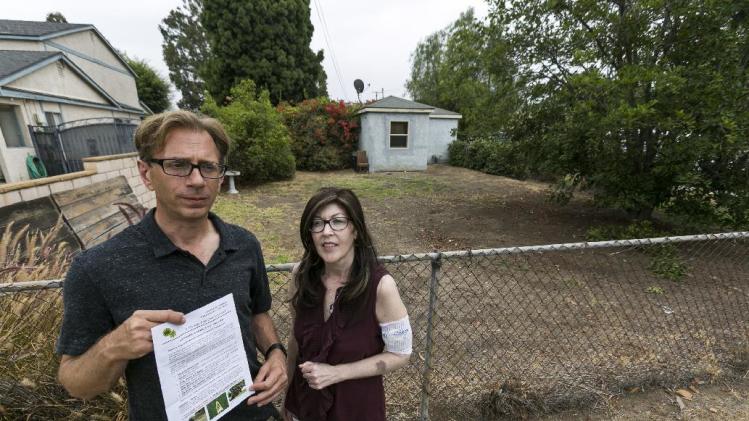
On the same day the state approved mandatory outdoor watering restrictions with the threat of $500 fines, the Southern California couple received a letter from their city threatening a $500 penalty for not watering their brown lawn. It's brown because of their conservation, which, besides a twice-a-week lawn watering regimen, includes shorter showers and larger loads of laundry. They're encouraged by the state's new drought-busting, public service slogan: Brown is the new green. The city of Glendora sees it differently. "Despite the water conservation efforts, we wish to remind you that limited watering is still required to keep landscaping looking healthy and green," says the letter, which gives Korte and Whitney 60 days to restore their lawn.
Michael Korte and his wife Laura Whitney, pose outside their home lawn in Glendora, Calif., Thursday …
They're among residents caught in the middle of conflicting government messages as the need for conservation clashes with the need to preserve attractive neighborhoods. "My friends in Los Angeles got these letters warning they could be fined if they water, and I got a letter warning that I could be fined for not watering," Whitney said. "I felt like I was in an alternate universe." Despite the drought, Californians have increased their water use by 1 percent in May compared with previous years, according to a state survey of water providers. To combat perceived complacency, the state water board voted this week to require water agencies to adopt emergency drought plans and authorized fines of up to $500 a day for water wasters.
The board's chairwoman, Felicia Marcus, said "a brown lawn should be a badge of honor because it shows you care about your community." But several homeowners are reporting that a dried-up lawn instead attracts the wrath of their community. Homeowners associations can't punish residents for scaling back on landscaping under an executive order signed by Gov. Jerry Brown in April and a bill awaiting his signature. While both measures are silent on fines imposed by local governments, the governor's office condemned moves that punish drought-conscious Californians.
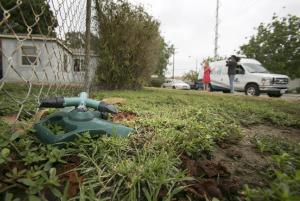
A lawn sprinkler is seena at the Whitney's home lawn, as television crews report on California…
"These efforts to conserve should not be undermined by the short-sighted actions of a few local jurisdictions, who chose to ignore the statewide crisis we face, the farmers and farmworkers losing their livelihoods, the communities facing drinking water shortages and the state's shrinking reservoirs," said Amy Norris, a spokeswoman for the California Environmental Protection Agency, in a written statement.
Local officials say conserving water and maintaining healthy landscaping are not mutually exclusive goals. They caution that even in times of water shortages, residents shouldn't have free rein to drive down property values, and they can use drought-resistant landscaping or turf removal programs to meet local standards.
"During a drought or non-drought, residents have the right to maintain their landscaping the way they want to, so long as it's aesthetically pleasing and it's not blighted," said Al Baker, president of the California Association of Code Enforcement Officers.
Anaheim resident Sandra Tran, 47, said she started installing drought-resistant landscaping after receiving violation notices from Orange County Public Works. She spent more than $600 on the changes as the agency mandated she water and maintain her yard in "a healthy green condition."
Yet as Tran drives home from work, she sees signs flashing on the freeway urging her to conserve water.
Laura Whitney shows a warning letter from the city of Glendora at her home in Glendora, Calif., Thur …
"It's almost crazy because one agency is telling you one thing and another is forcing you to do the opposite," she said.
Democratic Assemblywoman Cheryl Brown introduced a bill that would have prohibited local governments from imposing fines, but she dropped AB1636 after cities in her district promised not to penalize homeowners for brown lawns during a drought emergency.
Brown was shocked when she heard the practice continued elsewhere in the state, and said she would consider reviving her bill in 2015.
"It seems to me those cities aren't using common sense," Brown said. "It's too bad you need a law."
EDITOR'S NOTE: I wonder if they will attach liens to homes if the homeowner refuses to pay the (ahem "graft") fine? If so maybe we will hear about judicial foreclosures for watering. Doesn't sound like the "home of the free" to me.
The Feds Want to Take Your Car! from Randal O'Toole's Transportation Newsletter #2415 July 2014
The war against the automobile is being
waged on three fronts:
1. Congress to Pass Short-Term Fix to Highway Fund 2.
Metropolitan Planning Organizations Write So-Called Sustainability Plans 3.
Cities and Transit Agencies Plan Obsolete Rail Transit Systems 4. Preserving
the American Dream Conference
1. Congress to Pass Short-Term Fix to Highway Fund
Congressional authority to collect the federal gasoline
tax expires on September 1 and, more important to some, the Highway Trust Fund
is expected to run out of money at about the same time. The media has inundated
the public with dire warnings of what will happen if the trust fund is
exhausted and how our highways are crumbling and need federal funding.
In fact, our highways are in good shape: the number of
bridges that are structurally deficient has declined by 50 percent since 1990
and the average smoothness of pavement has improved each year. The trust fund
is running out of money because of overspending, not underfunding: Congress has
diverted at least 20 percent of gas taxes to non-highway programs and mandated
spending even if revenues weren't sufficient to cover those costs.
A proposal to increase gas taxes by 12 cents a gallon was
enthusiastically endorsed by Democrats in Congress who want more money to
spend, but was entirely unnecessary for America's highways or transportation in
general. Fortunately, it appears this proposal will not pass. Instead, Congress
appears likely to pass a very short-term bill that will replenish the trust
fund and reauthorize the gas tax for less than a year. That means we can expect
this debate to pop up again next Spring.
Unstated is that both parties hope to make gains in the
2014 elections, and if one house or other switches party whichever one that is
in power thinks it will be able to do what it wants in 2015. If instead the
Republicans continue to hold the House and the Democrats hold the Senate, then
next year will see the same near-gridlock as this year.
Early in Obama's first term, the secretaries of
Transportation and Housing & Urban Development and the director of the
Environmental Protection Agency agreed to jointly require that metropolitan
planning organizations (MPOs) write "smart-growth" plans for their
regions. This would be done through the regional transportation plans that MPOs
are required to update every five years.
To promote this idea, in 2010 and 2011 the administration
gave $165 million in "sustainability planning" grants, ranging from
$225,000 to $5 million, to 58 cities, states, and--mainly--MPOs. Now the plans
funded by these grants, and similar plans in other cities, are being released,
and they all call for the same pack-and-stack policy: invest in transit rather
than highways and somehow require that most if not all new housing and other
development take place in transit corridors. Plan Bay Area (for the San
Francisco-Oakland-San Jose region) and Plan Lafayette (for a Louisiana city of
100,000) both followed this pattern. Now the Twin Cities Thrive 2040 plan and
Chattanooga's Thrive 2055 plan appear on the road to following the same pattern
as well.
To justify these one-size-fits-all plans, several of the
planning agencies have hired Arthur Nelson, a University of Utah planning
professor who claims that Americans want to move into smaller homes and
estimates the U.S. will have 20 million surplus single-family homes by 2025.
His analysis are shallow and poorly documented. Over the past few months, I've
had a running debate with Twin Cities planners who support the region's plans
to concentrate most new housing in transit-oriented developments. I encourage
people in other regions to engage their MPOs in similar debates and will be
glad to help.
3. Cities and Transit Agencies Plan Obsolete Rail Transit
Systems
Except in extremely dense urban areas--and New York City
is the only one this dense in the United States--urban rail transit is
obsolete, and will become even more obviously obsolete as driverless cars enter
the market in a few years. Yet cities and transit agencies all over the country
are pressing to spend hundreds of millions of dollars on streetcars and billions
on light rail.
Austin, Tx and St. Petersburg, FL will vote on light rail
this November. San Antonio, Anaheim, St. Paul, Santa Ana, CA, and Arlington, VA
are among the many cities pushing to fund and build streetcar lines under the
mistaken belief that an 8-mph, low-capacity streetcar alone will somehow
generate billions of dollars worth of economic development, and San Antonio may
vote on this in November.
A license-plate reader mounted on a San Leandro Police Department car can log thousands of plates in an eight-hour patrol shift. “It works 100 times better than driving around looking for license plates with our eyes,” says police Lt. Randall Brandt. [Editor's Note: I saw a similar device on top of a San Rafael cruiser in December 2013. I assume this technology will be part of the equipment upgrades for the new 50 million dollar MERA (Marin Emergency Radio network www.meraonline.org) upgrade that is expect to be on the November 2014 ballot.]
Credit: Michael Katz-Lacabe
When the city of San Leandro, Calif., purchased a license-plate reader for its police department in 2008, computer security consultant Michael Katz-Lacabe asked the city for a record of every time the scanners had photographed his car.
The results shocked him. The paperback-size device, installed on the outside of police cars, can log thousands of license plates in an eight-hour patrol shift. Katz-Lacabe said it had photographed his two cars on 112 occasions, including one image from 2009 that shows him and his daughters stepping out of his Toyota Prius in their driveway.
That photograph, Katz-Lacabe said, made him “frightened and concerned about the magnitude of police surveillance and data collection.” The single patrol car in San Leandro equipped with a plate reader had logged his car once a week on average, photographing his license plate and documenting the time and location. At a rapid pace, and mostly hidden from the public, police agencies throughout California have been collecting millions of records on drivers and feeding them to intelligence fusion centers operated by local, state and federal law enforcement.
An image captured by a license-plate reader in 2009 shows Katz-Lacabe and his daughters stepping out of a car in their driveway. The photograph made Katz-Lacabe “frightened and concerned about the magnitude of police surveillance and data collection,” he says.
With heightened concern over secret intelligence operations at the National Security Agency, the localized effort to track drivers highlights the extent to which the government has committed to collecting large amounts of data on people who have done nothing wrong.
A year ago, the Northern California Regional Intelligence Center – one of dozens of law enforcement intelligence-sharing centers set up after the terrorist attacks of Sept. 11, 2001 – signed a $340,000 agreement with the Silicon Valley firm Palantir to construct a database of license-plate records flowing in from police using the devices across 14 counties, documents and interviews show.The extent of the center’s data collection has never been revealed.
Neither has the involvement of Palantir, a Silicon Valley firm with extensive ties to the Pentagon and intelligence agencies. The CIA’s venture capital fund, In-Q-Tel, has invested $2 million in the firm. The jurisdictions supplying license-plate data to the intelligence center stretch from Monterey County to the Oregon border.
According to contract documents, the database will be capable of handling at least 100 million records and be accessible to local and state law enforcement across the region. Law enforcement agencies throughout Northern California will be able to access the data, as will state and federal authorities. In the Bay Area, at least 32 government agencies use license-plate readers. The city of Piedmont decided to install them along the border with Oakland, and the Marin County enclave of Tiburon placed plate scanners and cameras on two roads leading into and out of town.
Law enforcement agencies throughout the region also have adopted the technology. Police in Daly City, Milpitas and San Francisco have signed agreements to provide data from plate readers to the Northern California Regional Intelligence Center [Editor's Note: Marin County Law Enforcement is a part of this network]. A Piedmont document indicates that city is also participating, along with Oakland, Walnut Creek, Alameda and the California Highway Patrol. Katz-Lacabe said he believes the records of his movements are too revealing for someone who has done nothing wrong.
With the technology, he said, “you can tell who your friends are, who you hang out with, where you go to church, whether you’ve been to a political meeting.” Lt. Randall Brandt of the San Leandro police said, “It’s new technology, we’re learning as we go, but it works 100 times better than driving around looking for license plates with our eyes.” The intelligence center database will store license-plate records for up to two years, regardless of data retention limits set by local police departments.
Many cities use license-plate readers to enforce parking restrictions or identify motorists who run red lights. Police in New York City have used the readers to catch car thieves and scan parking lots to identify motorists with open warrants.
In California, Long Beach police detectives used scanner data to arrest five people in a 2010 homicide. Plate readers in Tiburon identified celebrity chef Guy Fieri’s yellow Lamborghini in March 2011, which allegedly had been stolen from a San Francisco dealership by a teenager who embarked on a crime spree two years ago and now faces attempted murder charges. Sid Heal, a retired commander with the Los Angeles County Sheriff’s Department, oversaw the adoption of plate readers in his agency in the mid-2000s. Heal recalled the dramatic uptick the plate readers made in the auto theft unit’s productivity. “We found 10 stolen vehicles on the first weekend in 2005 with our antitheft teams,” Heal said. “I had a hit within 45 minutes.” Before, Heal said, police had to call license plates in to a dispatcher and wait to have the car verified as stolen. Plate readers, Heal said, “are lightning fast in comparison” and allow officers to run up to 1,200 plates an hour, as opposed to 20 to 50 plates per day previously.
But Jennifer Lynch, a staff attorney at the Electronic Frontier Foundation, said the Northern California database raises significant privacy concerns. “Because so many people in the Bay Area are mobile, it makes it that much more possible to track people from county to county,” Lynch said.In May, the Electronic Frontier Foundation, along with the American Civil Liberties Union of Southern California, sued the Los Angeles County Sheriff’s and Los Angeles Police departments for a week of data gathered and retained in a multiagency network.
For now, it’s unknown which agency administers the Los Angeles database, how many agencies contribute or have access to the database, how many records the system retains or how long they are kept. In San Diego, 13 federal and local law enforcement agencies have compiled more than 36 million license-plate scans in a regional database since 2010 with the help of federal homeland security grants.
The San Diego Association of Governments maintains the database. Unlike the Northern California database, which retains the data for between one and two years, the San Diego system retains license-plate information indefinitely. “License-plate data is clearly identifiable to specific individuals,” said Lee Tien, a senior staff attorney at the Electronic Frontier Foundation. “This is like having your barcode tracked.”
Few limits on license-plate data
License-plate readers are not subject to the same legal restrictions as GPS devices that can be used to track an individual's movements. The U.S. Supreme Court ruled unanimously last year that lengthy GPS tracking constitutes a Fourth Amendment search and may require a warrant. But plate readers might not fall under such rulings if police successfully argue that motorists have no “reasonable expectation of privacy” while driving on public roads.
Then-California state Sen. Joe Simitian, D-Palo Alto, introduced a bill last year that would have required California police to purge license-plate data after 60 days and applied that rule to companies that collect such data. Law enforcement and private businesses involved in the technology resisted, and the bill died. “Do we really want to maintain a database that tracks personal movements of law-abiding citizens in perpetuity? That’s the fundamental question here,” said Simitian, now a Santa Clara County supervisor. “Larger and larger amounts of data collected over longer periods of time provide a very detailed look at the personal movements of private citizens.”
While some law enforcement agencies, like the California Highway Patrol, have their own data retention guidelines for license-plate scanners, Simitian said there still is no larger policy that protects the privacy of Californians on the road. “Public safety and privacy protection are not mutually exclusive,” he said. “There's a balance to be struck, and most people understand that.” Heal, the retired sheriff’s commander, said that absent clear legal limits on license-plate readers, law enforcement agencies will continue to expand their ability to gather such information. “A lot of the guidance on this technology – the court doctrine – is nonexistent,” Heal said. “Until that guidance comes, law enforcement is in an exploratory mode.”


 They're among residents caught in the middle of conflicting government messages as the need for conservation clashes with the need to preserve attractive neighborhoods.
 "These efforts to conserve should not be undermined by the short-sighted actions of a few local jurisdictions, who chose to ignore the statewide crisis we face, the farmers and farmworkers losing their livelihoods, the communities facing drinking water shortages and the state's shrinking reservoirs," said Amy Norris, a spokeswoman for the California Environmental Protection Agency, in a written statement.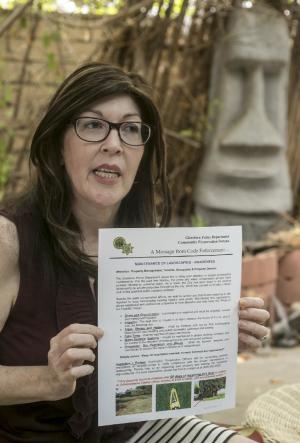


 An image captured by a license-plate reader in 2009 shows Katz-Lacabe and his daughters stepping out of a car in their driveway. The photograph made Katz-Lacabe “frightened and concerned about the magnitude of police surveillance and data collection,” he says.
