Thursday, June 13, 2013

NEWS FLASH: Marin Community Foundation pulls out of Grady Ranch but....


Lucas Valley is home to the pristine Miller Creek Watershed
Just released:

http://www.marinij.com/marinnews/ci_23454105/marin-community-foundation-drops-george-lucas-grady-ranch

http://www.northbaybusinessjournal.com/74781/marin-community-foundation-pulls-back-from-grady-ranch/

but George Lucas may still develop affordable housing on his own.   More news surely will surely follow.

We hope that Mr. Lucas will recognize the unique location at the head of the Miller Creek Watershed and build an environmental education facility that can serve Bay Area schools.  It is located at a nexus of two huge parcels of open space and is uniquely suited for this purpose.

Tuesday, June 11, 2013

Danville reduces sites for affordable housing, adopts growth plan

Downtown  Danville, CA

 See article Contra Costa Times:

Danville reduces sites for affordable housing, adopts growth plan


Updated:   03/20/2013 04:32:02 PM PDT
 
DANVILLE -- Danville has a new town growth plan. It's a watered-down version changed in response to a huge controversy over proposals to encourage high density and affordable housing in this affluent community.
 
Hearing from another round of speakers who warned "stack and pack" housing would undermine Danville's charm and character, the Town Council in the wee hours of Wednesday approved a new 2030 general plan that designated less land for affordable housing than originally proposed.
The 5-0 vote just before 1 a.m. culminated weeks of packed hearings (four before the Planning Commission and two before the Town Council) and debate on whether high-density housing would help the environment or damage the suburban lifestyle.

Several speakers in the audience of some 200 people Tuesday night said they were pleased the council had deleted parts of an earlier proposal. The final general plan designates two sites covering 9.5 acres for affordable housing, far less than the 14 sites originally proposed.

The council also scrapped the idea of designating downtown Danville as a priority development area that could qualify for government subsidies for housing near jobs, stores, or public transit stops.
"The council was right to make changes," said Mike Arata, a member of a group called Friends of Danville, "but I think they could have done more to remove references to sustainable development that are part of an attack on suburbs."

Mayor Newell Arnerich said the council came up with a good plan after listening to the public and making changes.

"While we don't agree with everything we heard, I think it was a good process," Arnerich said.
Only about 30 in an audience of some 200 people stuck around early Wednesday for the vote.
Earlier in the evening, several speakers welcomed the changes in the plan but grumbled that the town was being prodded to meet affordable housing goals based on calculations by a regional agency called the Association of Bay Area Governments.

"It is clear to me the community doesn't want to be part of the program and defining ourselves in this way," said Kerri Gilbert, a longtime town resident. "We love Danville the way it is. We don't want it to change."

Chris Shipley, a retired BART police officer, said he worries that high-density, low-income housing would bring crime to a safe city.

"This high-density, low-income housing threatens public safety. I've seen it first hand," he said.
Former congressman Bill Baker of Danville said it was folly to promote high density housing in Danville as a tool to reduce auto use and pollution. The town, he noted, is miles from the closest BART stations and has limited public transit bus service. Not everyone viewed compact housing so negatively, and some suggested it could provide affordable homes for young adults, seniors and people who work in Danville.

John Chapman of Danville, a leader in the Greenbelt Alliance, said encouraging sustainable development is a path toward protecting open space and easing the environmental impacts of growth.
"Cities are stepping up to do their part," Chapman said. "Now it's Danville's turn."

City planners and administrators said Danville is no different from other California cities in facing a state mandate to designate places for a mix of housing types. Also early Wednesday, the Town Council adopted a sustainability action plan that encourages a variety of energy and water conservation measures.

In a written release handed out at Tuesday's meeting, Friends of Danville claimed while "sustainable" seems like a harmless term, the term is used by groups that want to "to get us out of our single family homes, out of cars, control our private property, and further invade our daily lives." Times. All rights reserved.
 

Sunday, June 9, 2013

Marinwood's Ray Day and Stephen Nestel Present Petitions to the Board of Supervisors at 6/4/2013 Meeting/ Bridge Housing expected to get 2 million dollar grant.

Get Microsoft Silverlight Ray Day of Organized Residents of Marinwood and Stephen Nestel of Savemarinwood.org present petitions to the Board of Supervisor.

Ray Day present a petition signed by 769 residents in a 10 day period against the Marin County Housinng Element EIR and the One Bay Area Plan.  Residents are upset at the lack of public involvement in the plans, funding for schools, planning for water, traffic, government services and the lack of tax contributions from the developers.

Stephen Nestel of www.savemarinwood.org presented the petition to suspend approval of the Housing Element for six months so that the community may meet and discuss the pros and cons of the plan and provide true community voice in our future.

Speak up.  We need your voice.


Saturday, June 8, 2013

Is Supervisor Adams misleading the public about the Marinwood Priority Area ?

Get Microsoft Silverlight
More Proof that the Marinwood Priority Development Area is 100-500 acres larger than Marinwood Plaza

At the June 4, 2013, Board of Supervisors Meeting,  Supervisor Susan Adams expressed "shock" that a map of the Marinwood Priority Development Area included greater area than just Marinwood Plaza.  

Perhaps she forgot the description of the 101 Corridor Priority Development Area (PDA) is all land within 1/2 mile of the 101 Freeway.   She brought the motion for its creation on August 7, 2007. (see video below). We are termed a "Transit Neighborhood" and homes will be 20 to 50 units per acre.  Plan Bay Area wants 80% of all growth to occur within PDAs.

The following document states the minimum criteria for a PDA is 100 acres:

The 2012 Priority Development Area criteria

The tiny city of Benecia is another "transit neighborhood".  They will need a minimum of 982 housing units but are hampered by the 40 foot height limits in their zoning.   Check out this article in the Benecia Herald: Benecia struggles with a PDA designation

For a complete description of Transit Neighborhoods and the One Bay Area vision this document says it all.

PDA Station Area Planning Manual from MTC


We are not getting the truth!


Thursday, June 6, 2013

Supervisors Susan Adams asks planning staff to study withdrawal of Marinwood Priority Development Area

Get Microsoft Silverlight


Marin County Supervisor Kate Sears and Susan Adams ask Planning Director Brian Crawford to examine the effects of withdrawing Tam Almonte, and Marinwood Priority Development Areas from the Plan Bay Area.  It may mean loss of transportation revenue for projects such as a bike path in Southern Marin.

Supervisor Adams startled the audience by showing a map of the Marinwood Priority Development Area available for years on the Association of Bay Area Governments Website here:

Susan Adams has served on Association of Bay Area Goverments (ABAG) for 9 years including 1 1/2 years as a Vice President and advocated for the Marinwood Priority Development Area for urbanization.  Marinwood is considered a "Transit Neighborhood" and is targeted to have an additional 1500 to 4000 to the estimated 350 homes we have now.  It is expected that the once Marinwood Village is built,  home sites east of Las Gallinas will upzoned from 30-50 units per acre.  These are three to five story apartment buildings.  Areas west of Las Gallinas will have 20 units per acre designation.

We certainly hope that Supervisor Adams will remove the Marinwood Priority Development Area designation and fight to retain local planning control for the people.  


The Marinwood Priority Development Map is published here

See full 6/3/2013 meeting here

Tuesday, June 4, 2013

Even the President wants no part of a Priority Development Area!


Supervisor Mark Luce, Napa County and President of ABAG 


On January 17, 2012, both my opponents voted to designate parts of the City of Napa as “Priority Development Areas” for housing in the Bay Area.  This will require that the City zone for significantly more housing in the future.  I oppose this designation as it is contrary to our efforts to limit housing growth in our community.  

As the name implies, a "Priority Development Area" (PDA) is an area designated to receive a greater allocation of the Bay Area's housing in return for the promise of more transportation funding. It is expected that over half of the Bay Area's housing units will be allocated to PDAs.

Why won't our District One Supervisor Susan Adams, admit that the Marinwood Priority Development Area is a massive scheme to turn all land East of Las Gallinas into a dense urban corridor? 
Marinwood-Lucas Valley in the future?
Marinwood PDA for Urban Growth will bring 1500 to 4000 housing units to all land east of Las Gallinas.  Supervisor Susan Adams has confirmed that she supports minimum densities of 30 units per acre in this area but lower densities elsewhere.
 
Why won't Supervisor Susan Adams tell us why she recommended the Marinwood PDA while serving on the Association of Bay Area Governments (ABAG)?
 
Why has Mark Luce, ABAG fought a PDA in his hometown of Napa?


Thursday, May 30, 2013

Smart Growth Vs. Environmentalists (and Other Challenges) in Bay Area

Beware of  Capitalists posing as Environmentalists


From Planetizen : Smart Growth Vs. Environmentalists

What to do with 200 vacant, industrial acres bordering S.F. Bay in Newark, CA is no easy task for city planners who face activists, including environmentalists, skeptical of any development, let alone one of higher density.
 
Braden Reddall and Rory Carroll examine the challenges faces the small, East Bay city of Newark as they plan the next phase for the massive, bay-side redevelopment known as the Dumbarton Transit-Oriented Development. The project is located adjacent to a rail station for the proposed Dumbarton commuter railroad crossing of the lower San Francisco Bay, connecting to Redwood City in southern San Mateo county in the West Bay (also known as the Peninsula).

The city is keen on meeting the intent of state law SB 375 - reducing transportation-generated greenhouse gas emissions by a variety of measures, particularly smart growth land use strategies that reduce vehicle trips. "With an eye on the state's new land-use laws to cut carbon output, Newark's city council just voted to convert 200 acres owned largely by chemical companies into a development that should set the trend for a state bent on decarbonising its economy, the world's ninth largest.
The marshes could be turned over to birds, satisfying environmentalists, or paved over with single family homes, like most of the Bay Area. "We're trying to be a post-suburban community," said Terrence Grindall, Newark's community development director. "And then there are the environmentalists and homeowners who do not want the last patches of undeveloped land clogged up with dense housing that's bad for wildlife and property values.

"I wouldn't want to live in something like this. People are going to be packed in like sardines," said Margaret Lewis, a member of the Citizens Committee to Complete the Refuge, a group dedicated to protecting the San Francisco Bay's remaining wetlands, which opposes the Newark project.
According to city plans, "higher densities of residential development-such as condos-would be located within a quarter-mile radius of the transit station, medium densities-such as townhomes-are located slightly further, and single family dwellings are located farthest from the station."
"Having to battle environmentalists for more sustainable projects is not what developers had in mind."

"There's an identity crisis in the environmental movement," said Peter Calthorpe, an urban planner who designed models for the state's regional planners . [ Editor's note:  Peter Calthorpe was a builders consultant for the hugely unpopular plan to to turn St Vincents/Silvera Ranch into a city in the 1990s. Supervisor Susan Adams was elected to office for her "opposition" to high density growth.  Times have changed]  Environmentalists in the 1970s were the vanguard opposing sprawl. And now, he says, they provide cover for anyone who opposes dense urban housing.


Comments (1)

MikeOConnor wrote:
So, having destroyed industry, the State now ordains that the citizens shall not be allowed to have either automobiles or spacious homes. No gardens, no home workshops, no Labrador retrievers, no treehouses, no remodeling additions, etc. They’ll go to sleep listening to the disgusting noises that their neighbors make and spend an extra hour and a half a day waiting to make subsidized transit connections. Terrific! Way to go, bleepheads!
 
Editor's Note: Our feelings exactly Mike.

Wednesday, May 29, 2013

Environmental Standards for Marin Threatened.


Steinberg’s CEQA Modernization Bill Gains Bipartisan Support from Senate Committee


May 01, 2013

Senate Environmental Quality Committee Approves SB 731

(Sacramento) – With bipartisan approval, the Senate Environmental Quality Committee has passed Senate President pro Tempore Darrell Steinberg’s measure for modernization of the California Environmental Quality Act (CEQA), SB 731. The vote followed testimony by a long list of supporters representing California business, environmental and labor groups.

“I think this shows that CEQA reform is alive and well. We’re moving forward and we’re going to get this job done in a smart way, updating this 42-year-old statute to bring real incentives to streamline the very clean and green projects we want to see done,” said Steinberg (D-Sacramento). “We can promote infill development, and set standards for elements like traffic, noise and aesthetics to limit them from CEQA litigation and bring more certainty to the process.”

Those testifying in support of SB 731 included the California Chamber of Commerce, the Infill Builders Association, the California Building Industry Association, the League of California Cities, Business Roundtable, the California League of Conservation Voters, the Natural Resources Defense Council, the State Building and Construction Trades Council, the International Brotherhood of Electrical Workers, and the International Union of Operating Engineers.

“It’s noteworthy that organizations usually at great odds with each other on these issues are all coming forward to say that while there’s more work to be done, they want to engage in the process and are willing to work with the elements of this measure,” said Steinberg. “Through months of discussion and give-and-take, we have set the table for the parameters of negotiation and debate, and I think we’ve set it effectively.“

SB 731 achieves the following:

1.     Statewide standardized environmental thresholds for the environmental impacts of traffic and noise for infill projects. Projects meeting these thresholds would not be subject to lawsuits for those impacts under CEQA and would not be required to do more for those thresholds in environmental documents unless required by a local government. Also excludes project aesthetics from CEQA consideration.

These aspects of a project impacts are currently common elements for CEQA litigation and typically are most complicated for lead agencies and project proponents to analyze and mitigate.

2.     Better state-level planning to reduce CEQA legal challenges and incentivize smart planning by amending the Government Code Specific Plan section to exclude unsubstantiated opinion for “new information” that would trigger additional revisions to the Environmental Impact Review. Also appropriates $30 million for SB 375 (of 2010) planning grants based on competitive process.

This expands the current CEQA exemption for specific planning so that projects undertaken pursuant to that local plan and EIR are not subject to further review or CEQA lawsuits. Further, local governments typically prioritize investment in smart growth plans. 

3.     CEQA streamlining for clean energy projects and formalizes a Renewable Energy Ombudsman position to expedite renewable siting.

This would cut red tape on large renewable energy projects and establish a position in the Office of the Governor to champion renewable energy projects within the State Government.

4.     CEQA lawsuit reforms to speed up disposition of legal challenges. Specifically:

·  Allows the lead agency to comply with notices and findings on EIR’s through the Internet;

·  Allows the 30-day statute of limitations to bring actions under CEQA to be tolled by mutual agreement of parties in order to facilitate settlements; 

·  Authorizes project proponents to request and pay for concurrent internet-based preparation of the administrative record for all projects to reduce litigation delays, saving months if not a year off project delays;

·  Allows courts to issue partial remands of environmental documents to reduce re-notice/recirculation/litigation delays where lead agencies have been found to be in violation of the law;

·  Directs the Attorney General to track lawsuits and report to the Legislature in order to provide lawmakers and the public with accurate information on whether or not CEQA is being abused by vexatious litigants.

SB 731 will now be sent to the Senate Appropriations Committee for fiscal review.

The townhouses are coming! The townhouses are coming!

Single family homes will be destroyed to make room for townhouses after upzoning.
The view on Las Gallinas Avenue ?


Do you want to live in a "transit neighborhood"?

Editor's Note:  Although much of our focus has been on the affordable housing that pay no taxes into the community,  residents of Marinwood-Lucas Valley may have more to worry about. When upzoning happens on your street with pri your  neighborhood may become a noisy apartment block.  Upzoning  may allow 4-5 homes where single family residences once stood. You will be forced move if you want to retain a suburban lifestyle with adequately funded schools, less congestion and other urban problems.

This article just published in the Houston Chronicle is a cautionary tale for us in Marin. We have no plans for funding our schools, government services or a reliable water supply for the expected growth of our community with the 2012 Housing Element of unincorporated Marin.

Make no mistake, Marinwood-Lucas Valley is the test community in Marin for the Supervisor's Priority Development Area scheme to intensify development along the 101 corridor.  We are politically weak and they only need three votes to change zoning in our community. If our Supervisors  won't support us,  we are effectively subject to the whims of the county planners and politicians. That is why many of us are signing the recall at www.marinrecall.com to seek immediate representation on the 25 year plans before us. Supervisor Adams sadly is favoring rapid development over neighborhood majority who want a community focused plan instead .
===========================================================

See Article in Houston Chronicle: The townhouses are coming! The townhouses are coming!


"So the bad stuff we're going to see today," I asked, "it'll be a cautionary tale for the suburbs?" I was driving west from downtown on what I thought of, privately, as the Terror o' Townhouses Tour, a sort of scared-straight exhibit for suburbanites like me, who haven't realized what a boring-sounding change to city development rules may be about to unleash on our outside-the-Loop neighborhoods.

David Robinson and Jane Cahill West were my guides. As neighborhood activists, they'd both seen firsthand how, 14 years ago, a similar change to Chapter 42 of the city of Houston ordinances made high-density development possible inside Loop 610, transforming entire neighborhoods lot by lot. One-story houses with yards gave way to townhouses so quickly that it became disconcerting to drive down a street you hadn't seen in a while.

"Yeah," Robinson said from my Hyundai's back seat. "We're interested in how the city is going to educate the suburbs." (Robinson, an architect, is one of those civic activists who seem to be everywhere: head of the Neartown Association, former president of the Super Neighborhood Association, former member of the planning commission, a candidate for City Council, veteran of a bazillion stakeholders' committees.)

"Just getting the word out is a problem," said West in the front seat. (Her résumé is as overstuffed as his: vice president and resident expert on development for the Super Neighborhood Alliance, recent president of Washington Ave/Memorial Park Super Neighborhood Council, a former board chair of the Tax Increment Reinvestment Zone for the Old Sixth Ward, and on and on.) "It's a tough subject to cover."

"They're getting hit by a tidal wave," said Robinson.

"Now get in the right-hand lane," West said. "Crooms Street is coming up."

Crooms Street

I drove slowly down Crooms, a single long block just north of Memorial, between Asbury and Detering, one of those townhouse-lined streets that looks nothing like it did 15 years ago. Slow was the only speed possible. The skinny street, once able to handle two-way traffic of its few residents, is now one-way, with cars parked here and there along the sides. And that morning, garbage cans lined both sides, making it seem even narrower.

Midblock, a man was walking tentatively at the edge of the street, next to an open ditch, dodging the cans. "That guy could use a sidewalk," said Robinson.

Billy Smith II, Staff
A delivery truck squeezes through tightly packed Crooms, between Asbury and Detering.
"But where are the sidewalks?" West asked rhetorically. As a place grows denser, she noted, sidewalks become ever more important: There's simply not enough space for everyone to drive and park. But inside the Loop, many townhoused streets give no quarter to anyone not ensconced in a car.

As a matter of policy, West explained, the city doesn't build neighborhood sidewalks. Instead, it requires private developers to build them in front of each new project, or at least to make sure that they're up to code. If that system worked, a street jammed with new development would have nice fresh sidewalks 5 feet wide, friendly not just to pedestrians but to wheelchairs and strollers. But Crooms was a scary place to walk - and it's hardly alone.

"There aren't enough inspectors to enforce the rules," West explained. "Or the developers ask the Planning Commission for a variance, so they don't have to build a sidewalk, or so they can build one that's 4 feet wide instead of 5. The Planning Commission hands out variances like Halloween candy."

"No, we don't!" said Robinson. (I checked the rearview: smiling.)

West continued unfazed. "And once that happens, a precedent is set. 'So and so at the property next door got that variance, so why can't we have it?' You end up with a street like this."

I kept inching down Crooms. "That one has no drainage," West said, pointing to a townhouse. "Lots of them don't."
Billy Smith II, Staff
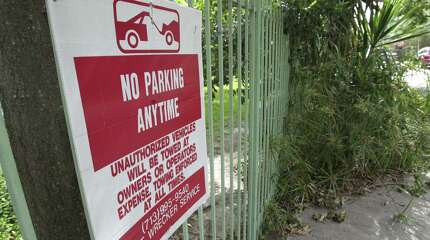
A no parking sign put up by a resident on Crooms St., between Asbury and Detering, Tuesday May 21, 2013. (Billy Smith / Chronicle)

Each lot is supposed to have either an open ditch or a curb with a gutter, she explained. Those flat spaces that just flow into the street with no hard edge? Those have been filled in illegally. Lots of little builders do that. Then some even have the nerve to put up illegal no-parking signs, transforming public right-of-way into private yards or parking spaces.

As things stand, she said, it's important for neighbors to monitor new construction closely and file a complaint if there's obviously no drainage. The city might then stop the project until the problem is fixed. But once construction is finished, it's too late. A right has been established, and the city won't act - never mind that the neighbors become far more likely to be flooded.

"The city needs more staff to review plans, do inspections and enforce the rules we have," said Robinson. "We can't enforce those rules already. Now we're about to expand those rules to an eightfold increase in territory. And so far, the city hasn't allocated or reallocated money for a single new inspector."

At the end of the street, where Crooms meets Detering, we heard the beep and rumble of a garbage truck. "Do they have special trucks for a one-way street like this?" West asked Robinson. "With special arms on both sides, to get cans on both sides of the street? Or does the truck just drive the wrong way down the street?"
I thought that was another rhetorical question. But then, suddenly, the truck turned onto Crooms, driving the wrong way: facing my car.

Robinson, an old hand at documenting neighborhood annoyances, jumped out of the back seat, clicking away with his phone camera. I pulled into a driveway so the truck could pass.

A minute later, he climbed back into the car, grinning, and passed his phone to the front seat so West and I could see the photo. He'd scored: The screen showed the garbage truck entering Crooms, right next to the Do Not Enter sign. It was the kind of Exhibit A documentation that beleaguered neighborhood activists treasure, the kind of thing that shows the unexpected, unplanned-for problems of high-density development.
"You know something is wrong when the municipal authorities have to break the law to do their job," Robinson said. It was a good line. I figured he'd use it again soon with that photo, at one of the subcommittee or commission meetings where the nitty-gritty work of fixing a city gets done.

It was too late to fix Crooms, of course. But for those suburban townhouse neighborhoods yet to be born, there's still a chance to get things right.


Density for dummies

What's up: Chapter 42, the city of Houston ordinance that controls how land is subdivided, changed in a big way last month. Now city rules encourage higher-density development outside Loop 610.
Why it's a big deal: The last revision, in 1999, transformed inside-the-Loop Houston. In an astonishingly short time, many neighborhoods' single-story houses and grassy lawns gave way, one lot at a time, to three-story townhouses. Now that kind of development will be allowed in a much, much larger area: not just the 96 square miles inside Loop 610, but in all 600 square miles inside city limits.

What won't change: Neighborhoods protected by well-enforced, up-to-date deed restrictions that specify a minimum lot size. Those private contracts will still apply.

What could change radically: Neighborhoods without strong deed restrictions, or whose deed restrictions don't specify minimum lot size. (Those neighborhoods have a year to submit a minimum-lot-size petition.) Development pressure will likely be greatest in the north and west suburbs.

Possible upsides: Rising land values in denser neighborhoods. More new housing in the $200,000-and-up range. Development of run-down properties.

Stuff to worry about: Lack of enforcement of existing city rules. Radical change of your neighborhood's character. Drainage problems. Increased traffic tie-ups in suburbs with only one or two entry points. Noise. Lack of sidewalks, which become more important as a neighborhood grows denser. Loss of green space.
Timeline: The new ordinances are being phased in over two years. To tighten deed restrictions or petition for lot-size protection, neighborhoods need to start right away.

========================================================
The map below is the Priority Development Area that Supervisor Adams advocates 30 to 50 housing units per acre. It is all land east of Las Gallinas to the 101 Freeway.

Townhouses on your street?


Tuesday, May 28, 2013

This is a Major Reason Family Housing should not be built at Marinwood Plaza.


Families living at Marinwood Village will be exposed to Roadway Pollutants.

California Senate Bill- 352 (enacted in 2003)

 
Senate Bill 352 was written with the intent of protecting school children from health risks posed by pollution from heavy freeway traffic and other nonstationary sources in the same way that they are protected from industrial pollution.

This bill requires school district to ensure that schools are not located on an old hazardous waste site, a hazardous release site, or a site that contains pipelines that carries hazardous substances.

The school district must prepare an environmental impact or negative declaration and consult with local district to identify both permitted and non-permitted facilities, freeways and other busy traffic corridors, large agricultural operations, and railyards. In addition, school site boundaries cannot be located within 500 feet from the edge of the closest traffic lane of a freeway or busy traffic corridor unless appropriate air dispersion modeling shows that the air quality at the proposed site is such that neither a short-term nor long-term exposure poses significant health risks to pupils.

 
(Seems to me it would be very,very hard to control the exhaust (particulates) from cars and ,trucks (18 wheelers and industrial-diesel trucks) especially along 101).
 Unless the government mandates automobile drivers must use electric or hydrogen or solar powered vehicles>> is that coming ?