Tuesday, March 17, 2015

California Supreme Court to Decide Major CEQA, Climate Change Case

California Supreme Court to Decide Major CEQA, Climate Change Case

Justices' Latest Grant of Review Continues Supreme Court's Focus on Environmental Law

To paraphrase former President Ronald Reagan, there they go again.
The California Supreme Court on Wednesday granted review in an important case at the intersection of the California Environmental Quality Act (CEQA) and one of the state’s most important climate change laws.  The case, Cleveland National Forest Foundation v. San Diego Association of Governments, is the latest in an unprecedented series of CEQA cases taken up by the Supreme Court.  It’s also the justices’ first opportunity to confront the important legal and policy issues presented by the landmark 2008 climate change legislation popularly known as SB 375.
SB 375, formally titled the Sustainable Communities and Climate Protection Act of 2008, for the first time links California regional transportation planning and funding with state land use regulation and planning–the ultimate goal being to reduce greenhouse gas (GHG) emissions from California’s transportation sector, the state’s single largest source of those emissions.  The legislation does so by requiring each of the state’s regional transportation agencies to incorporate a “sustainable communities strategy” (SCS) into its periodically updated regional transportation plan.  SB 375’s objective is to incentivize more sustainable land use and transportation practices, thereby reducing California’s aggregate GHG emissions.SD Traffic
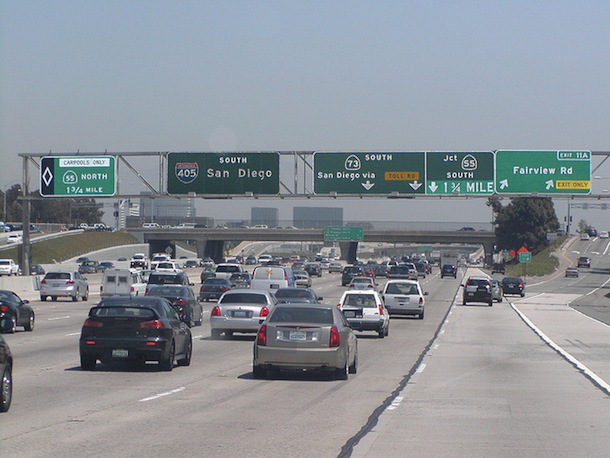
The San Diego Association of Governments (SANDAG) was the first regional transportation agency in California to adopt an updated transportation plan with an SB 375-required SCS component.  SANDAG did so after a lengthy regulatory process that included preparation of an environmental impact report (EIR) under CEQA to assess the overall environmental consequences of its proposed transportation plan and SCS.  The regional plan and SCS that SANDAG ultimately approved, while projected to achieve short-term GHG emission reduction goals, does not meet those goals over the long term.  Critically, however, the SANDAG EIR did not identify and address this inconsistency; nor did EIR focus on potential mitigation measures to address the projected environmental impacts of the regional plan’s GHG emissions.
Environmental organizations and housing advocates sued SANDAG, challenging the EIR’s adequacy under CEQA.  California Attorney General Kamala Harris intervened in the litigation on behalf of the People of the State of California and in support of the plaintiffs, a controversial decision that dramatically raised the stakes and profile of the litigation.
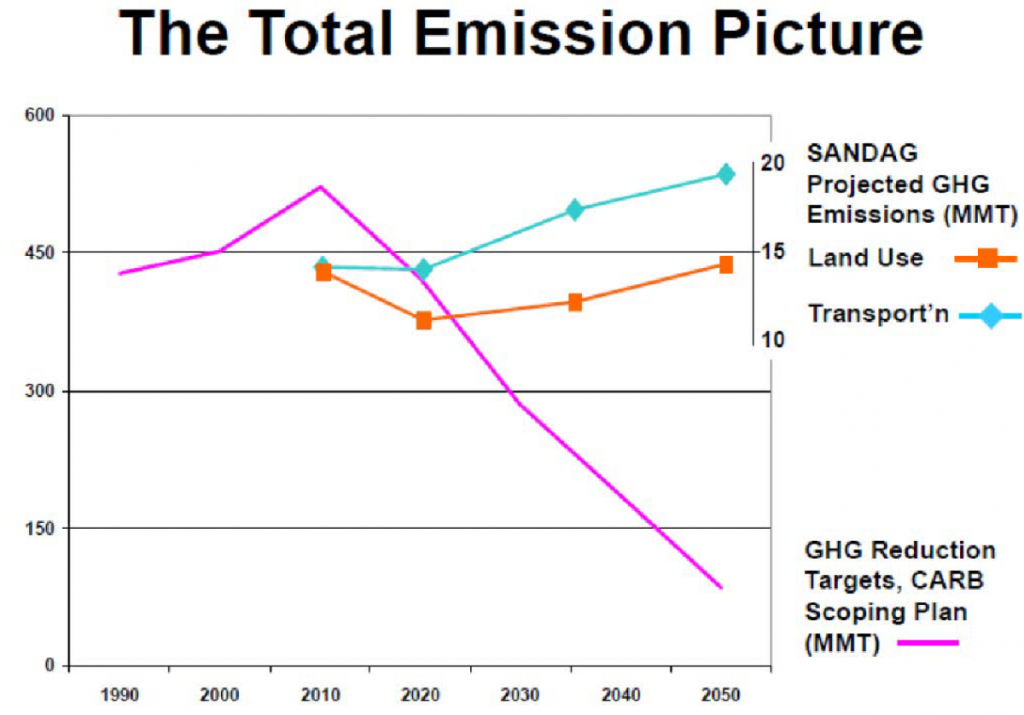
SANDAG total emissionsThe trial court ruled in favor of the plaintiffs and Attorney General Harris, a development reported inan earlier post by Legal Planet colleague Ethan Elkind.  SANDAG appealed, and a divided panel of the Court of Appeal affirmed, finding the EIR prepared by the agency in support of its regional transportation plan and SCS to be legally deficient in numerous respects.  (Ethan did a nice job of covering that decision as well in another previous post.)
SANDAG then sought review from the California Supreme Court regarding a number of perceived flaws in the Court of Appeal’s 2014 opinion.  All seven justices of the Supreme Court concurred in today’s decision to take up the case, but they limited review to a single issue which they reframed as follows:
 Must the environmental impact report for a regional transportation plan include an analysis of the plan’s consistency with the greenhouse gas emission reduction goals reflected in Executive Order No. S-3-05 to comply with the California Environmental Quality Act?
(Executive Order No. S-3-05, issued by former Governor Schwarzenegger in 2005, establishes the GHG reduction targets for 2020 and 2050 that SB 375 is designed to help achieve on a statewide basis.)
The California Supreme Court’s grant of review in Cleveland National Forest Foundation is noteworthy for several reasons:
  • First, it continues and underscores the Supreme Court’s continuing interest in–some would say obsession with–environmental law in general and CEQA in particular.  (I commented on this noteworthy trend in a recent post.)  The justices’ grant of review again brings the number of CEQA cases pending before the Court to nine and the number of pending environmental cases overall to 20–both records in California Supreme Court history.  Cleveland National Forest Foundation, moreover, is the second currently pending case before the justices to involve the intersection of CEQA and climate change, joining California Building Industry Assn. v. Bay Area Air Quality Management Dist. (which I discussed in the above-referenced, earlier post).
  • Cleveland National Forest Foundation, while a CEQA case, also represents the first opportunity for the Supreme Court to address and apply SB 375, an important and particularly innovative component of California’s suite of laws designed to reduce the state’s aggregate GHG emissions.  The Court of Appeal decision in the case [now vacated as to the issue the Supreme Court will review] gave an expansive interpretation to SB 375 and the long-term objectives the legislation is designed to achieve.  It will be interesting to see if the Supreme Court applies a similarly muscular construction of SB 375 or, alternatively, adopts the more technical and limited interpretation of the legislation advanced by SANDAG.
  • Finally, another reason that watching the Cleveland National Forest Foundation case play out in the Supreme Court will be fascinating spectator sport is that it involves a veritable Super Bowl of CEQA advocacy.  The public interest plaintiffs are represented by managing partner Rachel Hooper of Shute, Mihaly & Weinberger, one of the very best environmental and land use law firms in  California.  Attorney General Harris, aligning herself with plaintiffs, is ably represented in the case by Principal Deputy State Solicitor General Janill Richards, herself a veteran, accomplished environmental litigator.  And SANDAG’s counsel before the Supreme Court is Margaret Sohagi, one of California’s most experienced and respected CEQA experts.  To say that this key California Supreme Court case will be ably litigated on all sides is a serious understatement.

Monday, March 16, 2015

Transbay Terminal


The Transbay Transit Center Project (Narrated by Peter Coyote) from Transbay Transit Center on Vimeo.

Transbay project in $300 million hole

'There's not enough money' for transit center project
 
Updated 8:46 am, Thursday, July 25, 2013
The construction cost for the first phase of the transportation hub at First and Mission streets, which will initially serve buses from seven transit agencies and eventually electric trains from Caltrain and high-speed rail, has risen from $1.6 billion to $1.9 billion in the revised budget the authority adopted on July 11. The project's first phase includes demolishing the old Transbay Terminal, building and operating a temporary terminal and building the five-story terminal, including bus decks and ramps, retail spaces, two below-ground rail levels and a rooftop park.

Funding elusive

To cover the hefty cost increase, Heminger said, the authority will use some of the money that had been dedicated to the second phase of the project - the downtown extension that would carry trains from Fourth and King streets to the Transbay center. That portion of the project had never been fully funded, and is a key Bay Area project competing for major federal funding. But the soaring cost of the first phase means it will be an even bigger challenge to find the funding to lay rails to the new transit center.
"There's not enough money to deliver the full project - not before the increases and not after," said Adam Alberti, a spokesman for the authority. "The fact that the cost increased by $300 million means that a bigger hole needs to be plugged."
San Francisco Supervisor Scott Wiener, a commissioner and Transbay center supporter, said after the meeting that the cost increase was disappointing but not a serious setback for the downtown extension.

'We'll get it done'

"I don't think it will have a meaningful impact," he said. "We have always known that getting the downtown extension done would take a lot of work over a number of years, and this doesn't change that. We'll get it done."
Alberti blamed the cost spike on increased and unanticipated federal security requirements for the transit center, whose prominence will make it a potential target for terrorist attacks. A federal vulnerability analysis identified an additional $56.8 million in detection, communications and protection systems needed for the project.
The resurgent economy and construction industry also contributed, pushing bids on the last major contract - structural steel - 75 to 80 percent over estimates. The authority received a single bid, rejected it and repackaged the work into three separate contracts to attract more bidders. It worked, resulting in lower bids, but they were still $95 million more than budgeted.

Economy strengthens

"It's largely reflective of the fact that the economy, and especially the construction economy, is heating up," Alberti said.
While construction costs are rising, so are land values, and that will help the authority cover the $300 million overrun. To take advantage of the boom, some of the land sales funding the center will be accelerated so that money is available sooner, Alberti said. The authority also hopes to win additional Proposition K transportation sales tax funds in San Francisco, transit center impact fees and grants from the MTC. It also hopes to refinance a federal infrastructure loan.
But if those efforts fail, Heminger said, the authority may ask the commission to borrow toll money. He said the agency would consider that request but is unlikely to give any additional grants to the transit center project. The terminal is expected to open, without the downtown extension, in late 2017.

Design changes

Alberti said the Transbay authority has made design changes to hold the costs down, including replacing the glass covering of the curvaceous center with a perforated metal skin. It's also adjusted estimated costs of future construction contracts upward to reflect the change in the economy.
The authority also hopes to win new state and federal grants. But the biggest hope is that the project is awarded $650 million or more from the federal New Starts program, a competitive grant program that has helped fund major Bay Area transit projects, including the Central Subway, the San Jose BART extension and the BART extension to San Francisco International Airport.

New York's $4 Billion Train Station make San Francisco 3 Billion Dollar Transbay Terminal look like a bargain


New York's $4 Billion Train Station: In 100 Years, Will Anyone Still Care About All That Wasted Money?

New York magazine's Andrew Rice defends Santiago Calatrava's "glorious boondoggle." Here's what he gets wrong.


The World Trade Center Transportation Hub |||
Santiago Calatrava's World Trade Center Transportation Hub in lower Manhattan, dubbed "the world's most expensive train station," will cost $4 billion, or roughly double the price tag sold to the public when the project was first announced 11 years ago. The Port Authority of New York and New Jersey, the public agency in charge of the project, has squandered hundreds of millions of dollars over the years on ill-advised construction contracts and lousy planning.
A new essay by Andrew Rice in New Yorkmagazine, "The Glorious Boondoggle," argues that none of this matters so much because it's a phenomenal structure—"No recent addition to the cityscape has aspired to combine public utility and aesthetic daring to the same degree"—and eventually we'll all forget about the wasted money. Rice approvingly quotes architect Daniel Libeskind:
Someday…people will revel in Calatrava’s creation and the controversies will be forgotten. "Bernini, most people don’t know, built a tower at the Vatican that collapsed," he says. "He had such a failure he thought his career would never recover. Now we look back at Bernini and say, 'wow, what an architect.' So, look, you have to give it time."
New York is indeed filled with worthwhile infrastructure project that were scandals in their own time. Is anyone still pissed that Tammany Hall embezzled millions during the construction of the Tweed Courthouse, which stands a few blocks from the World Trade Center Transportation Hub? It dominated the headlines for a period in the 1870s; today the building's considered a treasure.
But Rice doesn't dwell on how all that money otherwise could have been spent. It's no wonder that we’re more apt to appreciate the public infrastructure that exists than to mourn the unnamed projects and initiatives that never came to fruition because of lousing planning and government ineptitude.
Rather than a $4 billion train station, wouldn't it have been better for the Port Authority to build out an actual train? The city's $2.4 billion extension of the number 7 train is also scandalously expensive, but at least it's the sort of project that makes the city more habitable and creates conditions for private developers to build grand structures. We could have gotten almost two of those instead of the station.
Or, taxpayers could have held on to those funds and spent them in ways invisible to the rest of us but also of benefit to future generations.
For more on the World Trade Center rebuilding saga, check out this Reason TV video Kennedy and I made back in 2012:

Sunday, March 15, 2015

New Testimony to RWQCB about the Toxic Waste spill at Marinwood Plaza that threatens our health

Marinwood Plaza, LLC, the current owners of Marinwood Plaza  aka Hoytt Enterprises is under order to clean up the toxic waste contamination of PCE from Prosperity Cleaners.   There is a profound threat to the health of our community.  A cancer hotspot is reported yards away in Casa Marinwood.  

Very little clean up appears to have happened since the order was issued in February 2014.   Former Supervisor Susan Adams and Assemblymen Marc Levine have PERSONALLY INTERVENED in the process in an attempt to INTIMIDATE the non partisan scientific board.   It seems that it has worked.

The commissioners who were adamant that the clean up begin immediately in February 2014 suddenly have backed off of their demands.  The case officer at the RWQCB (Regional Water Quality Control Board) suddenly was "retired" and will not speak of the case.   Marinwood Plaza has fallen out of escrow and is now being offered for sale (Bridge housing has a offer in.  We presume they are counting on the taxpayer to foot the bill on their behalf)

Susan Adams,  a nursing PHD seems to be more concerning with advancing her objective of helping Bridge Housing than the health of her neighbors.   She was delivered a crushing election defeat in June 2014 but still remains on the ABAG regional planning board as a member of the "public" representing "public health".

The sleaze is surreal.  Even if one is for affordable housing at Marinwood Plaza, does it make sense to imperil the health of the community so that Marinwood Plaza can save money over clean up?

The property should be seized immediately and cleaned up and turned over to Marinwood CSD.


Trust Me.  I support affordable housing and green jobs

My Comments for EIR Scoping of Marinwood Village.

Editor's Note: According to Kevin Haroff, lead attorney for  www.alliancemarin.org lawsuit against the Marin County Environmental Impact Report for unincorporated Marin,  people have a right to comment AFTER the artificially imposed comment deadline for today, April 7th.  Comments become part of the official record and the only points to which the public can appeal.

It is important to have your voice heard.  Send your concerns today.

+++++++++++++++++++++++++++++++++++++++++++++++++++++++++++++++++++++++++

Sent to: 'envplanning@marincounty.org'

Rachel Reid
Environmental Planning Manager
3501 Civic Center Drive, Suite 308,
San Rafael, CA 94903


The Marinwood Village project raises many environmental concerns to the community of Marinwood Lucas Valley.  Its impact to the health, safety, aesthetics, financial, parking, ground water school impacts, archeological heritage, air quality and local government services will be dramatic.  In addition, the proximity to five other potential sites within a 4 mile radius, the cumulative impacts will spread far beyond the immediate neighborhood.  

While affordable housing per se is not the issue,  non profit (tax payer subsidized) affordable housing at the Marinwood Plaza site is particularly challenging especially given the known toxic waste and benzene contamination, and  a microwave farm located on the property.    This site is wholly unsuited for high density development, placing its residents at health risks from the toxics from the former gas station,  prosperity cleaners site and highway 101.  Indeed, a cancer hotspot is located several hundred yards away in Casa Marinwood. see: http://youtu.be/HfsCiHUvZsI

The community concerns raised at the March 29th are just a beginning.  Other sites within the Marin County Housing element are far less impactful than the Marinwood Village site.

1.)  The EIR shall study the impacts cumulatively from all areas between South Novato Blvd at Hwy 16 in Novato to the Civic Center, San Rafael,  and Nicasio through the Baylands Corridor and San Pablo Bay..  Marinwood Plaza may soon be joined by 240 residences at Silveira Ranch, 173 units at Oakview, 225 units at Grady Ranch, Rocking H ranch  240 units, Big Rock Deli 60 units plus 60 units across the street at Rotary Field plus whatever else the community development department may propose.  It is clear that the current board of supervisors have specifically targeted Marinwood/Lucas Valley for major development of non-profit affordable housing to meet its HUD requirements under the Analysis of Impediments agreement.  In addition, Marinwood was identified as a potential Priority Development Area for urbanization, which  may increase the number of living units west of Las Gallinas by 1500-4500 households . (www.onebayarea.org). Although this designation has been temporarily withdrawn, the Board of Supervisor reserve the right to reinstate it at a later date.

2.) The EIR shall study the effects on local and freeway traffic especially if Marinwood market is forced to close due to loss of parking and freeway visibility. Since Marinwood Lucas Valley only has one retail shopping center and virtually no employment beyond government services, the destruction of the shopping center will forever doom its residents to travel elsewhere for all of their  living essentials and jobs.  Marinwood market is a gourmet deli with premium pricing and unlikely to serve the needs of a neighboring low income population. The residents will be forced to travel to Novato or San Rafael to shop for essentials. 

3.) The EIR shall study the comparative environmental effect of a neighborhood retail shopping center that will serve the local community within walk-able and bike-able distances.  Especially study the positive impacts on health, well being of the community and positive  impacts for mobility impaired people.

4.) The EIR shall focus on the effects on the environmental effects of the immediate community of Marinwood-Lucas valley and ignore irrelevant, non-objective conjecture such as "greenhouse gases saved" by avoiding building 82 single family homes in a distant community.

5.) The EIR shall study the FULL toxic waste removal of the PCE contamination that has traveled beneath the 101 freeway and threatens the water supply of Silveira Ranch.  The removal is most likely excavation and will imperil the community health from dust and debris. Residents from Casa Marinwood plus the hundreds of school children who ride the school buses could be affected.   The Silveira dairy herd is imperiled from the current contamination and threatens the health of thousands of milk drinkers. See: http://youtu.be/HfsCiHUvZsI ;  http://youtu.be/sZJoMdOMzd0 ; http://youtu.be/4aeGaJ4mcMY  and also RWQCB website for Geologica Report.

6.) The EIR shall study the current contamination of the old gas station property at the corner of Marinwood Avenue and Miller Creek which will house ten housing units and commercial spaces.  The current site has been cleaned to commercial standards according to the RWQCB but not to residential standards.  Further cleanup must occur on this site before construction is permitted.  The effects on the health of residents of Casa Marinwood and Blackstone drive shall be studied.  

7.) The EIR shall study the effects of parking during peak usage during the weekends when workers are home and people need to shop at Marinwood Market.  Since the residents auto use will be high (or higher due to multiple adults per residence) due to the lack of local shopping and job opportunities, it is likely that every available parking space will be continually occupied and additional street parking will be needed on Marinwood Avenue, Miller Creek avenue and Blackstone Rd.  The EIR shall study the negative effects on groundwater pollution on the Miller Creek watershed.

8.) The EIR shall study the effects of the removal of trees, providing healthy oxygen and filtering roadway pollutants and GHG  currently lining Marinwood Avenue. 

9.) The EIR shall study the effects on the archeological resources of the ancient Miwok village which was sited along  Miller Creek for thousands of years.  Indigenous people's relics from past civilization are still found regularly in Miller Creek.  Several major anthropological studies have been made along Miller Creek and reside in the Marin County Library. Further work is needed to protect the legacy. A state licensed archeologist shall be present at the dig sites.

10.) The EIR shall study the effects of construction of new schools. The increased population of children will necessitate building new school facilities.  Brad Wiblan, VP of Bridge Housing, stated at the October 28, 2012 meeting at Mary Silveira school that he estimated 1.6 school children per apartment, or approximately 160 children.  At minimum, this is likely 6-8 classrooms depending on the distribution of grades.  It is likely to trigger the construction of a new elementary school given the current capacity constraints.  Additional schools will be needed when the new developments at St Vincents and other areas are completed.  This impact is especially important to study cumulatively. http://youtu.be/v8435IFLilc

11.) The EIR shall study the impacts on our burdened Marin Municipal Water Supply especially during drought conditions.  The current drought has seen our water supply perilously close to water rationing.  This impact shall be studied cumulatively on the entire water district and its sources.  Sonoma county, has aggressive housing mandates which will lessen the supply available for our district.

12.) The EIR shall study the impact on the overburdened Las Gallinas Sanitary District.  It is overcapacity, dated and in need of a major upgrade to stay current with environmental regulations.  Study the cumulative impact on the current system plus the construction of a new sanitary system.  The current sewage pipes are 60 years old and in need of replacement. Please study the effects of replacing sewage pipes to carry the additional waste.

13.) The EIR shall study the impact of groundwater runoff from the parking lots on the spawning habitat of threatened salmon population, egrets, otters and endangered species found locally.

14.) The EIR shall study the aesthetics of building an urban style high density housing project that is 3 times as dense and 50% taller than any other multifamily building in Marinwood-Lucas Valley.  The prevailing density is 5 units per acre in the adjoining neighborhood and 10 units per acre in Roundtree Condominiums. The architectural character of Casa Marinwood is Mission Style and the single family homes are Mid Century ranches.  The aesthetics of Marinwood Village is "Miami Vice Modern" clashing with the character of our Mid Century suburb.

15.)The EIR shall study the effects on increase crime with high density housing.  Increased population, especially in densely packed housing has been shown to increase overall crime even if the "per capita" crime rate remains constant.  More people equals more crime. Compare affordable housing in Bay Vista and Wyndover apartments in Novato crime rates with existing crime rate in Marinwood-Lucas Valley.  The EIR shall study increased police protection required to keep crime rates low.  See: www.crimereports.org

 Respectfully submitted,


Stephen Nestel


How we got to Plan Bay Area- A resource of Government Documents and Industry links.

How we got to Plan Bay Area


*American National Park System The Critical Documents 1864

http://www.nps.gov/history/history/online_books/anps/

*Population Council created in 1952, founded by John D. Rockefeller 3rd

http://www.popcouncil.org/about/timeline

*Outdoor Recreation for America

A Report to the President and to the Congress by the Outdoor Recreation 

Resources Review Commission (ORRRC)

Laurance S. Rockefeller, Chairman, January, 1962

http://www.cr.nps.gov/history/online_books/anps/anps_5d.htm


Nixon Administration


*Rockefeller Commission report: Population and the American Future

http://www.population-

security.org/rockefeller/001_population_growth_and_the_american_future.ht

NEPA National Environmental Policy Act of 1969 sets up:

http://ceq.hss.doe.gov/

US Environmental Protection Agency (USEPA)

http://www.epa.gov/

Environmental Quality Council  (EQC)

EQC Reports: 

*The Unfinished Agenda

www.geraldbarney.com/Rockefeller_Brothers_Fund/Unfinished.pdf

Report Sponsored by the Rockefeller Brothers Fund

*The Use of Land

Report Sponsored by the Rockefeller Brothers Fund

Environmental Protection goes global: United Nations

UN Bruntland Commission report Our Common Future, the three E's: equity, 

environment economy the pillars of Sustainable Development

www.un-documents.net/our-common-future.pdf

http://sustainabledevelopment.un.org/index.php?menu=122

http://www.un-documents.net/index.htm

http://www.un-documents.net/vp-d.htm

UN Agenda 21 (international environmental management system)

Plan for Inventory and control of all: Land, Minerals, Plants, Animals, Water,  

Energy, Means of production, Construction, Education, Human beings and 

Information in the world.

Land cannot be treated as an ordinary asset. 

National land use plan changes our urban, suburban and rural land use to 

urban, open space, agriculture and wildand/habitat.

http://www.sustainabledevelopment.un.org/content/.../Agenda21.pdf

UN Biodiversity Assessment

http://www.un.org/earthwatch/biodiversity/assessment.html

Unsustainable: 

http://www.freedomadvocates.org/what-is-unsustainable/


Bush Administration


Signed on to the 1992 Earth Summit Action Plan for sustainable development 

aka Agenda 21

http://www.c-span.org/video/?26576-1/rio-earth-summit


Clinton Administration 


Executive Orders creates President' Council on Sustainable Development 

http://clinton2.nara.gov/PCSD/

Sustainable Development is Smart Growth (urban) and wildlands (rural)

HUD grant to American Planning Association (APA)

This APA legislative guidebook was prepared under HUD

Cooperative agreement H-59-51‐CA in 2002

http://www.planning.org/growingsmart/


Obama Administration


Executive Order creates Rural Council

http://www.whitehouse.gov/administration/eop/rural-council

http://www.whitehouse.gov/administration/eop/ceq/sustainability/plans

http://www.usa.gov/Agencies/Federal/Executive.shtml

http://archive-sustainability.performance.gov/

Sustainable Development in Federal Agencies

United States federal executive branch agencies implementing sustainable 

development: through Sustainability performance plans

*Department of Agriculture (USDA) 

http://www.dm.usda.gov/emd/docs/2013%20USDA%20Strategic%20Sustai

nability%20Performance%20Plan.pdf.

*Department of Commerce (DOC) 

2013 Strategic Sustainability Performance Plan

*Department of Defense (DOD) 

http://www.acq.osd.mil/ie/download/green_energy/dod_sustainability/Stra

t%20Performance%20Plan%20FactSheet_GPP_v2.pdf

*Department of Education (ED) 

2013 Strategic Sustainability Performance Plan

*Department of Energy (DOE) 

http://www1.eere.energy.gov/sustainability/pdfs/doe_sspp_2012.pdf

*Department of Health and Human Services (HHS) 

http://www.hhs.gov/about/sustainability/2013-sustainability-plan.pdf

*Department of Homeland Security (DHS) 

http://www.dhs.gov/sustainability-performance-plan

*Department of Housing and Urban Development (HUD) 

http://portal.hud.gov/hudportal/HUD?src=/program_offices/administration/

sustainabilityplan

*Department of Justice (DOJ) 

http://www.justice.gov/jmd/doj-sspp-june2012.pdf

*Department of Labor (DOL) 

http://www.dol.gov/open/sustainability/

*Department of State (DOS) 

http://www.state.gov/m/pri/rls/plans/176092.htm

*Department of the Interior (DOI) 

http://www.doi.gov/greening/sustainability_plan/index.cfm

*Department of the Treasury 

http://www.treasury.gov/about/organizational-

structure/offices/Documents/Treasury%202013%20Public%20SSPP%20Final.pdf·  

*Department of Transportation (DOT) 

http://www.dot.gov/mission/sustainability/our-sustainability-efforts-0

*Department of Veterans Affairs (VA)

http://www.green.va.gov/environment/sspp.asp


State of California 


AB32 Climate Change Act

http://www.arb.ca.gov/cc/ab32/ab32.htm

SB375 Regional Sustainable Community Strategy

http://www.arb.ca.gov/cc/sb375/sb375.htm

State Housing Element Law

Regional Housing Needs Allocations (RHNA)

http://www.abag.ca.gov/planning/housingneeds/ 

Essential Habitat Connectivity

https://www.dfg.ca.gov/habcon/connectivity/

https://www.wildlife.ca.gov/Conservation/Planning/Connectivity

Joint Powers Act (JPA)

http://www.leginfo.ca.gov/cgi-bin/displaycode?section=gov&group=06001-

07000&file=6500-6536

Joint Policy Committee (JPC/JPA)

http://www.abag.ca.gov/jointpolicy/

 Federal Metropolitan Planning Organizations (MPO's) is funding priority 

development areas (PDA's) through One Bay Area Grant Program (OBAG). 

Metropolitan Transportation Commission (MTC) is our MPO.

http://webcache.googleusercontent.com/search?q=cache:heneEnrjWTEJ:ww

w.dot.ca.gov/hq/tpp/offices/orip/index_files/Updated%2520Files/MPO-

RTPA_1-10.pdf+&cd=7&hl=en&ct=clnk&gl=us

 Federal Congestion Management Agencies (CMA's) funding priority 

conservation areas (PDA's). Valley Transportation Agency (VTA) is our 

http://www.fhwa.dot.gov/planning/congestion_management_process/cmp_g

uidebook/cmpguidebk.pdf

 Council of Governments (COG's): the Association of Bay Area Governments 

(ABAG) is a COG.

COG's across California:

http://www.abag.ca.gov/planning/interregional/stateirp/state_program.htm

COG's worldwide:

http://www.abag.ca.gov/abag/other_gov/rcg.html

Regional Initiatives

http://onebayarea.org/regional-initiatives.html

Plan Bay Area

http://onebayarea.org/plan-bay-area.html

Follow the Money: Nonprofit Maps

http://www.discoverthenetworks.org/funderprofile.asp?fndid=5322


The Last Choice of Freedom:


1. Local » Regional » Global Governance

*UN Declaration of Human Rights and Freedoms

http://www.un.org/en/documents/udhr/

*UN Charter: Purposes and Principles

http://www.un.org/en/documents/charter/chapter1.shtml


2.  City » County » State » National Government

United States of America Declaration of Independence

http://www.archives.gov/exhibits/charters/declaration_transcript.html

United States Constitution

http://www.archives.gov/exhibits/charters/constitution_transcript.html

California State Constitution

http://leginfo.legislature.ca.gov/faces/codes.xhtml