Showing posts with label Apartment Crowding. Show all posts

Sunday, September 9, 2018

Apartment Over Crowding in the Canal District


The more the merrier.

From Wikipedia on the Canal District


Demographics and housing


The above two apartment complexes (55 Fairfax and 162 Belvedere St) in the Canal District are owned by Bridge Housing.  see related stories in Apartment Overcrowding

Most of San Rafael's low-income residents live in the Canal Area, along with many affluent residents. There is at least one concern (on Harbor Way) that rents slips for boats that people can live aboard legally.
The more affluent residents live in the houses constructed in the 1960s right on the Canal and in two housing developments in the eastern part of the Canal's residential area: Baypoint Lagoons (constructed in the late 1990s) and Spinnaker Point (constructed earlier). Some real-estate agents refer to these two developments as being in "East San Rafael", to avoid the stigma of the name "Canal Area".
The low-income homes (almost all of which are apartments) are inhabited mainly by immigrants (documented and undocumented), from a variety of countries. Seventy percent are Hispanic, 11 percent Asian, 10 percent Caucasian, 5 percent African-American and 4 percent are of other ethnic groups.[citation needed] This area provides a location for workers who hold low-income jobs that are essential to the functioning of the community to live close to their place of employment.
Although the majority of residents in this area are low-income workers, most of the apartments in which they live are neither subsidized nor less expensive than comparable apartments elsewhare in San Rafael.
 In order to pay the relatively high rents, the residents resort to sharing their dwellings with many roommates, typically at least two persons per bedroom, plus one person in the living room. Often as many as eight or more persons, including children, will occupy a two-bedroom apartment

Sunday, May 27, 2018

YIMBY Urbanists can learn from Gardeners. "Overcrowding Kills Growth"

Poor Garden Spacing, Overcrowding,
Failure to Thin

This one is my pet peeve about beginning gardeners, because garden spacing mistakes are costly and completely avoidable. Overcrowding ALWAYS leads to an unnecessary crash course in pest control and disease management.
Spinach and Lettuce Interplanted with Chiles
Spinach and Lettuce Interplanted with
Chiles
 © Steve Masley…Click IMAGE to Enlarge
Beginning gardeners have enough on their plate without this.
I can’t tell you how many times I’ve seen starter pots of 20 or 30 basil seedlings just stuck in the ground without separating the seedlings and spreading them out.
It’s easy to understand how this happens. People are afraid to damage delicate seedlings, so they just plunk the whole pot in the ground.
Then there’s the reverse problem, the temptation to fill in all that bare, empty expanse of prepared soil with plants. Seeds and seedlings look so tiny in all that black space, but you have to imagine them as they’ll be at full size, and space them accordingly.


Click Any Image to See a Larger Version
‘Academic’ (Pointy-Headed) Cabbage, a.k.a., ‘Caraflex’
Tomato Varieties—'Enchantment' 2
Green Bean Varieties—'Spanish Musica' 3
Growing Tomatoes ‘Italian-Grandfather-style’. Fruit Sets in Fat Clusters Along the Stake

Top 10 Mistakes
 1.) Too Much Garden
 2.) Wrong Varieties
 3.) Planting Too Early
 4.) Poor Soil Preparation
 5.) Poor Garden Spacing
 6.) Not Enough Light
 7.) Incorrect Watering
 8.) "More is Better" Trap
 9.) Not Mulching
10.) Ignoring Pollinators
“I paid for 6 zucchini plants, I may as well plant them.”
“I planted seeds and got so many carrot seedlings, I just don’t have the heart to thin them.”
Such are the rationalizations that get newbies into trouble. Plants in overcrowded plantings are undernourished, stressed by crowding, produce a fraction of their potential yield, and are more susceptible to pests and diseases than properly spaced plants.
If you just get Garden Spacing right, you can save yourself a huge amount of frustration and wasted effort later in the season.

Saturday, December 2, 2017

Planning for displacement of thousands of people due to Plan Bay Area

"Hit the Road Jack.  We are here from ABAG to rebuild your neighborhood."

by Tim Redmond : sfbg.com – excerpt

Regional planners want to put 280,000 more people into San Francisco — and they admit that many current residents will have to leave…Social Engineering video

CLIMATE CHANGE AND “SMART GROWTH”

The threat of global climate change hasn’t convinced the governor or the state Legislature to raise gas taxes, impose an oil-severance tax, or redirect money from highways to transit. But it’s driven Sacramento to mandate that regional planners find ways to reduce greenhouse gas emissions in California cities.

The bill that lays this out, SB375, mandates that ABAG, and its equivalents in the Los Angeles Basin, the Central Coast, the Central Valley and other areas, set up “Sustainable Communities Strategies” — land-use plans for now through 2040 intended to reduce greenhouse gas emissions by 15 percent…

The notion of smart growth — also referred to as urban infill — has been around for years, embraced by a certain type of environmentalist, particularly those concerned with protecting open space. But now, it has the force of law…

And while ABAG is not a secret government with black helicopters that can force cities to do its will — land-use planning is still under local jurisdiction in this state — the agency is partnering with the Metropolitan Transportation Commission, which controls hundreds of millions of dollars in state and federal transportation money. And together, they can offer strong incentives for cities to get in line…
The vast majority of the housing that will be built will be too expensive for much of the existing (and even future) workforce and will do little to relieve the pressure on lower income people. But there is nothing whatsoever in the plan to ensure that there’s money available to build housing that meets the needs of most San Franciscans.

 Instead, the planners acknowledge that 36 percent of existing low-income people will be at risk for displacement. That would be a profound change in the demographics of San Francisco… (more)

THE NUMBERS GAME

Projecting the future of a region isn’t easy. Job and population growth isn’t a straight line, at best — and when you’re looking at a 25-year window in a boom-and-bust area with everything from earthquakes to sea-level rise factoring in, it’s easy to say that anyone who claims to know what’s going to happen in 2040 is guessing…

But no matter which alternative you look at, two things leap out: There is nothing effective that ABAG has put forward to prevent large-scale displacement of vulnerable communities. And despite directing growth to transit corridors, the DEIR still envisions a disaster of traffic congestion, parking problems, and car-driven environmental wreckage…

THE DISPLACEMENT PROBLEM

ABAG has gone to some lengths to identify what it calls “communities of concern.” Those are areas, like Bayview Hunters Point, Chinatown, and the Mission, where existing low-income residents and small businesses face potential displacement. In San Francisco, those communities are, to a great extent, the same geographic areas that have been identified as PDAs….

“The projections don’t take into account social change,” Jason Henderson, a geography professor at San Francisco State University and a local transportation expert, told me. “And social change does happen.”…

Henderson argues that the land-use policy is flawed. He suggests that it would make more sense to increase density in the Bay Area suburbs along the BART lines. “Elegant development in those areas would work better,” he said. You don’t need expensive high-rises: “Four and five stories is the sweet spot,” he explained...

SIDELINING CEQA

ABAG and the MTC have a fair amount of leverage to implement their plans. MTC controls hundreds of millions of dollars in transit money; ABAG will be handing out millions in grants to communities that adopt its plan. And under state law, cities that allow development in PDAs near transit corridors can gain an exemption from the California Environmental Quality Act….

Under SB 375 and Plan Bay Area, CEQA exemptions are available to projects that meet the Sustainable Community Strategy standards and are close to transit corridors. And when you look at the map of those areas, it’s pretty striking: All of San Francisco, pretty much every square inch, qualifies.

 That means that almost any project almost anywhere in town can make a case that it doesn’t need to accept full CEQA review.

The most profound missing element in this entire discussion is the cost of all this growth…
Instead of looking at displacement as inevitable, and traffic as a price of growth, the planners could tell the state Legislature and the governor that it’s not possible to comply with SB375
— not until somebody identifies the big sums of money, multiples of billions of dollars, needed to build affordable housing; not until there are transit options, taxes, and restrictions on driving.

Because continued car use and massive displacement — the package that’s now facing us — just isn’t an acceptable option… (more)

Short Takes: Tidbits on planning from around the Bay you need to know
Regional planning hits Chinatown

When regional planners at the Metropolitan Transportation Commission funded a study to create a bus-rapid transit system on Van News Avenue, they decided, in the interest of speeding the buses along, to allow only one left turn — onto Broadway.
That would turn Broadway into a much-busier thoroughfare — and have a huge impact on Chinatown, where there’s heavy pedestrian traffic. That, Cindy Wu says, is one of the problems with regional planning — it doesn’t always consider the impacts on existing, fully developed neighborhoods.

 Wu is a planner with the Chinatown Community Development Center and a member of San Francisco’s Planning Commission. She’s concerned that Plan Bay Area, with its macro focus, ignores the micro — the people who already live in communities that will feel the pressure.
Thousands of Chinese Immigrants may be displaced from one of the Oldest Chinatowns in American

“Chinatown is performing amazingly,” she told me recently. There’s low car use, high density … all the things ABAG seems to want. And yet, it’s in the Priority Development Area, where new construction could lead to displacement. “It doesn’t get to the neighborhood scale, where people will be forced to control the impacts of growth.”

Gen Fujioka, policy director at CCDC, noted that the plans says people displaced from a San Francisco community like Chinatown can be accommodated elsewhere in the region. “Like that’s an acceptable alternative,” he said…  (more)

Apartment Overcrowding among Indigenous Farmworkers


Many American families a few generations ago lived like this

Thrifty immigrants often live several families per apartment

Editor's Note:  We showed you three of Bridge Housing's family apartment complexes in San Rafael. Two of the complexes are in the Canal District which is largely populated by immigrants from Mexico and Central America. They tend to work in landscaping, agriculture, construction, cleaning. They are hard working community, many are undocumented living under the constant fear of deportation.

Entire villages from their old country will often live in the same apartment building , several families per apartment just as new European immigrants did in the last century. This study found that an average of 1.8 people per room in Santa Rosa among farmworkers. This means that an average two bedroom apartment will have 6 people. People often sleep in kitchens and living rooms to save money.

Marinwood Village is expected to have 83 apartment units of one, two and three bedroom units. It will be Bridge Housing's largest family complex in Marin County. It is not inconceivable that it will have a population of 600 people (300 school children) because of apartment overcrowding.

Those of us who have actually visited the homes of typical low income apartments in California know this is not an exaggeration. We also know that this community are industrious, rich in heritage, have a strong sense of family.

Pleasanton found that 3.1 children occupied each low income apartment, forcing them to build new schools. Dixie School District is over capacity now. Some classrooms have 28 children per teacher instead of the state standard of 18. Any addition of children will be very costly. It will require more classrooms, teachers and administrators or possibly a whole new school.

Whatever your conclusions about affordable housing in Marinwood-Lucas Valley, this article shows you a real world view of the living conditions of those people who will qualify for affordable housing in Marinwood Village.
*******************************************

The Indigenous Farmworker Study

Indigenous farmworkers throughout California face consistently appalling living conditions

Friday, November 10, 2017

Cooped up People and Free Range Chicken?-High Density Zoning in Marinwood Priority Development Area


Feel that your freedom to live peacefully among nature in Marinwood-Lucas Valley is being threatened?


Wait until our new low income neighbors get here.  Our population will increase by 25%.


Housing density will increase dramatically,  yet we will not have any more the essential services, water and land to support this growth...  It's all about "Big Box" apartments. More people per square acre makes more money for developers.  Some environmentalists think it is greener but the opposite is true.  More people in smaller places concentrates pollution and increases social problems.
Children need a place to play. People need clean air to breath. 


Just ask any Free Range Chicken.


The Principles of Responsible Chicken Raising

Chickens must be given ample room.

Plenty of sunlight. 

Clean living area.

No debeaking or other unnecessary trauma.

Must have the ability to scratch around in the dirt, spread their wings, and otherwise express their chickenness.


Should the Children in affordable housing receive less consideration than free range chicken?

Monday, November 14, 2016

Can We Build Cities Out Of Apartments the Size of Parking Spaces?

Some urban planners call this "efficient and humane"

© Eugene Lubomir

See full article here:

Americans are not used to living in small spaces; a few years ago when Apartment Therapy wrote about a 430 square foot apartment in Paris that housed a family of four, commenters were outraged, considered it cruel, with one saying " In the US, the children would be taken." In the New York Times, Allison Arieff wonders How small is too small?

Arrieff looks at the range of small unit projects being proposed in New York and San Francisco that we have covered in TreeHugger (see related links at left) but also the Eugene Lobomir's wonderful upLIFT competition entry (done in collaboration with atr+d & Brian Schulman). Lubomir describes the design:
These plug and play units are completely prefabricated, injection moulded panels made from recycled materials. As interchangeable panels, variety and customization become the standard condition.

© Eugene Lubomir
The units weigh about the same as a car, and so that they can be delivered on a truck and parked in pre-existing spaces. The upLIFT "appropriates the space of the automobile.... in an effort to re-envision space of human occupation."
The units look perfectly reasonable for a single person, more than enough when the city is your living room and entertainment centre. As Allison writes,
Small housing units can be well designed, though their success is contingent on the success of the urban setting in which they exist. In other words, what’s outside the door needs to be compelling enough to make up for what might otherwise be internalized inside a larger home.
The real issue is going to be the accommodation of urban families. Many people don't believe that kids belong in apartments in the city; The deputy mayor of Toronto recently questioned the merits of it, saying “I mean, I could just see now: ‘Where’s little Ginny?’ ‘Well, she’s downstairs playing in the traffic on her way to the park!’”

In fact people do it all over the world, and we are going to be seeing a lot more of it in North America. More in the New York Times

Sunday, September 13, 2015

Parking Problems Plague Portland from Foolish Zoning Laws

Parking problem spreads in Portland

As more people move in, tensions rise over increasingly scarce spaces for cars

John Golden, an opponent of a plan to build a four-story apartment building that comes with no parking spaces, explains the potential fight for spaces if the building is constructed in Portland.


photo
AP
A motorist passes an 81-unit apartment building under construction in Portland.
photo
AP
A bicyclist and motorist pass an 81-unit apartment building under construction in Portland.
photo
AP
A four-story, 81-unit apartment building under construction at right shares a quiet side street with older houses in Portland. The building will include scores of bicycle racks but not one parking space for automobiles.
PORTLAND — Though Portlanders are remarkably united when it comes to protecting the environment, a property on aptly named Southeast Division Street has provoked an unexpected backlash against the city's progressive approach to housing its burgeoning population.
The general reason for the controversy — insufficient parking. But how this got to be a problem on Division Street typifies Portland, a place proud of its plastic shopping bag ban and global warming "action plan" but still struggling with how to grow while staying green.
A developer, Dennis Sackhoff, last year demolished what had been the city's landmark lesbian bar and started construction on a four-story, 81-unit apartment building that will include scores of bicycle racks — but not one parking space for automobiles.
It's one of about 30 parking-free apartment buildings that have been recently completed or are in some stage of development in the city, mostly in the cozy neighborhoods on the east side, across the Willamette River from downtown.
Developers such as Sackhoff are capitalizing on one of the nation's tightest rental markets while following Portland zoning rules that require them to provide parking for bicycles but not cars.
The people who already live in these neighborhoods worry about increased traffic and an inability to find parking in front of their places. And though the apartments are intended for those with a bicycle-first mentality, most of the new tenants are not choosing a car-free existence.
"The developer says he is trying to give Portland what it says it wants, but in reality, Portland wants it both ways," said John Golden, a high school teacher trying to stop, or at least reduce, the size of another four-story apartment building in the works near his northeast Portland house.
Sackhoff, who declined to be interviewed, is the developer on that project, too.

Not easy being green

Portland has carefully charted a course that has made it one of the most environmentally friendly urban areas in the country. Its strategic planning emphasizes the use of alternative forms of transportation, such as light-rail, a streetcar, skateboarding and bicycles. A major bridge is under construction across the Willamette that will be off-limits to cars.
The zoning rules and planning goals that spawned the surge in parking-free apartments were meant to discourage people from owning cars and also entice developers to build apartments closer to downtown, limiting the type of farmland-devouring sprawl seen in many U.S. metropolitan areas.
Mayor Charlie Hales was on the City Council in 2002 when it approved a zoning change that allowed housing to be constructed without parking if it's within 500 feet of a bus or light-rail stop with frequent service. That's defined as an arrival every 20 minutes.
Hales said he envisioned developers building condominium- or townhouse-sized apartments on top of retail stores. He did not expect boxy, four-story buildings packed with studios and one-bedroom apartments.
For almost a decade, his vision was right. But then Portland found itself with an apartment shortage following the condominium boom and ensuing real-estate bust, and developers saw a chance to fill the desperate need.
Hales said he remains a champion of "density," a word you hear a lot in Portland, but the city has to make adjustments so that future buildings better "fit into the urban fabric."
"It is a good thing that we're building up and not out," Hales told The Associated Press. "But we also have to be pragmatic in the present day. People still own cars."
The city's Bureau of Planning and Sustainability has proposed that developers of larger buildings — those with at least 40 units — include at least one parking space for every four units. Hales said he has yet to decide if that's the right target.
Joe Zehnder, Portland's chief planner, said the city is looking for a middle ground that takes some pressure off of streets like Division but does not create so much parking that the city is one day awash in unused spaces.
Car-sharing programs are proliferating and the national trend, especially for younger people, shows a decline in vehicle ownership, he said.
Justin Wood, a developer and associate director of the Home Builders Association of Metro Portland, said Zehnder's idea is a good compromise for a city that wants to limit sprawl, steer people away from driving and have relatively affordable apartments.
According to city estimates, it costs developers $3,000 per space for surface parking, $20,000 per space for structured parking and $55,000 per space for underground parking. Wood notes that many of the planned buildings are on small lots, making it a challenge to install parking spaces.

Distaste for suburbia

Wood said he wouldn't like to see a four-story building with no parking rise next to his house. But the only other way the city could handle the newcomers is to embrace the suburban-style growth that makes most Portlanders cringe.
"You're not going to stop people from moving to Portland," he said.
City leaders want to see them in neighborhoods with a mix of residential and commercial structures, so people can be a quick walk or bike ride away from restaurants, coffee shops and grocery stores.
A city survey of residents in the parking-free buildings found that 72 percent own cars, but only half that many drive to work. They keep a vehicle for trips across town or weekend getaways.
Ryan McGuire, 30, moved to Portland from St. Paul, Minn., last year and lives in the 50-unit Irvington Garden Apartments. The building in northeast Portland has more than 50 bike racks but no parking. McGuire said he and his girlfriend both have bikes and share one car. As the city survey suggests, McGuire said he keeps a car to go snowboarding and "haul stuff."
On-street parking also does not appear to be that difficult to find on Division Street, the epicenter of the apartment boom. Ample spaces were found during three recent visits to the neighborhood, on different days and at different times.
That, however, will likely change when more of the planned apartment buildings reach completion, including the 81-unit building that is the largest project on what has become a trendy stretch of the city. Construction on that building has stopped, at least temporarily, because of an Oregon Land Use Board of Appeals ruling that involves a technicality unrelated to the lack of parking.
Elisabeth Varga, who lives near the building and was one of the people who filed the Appeals Board complaint, emphasized that she and other opponents favor density, as long as it's done responsibly.
Zehnder, the city planner, said Portland's policy goals of becoming less car-dependent while growing taller instead of wider appear to be working, but he understands why it may be alarming to residents such as Varga.
"Now you're seeing it," he said of the density. "And it's one thing to think it hypothetically, it's one thing to see it happen and it's another thing entirely to see it happen as much at one time as they're seeing it on Division."
Editor's Note:  The "smart growth" planning fad began about twenty years ago in Portland, Oregon.  The city has been on a massive building binge of "compaction and densification" inside the "urban growth boundaries. The city is upzoning suburban areas with apartment buildings destroying suburban neighborhoods (aka "Sprawl" to the chic set) in the belief that people will take more mass transit.  We can expect upzoning to come along the "101 Urban Corridor" now pushed by Susan Adams and the rest of the Board of Supervisors.  Replacing our suburbs with dense urban living is the ultimate objective of Plan Bay Area.
81 unit building on a tree lined street with no parking.

Saturday, September 6, 2014

Health, Happiness, and Density

See New Geography:

Health, Happiness, and Density

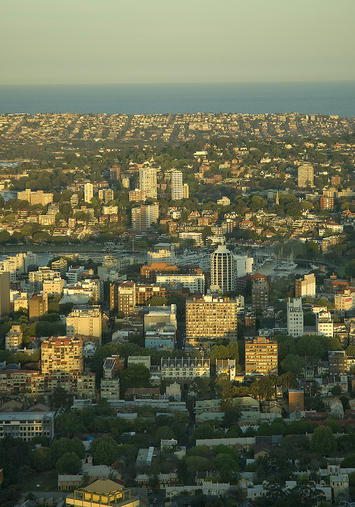
bigstock_Sydney_suburb_6654222.jpg
The proponents of currently fashionable planning doctrines favouring density promulgate a variety of baseless assertions to support their beliefs. These doctrines, which they group under the label of “Smart Growth”, claim, among other things, that from a health and sustainability perspective, the need to increase population densities is imperative.

With regard to health these high-density advocates have seized upon the obesity epidemic as a reason to advocate squeezing the population into high-density. This is based on a supposition that living in higher densities promotes greater physical activity and thus lower levels of obesity.  They quote studies that show associations between suburban living and higher weight with its adverse health implications. But the weight differences found are minor – in the region of 1 to 3 pounds. Nor do the studies show it is suburban living that has caused this.

The suburbs, after all, have been with us for 70 years and reached its mature development over 40 years ago. Obesity, on the other hand, is a much more recent phenomenon and is primarily due to people eating too much fattening food.

Less discussed, however, are other facets to human health and it is important to consider the results of research on the association with high-density living of mental illness, children’s health, respiratory dsease, heart attacks, cancer and human happiness.

A significant health issue relates to the scourge of Mental Illness. There is convincing evidence showing adverse mental health consequences from increasing density.

A monumental Swedish study of over four million Swedes examined whether a high level of urbanisation (which correlates with density) is associated with an increased risk of developing psychosis and depression. Adjustments were made to cater for individual demographic and socio-economic characteristics. It was found that the rates for psychosis (such as the major brain disorder schizophrenia) were 70% greater for the denser areas. There was also a 16% greater risk of developing depression. The paper discusses various reasons for this finding but the conclusion states: "A high level of urbanisation is associated with increased risk of psychosis and depression".
Another analysis, in the prestigious journal Nature, discusses urban neural social stress. It states that the incidence of schizophrenia is twice as high in cities. Brain area activity differences associated with urbanisation have been found. There is evidence of a dose-response relationship that probably reflects causation.

There are adverse mental (and other) health consequences resulting from an absence of green space. After allowing for demographic and socio-economic characteristics, a study of three hundred and fifty thousand people in Holland found that the prevalence of depression and anxiety was significantly greater for those living in areas with only 10% green space in their surroundings compared to those with 90% green space.

High-density advocates seem most oblivious to the needs of children. Living in high-density restricts children’s physical activity, independent mobility and active play. Many studies find that child development, mental health and physical health are affected. They also find a likely association of high-rise living with behavioural problems.

An Australian study of bringing up young children in apartments emphasizes resulting activities that are sedentary. It notes there is a lack of safe active play space outside the home – many parks and other public open spaces offer poor security. Frustrated young children falling out of apartment windows can be a tragic consequence. Children enter school with poorly developed social and motor skills. Girls living in high-rise buildings are prone to increased levels of overweight and obesity.

A British study found that 93% of children living in centrally located high-rise flats had behavioural problems and that this percentage was higher than for children living in lower density dwellings. Anti-social behaviour often results. An Austrian study showed disturbances in classroom behaviour higher for children living in multiple-dwelling units compared to those living in lower densities. 
There is also evidence of other potential health impacts on children living in higher density housing. These include short-sightedness due to restricted length of vision, and diminished auditory discrimination and reading ability due to exposure to noise.

Air pollution increases with density. This results from higher traffic densities together with less volume of air being available for dilution and dispersion. Nitrogen oxides in this pollution have adverse respiratory effects including airway inflammation in healthy people and increased respiratory symptoms in people with asthma. There is consistent evidence that proximity to busy roads, high traffic density and increased exposure to pollution are linked to a range of respiratory conditions. These can range from severe conditions (such as a higher incidence of death) to minor irritations. Moreover, these respiratory health impacts affect all age groups.

Several studies relate low birth weight to air pollution. A South Korean report, for example, found the pollutants carbon monoxide, nitrogen dioxide, sulfur dioxide, and total suspended particle concentrations in the first trimester of pregnancy pose significant risk factors for low birth weight.
Air pollution particulates are associated with killing more people than traffic accidents. Pollutants such as those emitted by vehicles are significantly associated with an increase in the risk of heart attacks and early death.

Cancer is a major health scourge and a relationship between increased colon cancer, breast cancer and total cancer mortality with population density has been found.

There is an association between overall Human Happiness and density. Professor Cummins’ Australian Unity Wellbeing Index reports that the happiest electorates have a lower population density. A United States study finds the satisfaction of older adults living in higher density social housing reduces as building height increases and as the number of units increases. By contrast, in lower densities there are higher friendship scores, greater housing satisfaction, and more active participation. This does not apply only to single family houses: Residents of garden apartments have a greater sense of community than residents of high-rise dwellings.

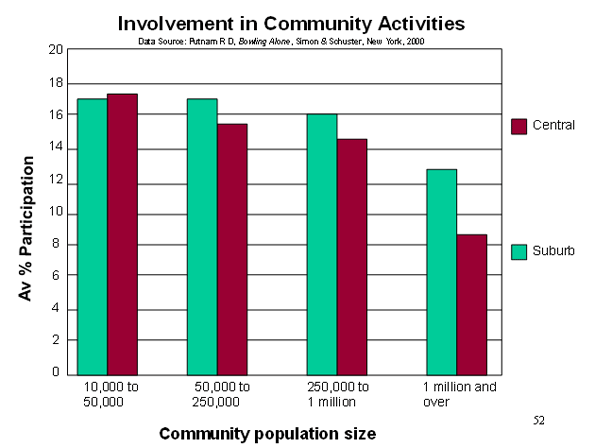
An example of misinformation on this issue can be found in R.D. Putnam’s famous book “Bowling Alone”.  Putnam states that "suburbanisation, commuting and sprawl" have contributed to the decline in social engagement and social capital.  However I have shown that data from charts in his book indicate quite the opposite:

Adapted from Figure 50, Putnam R D, Bowling Alone, Simon & Schuster, New York, 2000
This shows that involvement in these social activities are more common in the suburbs than in the denser centres of cities (and that they become more common as the community size and density decreases).

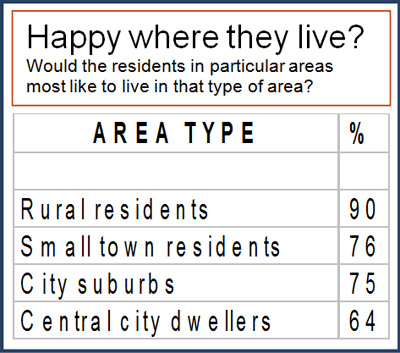
Community contentment relating to the density of surroundings is revealed by a study in New Zealand that asked people if the type of area they would most prefer to live in is similar to the area they currently live in. The responses are shown in this table.


So 90% of rural residents would prefer an area similar to their current area but only 64% of central city dwellers would prefer an area similar to their current surroundings.  It can be seen that satisfaction decreases as density increases.

Thus evidence from a variety of sources points to greater human happiness and better health in lower densities --- the exact opposite of the theories of the advocates for “cramming” people into ever small places.

(Dr) Tony Recsei has a background in chemistry and is an environmental consultant. Since retiring he has taken an interest in community affairs and is president of the Save Our Suburbs community group which opposes over-development forced onto communities by the New South Wales State Government.

Thursday, September 4, 2014

"I'm sorry, your child lost the admission lottery for Dixie Schools"

Over crowded Dixie schools may force a lottery for admission

 Will you lose your right to send you child

to our Dixie Schools?

No one likes to think that their child may have to go to school in another school district.  That may be the only solution when an estimated 60-150 school children or more arrive from Marinwood Village low income housing.

Local taxpayers fund each child upto $10,000 per year. Developer Bridge Housing pays only $10.000 total for parcel taxes for  the entire  40 million dollar apartment complex.  It's 83 units are expected to have an average of up to three children per apartment. 

The cost of educating these children is $600k to $1.5 million dollars.  This means either the local taxpayers will be forced to pay additional school taxes or the classrooms must be even more impacted. 

Currently Dixie school are at capacity with historically high enrollments. Some classrooms have up to 28 students versus the state norm of 18 children.  The addition of more children will surely require temporary classrooms at the very least or possibly build a new school for many millions of dollars.

Another solution suggested was to redraw district lines.  Some people at the edge of the district (perhaps on the East side of 101) will no longer be able to attend Dixie Schools.

It amazes us that politicians and planners have not thought of the impact on our schools  when planning for housing.  They are suggesting that 71% of all affordable housing for unincorporated Marin be located within the Dixie school district. 

If the other five large projects are built, we will have potentially more than a thousand school children in affordable housing to educate.. We taxpayers will be forced to pay for them.

Shouldn't we have a plan for Marinwood-Lucas Valley that protects our schools? Are you surprised that "no one" has considered the costs our community must bear?

If you child cannot attend our Dixie Schools, will the politicians, planners and "neighborhood leaders" that support Marinwood Village say "I'm sorry"?


The City of Pleasanton discovered affordable housing had 3.1 children per apartment here


Editor's Note: Since publishing this last year, the situation in Marinwood-Lucas Valley has become much worse.  The newest housing element again places 60% of all government subsidized ("workforce") housing to the unincorporated areas of Marin in Marin-Lucas Valley.  In addition, we discovered that the City of San Rafael has also placed an additional 700 units across our border.  ALL of the estimated 1500 units approved will likely be non-profit housing which pay virtually no taxes. ALL are inside the Dixie School District.   Now, the Dixie School distict is asking for a PARCEL tax to pay for the budgeting shortfalls.    Local Taxpayers are being asked to pay for the Board of Supervisor's unfair concentration of  TAX FREE apartments that will eviscerate Dixie School funding.  I urge you to Vote No against this parcel tax this November and find a way to contribute outside the PARCEL TAX levy.  Remember PARCEL TAXES are forever.