Showing posts with label sb828. Show all posts

Wednesday, August 29, 2018

Take 12 minutes to stop the SB828 bill in Sacramento


Hi Marin Activists -  Thanks again to those of you who took action a few weeks ago to oppose SB 828 in Assembly Appropriations.  Now there's another need to act to urge a dozen key Senators to vote No.DB828

NOW-today - please make calls to a select number of Senators (list and phone numbers below). Leave a message urging them to vote No on SB 828, which changes the process to determine regional housing needs allocation (RHNA). The full Senate vote will be in the next day or two. Even if you called or emailed before, this is a new vote and your call is important before the bill gets to the Governor's desk.


Q: How much time will it take?   A: 15 minutes or less.
Q: Why bother?  A:  Your call shores up local control and collaborative problem solving against the top-down, power grab of corporations, regional agencies, profit-driven developers, and career politicians.
Q: What else can I do?  Forward this email to your other lists and family and friends throughout California. Urge them to follow your example.

Please call the following Senators: 
Ben Allen, D; Redondo Beach - (916) 651-4026
Jim Beall - D; San Jose - (916) 651-4015
Steve Bradford, D; Ingelwood - (916) 651-4035
Kevin de Leon, D; Los Angeles - (916) 651-4024
Steve Glazer - D; Orinda - (916) 651-4007
Hannah-Beth Jackson, D; Santa Barbara - (916) 651-4019
Ricardo Lara - D; LA - (916) 651-4033
Mike McGuire - D; Marin/Sonoma counties - (916) 651-4002 
John Moorlach - R; Costa Mesa - (916) 651-4037
Henry Stern, D; Calabasas. -  (916) 651-4027
Jeff Stone - R; Riverside County - (916) 651-4028
Andy Vidak - R; Fresno and Kings counties - (916) 651-4014
Your Senator if not on this list. https://www.senate.ca.gov/senators

When you call, the staff person will ask for your name, zip, and the bill #; sometimes more. If staff resist your input because you don't live in their district, remind them you're impacted by every Senator's vote on this statewide bill.  Keep it as simple as saying, "Please register my request the Senator vote "NO" on SB 828.  

Summary of Opposition, if you want to elaborate: (See attached notes for more details)
  • Deepens antagonism between local governments and Sacramento around housing. 
  • Mandates a one-size-fits-all methodology that doesn't respect or account for geographic differences.
  • Disregards years of community planning on General Plans, Housing Elements, and Design Review.
  • Increases financial burdens on local governments, already reeling from unfunded pension liability.
  • Building a preponderance of market rate housing will not solve the housing problem.

Act as if our communities' futures depends on your call.  It does!

Thursday, June 7, 2018

State Senate Passes Amended High-Density Housing Bill (SB-828)


State Senate Passes Amended High-Density Housing Bill (SB-828)

Posted by: Sharon Rushton - June 4, 2018 - 10:13am

A watered down version of Senate Bill 828, which would have dramatically raised the number of units a jurisdiction must plan for, was recently passed by the State Senate. Although highly improved, there are still concerns about the bill and it would be better if it were defeated. The bill will now head to the State Assembly for review and possible approval.

Here are definitions of terms that will help you understand this article:

"General Plans": General plans serve as the local government’s "blueprint" for how the city and/or county will grow and develop and include seven elements: land use, transportation, conservation, noise, open space, safety, and housing. The law mandating that housing be included as an element of each jurisdiction’s general plan is known as “housing-element law.”

"Housing Element": Every jurisdiction must adopt a Housing Element as part of their general plan. The Housing Element is essentially a housing plan that must adequately plan to meet the housing needs of everyone in the community.

"Regional Housing Needs Allocation": The Regional Housing Needs Allocation (RHNA) is the state-mandated process to identify the total number of housing units (by affordability level) that each jurisdiction must accommodate in its Housing Element. In the bay area, each jurisdiction is assigned its RHNA by the Association of Bay Area Governments (ABAG).

IMPROVEMENTS TO SB-828:

SB-828 still increases the RHNA but less so: The bill automatically raises the Regional Housing Needs Allocation (RHNA), which is the state mandated number of housing units a jurisdiction must plan for, by 25% to equal 125%. However, this is lower than the original version of the bill. The previous version of the bill required cities and counties to identify enough land to meet 200% of their Regional Housing Need Allocation.

The unmet need audit is removed from the bill: The previous version of the SB-828 required a jurisdiction to plan for and potentially zone for more land for residential properties if a state audit showed there was a shortage in that community. This audit has been removed.

The rollover units were removed from SB-828: The bill had required a jurisdiction to plan for, and potentially zone for, housing units not built under production goals from the prior eight years. This section was removed.

The bill no longer mandates the building of new housing units: SB-828 in its amended form is advisory. Just like current law, this bill does not mandate the building of any new housing units. Although jurisdictions must still plan and zone for the number of housing units assigned to them through the RHNA process, which still has consequences.

The “shall” language in the legislation that required local municipalities to fulfill their Regional Housing Needs Allocation (RHNA) quota by ensuring the housing units were actually built was changed to “should”.

Why this is significant: The amended bill reverts back to existing law that essentially acts as guidance and encouragement for cities and counties rather than a mandate. There is no longer a mandate in this bill that requires local municipalities to fulfill their RHNA quota, which means they no longer need to ensure that the housing units they plan for are actually built. They do still have to plan and zone for the number of housing units assigned to them by the RHNA process.

REMAINING CONCERNS ABOUT SB-828

There are still concerns about SB-828. Although watered down, the bill still increases the pressure for cities and counties to plan for more and more housing.

Here is a newly amended section of the bill that makes it more difficult for a jurisdiction to lower its Regional Housing Needs Allocation (RHNA) if it feels that the number is too high:

"(f) The following criteria shall not be a justification for a determination or a reduction in a jurisdiction’s share of the regional housing need:

(1) Any ordinance, policy, voter-approved measure, or standard of a city or county that directly or indirectly limits the number of residential building permits issued by a city or county.
(2) Prior underproduction of housing in a city or county from the previous regional housing need allocation, as determined by each jurisdiction’s annual production report submitted pursuant to subparagraph (H) of paragraph (2) of subdivision (a) of Section 65400.
(3) Stable population numbers in a city or county from the previous regional housing needs cycle."

Here is a newly amended section of the bill that would assign additional weight (meaning increase housing quotas) to local governments that meet certain criteria:

"(j) (1) It is the intent of the Legislature that housing planning reduce racial and wealth disparities throughout a region. To achieve this goal, the allocation plan shall assign additional weight to local governments that meet the following criteria in subparagraphs (A) and (B) in the distribution of the regional housing needs allocation for all income categories, in particular housing needs allocations for low- and very low income households:
(A) A local government with median employed household incomes above the 50th percentile for the region.
(B) A local government that either contains a major regional job center, as determined by the council of governments, or contains high-quality public transportation for the region, such as a major transit stop or stops along a high-quality transit corridor, as defined in Section 21155 of the Public Resources Code, that connects to a regional job center.
(2) The resolution approving the final housing need allocation plan shall demonstrate government efforts to reduce racial and wealth disparities throughout a region by assigning additional weight to local governments that meet the criteria in subparagraphs (A) and (B) of paragraph (1) in the distribution of the regional housing needs allocation for all income categories, in particular housing needs allocations for low- and very low income households."

SB-828 still impedes cities’ and counties’ ability to implement lower density solutions in order to fulfill their housing need:
As noted before, SB-828 would require a jurisdiction to plan for 125% of its Regional Housing Needs Allocation (RHNA). The bill would also require at least 100% of the locality’s share of regional housing need (which would be raised to 125%) to be available for multifamily housing in developed areas. The 100% multifamily requirement does not allow many RHNA units for lower-, low-, and moderate-income households to be fulfilled with second units, accessory dwelling units, or junior accessory dwelling units. These lower density units are easier to build in smaller towns and counties, with little vacant land, where small-town and semi-rural character is valued and where there is strong opposition to high-density housing. More conversion units and assisted living units should also count toward the RHNA.

SB-828 would still increase SB-35 streamlining:
In short, Senate Bill 35 (a bill adopted in 2017) streamlines multi-family and mixed-use housing project approvals located in municipalities that either have failed to submit two or more annual housing reports or have not issued enough building permits to build the dwelling units called for by the jurisdiction's Regional Housing Needs Alllocation (RHNA). Should a municipality fall within the scope of SB-35, a proposed multi-family development project may apply under a streamlining approval process, which requires ministerial, or "by right", approval of a qualified development project.

Since SB-828 would increase a jurisdiction's Regional Housing Needs Allocation by 25%, there would then be greater probability that the jurisdiction would not have issued enough building permits to build the dwelling units called for by the jurisdiction's Regional Housing Needs Allocation. Thus, due to the combination of SB-35 and SB-828, there would be potential for more multi-family development projects to take advantage of SB-35’s streamlining and avoid CEQA and its required public engagement process on sites that meet SB-35 criteria.

Streamlining goes against the principles of local democracy and public engagement. Public hearings allow members of the community to inform their representatives of their support and/or concerns about potential development and leads to better project outcomes.


We should remain vigilant and follow SB-828 as it moves through the State Assembly.

Thursday, April 26, 2018

CA Senate Housing and Transportation Committee advances SB 828 in Sacramento


CA Senate Housing and Transportation Committee advances SB 828 in Sacramento
Posted by: Bob Silvestri - April 25, 2018 - 9:24am


Weak-kneed legislators bowed to political pressure and special interest groups, yesterday, and voted to advance Senate Bill 828 to the Appropriations Committee. As amended, the latest version of Senator Scott Wiener’s bill, which was heavily supported by development interests, would increase every city’s Regional Housing Needs Assessment quota for low income units by 25% of the existing requirement. More significantly, it also changes that quota from a planning goal to a mandatory housing production quota, with heavy penalties to cities that fail to meet it.

This completely nonsensical and arbitrary legislation, primarily driven by “politically correct” rhetoric, may have dire economic, environmental and social consequences for all San Francisco Bay Area cities, except for San Francisco, San Jose and Oakland.

As reported by LBReport.com,


SB 828 would change… current RHNA numbers from state mandated "goals" for cities to incorporate into their local land use planning documents into de facto required outcomes, with any "deficiencies" in actually produced "needed" housing units rolled over to increase the number of housing units that a city must produce in subsequent planning periods.


That outcome could make it more difficult for some cities (already assigned high "needed" numbers) to meet the requirements of SB 35 (a bill authored by Sen. Wiener and enacted in 2017) that now requires cities to give "streamlined" approval to housing developers for multi-unit housing projects if a city hasn't met meet "needed" housing units.


Historically, the vast majority of Bay Area cities have been unable to meet the out sized, top-down quotas demanded of them. The reason is simple. Cities don’t build housing – private developers build housing.And, since the vast majority of Bay Area cities have no financial incentives to offer developers and very limited available land, it is assured that small cities will never be able to meet these new, compounding quotas, and will suffer significant financial consequences.

In addition to being required to provide developers with streamlining of the approval process (removal of review of impacts on traffic, parking, infrastructure, the environment, etc.), under SB 35 (passed in September 2017), “any reasonable person” (meaning, any outside advocacy group) can now sue cities for not meeting their RHNA mandates.

SB 35 also shifted the burden of legal proof on to cities, to show they made critical findings to not approve projects, and if they fail to do that, a judge can now assess unspecified financial penalties on non-compliant cities.

The negative financial consequences for small cities and their residents are incalculable.

Here are just some of the reasons that SB 828 is an insufferable bad piece of legislation:

The premise of SB 828 is flawed: Cities don’t build housing, private developers do.

SB 828 is based on the same fallacy as SB 827. It assumes that cities build housing in order to comply with their RHNA quota that is reflected in their Housing Element. This is untrue. Cities can only provide certain limited incentives but the market decides what type of development proposals are submitted. Because of this, it is unlikely that most of the municipalities in the San Francisco Bay Area would ever get out from under their endlessly accumulating, unbuilt RHNA quota.


The 125% RHNA figure in SB 828 is arbitrary and violates all existing RHNA calculation procedures and fact based “findings,” as required by state law.

Since its inception, the methodology for calculating the Regional Housing Needs Assessment figures is based on detailed and fact-based analysis of population growth and jobs growth. These studies are thorough and vetted and updated to reflect actual projections. The total RHNA allocation for a Regional Metropolitan Planning Organization (MTC/ABAG) is, therefore, a constantly changing number based on actual conditions.

As is, the RHNA adapts to statistically provable need. It is a dynamic methodology that already accomplishes what SB 828 attempts to do. Imposing afixed 125% quota is not needed and is completely nonsensical

The 125% RHNA figure in SB 828 is arbitrary and unsupported by any reasonable economic, environmental or social impacts analysis.

The existing RHNA determination process by its very nature is reflective of credible economic, environmental and social impacts data, which is reflected in the population and jobs growth data it is based upon. To arbitrarily change the RHNA outcomes of that analysis, essentially negates the entire rationale for determining an accurate RHNA and turns the RHNA quota into a purely political tool driven by personal agendas and personal prejudices.

SB 828 is yet another naked attack on California's dwindling middle class and our livable suburban communities.


The 125% RHNA figure found in SB 828 is prejudicial against all but the largest cities in the state.

In the SF Bay Area, only three cities of the 103 municipalities will ever be able to meet the arbitrary 125% RHNA quota: San Francisco, Oakland and San Jose.The other municipalities and particularly smaller cities simply do not have the available land to do so. And, simply saying that single family zoned land can be transformed into multifamily zoned land in a way that makes housing development feasible is incorrect.[1]

The requirement in SB 828 that the entire, original 100% of RHNA (still on the table) now be allocated to multi-family housing, negatively impact the economic tax base of all but the largest cities in the state and increase commuting times an environmental impacts.

Traditionally, the RHNA is divided into various percentages of each type of housing found in a city (based on federal statistical guidelines): from 30% of median income to market rate housing.SB 828 appears to require all the original RHNA (100%) to be allocated to multifamily housing, but without any income requirements.

One would assume that the other 100% will be allocated the same as it is now, among all the housing / income types, but the bill is not clear on this.

However, small cities simply do not have any economically viable[2] land to designate for multifamily development except their commercial land (office, retail, industry). If that land is rezoned for housing, cities will lose their major tax base from commerce. This will turn more cities into bedroom communities of major jobs centers and increase commuting times.

In the context of SB 35, penalizing cities for failing to build housing may violate the unfunded mandate provisions of California Housing Law.

Legislation passed in September of 2017, particularly SB 35 but including other bills, have now created an unprecedented legal nexus of penalties between RHNA quotas and potential financial penalties and consequences for municipalities. As it now stands, if “any reasonable person” decides that a municipality has failed to do what it has to do to promote housing affordability and to fulfill its RHNA obligations, those persons can sue for damages and a court can assess financial penalties against a city.

It is our opinion that such an occurrence will constitute a violation of the California State Constitution and the unfunded mandate provisions, based on the state’s interpretation of Dillon’s Rule.

This has not yet been tested in the courts and suggests that legislators should exercise extreme caution before introducing additional housing laws, until the impacts of the 17 laws passed in 2017 are fully known.

SB 828 requires municipalities to now engage in compiling racial profiling data, in violation of federal Fair Housing laws.

Since 1937, California housing law has mirrored federal housing law and used income levels as the basis for assessing the need for “affordable housing” and determining the RHNA quotas.

SB 828 introduces the concept of and incorrectly mixes “racial” profiling into the Housing Element and RHNA process, which promotes racial profiling, discrimination and reverse discrimination and other abuses that are illegal under federal housing law. In addition, there are no legal standards, federal or state, to look to in order to interpret the findings being required by SB 828.

SB 828 requires municipalities to now engage in compiling “wealth” profiling data, in violation of federal Fair Housing laws, in that it proposes to penalize individual “wealth” as a special class.

Since 1937, California housing law has mirrored federal housing law and used income levels as the basis for assessing the need for “affordable housing” and determining the RHNA quotas. It is not based upon nor is it prejudicial against the personal wealth of individuals residing in a municipality.

SB 828 introduces the concept of “wealth” profiling into the Housing Element and RHNA process, which promotes reverse discrimination and other abuses that are illegal under federal housing law. In addition, there are no legal standards, federal or state, to look to in order to interpret the findings being required by SB 828.

SB 828 appears to give powers to unelected agencies over locally elected government, in violation of state law.

SB 828 indicates that unelected state and regional agencies (e.g., the Department of Housing and Community Development, the Metropolitan Transportation Commission, etc.) that are involved in the RHNA creation and allocation process, will have decision making powers over elected governments that are not subject to appeal.

As far as we know, this is unprecedented in California housing law.

LBReport.com reports

SB 828 now heads to the state Senate's Appropriations Committee, a "non-policy" committee that's supposed to consider only fiscal impacts of proposed bills but as a practical matter operates as a majority-party controlled "gatekeeper" preventing bills from reaching the Senate floor if not supported by majority party (Dem) leadership. The Appropriations Committee is chaired by state Senator Ricardo Lara (D, LB-Huntington Park).


[1] Converting single family zoning to multifamily would likely increase "land" costs, because the land/house values of residential lots is much higher than fallow commercial acreage. For example, if a typical Marin County house is worth $1 million on a 50 x 100 lot (approx. 1/8th acre), so that's $8 million per acre in land cost to develop multifamily. At the same time, economically obsolete commercial parcels in town sell for about $4,000,000 per acre. If no one can “pencil” affordable housing now at $4 million per acre, how will they do it at $8 million per acre?

[2] See Footnote 1.

Wednesday, April 25, 2018

Senator McGuire supports SB828 that will ATTACK local Planning


Senator Mike McGuire (Healdsburg) Northbay supports Senators Wieners SB828 that advocates an increase in RHNA allocation for affordable housing AND IT PUNISHES communities if they are not built by triggering "by right" development for ALL HOUSING. It is an outrageous intrusion into local planning decisions and is an unfunded mandate.

Monday, April 23, 2018

Action Alert! Call these Senators today


We need everyone to take action.  SB  828 has been largely ignored, but some/many think it is worse than SB 827.   

Please call members of the Senate Transportation & Housing Committee and forward this email to others.  

Below you'll find:
  • Contact Info: Names and phone numbers. It can take as little as 1-2 minutes per call.  The primary purpose of your call is to be on record in OPPOSITION to SB 828.
  • A few talking points, if you're asked why you oppose the bill.
  • Invitation to join others in Sacramento on Tuesday


CONTACT INFO: Senators on the Senate Transportation and Housing Committee: 
The Yes, No or ABS shows how they voted on SB 827.
  • Senator Jim Beal (Chair), D-San Jose (No): 916-651-4015 
    Senator Anthony Cannella (Vice Chair), R-Stanislaus County (No) : 916-651-4012
  • Senator Ben Allen, Santa Monica, (No), 916/651-4026
  • Senator Bill Dodd, D-Napa (No): 916-651-4003
    Senator Ted Gaines, R-El Dorado Hills (Yes): 916-651-4001
    Senator Cathleen Galgiani, D-Stockton (No): 916- 651-4005
    Senator Mike McGuire, D-Marin & Sonoma Counties (No): 916-651-4002
    Senator Mike Morrell, R-San Bernadino County (Yes): 916-651-4023
    Senator Richard Roth, D-Riverside (ABS): 916-651-4031
    Senator Nancy Skinner, D-Berkeley (Yes): 916-651-4009
    Senator Andy Vidak, R-Hanford (ABS): 916-651-4014
    Senator Bob Wieckowski, D-Fremont (ABS): 916-651-4010
    Senator Scott Wiener, D-San Francisco (Yes): 916-651-4011
TALKING POINTS: Why SB 828 should not be approved 
  1. SB 828, like SB 827, undermines local planning decisions with a one-size-fits all approach that is detrimental to all jurisdictions, regardless if they have a housing shortage or not.
  2. The failure to meet target housing levels triggers SB 35 (passed in 2017), allowing by-right development with perhaps only 10% affordable housing, which disrupts city planning and overburdens infrastructures, such as schools, water, roads etc.
  3. Cities are not developers and do not have control over how many projects are proposed or how many permits pulled by real estate developers. It makes no sense to punish cities possibly for what the cities have no control over.
  4. Community leaders know better than legislators what is needed for equity, quality of life, long-term infrastructure and sustainability.  Work with, not against, local efforts to meet housing needs.
  5. Legislators passed 15 housing bills in 2017, but haven't allowed time or provided funding to see the impact of these bills. Focus on implementing what's in place before adding more laws.
JOIN US IN SACRAMENTO 

11:00  Begin making office visits in teams of 2-3.

1:30  Senate Hearing

3:00 or after SB 828 is decided

Interested in joining a carpool?   send email to savemarinwood@gmail.com
Driving from your area?  Send an email to let others know.

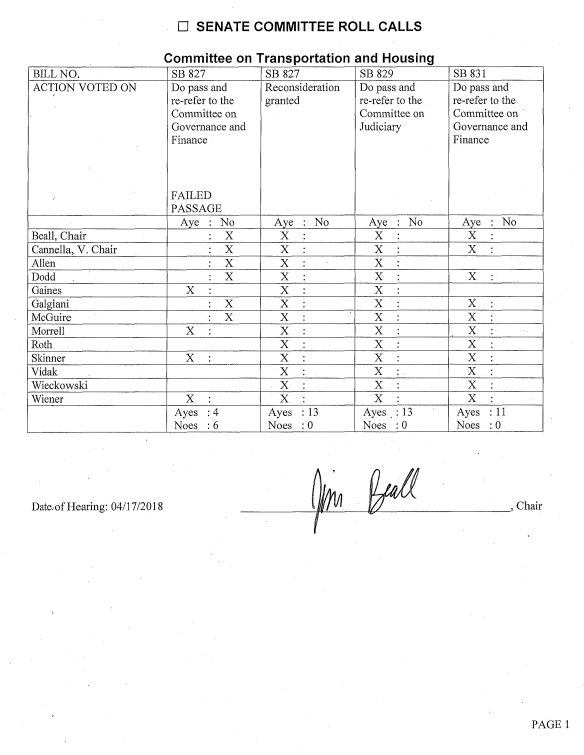
SB 827 is up for reconsideration on April 24 after the bill lost this week.

SB 827 is up for reconsideration on April 24 after the bill lost this week.

Clearing up the details of the SB 827 vote
A number of misinformed statements regarding the vote on SB 827 have been circulating. This is the official statement signed by the Chair of the Transportation and Housing Committee, Senator Beall. The vote was 6 no, 4 aye, and 3 not voting. If Scott can talk some into changing their votes, he can still pass this out of committee, however, he faces a much more difficult time getting it passed in the next committee in time to get it through the to the full Senate by the deadline. Still, some people will show up to oppose this one, since they will be opposing SB 828 as well.
Thanks to these bills, and a few others our Northern representatives are forcing on the state residents, many Southern California citizens are rising up to flex their rather large and powerful political powers. This year could see some changes coming to our state legislature that may shift the power away from the Bay Area. Too much too fast and too disruptive is creating a bad environment for the easy-going California lifestyle we have come to love and appreciate and there is a movement to resurrect it.
Here is a link to the Senate Transportation and housing committee schedule:  http://stran.senate.ca.gov/content/2017-2018-bill-hearings
Here is a link to the official voting results on SB 827 and a copy of the page below:
page1image256.png
The following is a link to the Senate Transportation and housing committee schedule:
The next link is how they voted on SB 827:
Advertisements

Friday, April 20, 2018

Letter to Senator Mike McGuire in Opposition to Senate Bill 828

Letter from Sustainable TamAlmonte to Senator Mike McGuire and the other members of the State Senate Transportation and Housing Committee in opposition to Senate Bill 828

            California State Capitol


Hi Sustainable TamAlmonte Friends,

Please read the attached letter, dated April 18, 2018, from Sustainable TamAlmonte to Senator Mike McGuire, urging him to oppose Senate Bill 828 and remove the bill from consideration.  We sent a similar letter to each member of the State Senate Transportation and Housing Committee.

Although Senate Bill 827 was defeated in committee, another just as powerful housing bill is on the horizon.  It is Senate Bill 828.  It is scheduled for a hearing in the Senate Transportation and Housing Committee on April 24th.

SB-828 changes Housing Element law and would exponentially increase the number of homes that cities and counties have to plan for in several ways:
•    Doubling the amount of land intended to house all income levels of residents by setting aside more properties for apartments and condominiums.
•    Zoning land to account for homes not built under production goals from the prior eight years.
•    Zoning even more land for residential properties if a state audit shows there’s a shortage in that community.
•    Boosting targets higher where home prices are far outpacing wage increases.

For more details about the bill, please read the LA Times article entitled; "A little-known bill could reshape housing development across California":

http://www.latimes.com/politics/la-pol-ca-under-the-radar-housing-bill-20180412-story.html

Excerpts from the LA Times article:
"A Bay Area lawmaker's housing proposal (SB-828) could expand the size and scope of home building efforts in California at an unprecedented scale."

"SB 828 has garnered less interest (than SB-827) because its changes are harder to understand and predict, said Greg Morrow, director of the Fred Sands Institute of Real Estate at Pepperdine University. But Morrow said SB 828's increases to allowable zoning for housing across the state could be as dramatic as those anticipated by Wiener's other bill (SB-827)."

I will soon be sending out an ACTION ALERT email regarding SB-828.  We will need all of you to send in opposition letters and call Senators if we are to defeat this bill.

Sustainable Tam Almonte

Friday, April 6, 2018

Here is where the 10 story buildings may be built in Marin if SB827 passes.


Here's a link to a map that includes the "Major Transit Stops" in Marin (Sausalito, Tiburon, and Larkspur Ferry Terminals and all the SMART depots).  However, it does not show any of the "High-Quality Transit Corridors" in Marin.


If you live in the red dot areas, a building like this could be built next door with NO PLANNING REVIEW.
Under SB827 it could be 50% taller  (10 stories) and there is literally nothing that can be done to stop it.

Call Senator Mike Mcguire to stop SB827 and Sign this http://www.tinyurl.com/No-to-SB827-SB828 

Friday, February 16, 2018

Wiener's Even More Onerous Senate Bill 828

Wiener's Even More Onerous Senate Bill 828


Posted by: Richard Hall - February 16, 2018 - 9:47am

While Senate Bill 827 is getting all the attention it deserves, sitting in it's shadow is another equally onerous Senate Bill proposed by Scott Wiener and likely authored again his partner in crime Brian Hanlon - See Senate Bill 828 with the innocuous title "Land Use: Housing Element".

SB 828 is about "housing quotas." Housing advocates such as the YIMBYs are hoping that with all attention on 827, Senate Bill 828 will slip under the radar. Like Senate Bill 827, Senate Bill demonstrates all the understanding of a child applying over-simplified logic when it comes to planning:


What are these housing quotas that you speak of?


For decades every city and county in California has been given a housing quota, or "Regional Housing Needs Assessment" allocation (RHNA, often pronounced ree-na) that it must plan for. Cities don't build housing or submit housing proposals (a fatal flaw in Wiener's Senate Bill 828 we'll come back to) but these quotas require that they produce specific numbers of units at different income levels.

These quotas are calculated by a number of regional government bodies such as the Association of Bay Area Governments (ABAG), the Southern California Association of Governments (SCAG), and the Association of Monterey Bay Area Governments (AMBAG).

Alternatively a city can appeal and receive their allocation number directly from the State of California through the Department of Housing and Community Development (HCD).

The quotas are set in 8 year cycles by these organizations. On a 2 year lag after the quota is allocated, cities and counties are obligated to respond with a "Housing Element" - a document that identifies the number of units that could theoretically be built based on current zoning at different income levels.

What happens if cities don't meet their quotas?


If a city or county either doesn't provide a housing element or presents a housing element that does not meet the required quota for certification, then it can be forced to go on a 4 year reporting cycle and exposes itself to liability and can be sued. The cities of Pleasanton and Menlo Park have both been sued for failing to meet their housing quotas by Urban Habitat.

This is not a light slap on the wrist. Not only are the penalties substantial but the city must pay the petitioner's legal costs. This can amount to millions of dollars. Today, cities face challenges balancing the books with onerous payments needed to stave off bankruptcy caused by the unfunded pension benefits crisis. When Vallejo went bankrupt the results were significant:
All city hall employees bar 2 were made redundant;
Fire and Police were severely cut back;
Maintenance of basic city infrastructure was deferred -- traffic lights would break down flashing yellow resulting in major traffic delays

Author Michael Lewis, who wrote The Big Short, predicts in his book Boomerangthat when the next recession hits many California cities are likely to go bankrupt like Vallejo. This author's own city, San Rafael, heads the list of California cities with the largest pension cost revenue ratio of 17.58%. This means 17.58% of all taxes collected go not to supporting city services, but simply to pay of unfunded pension debt. It should be noted that many local tax increases claimed to support enhancing city services (new fire station, emergency radio system, sewer or water pipes) really disguise creeping unfunded pension costs.


So, the impact of not meeting these quotas is very real. It is almost the nuclear option for a city to fail to meet the quota - risking bankruptcy.

Wiener and his advocates like the YIMBY's know this and take full advantage.

What happens when quota's go wrong?


Ten years ago, city of Corte Madera in Marin County, which sits on about 5 square miles of land that is mostly built out except for a few parcels at risk of flooding, was allocated a quota of about 230 units in a prior RHNA cycle; but it only had zoning identified for about 40 units.

To meet the quota the city had to quickly rezone. While several parcels could have been rezoned, a developer working with the city planner convinced the city council that the best option was to rezone the former WinCup polysterene cup factory, which about to be sold. If rezoned the value of the land increased considerably.

Faced with a gun-to-the-head quota, and with the encouragement of its planning staff, the city council caved in and rezoned the WinCup site for 182 units of residential development. The quota was met. The rest is history.

Within 2 weeks of the zoning change, Macfarlane Partners submitted plans to develop the site with housing. Nothing ever happens that fast in planning!


Meanwhile, Corte Madera's mayor went back to the Association of Bay Area Governments and demanded to see the methodology of how such a small city with limited remaining land was given such a large quota. ABAG produced their spreadsheet, but concealed the calculations in the cells. On further protest ABAG, without admitting fault, reduced Corte Madera's quota for that cycle to just 80 units.

But it was too late - the zoning had been changed, and the developer of WinCup had got their foot in the door. The new development was beyond the point that it could be stopped.

Today Tamal Vista (referred to locally in Marin as "WinCup" even though that was really the name of the polystyrene cup factory) is looked upon by both sensible growth and fast advocates as a disaster. The 5 story, gaudy, box like building overlooks 101 and is out of scale with other small city buildings in the county. WinCup has become the poster child for the type of high density, rapid growth advocated by Scott Wiener and the YIMBYs.


Senate Bills 35 and 828 - A deadly cocktail


Now readers understand the background - these housing quotas threaten to bankrupt cities if they are not met - the significance of Senate Bill 828 can be fully realized.

Senate Bill 35 (another Wiener bill) enacted in January adds further penalties. Cities must not only plan to meet their quotas with zoning, they must approve a certain number of units - if not Senate Bill 35 allows developers with qualifying developments (paying union rates) to submit plans that bypass important processes:
No environmental review
No local review
No city council approval required
Only objective, pre-written design requirements can be applied; e.g. planning commissions cannot subjectively require set backs, green space or light wells - items important for livability

The redeeming aspect of Senate Bill 35 are it's two requirements:
Compliant developments must pay "prevailing wage". This means paying union rates that typically are only affordable for large scale development in major cities like San Francisco or Los Angeles. However the author is learning that construction salaries are increasing and closing the gap; so this obstacle many deem to have neutralized Senate Bill 35 may be removed.
Compliant developments must include a specified amount of affordable housing. Typically this is 50% - a number that makes it difficult for market rate developers to make development pencil out. However for cities missing their quotas by a large margin this percentage drops to just 10%. A much more feasible number.

The fundamental mis-step with Senate Bill 35 is that cities do not control how many development proposals are submitted. But SB35 holds them accountable to how many units they approve. Readers should understand this disconnect. Wiener and Hanlon who authored SB35 chose not to. So cities may meet the quotas with zoning, but if they are unlucky they may not receive enough development proposals to meet their SB35 units approved requirements.

To illustrate the significance of SB 35 historically 97.6% of California cities did not meet their full RHNA goals. Only 13 cities (2.4%) met their goals making them exempt from SB 35 streamlining.

SB 828 dramatically increases RHNA quotas


Now the full ramifications of not meeting quotas is clear: all local and environmental review can be bypassed, and market rate development can occur with as little as just 10% affordable units when quotas aren't met.

Wiener's bills make a mockery of the years of community input put into citys general planning process. These plans can cost hundreds of thousands of dollars to generate and capture the communities vision for their city in the future.

The author is a steering committee member for his own city's general plan and is observing the great time and care put into general plans.

Senate Bill 828, if enacted, changes the way quotas are calculated and implemented:

It authorizes the department of Housing & Community Development to challenge and update the methodology for calculating quotas
It rolls over unbuilt quotas to the next cycle, like mobile phone rollover minutes. At present quotas are reset for each 4 year cycle. Now housing quotas can compound, cities can easily get into a quota debt they may never climb out of - and since these depend on developers submitting proposals (they only approve proposals) they can become trapped in a quota deficit they never climb out of. They then lose all control of planning and community input is systematically bypassed.
It requires cities plan for 200% of quotas. This forces cities to upzone and zone more land than they otherwise might to meet the quota. Typically the only areas remaining available are in the least suitable locations - locations at risk of flooding due to sea level rise or in industrial areas or next to freeways and transit corridors where mortality rates for asthma, heart disease are considerably higher and the areas are less safe and noisy.

So while Senate Bill 827 is the poster child - opponents need to step back and understand the full barrage of onerous bills Wiener and Hanlon are presenting - and their combined impact. These bills together accelerate removal of local control and planning. They don't help build affordable units and solve the housing crisis - but they are a gift to market rate developers.

SB828 Bill Text
https://leginfo.legislature.ca.gov/faces/billNavClient.xhtml?bill_id=201720180SB828

Web Linkwww.planningforreality.org

Monday, February 5, 2018

Scott Wiener’s war on local planning

Scott Wiener’s war on local planning


His next round of housing bills force cities to accept growth and displacement—without giving them the money or tools to mitigate it
BY ZELDA BRONSTEIN
-
February 1, 2018


On January 19, I attended UCLA Extension’s 2018 Land Use Law and Planning Conference at the Biltmore Hotel in downtown Los Angeles. Seated in long rows of tables under the glittering chandeliers of the hotel’s Crystal Ballroom, hundreds of elected and appointed public officials, developers, attorneys, and consultants are annually briefed by sharp pro-growth land-use lawyers and other like-minded experts on the latest California land-use legislation and case law.Sen. Scott Wiener wants to force cities to allow more high-end housing, without giving them the tools or money to control the impacts

This year the star of the show was State Senator Scott Wiener. He earned that role by authoring SB 35, the controversial “by-right” housing bill that Governor Brown signed into law in September. Like his fellow Yimbys, Wiener believes in a supply-side, build-baby-build solution to California’s housing woes and blames those woes on local jurisdictions’ resistance to new residential development. He presents himself as a brave policymaker who grapples with hard issues that others have dodged—an image belied by his evasive responses to my questions.

In California, Wiener told the conferees, “housing has been a purely local thing.” There have been “few laws on the books,” those that are on the books “are not enforced” and are outdated. What needs to happen, he said, is that the state should govern housing the way it governs education. Local school boards “set policy,” but “the state sets the ground rules.” Just so, last February the senator told Streetsblog, “if you [a city] are meeting your RHNA [Regional Housing Needs Allocation, set by the state’s Department of Housing and Community Development] goals…you maintain full local control.”

This strains to the breaking point any reasonable definition of local control, which, moreover, the Legislature has been chopping away for years. For starters, see SB 375, which spawned Plan Bay Area; SB 743, which eliminated local congestion as an environmental impact; and, in last year’s “housing package,” SB 35, SB 167 and AB 1515. On January 3, Wiener introduced two new bills, SB 827 and SB 828, that move beyond chopping into slash-and-burn territory.

SB 827

Drafted by California Yimby Executive Director Brian Hanlon, and coauthored by State Senator Nancy Skinner (D-Berkeley) and Assemblymember Phil Ting (D-San Francisco), SB 827 would prohibit cities from limiting heights to lower than 45 feet (six stories) or 85 feet (eight stories)—depending on the width of the street—on parcels within a half-mile of a “major transit stop” or a quarter-mile of “a high-quality transit corridor.” For such parcels, SB 827 would also suspend local parking minimums, density restrictions, and “any design standard that restricts the applicant’s ability to construct the maximum number of units consistent with any applicable building code.”

The bill defines a major transit stop as “a site containing an existing rail transit station, a ferry terminal served by either a bus or rail transit service, or the intersection of two or more major bus routes with a frequency of service interval of 15 minutes or less during the morning and afternoon peak commute periods.” The California Government Code defines “a high transit corridor” as “a corridor with fixed route bus service that has service intervals of no more than 15 minutes during peak commute hours.”

SB 828

Wiener’s companion bill, SB 828, would exponentially increase both cities’ Regional Housing Needs Allocations (RHNAs) and state authority over local land use planning. I’m going to review the bill in wonky detail, because though SB 827 has gotten the lion’s share of publicity, support, and pushback, SB 828 is likely to have at least as much impact.

Every eight years, the California Department of Housing and Community Development determines how much housing at various income levels will be needed to accommodate each region’s forecasted population. The region’s council of governments—in the Bay Area, the Association of Bay Area Governments—divvies up this number among its local jurisdictions, who must then plan and zone accordingly. See the FULL ARTICLE HERE