Showing posts with label Transit Oriented Development. Show all posts

Friday, April 26, 2019

SF Biz Times: no proof that TOD works

SF Biz Times: no proof that TOD works

Transit-oriented development has been a Bay Area buzzword for the last 15 years, heralded as the best weapon against the housing crisis, gridlocked traffic and widening sprawl.

Across the region, developers have pushed dozens of TOD projects into urban centers and far-flung suburbs alike, from Oakland’s Fruitvale Village to Walnut Creek. Meanwhile in Sacramento, the idea has grown legislative legs in proposals that would spur development near high-frequency transit stops.

“TOD is not only the rage, but it’s the right thing to do,” said Brian Fitzpatrick, real estate and property manager at SamTrans. “Get people closer to their jobs, get people closer to transit.”

It “just makes sense,” as AvalonBay senior vice president Nathan Hong put it.

But for all the chatter, a lack of comprehensive data about how Bay Area TOD projects have fared — in terms of transit use, traffic reduction or quality of life for residents — makes it difficult to keep transit-oriented development aligned to its lofty goals.

There’s minimal Bay Area-specific data to guide decisions about key issues like parking, amenities and transit access. Developers and planners are often left to follow their hunches.

“It’s interesting how much money we’ve put into TOD projects and encouraging them … but how little we really know about the success of them, and also how little strategy we have with TOD in the region,” said Tom Radulovich, executive director of nonprofit Livable City who served as a BART director from 1996 to 2016.


(Not) tracking success


The big-picture idea behind TOD is to get people out of their cars. Research has shown that people living near transit are about five times more likely to use it than the average commuter in the same city.

But no comprehensive data tells us how effective TOD sites have been at moving the needle in the Bay Area, said Kate White, planning leader for Arup and former state housing and environmental official. Instead, TOD studies are “piecemeal,” she said, spliced between the state’s 28 different transit agencies and often limited in scope.

Even collecting basic inventory of TOD projects can be difficult for staff-starved public agencies, said BART’s TOD program manager Abigail Thorne-Lyman. This year, BART has kicked off a study with UC Berkeley to survey residents’ transit patterns within a quarter-mile of its stations — for the first time since 2004.

“It’s really hard to monitor and collect this information, and it can take several years,” Thorne-Lyman said. “In terms of ‘does it work’ — do people actually take BART? — that requires tailored survey work that’s pretty resource-intensive.”

Some developers track anecdotal data about their own projects, but few with any consistency. AvalonBay Communities, for example, conducted a commuting survey at its 422-unit project in Walnut Creek in 2017, finding that about 42 percent of residents reported using BART daily.

But many outside studies about parking needs and desirable TOD amenities are already several years outdated by the time they’re published, said Hong of AvalonBay.

“It would definitely help if there was more parking usage data, for example, that tracked things year-over-year — it would help pick up a lot of information on how people live, travel, actually take transit,” Hong said.

Enlarge


AvalonBay Communities Sr. Development Director Jeff White, left, with Sr. Vice President Nathan Hong.

TODD JOHNSON | SAN FRANCISCO BUSINESS TIMES


Creating a sense of place


Back when AvalonBay first started developing TOD projects in the early 2000s, some people questioned who would want to live with the constant disruption of transit, said Jeff White, senior development director. AvalonBay’s completed or in-progress TOD projects include 505 units at the Dublin/Pleasanton BART station and 438 units at the Union City BART station.

But the market has borne out, in part because developers have taken wide-ranging approaches to designing welcoming TOD sites.

The Fruitvale Transit Village in Oakland, for example, includes both affordable housing, ground-floor retail with offerings like a beignet shop and a bank, plus a preschool and community services. It’s been held up as a national model after a UCLA study found it helped to spur socio-economic improvements in the neighborhood without displacing Latino and black residents.

Equally important is the project’s genuine sense of place, said Chris Iglesias, CEO of Fruitvale’s nonprofit developer, the Unity Council, during a recent walk-through of the village. As trains sped by, a group of teenagers shared a smoke outside the beignet shop and preschool workers waved to passersby.

“It feels like a TOD that has a heart — it’s very much community folks and members hanging around, a lot of strollers,” Iglesias said.

That feeling can actually be measured through “quality of life” scores, Radulovich said, including walkability, the interconnectedness of streets and surrounding income levels. Most transit-oriented developers also push for open space and hangout nooks, which make residents feel at home, said John Eudy of longtime developer Essex Property Trust.


Of course, that doesn’t prescribe a one-size-fits-all standard, either. At Essex’s multi-phase Station Park Green project at San Mateo’s Hayward Park Caltrain Station, a rooftop hangout spot, a “zen garden” and a bocce ball court aim to attract a more suburban crowd.

The question still unanswered is how these different versions of placemaking perform overall, said Radulovich. In other words, while projects should serve their location and demographic, the Bay Area still needs “state of the union” data to advise decisions.

“The good news is that we know more than we did 20 years ago in terms of making good places,” Radulovich said. “The thing that seems lacking is gathering data around policies and practices in terms of both transit agencies, employers, owners of housing — and making sure all those practices are the best practices.”

Enlarge


“You couldn’t get a better location, we believe, than the Transbay area,” says Eudy of Essex Property Trust.

TODD JOHNSON | SAN FRANCISCO BUSINESS TIMES

Lagging regulations


Whether it was a San Leandro project that took a decade to break ground or a Millbrae project already five years into negotiations, TOD is typically complicated, involving public agencies and private developers and taking years to come to fruition.

Not having up-to-date data and regulations makes it even harder, developers say. Case in point: When Panoramic Interests first proposed its 1,032-apartment project next to the West Oakland BART station, CEO Patrick Kennedy wanted just eight parking spaces on the site.

The city disagreed, and Kennedy compromised with 59 spots. Because “nobody knows” how much parking is the right amount, Fitzpatrick of SamTrans said, there’s wide variation in how up-to-date cities’ requirements are, and how aggressively they are enforced.

“The regulations lag quite a bit. You try not to build something obsolete on day one, but you have to comply with current regulations,” said Jeff White.

Both AvalonBay and Essex, for instance, have conceived ways to build parking garages that could be converted to new uses sometime in the future.

Despite those workarounds — and cities’ frequent reluctance to make radical decisions — developers and policymakers say the hunger for TOD is obvious: Residents actively look for units near transit. People are sick of traffic. And more than ever, the Bay Area needs homes.

“If we didn’t believe it’s working,” Eudy said, “we wouldn’t be developing next to transit stations.”

Wednesday, January 9, 2019

Dick Spotswood: Planners keep pushing the bogus concept of transit-centered housing

Dick Spotswood: Planners keep pushing the bogus concept of transit-centered housing


By DICK SPOTSWOOD | spotswood@comcast.net |
January 8, 2019 at 10:00 am


Regional governments tout the benefits of so-called transit-centered housing. The concept is at the heart of the Metropolitan Transportation Commission’s CASA (Committee to House the Bay Area) compact and San Francisco Democrat Sen. Scott Wiener’s new Senate Bill 50.

Superficially, it appears logical that people living in high-density apartments adjacent to rail, bus or ferry transit stops won’t need an auto to commute to work. Instead, they’ll take transit because it’s more convenient.

The reality isn’t so simple.

With transit-centered housing, the image that pops to mind includes a Manhattan or at least a central San Francisco, Philadelphia or Chicago level of public transit. There, with a century’s worth of transit infrastructure, they’ve crafted their bus/rail network to a stage of development where virtually every origin and destination is connected.

That’s crucial, because the 2019 commute doesn’t resemble the days of old when Bay Area suburban commuters were mostly headed to one destination: downtown San Francisco. Today’s commute, often involving two-employed resident households, resembles the crisscrossed lines of an old telephone switchboard running all over the Bay Area.

No doubt our region would be better served by a comprehensive transit network similar to that in greater London. To get there is enormously expensive and will, with America’s endless environmental reviews and litigious culture, literally take a century.

Let’s see if transit-centered housing works as promised in Marin. Presume our typical commuter lives at Corte Madera’s Tam Ridge Apartments, aka WinCup. The four-story 180-unit high-density complex is exactly the housing envisioned in SB 50. When approved, WinCup was touted as transit-centered housing next to a Highway 101 trunk line bus stop.

The time selected for this exercise is the 8 a.m. morning weekday commute. The destinations are six Bay Area employment centers. It’s a fair time for a test, because traffic is heavy and transit frequencies (public transportation such as bus, train or ferry) at their maximum. Travel time from WinCup to each destination by auto and transit is estimated using the smartphone Google map app.

From WinCup to:

• Montgomery and Market streets: auto, 33 minutes; transit, 55 minutes.

• UC Mission Bay Medical Center: auto, 42 minutes; transit, 1 hour, 18 minutes.

• UC Berkeley: auto, 28 minutes; transit, 1 hour, 40 minutes, via San Francisco.

• Santa Rosa’s Old Courthouse Square: auto, 41 minutes; transit, 1 hour, 43 minutes.

• San Francisco State University: auto, 28 minutes; transit, 1 hour, 13 minutes.

• Oakland’s Alameda County Courthouse: auto, 27 minutes; transit, 1 hour, 17 minutes.

The transit commute from WinCup to downtown San Francisco and UC Mission Bay is competitive with driving. The ease of bus travel versus driving and parking makes it viable. Not so, trips from WinCup to San Francisco State, downtown Oakland, Santa Rosa or UC Berkeley. Ditto for jobs in San Mateo County. New Tam Ridge residents – much less those living farther afield – are necessarily going to drive to those jobs. SEE the Full Article HERE

Monday, May 28, 2018

Transit Induced Gentrification

Efforts to build housing around transit threaten to price out those most dependent on bus and rail


A San Diego Metropolitan Transit System trolley stops at the corner of Park Boulevard and Market Street in the East Village, where expensive apartment buildings and condominiums stand in stark contrast to the neighborhood's economically challenged residents. (Howard Lipin / San Diego Union-Tribune)
Joshua Emerson SmithContact Reporter


On his way to a doctor’s appointment, Steve Schneider sits at a bus stop in North Park on Tuesday afternoon surrounded by trendy coffee shops, tattoo parlors and mustachioed hipsters sipping craft beer.

The 68-year-old has lived in the neighborhood for 25 years, but in just the last four, he’s seen his rent jumped from $850 to $1,275. As an epileptic on a fixed income, he cannot drive and has recently started to fear he may have to move and lose access to transit.

“I get anxious about it, especially last year when my rent went up, and I thought ‘What am I going to do?’” he said. “That’s when I decided to get rid of my cell phone and go on the food stamps.”

Schneider’s situation could be part of an emerging new trend of bus and rail riders priced out of their communities by the very policies designed to boost transit ridership.


Lawmakers, academics and urban planners from Southern California to Sacramento have long called for building denser housing around transit stops. The idea is to design neighborhoods that encourage people to ditch their car commutes — simultaneously fighting climate change while trying to address the state’s historic housing crisis.

However, efforts to inspire construction along rail and bus lines, coupled with a severe shortage of housing, have brought opulent apartment buildings and condominiums into economically challenged neighborhoods. As young professionals flock to the new housing, moderate- to low-income tenants in urban areas from San Diego to Sacramento are now facing displacement.


Tenants’ rights groups, especially in Southern California, say the trend is already playing out in many communities with serious consequences.The greatest risk is the places that are already showing signs of gentrification. There’s already value in those neighborhoods and the private market has seen.— Miriam Zuk, director of the Urban Displacement Project at UC Berkeley


“You’re seeing families pushed further from transit,” said Laura Raymond, campaign director for Alliance for Community Transit in Los Angeles. “Around the urban core, we still have a lot of low-income families living next to transit-rich areas. They don’t have cars. When those areas are gentrifying, they’re moving out, and it becomes a lot more difficult to access their jobs.”

In the last five years, there were about 400 multifamily buildings completed or under construction within a half mile of a transit stop in the metropolitan areas of San Diego, Los Angeles, Sacramento and the Bay Area, according to data from real estate tracker CoStar.

While the median family income in those neighborhoods was on average less than $64,000 a year, the average cost of a two-bedroom apartment was more than $3,500 a month, according to a San Diego Union-Tribune analysis of Census and Costar data.

And about one in five of those projects are in areas where the median household income is less than $30,000, where the average rent on a two-bedroom apartment is still more than $3,300.

Concerns have become so pronounced, in fact, that academics have given the phenomenon a name: “transit-induced gentrification.”

“Being within a half mile of a rail station, we did see higher rates of gentrification in those neighborhoods,” said Miriam Zuk, director of the Urban Displacement Project at UC Berkeley, who has studied the phenomenon.

“The greatest risk is the places that are already showing signs of gentrification,” she added. “There’s already value in those neighborhoods and the private market has seen that.”

Zuk participated in a report prepared last year for the California Air Resources Board by UC Berkeley and UCLA that tracked demographic shifts around rail transportation in Los Angeles and the Bay Area.

The report found that “transit proximity has a significant impact on the stability of the surrounding neighborhood, leading to increases in housing costs that change the composition of the area, including the loss of low-income households.”

A San Diego Metropolitan Transit System bus travels along Market Street at 13th Street near the 13th and Market apartments in East Village, where rent for a two-bedroom apartment is more than 2,800 a month. (Howard Lipin / San Diego Union-Tribune)

Will building more housing solve the problem?

While the idea that rising housing costs are overhauling the face of many neighborhoods around the state and country, what to do about it, especially in transit-rich areas, has become a hot-button issue in California.

Experts agree that the state’s skyrocketing rents and home prices are largely the result of a massive housing deficit.

In the last decade, the state has added an average of roughly 80,000 new homes annually, far short of the roughly 180,000 needed every year to keep pace with growth, according to a recent report from the California Department of Housing and Community Development.

However, to actually lower the cost of housing, the state would need to add roughly 2.5 million new units by 2025, or roughly 357,000 a year, according to a recent analysis from the University of Southern California.

Perhaps not surprisingly, nobody seems quicker to point out the need for a massive infusion of new workforce housing than the construction industry.

“You can demand transit-oriented development all day long, but it’s not going to house the people that need housing in those areas,” said Borre Winckel, president and CEO of the Building Industry Association of San Diego County. “I’ve never seen this much demand for the middle market. There’s no parallel in history. This is very scary, uncharted territory, and people are not taking this seriously.”

Coalitions of upwardly mobile professionals have formed in just the last year or so to demand lawmakers from city hall to Sacramento embrace policies to inspire new-home construction. These groups have embraced the notion that just dramatically increasing housing supply will bring down the price of homeownership as well as renting across all income levels.

Most notably the newly formed nonprofit California YIMBY — which stands for “yes in my backyard,” a play on the commonly used acronym NIMBY or “not in my backyard” — sponsored a bill in the state Legislature this year that would have bulldozed zoning requirements for density and parking up to a half mile from major transit stops all around the state.

Many academics supported the move enthusiastically.

“What’s really contributing to gentrification is the lack of new housing being built in general regardless of location,” said Ethan Elkind, director of the climate program at UC Berkeley School of Law. “If you don’t build new homes for these newcomers, they’re going to buy up existing homes and start gentrifying neighborhoods.”

However, a recent effort by state Sen. Scott Wiener, D-San Francisco, to loosen zoning regulations and encourage more construction around transit ran into opposition, from homeowners to local elected officials to even tenants’ rights organizations.


Affluent communities have routinely expressed concerns about new housing bringing increased traffic and undermining local aesthetics. More recently, lower-income renters have started demanding policies to prevent renters from being shunted aside in the rush to build housing for middle-class families.

After garnering national attention, Wiener saw his proposal, SB 827, to preempt local zoning rules around transit abruptly killed in its first committee hearing.

The death blow came, somewhat surprisingly, with opposition from rights groups for low-income tenants, such as Strategic Actions for a Just Economy, known as SAJE.

“My group really believe strongly in increased density along transit lines,” said Executive Director Cynthia Strathmann. “We just want to make sure that a big component of that is affordable.”

While Wiener and California YIMBY readily included a number of amendments at the behest of the fair-housing groups, it wasn’t enough to win their support. Backers of the bill are expected to renew their efforts and attempt to build a broader coalition next year.

Transit riders such Richard Krukowski aren’t holding their breath. The 51-year-old survives on disability payments and lives in a studio apartment in San Diego’s rapidly gentrifying East Village. He said he’s looking for a cheaper place to live on the bus line, but hasn’t had much luck.

“Clearly everybody’s concerned,” he said of all his friends in the area, “but pretty much everyone knows how it’s going to go. You’re not going to beat the developers and the big bucks.”

Can government policies ensure affordable housing for all?

Campaigns to bring down the cost of housing are threatening to pit the middle-class residents against the renters.

Right now, a developer who includes affordable housing in a project can get bonuses through the state and local government. Incentives include everything from faster permitting to being able to construct more units within a single building to relaxed parking requirements.

However, many advocates would like to see lawmakers take a more heavy-handed approach, requiring projects around transit stops to include a designated number of affordable units, using what are known as inclusionary zoning ordinances.

Such policies can be effective but they’re not without their consequences, said Casey Dawkins, a researcher with the National Center for Smart Growth at the University of Maryland.

“What tends to happen is you get affordable lower-income housing and you get more expensive unrestricted housing, and it’s harder to fill the middle and achieve moderate income affordability,” he said.

Some neighborhoods would like to see such zoning restrictions aimed at middle-income residents as well.

Under pressure from local residents, the city of San Diego has repeatedly stalled on plans to allow for greater density around planned transit stations that will serve the Mid-Coast Trolley extension, which is under construction from downtown to University City. Such proposals have routinely drawn huge crowds of angry homeowners from Bay Park, Linda Vista and Clairemont.

Recently, however, neighborhood residents have shifted from outright opposition to higher-density development to ensuring that whatever gets built is affordable for working-class people in the immediate area.

“What the community wants is workforce housing, and what the proposals are on the table from the land owners are luxury rentals with ocean views,” said James LaMattery, spokesperson for a group called Raise the Balloon, formed to oppose a city proposal to raise the building height limit in Bay Ho from 30 feet to 60 feet. “The city wants to rezone for more housing but they don’t want to guarantee the appropriate housing.”

LaMattery and others have suggested that developers who build workforce housing should get a break on inclusionary fees, which subsidized housing for the poor.

Therein lies the rub: In the decade or more it could take to erase California’s housing backlog, government policies aimed at controlling costs may result in winners and losers split along economic lines.

“Let’s be frank, there’s sometimes a blindness from the YIMBY crowd about the interests of the low-income tenant community and communities of color,” said Colin Parent, executive director of Circulate San Diego and member of a new local Democratic Party club YIMBY Democrats. “It just doesn’t occur to them that these displacement issues are big problems.”

In the meantime, efforts to enact rent controls are popping up around the state. For example, in National City — where 70 percent of the population are tenants — a signature drive is underway to cap annual rent increases at 5 percent in the city.

Statewide, tenants’ rights advocates have spearheaded a repeal of a decades-old law known as the Costa Hawkins Rental Housing Act, which prohibits cities from imposing rent control on single-family homes, condominiums, as well as any apartment buildings built after 1995.

Supporters are closing in on the 550,000 signatures they need to qualify a measure for the November ballot.

Landlords and developers strongly oppose lifting the restrictions, saying that rent control will only exacerbate the housing crisis. Experts and even progressive economists have agreed.

“It will absolutely interfere with new construction, and that’s the biggest fear we have,” said Debra Carlton, senior vice president of public affairs for the California Apartment Association. “If you can’t make that thing pencil it’s not going to happen in cities with strict rent control. It’s a great way to slow development.”

Carlton added that developers and even large corporate landlords aren’t making huge profits off the current situation.

“Despite what people might think the margins are very slim, because of the cost of land,” she said. “Even those high-end towers have staff costs, attorney costs, not to mention what it cost to buy and build it.”

Will affluent residents ever embrace public transit?

The overwhelming majority of transit riders are people of limited means.

In San Diego, for example, 84 percent of transit riders come from households that make less than $60,000 a year, according to data from the San Diego Association of Governments. And roughly 80 percent of riders are dependent on transit as their primary means of transportation.

A study in January from the UCLA Institute of Transportation Studies found that ridership of public transportation in Southern California had dipped as car ownership, especially among lower-income residents, increased.

After working her full-time job at a local coffee house in North Park, Wendy Islas drives with her husband to their home in Mexico, where they moved to save on rent. (Nelvin C. Cepeda / San Diego Union-Tribune)

Wendy Islas, for example, moved with her husband to Rosarito in January to avoid the rising cost of rent in her La Mesa neighborhood. For her it made more sense to trade a bus commute to the North Park job where she works for a more than hour-long drive by car.


“We’re trying to save money to buy a house, but if we kept living in San Diego it would be impossible,” said the 30-year-old San Diego native. “It’s tough right now because we have to wake up at the crack of dawn.”

An improving economy and cheap gas likely fueled the trend in falling transit ridership. But even as prices at the pump rise, some fear displacement of transit’s core patrons will continue to exacerbate challenges for systems around the state.

Even some of transit-oriented development’s biggest supporters have recognized the irony of the situation.

“The real story is those people that move into the high-density areas take Uber and Lyft not buses,” said architect-developer Jonathan Segal. “That’s the irony.”

Segal is no stranger to the changing dynamics of urban neighborhoods. He has built several critically lauded projects in North Park and Little Italy focused on invigorating street life.

He said that while newly arrived residents in these area may not be taking transit, he’s not giving up on his vision, which he believes still encourages people to drive less.

“Because it’s in a dense corridor, all the amenities come with that, like bars, coffee shops, the drycleaners,” Segal said. “So you don’t have to drive to Fashion Valley to see a movie.”

He might be right.

Findings from the Urban Displacement Project at UC Berkeley and UCLA have found no correlation between displacing transit riders and higher rates of overall driving in a region.

According to the report there is “little evidence that (vehicle miles traveled) would be affected by displacement unless it is accompanied by a loss of population near transit.”

The study found that lower-income residents drive less than more affluent households regardless of how close they are to transit, while higher-income residents tend to use their cars more infrequently the closer they are to a rail station.

Of course, that doesn’t mean that those residents are commuting to work using bus or rail systems.

Transit-rich San Francisco is the exception, with slightly more people biking, walking and taking transit to work than driving, according to Census data. But in San Diego County, for example, 85 percent of workers 16 years and older still drive to their job.

Sunday, March 11, 2018

LA Times Report:. Living close to the Freeway is causing many to become sick. Why the push for it in Marin County?

L.A. keeps building near freeways, even though living there makes people sick

Are you one of the 2.5 million Southern Californians already living in the pollution zone?


By TONY BARBOZA AND JON SCHLEUSS

MARCH 2, 2017, 3 A.M.

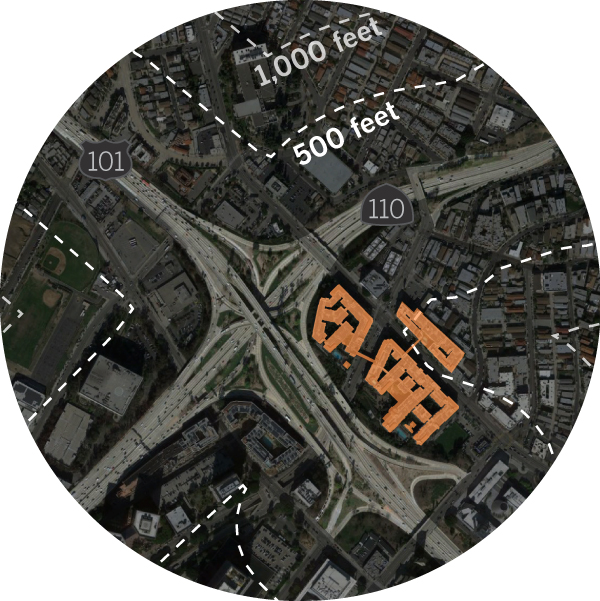
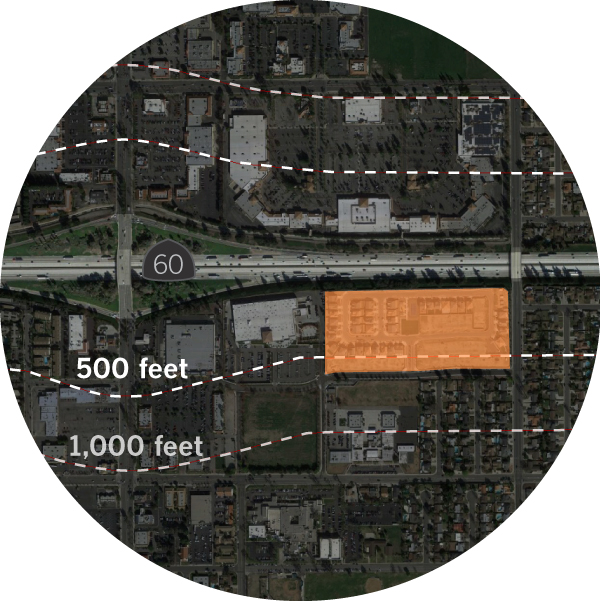
1 dot = 1 person living within 1,000 feet of a freeway in 2010


For more than a decade, California air quality officials have warned against building homes within 500 feet of freeways.

And with good reason: People there suffer higher rates of asthma, heart attacks, strokes, lung cancer and pre-term births. Recent research has added more health risks to the list, including childhood obesity, autism and dementia.

Yet Southern California civic officials have flouted those warnings, allowing a surge in home building near traffic pollution, according to a Los Angeles Times analysis of U.S. Census data, building permits and other government records.

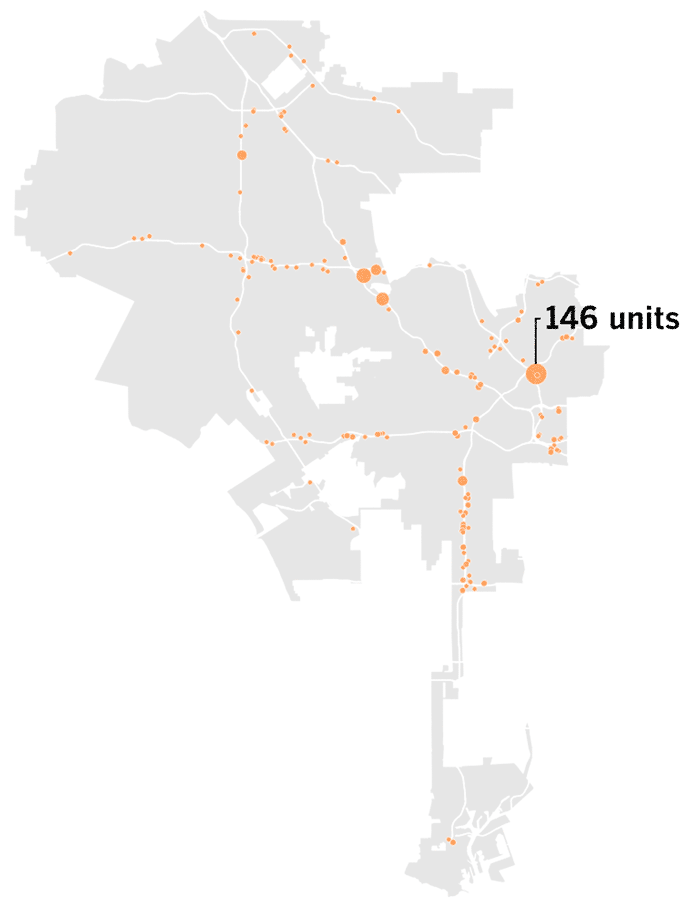
In Los Angeles alone officials have approved thousands of new homes within 1,000 feet of a freeway — even as they advised developers that this distance poses health concerns.

http://www.latimes.com/projects/la-me-freeway-pollution/#nt=notification

The city issued building permits for 4,300 homes near freeways in 2015 — more than in any year over the last decade — and signed off on an additional 3,000 units last year.

Public funds, including millions of dollars from California’s cap-and-trade program to cut greenhouse gas emissions, are going to developers to build new homes in freeway pollution hot spots.

The population near Los Angeles freeways is growing faster than elsewhere in the city as planners push developers to concentrate new housing near transportation hubs, convinced that increasing urban density will help meet state targets for greenhouse gas reductions.

More than 1.2 million people already live in high-pollution zones within 500 feet of a Southern California freeway, with more moving in every day. Between 2000 and 2010 — the most recent period available — the population within 500 feet of a Los Angeles freeway grew 3.9%, compared with a rate of 2.6% citywide.

Orsini

1,072-unit apartment complex
Opened in three phases between 2004 and 2010
1-bedroom apartment rents for $2,000 to $2,500 a month
Developer Geoffrey H. Palmer has built thousands of units near downtown L.A. freeways and plans more
Have you ever lived near a freeway? Tell us your story


Los Angeles City Councilman José Huizar, who lives several hundred feet from Interstate 5, said freeway pollution is such an urgent and complex problem that he wants the city to establish buffer zones. He called for a “comprehensive, citywide study of development near freeways that would analyze all impacts of limiting development around freeways.”

Other elected officials and business groups argue that Los Angeles is so thoroughly crisscrossed by freeways that restricting growth near them is impractical and would hamper efforts to ease a severe housing shortage. In some cases, city officials are paving the way by re-zoning industrial land along freeways and other transportation corridors.

In an interview at a recent groundbreaking for a freeway-adjacent apartment project, Los Angeles Mayor Eric Garcetti said that he grew up near the 101 and 405 freeways and that many in his family had cancer.Mayor Eric Garcetti attends a groundbreaking ceremony for a 160-unit affordable apartment project next to the 110 Freeway in South Los Angeles. View more photos

But he said he opposes any restrictions on how many homes can be built near freeways and thinks that improving air-filtration, building design and tailpipe emissions are a better way to reduce risks to residents.

“I take this stuff very seriously, but I also know that in looking for housing we have a very constricted city,” he said.

Garcetti spokesman Carl Marziali noted that a prohibition on building within 1,000 feet of freeways, for example, would cover more than 10% of land currently zoned for residential construction in the city, from Westwood to Boyle Heights and San Pedro to Sherman Oaks. But proponents of stricter planning, including supporters of Measure S, a proposal on the March 7 ballot that would place new restrictions on development, have criticized city officials for approving what they term “black lung lofts.”
How close to the freeway are you?


Low rent and a location near shops and restaurants are what brought Jeremiah Caleb to an apartment on Beloit Avenue, where a sound wall is all that separates the 405 freeway from sleek new apartments and lofts advertising “good living.”

But life got worse for Jeremiah and his wife Angel soon after moving into that one-bedroom on the Westside of Los Angeles.

The couple began to struggle with bouts of coughing, sneezing and headaches. They kept the windows shut, yet a grimy, black film settled regularly over the furniture, counters and even their skin — a never-ending reminder of the vehicle exhaust and soot they were breathing just 100 feet from 14 lanes of traffic.

“We were constantly sick,” said Caleb, an actor in his 30s. The couple worried enough about dirty air that they put off having children. “We were desperate to leave, but we felt stuck. We just couldn't afford it.”

Business groups have consistently opposed any suggestion of restricting development near heavy traffic.

“Freeways are part of Los Angeles' fabric and prohibiting housing by them is unrealistic,” said Carol Schatz, president of the Downtown Center Business Improvement District. She argues that such restrictions would worsen the housing crisis and severely limit the ability to build housing near mass transit.

The Southern California Assn. of Governments, the regional planning agency for Los Angeles, Ventura, Orange, Riverside, San Bernardino and Imperial counties, has projected that the population within 500 feet of a freeway will increase by a quarter million people by 2035.

Rob McConnell, a professor of preventive medicine at USC who studies roadway pollution, is one of a number of health researchers who has advised city officials not to allow new housing that close to freeways.

“I tell them you’re going to make a lot of people sick,” McConnell said.

Scientists have long known that polluted air cuts lives short.


But pinpointing the harmful agents in traffic pollution is difficult because it’s a stew of ingredients including toxic combustion gases, microscopic soot particles, compounds from worn tires and dust from vehicle brake pads. Recent research has narrowed in on one component of special concern: ultra-fine particles, pollutants in freshly emitted vehicle exhaust that can be five to 10 times higher near traffic.

The invisible, chemical-laden specks are less than one-thousandth the width of a human hair — so tiny they are hard to capture with pollution controls or filters. Scientists suspect ultra-fine particles are able to pass through the lungs and into the bloodstream, where they may harm the heart, brain and other organs. Yet they remain unregulated by state and federal authorities.

That emerging science has raised concerns that decades of government regulations, aimed at curbing smog that builds up across vast urban areas, are not sufficiently tailored to the more localized problem of roadway pollution.


Two years ago, state environmental officials concluded that diesel soot and other carcinogens in vehicle exhaust pose nearly three times the cancer risk previously thought.

In a long-term study, USC researchers have for more than two decades measured the lung capacity of thousands of school children across Southern California. They found that children growing up near major roadways have higher rates of asthma and other respiratory illnesses, including deficits in lung function that can be permanent and lead to a lifetime of health problems.

Even in communities with cleaner air, such as Santa Maria near the Santa Barbara County coast, children living near traffic had the same lung function loss as those in Riverside and other smoggy inland areas, the scientists found.

Anthony Moretti, chairman of pediatrics at White Memorial Medical Center in Boyle Heights, said children who live close to freeways are among those who most frequently land in the emergency room struggling to breathe and in need of treatment for asthma and other respiratory diseases.

“These kids will come in four, five, six times over a six-month period, and clearly their environment is a factor,” he said. "I feel for these families because they suffer an undue burden of illness simply because of where they live.“Dr. Anthony Moretti says children who live close to freeways are among those who most frequently arrive in the emergency room struggling to breathe and in need of inhalers and treatment for asthma and other respiratory diseases. (Mel Melcon / Los Angeles Times) View more photos

Public health officials have long warned that traffic pollution can drift well over 1,000 feet from traffic — and more recent research suggests that it may waft more than a mile.

Yet it took lawsuits and a nationwide mandate from the U.S. Environmental Protection Agency to force Southern California air quality officials to begin regularly measuring pollution near Southern California freeways in 2014.

The first readings confirmed that people near freeways breathe higher levels of the exhaust gases nitrogen dioxide and carbon monoxide. Then, in 2015, the South Coast Air Quality Management District detected the region’s highest concentrations of fine particulate matter at a new monitoring station 30 feet from the 60 Freeway in Ontario. The findings added compelling evidence that traffic emissions are piling on top of regional smog, hitting people near freeways with a double dose of pollution.

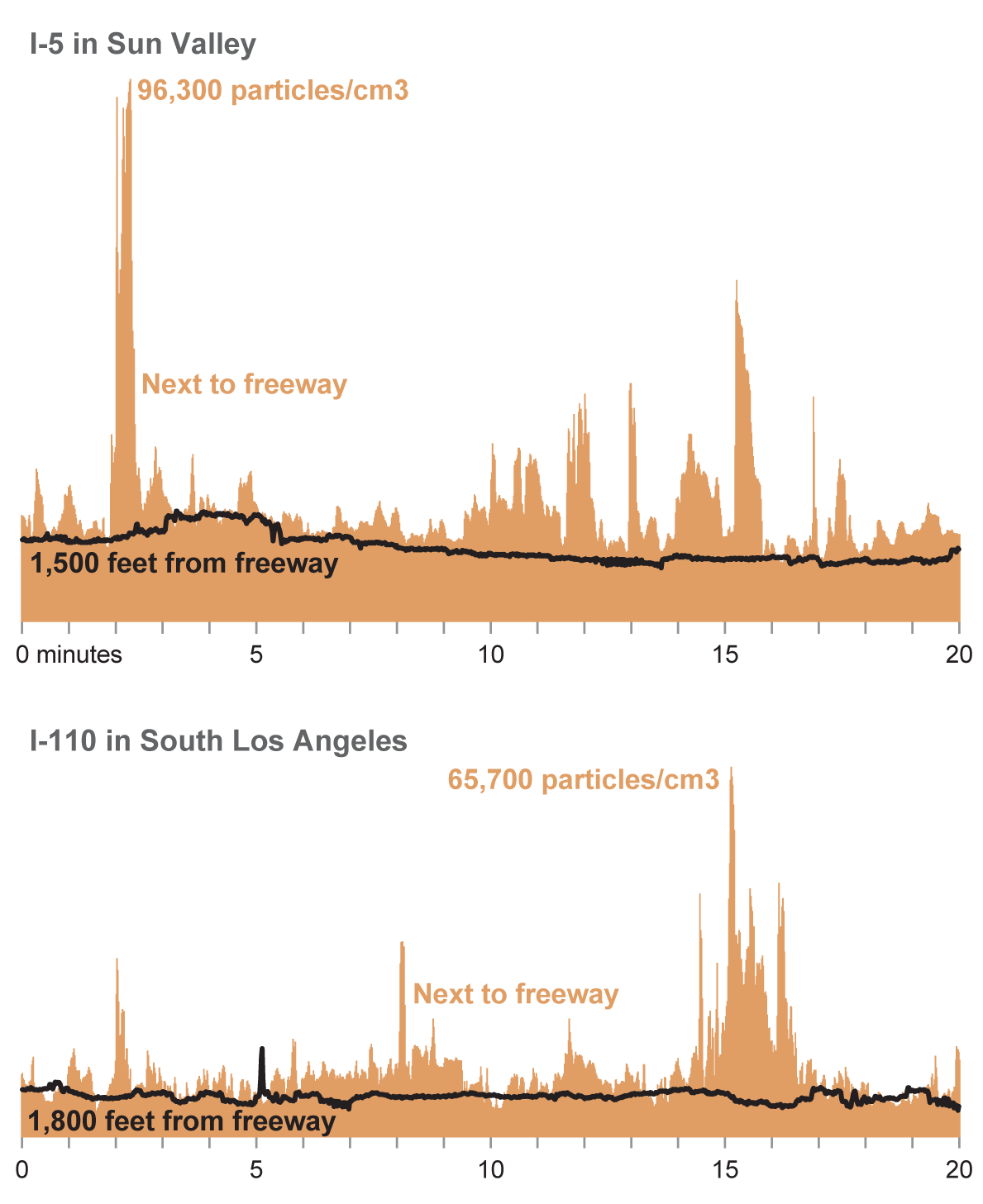
To learn more about the problem, The Times conducted air quality testing at sites where new housing is planned near Los Angeles freeways.

In August and September of 2015, reporters collected air samples at several locations using portable pollution sensors that detect ultra-fine particles, the microscopic pollutants in vehicle exhaust. One set of air samples was taken next to stretches of the 110 and 5 freeways and another set was taken 1,500 to 1,800 feet from the freeways.

Ultrafine particles spike near freeways

Source: TSI P-Trak Ultrafine Particle Counter 8525 readings on Aug. 20, 2015 and Sept. 24, 2015. See the data

Pollution readings near the freeways were three to four times higher than in neighborhoods at a distance from traffic. Diesel trucks produced the most noticeable pollution, coughing out foul plumes of exhaust and soot that could be seen and smelled as pollution readings jumped.

Scientists at USC and the South Coast air district said the readings were consistent with their measurements near freeways.

One of the locations where reporters detected high pollution levels was next to a vacant lot along the 110 Freeway in South Los Angeles where two apartment buildings for low-income residents are being built.

The $55-million Meta Housing Corp. project, which will bring 160 new housing units to the busy traffic corridor, is partly funded with money from pollution permits sold under the state’s cap-and-trade program, among other state and local government subsidies.

Among the most visible and controversial projects that have raised traffic pollution concerns in Los Angeles are developer Geoffrey H. Palmer’s massive Italianate apartment complexes overlooking downtown freeways. He has built thousands of units and is planning more.

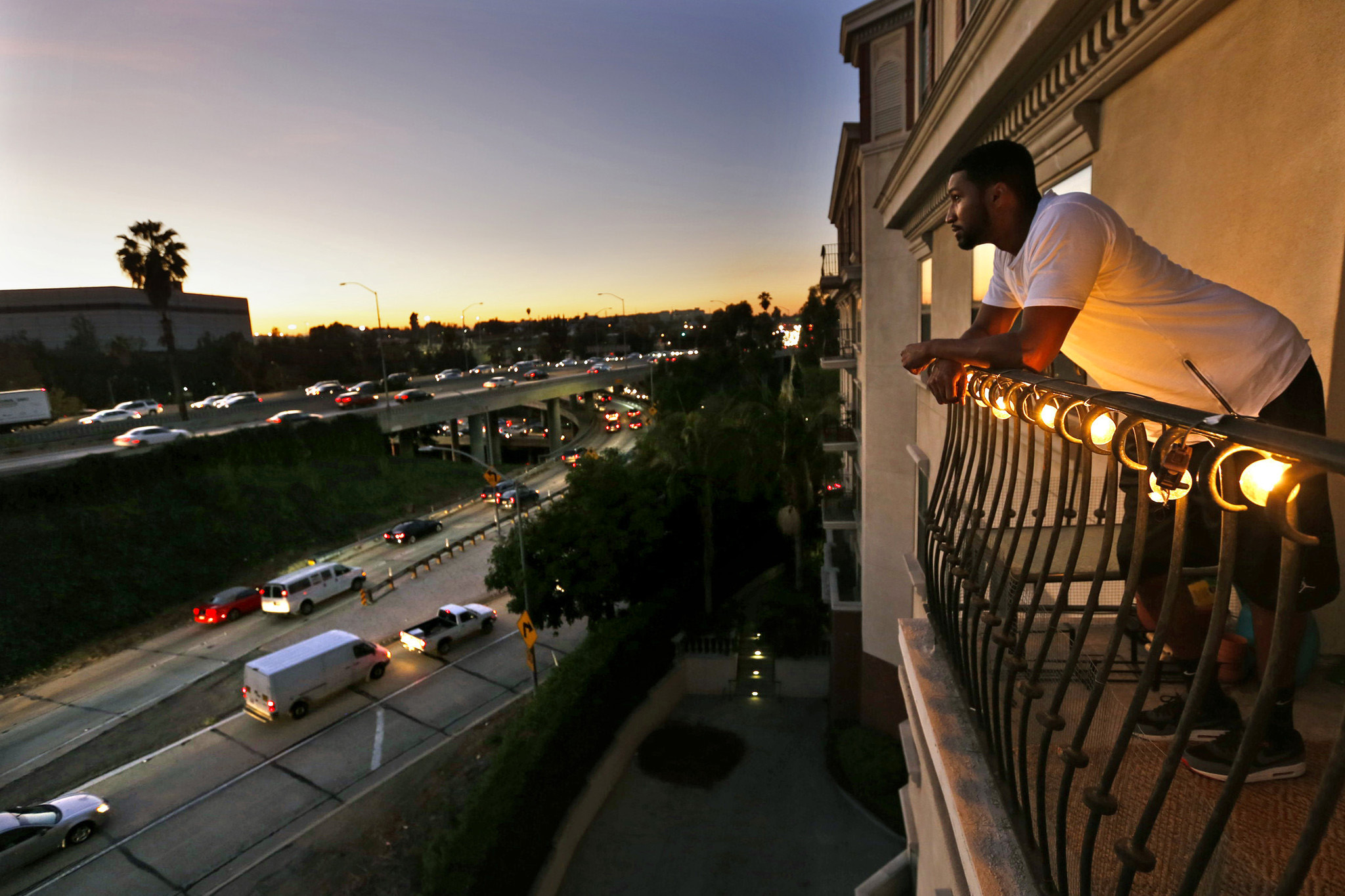
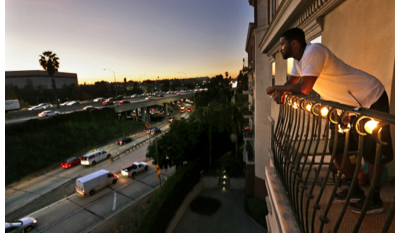
In interviews, current and past residents of Palmer’s Orsini development, which hulks over the interchange of the 101 and 110 freeways, said they moved to the complex for its convenient downtown location. But many spoke of keeping windows closed to block noise and pollution, deploying house plants to soak up the bad air and constantly sweeping and dusting the fine black soot that seems to find its way onto every surface.

Felicia Gargani said her pet peeve was the grime that collected on her fourth-floor balcony that looked out over the freeway. “If you walk out there barefoot,” she said, “your feet turn black."

Construction on the Orsini began more than a decade ago, before scientists grasped the extent of the health hazards of building so close to traffic.

In the years since, the South Coast air district has sent dozens of letters to cities sounding alarms about similarly risky home building proposals near freeways in Los Angeles and other communities across its four-county jurisdiction.

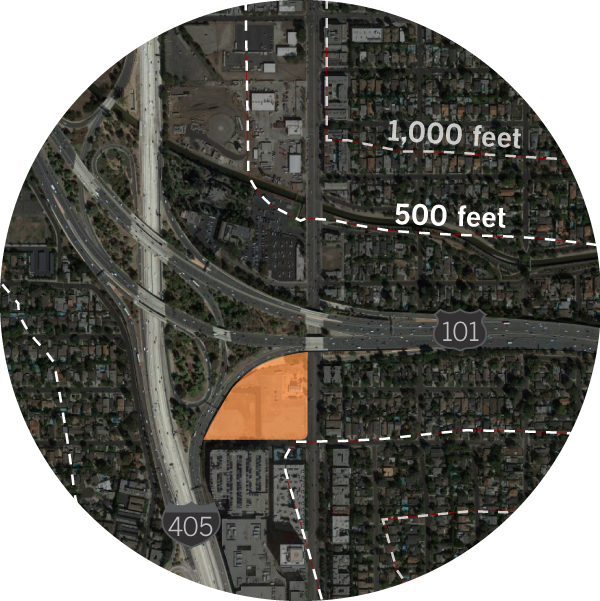
Il Villaggio Toscano

Planned 325-unit apartment complex
Approved in 2013 by the L.A. City Council over the objections of air quality officials
Developer M. David Paul pledged to use enhanced air filters Tell us your freeway story


The air-quality agency reserved some of its strongest criticisms for developer M. David Paul’s 325-unit Il Villaggio Toscano project proposed near the 405-101 interchange in Sherman Oaks, urging Los Angeles city planners in 2011 to “reconsider placing new housing immediately adjacent to one of the busiest freeway intersections in Southern California.”

The city “is ignoring the abundant health science data that has come out over the past decade that demonstrates serious health consequences for those living near a freeway,” the air district’s Ian MacMillan wrote.
Motorists travel along the 101 Freeway in Hollywood. (Mel Melcon / Los Angeles Times) View more photos Everett Smith, a renter at the Orsini apartments, looks out from his balcony at rush hour traffic on the 101 and 110 freeway interchange in downtown Los Angeles. (Don Bartletti / Los Angeles Times)


The City Council approved the project unanimously in August 2013, with its backers pledging to use the highest-rated air filters.

Los Angeles officials now require all homes built near freeways to have air filtration systems that rate at least 13 on the industry’s 16-point effectiveness scale.

California air regulators acknowledge that decades of strict vehicle emissions standards have slashed tailpipe emissions, and they say air quality along freeways will continue to improve as the state transitions to cleaner vehicles and fuels.

Health officials say that those mitigating steps are good, but that the only way to solve the problem is for city and county officials to stop residential building near freeways.

And that, say legal experts, is well within their authority.

Planning experts cite a number of possible approaches to the public health problem.

Cities could re-zone areas near heavy traffic to exclude new residential development or change their general plans to prohibit such uses, planning experts say. Officials could adopt ordinances or moratoriums on new residential development. Or they could strengthen building standards — as they have for seismic reasons — forcing developers to design buildings in a way that reduces residents’ exposure to polluted air.

“If there's a political will to protect people from this type of development then cities certainly know how to use zoning to accomplish that,” said James Kushner, an expert in land-use, development and urban planning at Southwestern Law School.
Thousands of homes approved near L.A. freeways

Use the slider to see where the city has issued building permits within a 1,000 feet of a freeway since 2005.
2005

S
ources: Los Angeles Department of Building and Safety, L.A. County Assessor, OpenStreetMap See the data

One of the only attempts at a ban on development occurred several years ago when the L.A. County Department of Public Health proposed language in the county’s general plan to prohibit new housing within 500 feet of freeways, citing the adverse health effects. County planners ultimately rejected the idea.

The failure of such restrictions to gain traction has left some local officials wondering if the only way to keep cities from building more homes near freeways is through a state law.

One precedent is a 2003 law California passed prohibiting the construction of new public schools within 500 feet of freeways out of concern for children’s health. But school districts have used exceptions in the law to keep building.

Meanwhile, the residential developments that are rising next to freeways continue to spread not just through the urban core, but across the region.

One of those new neighborhoods is Cedar Point, a subdivision of one and two-story houses in the San Bernardino County suburb of Chino. The development was built on land that had been re-zoned for housing in a special election paid for by a real estate company. It sits about 100 feet from the 60 Freeway.

More than 220,000 vehicles motor by each day on this major freight corridor, including some 27,000 big-rig trucks whose diesel engines cough out many times more harmful pollutants than cars.

In January 2015, the South Coast air district sent a letter to Chino officials warning that freeway pollutants would threaten the health of residents in the new homes.

A few months later, the building site swarmed with construction workers and heavy equipment.

Dennis Yates, former mayor of Chino who served more than 12 years on the region’s air quality board, said that as mayor he encouraged the developer to put in higher-rated air filters, but acknowledged he “personally wouldn’t live there.”

Cedar Point
84 single-family homes in San Bernardino County suburb of Chino
Built in 2015 along one of California’s busiest diesel truck corridors
4-bedroom houses by Frontier Communities sell for around $600,000 Tell us your story


Among those who did move into one of Cedar Point's four-bedroom houses was Mike Sanchez, his wife and two young daughters.

Buying so close to traffic was a difficult decision, he said, but “one of the sacrifices we made to get into a new home.”

Back on the Westside of Los Angeles, Jeremiah Caleb, who spent years battling black road dust and illness while living in an apartment next to the 405, said he and his wife were relieved when she landed a nursing job — a second income that allowed them to move to a less-polluted neighborhood about a mile from any freeway.

Their health has improved, with their once-constant headaches and respiratory problems now a rarity.

“I can leave my doors open and I'm breathing fresh air all the time,” he said. “We got lucky. But for most people . . . They're stuck because that's what they can afford.”

Wednesday, January 17, 2018

The “Build More Market Housing” Quack Miracle Cure


The “Build More Market Housing” Quack Miracle Cure for Los Angeles

DICK PLATKIN 11 JANUARY 2018


PLATKIN ON PLANNING-Los Angeles is heading toward a perfect storm of gentrification, well-camouflaged behind spurious claims of boosting transit ridership and addressing LA’s housing crisis through zoning and environmental deregulation.


This perfect storm is propelled by huge tail winds from the State Legislature in Sacramento, with big city Democrats fronting for the real estate interests that fund and mentor them. San Francisco State Senator Scott Wiener and Los Angeles Mayor Eric Garcetti are their current favorites, but many more are lining up at the trough.

To begin, there is a treasure trove of successful programs that they could turn to if they really wanted to increase transit ridership and address the housing crisis, but they are totally mute on these options. As for their cheerleaders, their silence is also deafening since the following public programs are at odds with their “build more market housing” miracle mantra for LA’s urban ills.

Increasing Transit Ridership through the following is not on their to-do list:
Reduce fares, such the UK’s program to allow those over 60 to ride subways and busses for free, is a perfect model for LA. For that matter, the pols could look closer to home. Between 1982-85 METRO used Proposition A funds to reduce bus fares to 50 cents. As a result, ridership quickly rose. But neither politician nor their kindred spirits ever calls for fare reductions. Apparently, they cannot be used to promote real estate speculation.
Shorten headways. In cities like New York and London, some riders use mass transit apps, but it is seldom necessary because they know the next bus or subway car will arrive within minutes. Unlike LA, long headways and unreliable bus schedules are not an issue in those cities. 

Make stations appealing. In transit-oriented cities like New York and Tokyo, subway stops have stores and amenities, unlike LA, where passengers cannot even find a bathroom or a newspaper vending machine.
Make bus stops comfortable. In LA, most bus stops only offer a sign or a “bum-proofed” bench. But, if every stop had a bus shelter, the bus riding experience would be vastly improved, especially during rains and heat waves. 

Transform the neighborhoods around transit stations into Transit Oriented Districts/Communities. These include comprehensive planning and municipally funded public improvements for mini-parks and play grounds, enhanced street and pedestrian lights, bicycle lanes, boulevard trees, sidewalk repairs, zebra-striped cross walks, intersection punch-outs, and ADA curb cuts.
At subway stations and adjacent neighborhoods METRO and LADOT could add facilitiesfor buses, cars, vans, taxis and ubers, pedestrians, and bicyclists.
Los Angeles could carefully monitor the transportation-related behavior of local residents and the demographics of transit passengers to determine which programs work and which do not.

Programs to address LA’s housing crisis:

The programs for fixing LA’s housing crisis are also well known, but are predictably ignored by the build-more-market-housing growth machine of real estate investors, building industry lobbyists, neo-liberal academics, Democratic politicians, and groupies. Their goal is to sweep away zoning and environmental laws that developers don’t like, not spend public money on unprofitable affordable housing projects. This is why they never call for the following:
Restore discontinued Federal housing programs, such as public housing projects, as well as 236 and 221d(3) subsidized apartments.
Vastly increase the funding for Section 8 housing. In Los Angeles, over 600,000 people want Section 8 housing, but only 400 people per year mange to get vouchers and move into affordable units.
Restore the Community Redevelopment Agency’s funding for affordable housing programs.
Transform LA’s Rent Stabilization Ordinance into a Rent Control This requires ending vacancy decontrol; applying rent control to all housing, not just rental apartments built before 1978; and restricting rent increases to the real cost of living.
Restore and establish public social service programs that treat homeless people afflicted by drug addiction and mental illness.
Increase wages in order to reduce economic inequality, a leading factor responsible for homelessness, overcrowding, and rent gouging.
Carefully monitor changing housing conditions, as mandated by the General Plan Framework, to determine which housing programs are effective and which are not.

But, instead of these obvious programs, Sacramento and LA’s City Hall have only provided us with real estate-related programs. hey may have different names, but they are united by a single purpose. Their goal is to sweep aside zoning and environmental laws disliked by real estate developers, so they can build what they want, where they want, regardless of the consequences. These ordinances include the following, with more on the way from the build-more-market-housing crowd’s current Wunderkind, Scott Wiener.

Pay-to-Play is still a reliable way for developers to build what they want because City Hall approves 90 percent of their applications for zoning waivers and General Plan amendments

Community Plan Updates are appended with lengthy land use ordinances that up-zone and up-plan hundreds to thousands of parcels at one time.

Density Bonuses are the local application of Senate Bill (SB) 1818, which allows, with no effective right of appeal, the waiver of many zoning provisions if developers promise to include a small percentage of low income units in their buildings. This ordinance is now being supplemented by a draft Value Capture Ordinance that would expand the zoning waiver options. Since neither ordinance contains any on-site inspection requirements, there is no way for the public or the City to verify that any of the new units are affordable and that their tenants are officially registered low income Angelinos.

Transit Priority Areas (TPAs) implement SB 743 in Los Angeles. This State law and its local implementation ordinance applies to nearly all of Los Angeles west, south, east of the downtown because all local parcels are located within a half-mile from an existing or proposed rail or bus stop. In those areas residential, mixed-use, and employment centers are exempted from two California Environmental Quality Act’s impact categories: parking and esthetics.

Transit Oriented Communities, the implementation of Measure JJJ, allows increases of up to 80 percent in the number of permitted units in exchange for an undefined inclusion of affordable housing units. Like similar programs, it, too, does not require any on-site inspections to confirm the presence of dedicated affordable units or qualified low-income tenants. Like Transit Priority Areas and the proposed Senate Bill 827, described below, this Los Angeles ordinance also applies to neighborhoods that are up to a half-mile from a subway and light-rail station or a quarter-mile from an Express bus line.

Transit Neighborhood Plans are intended to reduce zoning requirements at light and heavy rail stations, such as the Expo Line. While they are supplemented by streetscape plans, these off-site improvements are only unfunded guidelines. They are not backed up by any public funds covering the design, construction, operations, or maintenance of any streetscape features.

Re:code LA will eventually expand the list of permitted uses on most private parcels by eliminating the need for a variance to build non-permitted uses. Furthermore, even though re:code LA is billed as a zoning simplification program, it has already replaced the existing R-1 zone, which applies to about three-quarters of all single family homes in Los Angeles, with 12 alternate zones.

The Pitfalls of Scott Wiener’s Perfect Storm: The perfect storm headed toward Los Angeles is based on proposed legislation sponsored by State Senator Scott Wiener. His draft SB 827 bill grants a cost free and highly lucrative zone variance to private parcels up to a half-mile from a subway station and a quarter-mile from an express bus line. Any parcel in these “transit rich” areas that has received a “housing opportunity grant” will then qualify for the elimination of zoning provisions for design, building mass (Floor Area Ratio), some building height, and parking.

More specifically, in practice Wiener’s bill allows apartment projects that apply for an on-menu or off-menu density bonus -- as low as 5 percent -- to evade most zoning requirements in perpetuity. Since the City of Los Angeles automatically grants all density bonus applications, rejects all appeals, and never dispatches an on on-site inspector, this legislation will become a cornucopia for those who own private parcels zoned for apartment buildings. The value of their properties will soar. They can then sell them at an enormous financial gain, dodging new property taxes because of Proposition 13. As for new housing construction, most flippers could care less. What a deal!

While no one yet knows SB 827’s final provisions, we can already foresee its other major pitfalls:

Pitfall #1: Senator Wiener and his fan clubs have not given the slightest thought to the additional public infrastructure and public services that new transit-adjacent buildings and residents require. When the number of residents increases in areas near subway station and bus stops, these neighborhoods will need more garbage pick-ups, street sweeping, schools, parks, recreation centers, senior centers, libraries, emergency services, and so forth. The water mains, gas and sewage lines, and storm drains also need upgrading, as well as infrastructure for electricity and telecommunications. But since no planning or public funds are allocated through SB 827 for these many categories, we can expect a dramatic decline in the quality of life if/when the bill becomes a catalyst for new market-driven apartment buildings.

Pitfall #2: SB 827 does not include any on-site inspection programs. Angelinos will have no way to verify that the pledged affordable units that trigger de facto zone variances and a resulting real estate bubble are based on actual affordable units and low-income tenants.

Pitfall #3: We will also have no way to know, if as claimed by Senator Wiener, his financial backers, and his disciples, that people who move into new, transit-adjacent market and luxury housing will routinely abandon their cars to walk up to a half mile to catch a train station or bus. Furthermore, if this behavioral information is eventually collected, I predict that most well-off tenants will continue to drive their fancy cars for most trips. If so, SB 827 contains no repercussions if the new tenants seldom use transit or if the affordable units are soon rented out at market rates.

Pitfall #4: SB 827 would gut many transit corridor Specific Plans in Los Angeles, such as those on Ventura/Cahuenga Boulevard, Crenshaw Boulevard, and Colorado Boulevard, as well as the Vermont/Western Transit Oriented District Specific Plan. Years of planning that went into these transit corridor plans, that involved local communities and that integrate transportation and land use planning, would be summarily dumped. Since this legislation automatically purges Specific Plan provisions for height, FAR, design, and parking, it moves LA in exactly the wrong direction. These transit corridor Specific Plans should be the model for future planning in Los Angeles, not discarded by a real estate industry bill in Sacramento.

Pitfall #5: Because SB 827 treats transit corridors as accessories to real estate speculation, it will heavily politicize transit planning. Developers will heavily lobby transit agencies to ensure that the corridors they want to gentrify will be upgraded to express bus service or rail. At the same time, some communities interested in protecting low-rise apartment buildings already housing frequent transit users would be forced to bizarrely lobby for downgraded transit service. After all, if their bus service falls below 15-minute headways, then SB 827 would not apply, as well as Transit Priority Areas and Transit Oriented Communities.

Pitfall #6: SB 827 ignores the many proven public programs -- described above -- that would actually boost transit ridership and address LA’s housing crisis.

My conclusion about SB 827, by itself, and in combination with the land use ordinances I reviewed above, is that it is one of the dumbest pieces of planning legislation I have encountered in over three decades of city planning. Like all miracle cures, it won’t work. It might make some landowners and landlords rich, but it will not increase transit ridership or reduce the cost of housing.


(Dick Platkin is a former Los Angele city planner who reports on planning controversies in Los Angeles. Please send any comments or corrections to rhplatkin@gmail.com.) Prepped for CityWatch by Linda Abrams.

Friday, December 29, 2017

California officials say housing next to freeways is a health risk — but they fund it anyway

California officials say housing next to freeways is a health risk — but they fund it anyway


By TONY BARBOZA and DAVID ZAHNISER
DEC 17, 2017 | 5:00 AM

Traffic flows on the I-5 near the Sheldon Street exit where an empty lot is a possible site for a homeless veterans housing complex in Sun Valley on December 12, 2017. (Genaro Molina / Los Angeles Times)


It’s the type of project Los Angeles desperately needs in a housing crisis: low-cost apartments for seniors, all of them veterans, many of them homeless.


There’s just one downside. Wedged next to an offramp, the four-story building will stand 200 feet from the 5 Freeway.


State officials have for years warned against building homes within 500 feet of freeways, where people suffer higher rates of asthma, heart disease, cancer and other health problems linked to car and truck pollution. Yet they’re helping build the 96-unit complex, providing $11.1 million in climate change funds from California’s cap-and-trade program.


The Sun Valley Senior Veterans Apartments is one of at least 10 affordable housing projects within 500 feet of a freeway awarded a total of $65 million in cap-and-trade money since 2015, a Times review of records found. Those developments will place hundreds of apartments for homeless people, veterans and families near freeways in Los Angeles, the Bay Area and the Central Valley, some less than 100 feet from traffic.


California’s support for those projects shows how policies created to cut greenhouse gases and ease the housing crunch are also putting some of the state’s neediest residents at risk from traffic pollution. It's one way public dollars are helping finance a surge in residential development near freeways, where Los Angeles and other California cities have permitted thousands of new homes in recent years.

How close do you live to the freeway? »


State officials acknowledge that some cap-and-trade money, collected from companies that buy permits to emit greenhouse gases, will put residents near elevated levels of pollution. But they say dense housing near bus and rail lines is crucial to meeting California’s climate goals, by getting cars off the road.


Even in places with poor air quality, they argue, residents’ health will improve from walking and biking more. And they say the dangers from living near freeways can be reduced with anti-pollution design features recommended this year by state air regulators, including sound walls, vegetation barriers and high-efficiency air filters that remove some of the harmful particles from vehicle exhaust.


“When those strategies are employed, the environmental and public health benefits of these projects far outweigh the negatives,” said Ken Alex, a senior advisor to Gov. Jerry Brown who chairs the Strategic Growth Council, the agency that distributes cap-and-trade funds to affordable housing developers.Developers of the Sun Valley Senior Veterans Apartments say the project will have features to deal with nearby freeway pollution: a sound wall, dozens of trees and high-efficiency air filters to screen out pollutants. Genaro Molina / Los Angeles Times


California’s decision to subsidize low-income housing near freeways alarms some health scientists, who point to years of studies that link roadway pollution with a growing list of illnesses — and billions in healthcare costs. They say air filters and other mitigation measures are not enough to protect residents, especially children, whose lungs could be damaged for life, and seniors, who could die early from heart attacks.


“I see the economic incentives for doing this,” said Beate Ritz, an environmental epidemiologist at UCLA who has studied the health effects of traffic pollution for more than two decades. “But it’s kind of stupid, because we all know we will pay for it with long-term health effects. Somebody has to pay for the costs of diabetes, of cognitive decline or strokes. This is just creating a huge amount of costs for society in the long run.”


Construction is expected to start within weeks on the Sun Valley project, capping a decade of debate that pitted the need for more housing against the health of people who would live there. Proponents say those apartments will be far superior to life on the street, with higher-rated air filters and a buffer — dozens of trees, a sound wall and a parking lot — separating residents from pollution.A plan for a 96-unit affordable housing project in Sun Valley is opposed by a trio of local veterans: Gary Aggas, 70; Garry Fordyce, 70; and Mike O'Gara, 78. All three say the building will put seniors and veterans too close to freeway pollution. Genaro Molina / Los Angeles Times


Despite those measures, some locals argue the freeway is simply too close.


“These vets are going to be sucking in these diesel fumes. It’s going to shorten their lives,” said Mike O’Gara, who lives eight blocks away and is a veteran of the U.S. Naval Air Forces. “What a hell of a great reward for serving their country.”

Unpleasant choices


The Sun Valley project offers a window into the unpleasant choices faced by politicians, real estate developers and nonprofit groups as they struggle to counter rising rents and a surge in homelessness, which grew 23% this year across Los Angeles County, to nearly 58,000 people.


Los Angeles, a city crisscrossed by freeways, is embarking on a $1.2-billion plan aimed at financing 10,000 homes for homeless people. Land next to those corridors — often cheaper and less likely to spur outcry from neighborhood groups — will be tempting to build on.


If policymakers put low-cost housing next to freeways, they will place some of their poorest constituents in locations where pollution can be five to 10 times higher, saddling them with the health consequences. But if they prohibit new construction in those areas, they could make things tougher for people trying to get off, or stay off, the streets.


Of the roughly 2,000 affordable housing units approved in Los Angeles in 2016, 1 in 4 was within 1,000 feet of a freeway, according to figures from the Department of City Planning. Officials are weighing whether to build homeless housing on at least nine city-owned properties within 500 feet of freeways — including one that’s less than 200 feet from the sprawling 110-105 freeway interchange.Housing advocates argue that homeless Angelenos are already living near freeways. In L.A.'s Sun Valley neighborhood, Joe Carmelo has a campsite along the 5 Freeway, not far from the site of the planned senior veteran apartments. Genaro Molina / Los Angeles Times


Housing advocates point to studies that link homelessness to early deaths from drug use, respiratory disorders and other health problems. Homeless individuals are also less likely to obtain access to healthcare, mental health services and substance abuse counseling than those who have shelter, said Mike Alvidrez, chief executive of Skid Row Housing Trust, which has built 1,800 units of housing since 1989 — including one building next to the 10 Freeway.


“We know that people die sooner if they don’t get off the street and into housing. We just know that,” he said. “So if you have a solution that going to prolong someone’s life — irrespective of whether it’s the worst place you could put it, next to a freeway or next to two freeways — if you don’t have another option, that’s what you do.”


Across the region, homeless people are already living near freeways — in tents tucked along sound walls, in campsites obscured by shrubbery. Jason McKenney, 34, said he has spent some nights in North Hollywood Park, which runs along the 170 Freeway.Jason McKenney, right, said he has spent some nights in a park near the 170 Freeway in North Hollywood. Genaro Molina / Los Angeles Times


Sitting under a tree nursing an injured leg, the onetime construction worker said he would have no qualms about moving into a building next to a freeway, if it had cheap rents and counseling for substance abuse.


“I would jump at that chance,” he said.

Apartments near transit


With climate change now a top priority, California has embraced policies to cut carbon emissions by packing dense housing near jobs and transit. State leaders have set aside nearly $700 million from the cap-and-trade program to finance transit-oriented developments and infrastructure.


The planned Sun Valley development is on a noisy stretch of Laurel Canyon Boulevard with high-speed traffic and few walkable businesses. But because it’s near a bus stop, the project was eligible for cap-and-trade funds.


To boost transit use near the senior housing complex, a portion of those funds will go toward free bus and rail passes for the tenants, as well as new crosswalks, sidewalks and wheelchair ramps.


Like many projects that have received cap-and-trade money, the project is in a location that already endures a heavy pollution burden, which helped it qualify for state funds. The application for cap-and-trade money acknowledged the neighborhood has high rates of asthma.The planned Sun Valley Senior Veterans Apartments was eligible for state funding, in part, because it will go up near a bus stop. Genaro Molina / Los Angeles Times


Some in the neighborhood, such as 75-year-old Joan Winget, see the freeway as a serious health threat. Diagnosed with emphysema in 2012, Winget has lived more than 20 years in a mobile home park right next to the senior housing site.


The retired property manager smoked cigarettes until 1979, and her health issues are linked at least in part to that habit. But she worries her medical problems have been exacerbated by pollution from the nearby 5-170 freeway interchange, whose swooping ramps can be seen from the property’s driveway.


Each day, about 200,000 vehicles on the 5 pass her home. To protect herself, Winget keeps her doors and windows closed 24/7 and the air conditioning running around the clock. She misses the days when she let a breeze blow through her home late at night.


“I hate it,” she said. “I love fresh air. I like getting outside. I don’t like being stuck in the house all the time. I might not be getting the greatest air in here, but it’s worse outside.”Joan Winget, 75, stands inside her home next to the 5 Freeway in Sun Valley. In an effort to protect herself from car and truck pollution, she keeps her air conditioner on, and her windows closed, around the clock. Genaro Molina / Los Angeles Times


Regulators say decades of tough clean-air rules have slashed tailpipe emissions, reducing risks to people near freeways. But some scientists warn those health improvements will be undercut by the state’s push to concentrate high-density housing near transit hubs, which often sit near major roadways.


A 2016 study projected state climate policies would increase the number of preventable deaths from heart disease in Southern California by placing more people near traffic pollution. Establishing buffers between homes and heavy traffic, in contrast, would decrease heart disease deaths, especially among the elderly, according to the study by researchers from USC, the California Department of Public Health and several other institutions.


The state Air Resources Board — which since 2005 has recommended municipalities “avoid siting” homes within 500 feet of freeways — oversees the spending of billions of dollars in cap-and-trade funds by a dozen state agencies. But the board does not select the affordable housing projects that get the money. Those decisions rest with the Strategic Growth Council, a committee appointed by the governor and state lawmakers.


Records show the Strategic Growth Council voted unanimously to award funds for apartments next to the 110 Freeway in Los Angeles, housing along Highway 99 in Turlock and a 135-unit building in San Jose that’s just 25 feet from Highway 87, a location a state analysis ranks in the 95th percentile for diesel emissions.State cap-and-trade funds are being used to finance two affordable housing developments going up next to the 110 Freeway in L.A.'s Harbor Gateway neighborhood. Genaro Molina / Los Angeles Times


At least one member of the panel, Manuel Pastor, said he was unaware he had voted for housing so close to freeways.


Pastor, who directs USC’s Program for Environmental and Regional Equity and has written on the health implications of building near roadway pollution, said the issue never came up when the projects were being considered.


“Your pointing out the exact location of these projects is the first time it has come to my attention,” said Pastor, an appointee of State Senate leader Kevin de León. “I have not until now asked for a map of where these things are.”

‘Poor planning and bad zoning’


The push to build homes on the Sun Valley site began more than a decade ago, just as Los Angeles city officials were starting to reckon with the health risks posed by freeway-adjacent development.


Initially, the zoning for the site allowed for just three homes. The City Council hiked that number to 26 in 2008, at the request of the property’s owners. Three years later, the same developers asked the city to increase the number again, taking it to 96.The planned Sun Valley site will be wedged between a mobile home park and the Sheldon Street off-ramp. It will stand about 200 feet from Interstate 5. Jon Schleuss / Los Angeles Times


Each step of the way, there were warnings about freeway pollution — first from planning commissioners, then neighbors, and finally the South Coast Air Quality Management District. Early on, one mayoral appointee called it an example of “poor planning and bad zoning.”


But the developers had a champion in U.S. Rep. Tony Cardenas, who represented the area.


Cardenas and two of his allies, then-State Sen. Alex Padilla and then-Assemblyman Raul Bocanegra, urged city leaders in 2013 to allow a 96-unit elder care facility to go up on the site. All three have received a steady stream of political contributions from developers, architects and others who worked on the Sun Valley development — at least $70,350 over the last 15 years, a Times review of donations found.


The elder care project was approved, and in 2015, the owners sold it for $3.5 million, more than three times the amount paid in 2006, when only three homes could be built on the site.


Neither Cardenas nor Bocanegra would comment for this story. Padilla, now California’s secretary of state, said he supported the project because it offered “affordable living options for senior citizens.”


Businessman David Spiegel, one of the project’s developers at the time, said he followed the city’s rules. “There are hundreds of thousands of units that have been and are currently being built on the freeway,” he said, “so any impacts must be acceptable to city, state and federal agencies.”

Sealing windows shut


The property was purchased by the East L.A. Community Corp., a nonprofit housing developer with experience putting low-income housing next to freeways. ELACC, as the group is known, had already built 33 apartments for homeless veterans along the 5 Freeway in Boyle Heights. At that location, windows facing the freeway are sealed shut and the air conditioning system has higher-rated filters.


Isela Gracian, the nonprofit group’s president, said many of L.A.’s low-income neighborhoods were carved up by freeways decades ago. That, she said, makes it difficult to find properties far from car and truck pollution.Backers of the Sun Valley project say many of L.A.'s low-income neighborhoods are carved up by freeways, making it difficult to find affordable housing sites away from freeway pollution. Genaro Molina / Los Angeles Times


“Not every piece of land is available to us,” she said. “Whoever currently owns the land has to be willing and open to selling the property. It’s not like we can walk the streets and say, ‘This is a better location — let’s swap the project and move it over here.’ ”


Still, one agency in Los Angeles County has managed to avoid putting its money into projects along freeways.


The county’s Community Development Commission, which provides tens of millions of dollars in low-interest loans to affordable housing developers each year, decided in 2008 that it would not allow its money to finance projects within 500 feet of a freeway.


Kathy Thomas, who heads the agency, said that decision was made in response to warnings about the health hazards of traffic pollution from the Air Resources Board and other regulators. Yet even with that limitation, the commission finances hundreds of units of housing each year — and receives more requests for money than it has to lend, she said.


“We have not had any difficulty finding projects,” Thomas said in an email. “Our freeway buffer requirement is well-known among developers and we really don’t get any pushback.”


Thomas said it would be “negligent” for her agency to knowingly put low-cost housing next to freeways and undermine the county’s work in reducing “the cost burden of frequent users on the healthcare system.”


Some officials want similar conditions on the spending of cap-and-trade funds.


Dean Florez, a former state senator who sits on the Air Resources Board, said California should stop using cap-and-trade money for housing near freeways. Those projects, he said, “will endanger people’s lungs for decades.”


The Strategic Growth Council is moving ahead without such restrictions as it accepts applications for another $255 million in affordable housing funds.


Agency officials will score projects by proximity to transit, greenhouse gas reductions, walkability and other criteria. One thing they won’t measure is how close the projects are to freeway pollution.

Sunday, July 2, 2017

LA’s Black Lung Lofts … Another Kind of Freeway Death


LA’s Black Lung Lofts … Another Kind of Freeway Death 

PATRICK RANGE MCDONALD 22 JUNE 2017


MCDONALD REPORT--After years of alarming studies and in-depth news coverage, the Los Angeles City Council and Mayor Eric Garcetti have yet to address the devastating health impacts to residents who live in freeway-adjacent housing, which LA politicians continue to approve. On Tuesday, at the Planning and Land Use Management Committee meeting, the Coalition to Preserve LA and other community groups urged council members to finally take substantive action.


“There’s an urgent need to develop new and ambitious targets and rules for reducing freeway exposure,” said Michele Prichard of Liberty Hill Foundation, a social justice group.

“Living near multiple freeways, as we do in Pacoima,” said Yvette Lopez-Ledesma, deputy director of Pacoima Beautiful, an environmental justice group in the northeast San Fernando Valley, “is an urban planning death sentence.”

On Tuesday, the Planning and Land Use Management (PLUM) Committee asked the Department of City Planning to provide a report on current city practices to address freeway pollution impacts on nearby communities. As revealed during the meeting, there are no citywide policies in place to protect the public’s health.

Yet the City Council and Mayor Eric Garcetti have known since at least 2007 that freeway-adjacent housing, widely known as “Black Lung Lofts,” seriously endangers the health of children, who are highly vulnerable to life-long respiratory illnesses when living within 500 feet of a freeway. USC’s landmark Children’s Health Study, which was first published in 2004, has proven that beyond a doubt.

In addition, other scientific studies have shown that pregnant women and senior citizens face dangerous health impacts by living next to a freeway. The LA Weekly, in 2010, and Los Angeles Times, in 2017, have also sounded the public health alarm.

The City Council and Mayor Garcetti, however, have refused to implement important policies such as creating buffer zones so that developers can’t build housing within 500 feet of a freeway or instituting a mandatory notification system in which developers must inform prospective tenants of freeway-adjacent health hazards.

Instead, the City Council and Mayor Garcetti keep approving Black Lung Lofts, such as NoHo West (642 units) next to the 170 Freeway in North Hollywood and Clarendon Street Apartments (335 units) next to the 101 Freeway in Woodlands Hills.

Developers, who’ve long been top political patrons in LA and have outsized influence at City Hall, have contributed at least $6 million in campaign cash to city politicians since 2000.

At the PLUM meeting, Miki Jackson, of the Coalition to Preserve L.A, put the council members on notice.

“Knowing what you know,” she said, “being informed of how dangerous [freeway-adjacent housing] is, and allowing it to go forward could set the city up for some interesting lawsuits.”

East Hollywood activist Doug Haines, whose neighborhood sits along the 101 Freeway, said, “We must prohibit all new construction next to freeways.”

And Chris Chavez, deputy policy director of the Coalition for Clean Air, said his group “urges the City Council to work with the environmental community in developing the [planning department] report… to help ensure that the recommendations in the report are as effective as possible.”

The Coalition to Preserve LA agrees, and insists that residents and community groups are not only allowed to give input about recommendations, but are given a decision-making role in the creation of citywide policies for freeway-adjacent housing.

Friday, June 23, 2017

Will this Tech Company help builders destroy neighborhoods in Marinwood?

Owners of the seven properties outlined in red are selling together for a premium. (CityBldr Photo)
In November, Jane and Andy Freeman received an unexpected letter in the mail.
CityBldr CEO Bryan Copley wants to ‘build smarter cities.’ (Photo by Business Rockstars)
A company called CityBldr reached out to notify them that their Shoreline, Wash., home might be worth a lot more than they thought. Intrigued, they gave the Seattle startup a call. They learned that CityBldr software flagged their property as one of a handful that could be sold together for a much higher price than individually. In other words, the whole could sell for considerably more than the sum of its parts.
Working with CityBldr, the Freemans and two other neighbors agreed to sell their properties collectively. With three committed, four additional homeowners signed on, too. This week, all seven homes will go on the market as one unit, targeting developers eager to build more housing inventory for the region’s booming population.
CityBldr zeroed in on the properties for a few key reasons. Combined, they would make plenty of space for a large housing development, they’re located across the street from the Light Rail station going in at 145th St., and the properties fall within a region that was rezoned from single-family to mixed-use residential housing last year.
According to Jane Freeman, her property has the potential to sell for $100-140 per square foot when purchased as part of the assemblage of homeowners. Individually, her 7,000-square-foot lot is currently estimated to be worth about $497,381. Sold on its own, the house would have gone for about $71 per square foot.
“At the lowest, we would be getting for our part of the assemblage a minimum of $700,000,” she said.
The Freemans’ Shoreline home. (Photo by Jane Freeman)
CityBldr has been working with about 50 groups of homeowners, like the Freemans and their neighbors, to help them sell their properties collectively. The Seattle startup charges a 6 percent fee for its services, comparable to what a traditional broker would charge. Homeowners can use the website to find out if their property is undervalued for free.
“We tell them what the best and highest use of their property is and what the value is to a builder or developer if their property is underutilized,” he said. “To builders and developers, their core competencies, we learned, weren’t sales and acquisition, they were actually building. They wanted to take these sites and improve them and build them and develop them to best and highest use. They didn’t want to have a tool built for them, to help them go find sites.”
Instead of doing their own scouting, CityBldr is providing that tool for developers and homeowners in the Seattle area and, as of last week, Los Angeles. Copley says the service will expand to 10 markets in the next six months.
To fuel that growth, CityBldr has raised a $1.6 million investment round, led by real estate developer SRM, which is known for building the Seattle Google Campus. A long list of additional investors participated in the over-subscribed round, including Start It Labs, Millenium Global, PWR Financial, Realogics Sotheby’s, and TUNE CEO Peter Hamilton.
Copley hopes CityBldr’s software can eventually be used to help address Seattle’s homelessness and housing affordability issues. CityBldr is working with a handful of Seattle non-profits to advance that agenda.
As for the Shoreline homeowners, CityBldr’s software predicts their parcel will be used to develop 220 units of multifamily housing. “CallisonRTKL is the architect that has drawn up the plans for the site and corroborated that the software’s yield study is accurate,” Copley said. “The site will attract both local and regional developers and builders as well as foreign investors.”
CityBldr, which launched in May of last year, has broader ambitions than helping homeowners upsell their properties. The company aims to help cities identify and understand underutilized land to make more efficient urban planning choices.
“CityBldr’s goal is to create smart cities,” Copley said when the startup launched. “We can use artificial intelligence paired with empathy and create happy, functional, sustainable communities.”