A blog about Marinwood-Lucas Valley and the Marin Housing Element, politics, economics and social policy. The MOST DANGEROUS BLOG in Marinwood-Lucas Valley.
A letter to state Sen. Scott Wiener about Senate Bill 827. (Examiner file photo) By Nato Green on June 16, 2018 1:00 am
State Sen. Scott Wiener made waves for Senate Bill 827, which proposed to answer the housing crisis by overriding local zoning to allow more density built near transit. The bill died in committee in April, with Wiener saying “we started a conversation” (read: lost) and pledging to bring it back in a groovier form. Here’s what I hope the senator learned from the effort.
Everybody knows that affluent low-density suburbs (cough, Palo Alto, Los Gatos) brim with chutzpah for refusing any new housing while the entire world gets evicted.
SB827’s twist was that Wiener cast the bill as a bold stance to promote racial equity.
Wiener wrote on Medium, “SB827 is an unprecedented action *against* restrictive land-use restrictions with origins in racial discrimination and exclusion.”
Except many organizations based in communities of color denounced SB827 as a gentrification bomb. The LA Tenants Union wrote SB827 “will have a devastating impact on low- and middle-income neighborhoods and communities of color.”
My data geek pal with the nom-de-tweet Revolutionary Clown (also my silent partner in SPORC, our fake PAC for pro-tenant landlords) overlaid the SB 827 impact zones with census blocks to find the percentage of renters, of non-white people, and the median income in SB827-affected areas.
Turns out the racial justice organizations were right. Areas affected by SB827 were in fact lower-income, less white, and more renty than California as a whole. Affected neighborhoods within counties were poorer, less white, and more renters than county average.
According to RevClown, California is 39 percent non-white, but SB827-affected areas were 52 percent non-white. Statewide, 46 percent of units are occupied by renters, but 68 percent of the units in the SB827 areas. The state median income is $84,111, but the impact area is $78,008.
In-county disparities were minimal in San Francisco because most of the city is less than a quarter of a mile from transit, but elsewhere it was stark. Tony low-density Marin is 21 percent non-white, 37 percent renters and with a median income of $119,598. But the Marin SB827 impact area was 62 percent non-white, 74 percent renters, with a median income of $75,961. Contra Costa County is 40 perecent non-white but the SB827 area is 61 percent white, with a median income almost 35 percent below the county average. Riverside is 37 percent non-white, but the SB827 area is 63 percent white, with a median income a whopping 60 percent below the county average. Similar patterns repeated across the state.
Senator Wiener may have been incorrect to claim that SB827 would end historic racist exclusion.
For the future, I would like to say the following to my senator:
Dear Senator Wiener,
Maybe you don’t mind SB827 disproportionately affecting lower income, non-white renter communities more than their more affluent neighbors, because you heart massive homebuilding. But then don’t claim you’re doing something to address racism. You’re not helping people from San Pablo move to Moraga.
Let’s assume you genuinely desire to promote racial justice via housing. You did a crap job.
You didn’t understand how you might appear to affected communities as anything other than the latest in a long line of white technocrats brandishing studies while inflicting pain.
By declining to consult with and incorporate the priorities of the people you said you wanted to liberate when drafting the bill, you—this is a technical term—pooped in the pool.
You didn’t seem to get that the desire for local control in rich suburbs that always enjoyed it is different from the desire for local control in poorer communities of color that never had it.
There is no path to racial equity that does not involve people of color as the architects of their own liberation. There is no corrective for historic structural racism that by design gives communities of color less control over their own land.
If you want to draft legislation to decrease the power of affluent white communities to block housing while increasing the resources available to communities of color to determine their own fate, I am for it, even if the resulting policy is less lucrative than repackaging urban renewal and calling it racial justice.
Love,
Nato Nato Green is a writer and comedian. See him and Natahsa Muse riffing over TITANIC for Riffer’s Delight at the Alamo Drafthouse on Monday June 25. Send brunch invites @natogreen and technical questions to @revclown.
Data analysis indicates that areas affected by SB827 were lower income, less white and included more renters than California as a whole. (Courtesy @revco)
NOTE: I’m white. That doesn’t mean I can’t call these writers and media corporations on their structurally racist bullsh*t.
Through April 20, there were 29 articles in total published about California’s proposed YIMBY upzoning bill, SB 827, across Vox, the LA Times, the NY Times, NY Magazine, CityLab (run by The Atlantic), and Slate. Every single one was written by a white person, or multiple white people. Excluding the two pieces written by the LA
All the people who wrote articles on SB 827 for Vox, the LA Times, NY Times, NY Magazine, CityLab, and Slate. (The two women are from the LA Times’ Editorial Board)
Times’ Editorial Board — 7 out of 9 members are white — these articles were exclusively written by white men.
Such overwhelming whiteness in these big media corporations is of course a huge problem in itself. But at the very least, these authors could’ve looked to the knowledge and experiences of organizations rooted in communities of color that have been fighting gentrification and a permanent housing crisis for decades.
Yet, in a shameful collective display of white arrogance, worries about gentrification and displacement were minimized or disregarded entirely as the writers nearly unanimously put forth supply-side analyses of the housing crisis.
My (extremely charitable) interpretation of why this happened: these white authors are blinded by their race and class.
SB 827 was dubbed “Urban Renewal 2.0” by the Black Community, Clergy, and Labor Alliance (BCCLA), and was vehemently opposed by nearly everysingletenants’, anti-gentrification, and low-incomeadvocacyorganizationacross the state that took a stance on the proposed legislation. A coalition of 37 progressive grassroots organizations from LA, for example, argued that the bill would “exacerbate the very issue it seeks to remedy, especially in low-income communities and communities of color.” Meanwhile, it was supported by reactionaries like the California Apartment Association, the California and LA Chambers of Commerce, and tech CEOs.
But this was not the picture presented to the millions of readers of these mainstream liberal publications. The authors of these articles consistently framed SB 827 as a courageous and progressive approach, if perhaps slightly flawed, that would make huge advances towards ending California’s housing crisis — if only those cranky NIMBY (“Not In My BackYard”) homeowners would get out of the way.
These authors think of themselves as objective arbiters of truth, but their worlds — the newsfeeds they scroll through each day — are filled with other upper-class white people and their perspectives. Matt Yglesias is more likely to engage with worthless pundits like Josh Barro and this economist from the Koch-funded Mercatus Center than he is to read material published by Causa Justa, Right to the City Alliance, or Defend Boyle Heights (check out this article).
They live in a lily-white bubble, and this shapes how they learn about issues and whose knowledge they consider legitimate, resulting in the shallow, white-centric understandings of gentrification and the housing crisis that we get from these pieces. A “housing bill” or a “displacement bill”?
Right off the bat, the framing of SB 827 as a sweeping solution to the housing crisis, and the near-universal presumption that this bill would actually make things better, shows what perspective these journalists are writing from.
The presumption that SB 827 would actually improve the housing situation seems to underlie most of the reporting beyond the headlines. For typical examples of this, look at the first few sentences from these two articles by the LA Times and NY Times — though the winner in this category is surely this article by Henry Grabar of Slate, which says explicitly in the headline that SB 827 would “solve state housing crisis.”
It’s not that these characterizations are plainly wrong. They could be true, but only from the vantage point of those that can afford to live in the new units that would result from SB 827.
For others, this bill spells intensified displacement and the loss of their communities, as argued by the Western Center on Law and Poverty, Housing California, and the California Rural Legal Assistance Foundation: “SB 827 will fuel the displacement of low-income communities and communities of color by investors and speculators who seek to build higher-income developments. Even with the March 1st amendments, nothing in the bill prevents or mitigates both the direct and indirect displacement that will occur as a result of the proposal.”
But not once do we see SB 827 referred to as a “gentrification bill” or a “displacement bill.” It’s clear whose opinions are really being reflected in this coverage.
Even when concerns about gentrification and displacement are mentioned, they tend to be mid-way down the article, and they certainly don’t capture the stakes involved in what is fundamentally a life-or-death struggle for entire communities. The journalists act as if mentioning opposition from poor people and people of color is a box they have to check before moving on.
(Finally, some articles act as if there is no opposition at all from low-income communities, completely ignoring their existence. See these two from Matt Yglesias, and pieces by Thomas Edsall and thesethreeYIMBYs that were given platforms by the LA Times and CityLab.) “Capitalism works for me, so it will work for you, too”
Ultimately, they completely discount alternative analyses that argue forcefully that capitalist institutions — and the system of capitalism itself — built on a political economy embedded in white supremacy, lie at the root of the crisis. For example, this 80-page report from Right to the City Alliance states plainly that “corporate and individual control of property to maximize private gain is the fundamental problem with the current housing model.”
BCCLA’s statement also directly refutes these supply-side theories: “It is an insult to your own intelligence and to our history of struggle to suggest that the powerful financial interests that every day evict us, engage in predatory lending, and rob us of our limited wealth are suddenly in favor of policies to break up their lucrative system that profits from our continued oppression and exploitation.”
But capitalism has been good to these white guys. They worked their way up our so-called meritocracy and now have jobs writing for big media companies. Again we can see how their race and class shape how they see the world, and lead to their analyses that tell us the way to solve the housing crisis is to expand the reach of the market, that we shouldn’t focus on the people and corporate institutions making a killing off of squeezing and displacing poor people, and that strategies like rent control actually do more harm than good. Meanwhile the profit (and eviction, and displacement, and resegregation) machine keeps on spinning. Who wins?
Ultimately, the narratives coming out of these large media corporations benefit the powerful white people and white-dominated institutions that make enormous sums of money actively investing in real estate. They also serve to comfort a large portion of their readership, white yuppie city-dwellers who, instead of being made to feel like they’re partaking in a destructive system rooted in “capitalism, white supremacy, and colonialism,”can simply think of themselves as rational consumers in a housing market with artificially constrained supply.
I’m not saying this is conspiratorial. Matt Yglesias doesn’t ignore the existence of people of color that disagree with him and write trash takes on gentrification because he’s in cahoots with real estate interests and gentrifiers. And the larger problem of the whiteness of corporate media is in large part structural, a product of these media companies existing as capitalist institutions and being accountable only to their shareholders.
But we should be aware of who profits when all these white writers refuse to even consider arguments that label racial capitalism as a fundamental part of the problem, and downplay concerns over displacement. There are material consequences when these are the narratives seen by influential people that read these liberal publications. In this case, real estate investors win, and poor people and people of color lose.
Update 2:23pm 5/10/2018: This piece has been edited to include specific reference to “A major California housing bill failed after opposition from the low-income residents it aimed to help. Here’s how it went wrong” by Liam Dillon. -Knock Editors Editor's Note: In general, I think there is far more ignorance of cultures than outright racism. The author does have valid points that much of the coverage is from elite, college educated urbanists who ASSUME their plans improve lives. They are not listening.
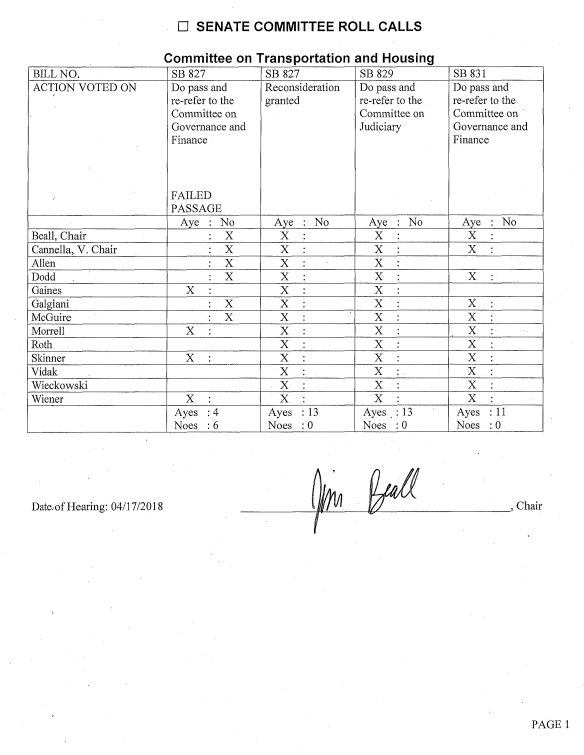
A number of misinformed statements regarding the vote on SB 827 have been circulating. This is the official statement signed by the Chair of the Transportation and Housing Committee, Senator Beall. The vote was 6 no, 4 aye, and 3 not voting. If Scott can talk some into changing their votes, he can still pass this out of committee, however, he faces a much more difficult time getting it passed in the next committee in time to get it through the to the full Senate by the deadline. Still, some people will show up to oppose this one, since they will be opposing SB 828 as well.
Thanks to these bills, and a few others our Northern representatives are forcing on the state residents, many Southern California citizens are rising up to flex their rather large and powerful political powers. This year could see some changes coming to our state legislature that may shift the power away from the Bay Area. Too much too fast and too disruptive is creating a bad environment for the easy-going California lifestyle we have come to love and appreciate and there is a movement to resurrect it.
SACRAMENTO — A sweeping bill that would have given the state unprecedented power over local development failed in its first committee hearing, crushing the hopes of those who saw it as the key to making housing in the state more affordable.
At a lively and crowded hearing Tuesday, the Senate Transportation and Housing Committee blocked Senate Bill 827, a bill to force cities to allow apartments and condominiums of roughly four to five stories within a half mile of rail and ferry stops — as well as denser housing near bus stops with frequent service.
The vote abruptly halted a feverish debate over one of the biggest housing proposals introduced in Sacramento this year — one which took aim at cities reluctant to embrace larger developments. Its demise also underscored the political realities and pace of change at the Capitol, even as pressure mounts for the state to respond to runaway housing costs.
“Every housing advocate should know that this was always going to be an uphill battle,” said Laura Foote Clark, executive of San Francisco YIMBY Action, which advocates for more housing construction. “Of course there are going to be setbacks, but we are going to rally and keep fighting for it.”
Just four of the 13 committee members, including the bill’s two main authors, Sens. Scott Wiener, D-San Francisco, and Nancy Skinner, D-Oakland, supported the proposal.
Some senators said they liked the idea of housing density near public transportation, but the details were off: that the bill didn’t make sense for smaller, more rural areas, or that its affordable housing provisions weren’t strong enough.
“My challenge, frankly is the one-size-fits-all approach to the bill,” said Sen. Richard Roth, D-Riverside.
When the bill’s fate became clear, Wiener vowed to keep the idea alive — a sentiment echoed by a number of his colleagues, even some who voted against it. “Whatever happens today,” he said, “we’re going to keep working.”
As he made his case to his colleagues, Wiener had argued the ambitious proposal was long overdue, given the state’s spiraling housing costs and freeways clogged with long-distance commuters who can’t afford to live near their jobs. Wiener, a former San Francisco supervisor elected to the statehouse in 2016, says he knows firsthand the pressure on local elected officials to preserve the status quo, and that the bill would bring sorely needed housing where it is needed the most.
“In California, for decades now, we have made a conscious decision that having enough housing simply doesn’t matter,” Wiener told the committee earlier as he made his case. “SB 827 promotes exactly the kind of housing that we need.”
The bill was sponsored by California YIMBY, a coalition of pro-development Yes In My Backyard groups who are newcomers to Sacramento politics. Also backing it were Silicon Valley CEOs and development and real estate trade associations. Dozens of urban planning and housing experts have lined up in favor of the proposal, arguing it could encourage more racially integrated neighborhoods and ease the state’s housing shortage. But the proposal had an even longer list of detractors, including scores of cities and many tenants’ rights and affordable housing groups who predicted it would hasten gentrification and put tenants at even greater risk of displacement.
The state’s influential construction union, the State Building & Construction Trades Council of California, also came out against the bill, which did not include prevailing wage standards or other labor-friendly provisions.
The vice mayor of Beverly Hills, John Mirisch — a vocal opponent of SB 827 — drew cheers and laughter when he called the bill “the wrong prescription,” likening the effort to “trying to cure psoriasis with an appendectomy.”
At least twice during the hearing, the committee chairman Sen. Jim Beall, D-Campbell, had to tell the crowd to be quiet. “No outbursts whatsoever,” he said.
Wiener twice amended the bill after its introduction in January. The second set of changes, made last week, lowered height limits, gave cities more time to prepare for the new rules to take effect, and added provisions that the senator argued would protect low and middle-income tenants at risk of losing their homes.
But the new language did little to neutralize the opposition.
Related Articles Why did California’s major housing bill fail so quickly?“We just think it was very, very deeply flawed from the start,” said Anya Lawler, a policy advocate for the Western Center on Law & Poverty, in an interview Tuesday. “Do we support high density housing near transit? Of course we do. But we have to be very thoughtful about how we get there.”
In a statement issued after the vote, Wiener said the outcome was not a surprise, given the scope of the proposal.
“I have always known there was a real possibility that SB 827 – like other difficult and impactful bills that have come before – was going to take more than one year,” he said. “… I will continue to work with anyone who shares the critical goals of creating more housing for people in California, and I look forward to working in the coming months to develop a strong proposal for next year.”
HURRAY! After fierce debate, the State Senate Transportation and Housing Committee Kills High-Density Housing Bill - Senate Bill 827 Contemplative Senator Wiener with Senator Beall in the background (Photo by Paul Chinn, The Chronicle)
HURRAY! On Tuesday, the Senate Transportation and Housing Committee killed Senate Bill 827 (Wiener), a bill that would have limited the ability of counties and cities to block high-density apartment and condominium construction near public transit.
The committee voted 5 "Nay" to 4 "Yay" and prevented the bill from moving forward. Four Senators did not cast votes, even though they were present. Here's how the Senators voted:
Sen. Jim Beall, D-San Jose (chair): No Sen. Anthony Cannella, R-Ceres (Stanislaus County) (vice chair): No Sen. Benjamin Allen, D-Santa Monica: No Sen. Bill Dodd, D-Napa: No Sen. Ted Gaines, R-El Dorado Hills: Yes Sen. Cathleen Galgiani, D-Stockton: Not voting Sen. Mike McGuire, D-Healdsburg: No Sen. Mike Morrell, R-Rancho Cucamonga (San Bernardino County): Yes Sen. Richard Roth, D-Riverside: Not voting Sen. Nancy Skinner, D-Berkeley: Yes Sen. Andy Vidak, R-Hanford (Kings County): Not voting Sen. Bob Wieckowski, D-Fremont: Not voting Sen. Scott Wiener, D-San Francisco: Yes
The Senate Committee's discussion began with Senator Wiener presenting his case and the benefits of the bill. Wiener argued the ambitious proposal was long overdue, given the state’s spiraling housing costs and freeways clogged with long-distance commuters who can’t afford to live near their jobs. "SB 827 promotes exactly the kind of housing that we need."
The San Francisco Chronicle reported; "He (Wiener) took aim at Beverly Hills and Marin County, saying they opposed his bill because it would remove an obstacle that wealthy cities use to keep new housing out of their communities."
Then, each Senator gave reasons for his/her vote.
Senator Beall (D-San Jose) stated that it didn't make sense to plan housing near bus services that are not permanent and recounted a personal story about how his father sold his car with the intention of relying on the bus to get to work, but then the bus route was eliminated. Beall was also concerned about the bill's impact on social justice.
Senator Roth (D-Riverside) said; 'My challenge, frankly, is the one-size-fits-all approach to the bill." Senator Dodd (D-Napa) stated something similar; "The bill isn't flexible enough." and doesn't work for small cities.
Senator Ben Allen (D-Santa Monica) indicated it was poor city planning to have long corridors of dense housing. He added; "It doesn't make sense to dole out development near non-permanent bus routes." Allen also stated; "Density doesn't bring affordable housing. Just look at Manhattan" and the bill doesn't include historical preservation.
Senator Cathleen Galgiani (D-Stockton) relayed that the bill didn't address the needs of her area, which is housing-rich and jobs-poor, the exact opposite of what San Francisco (Wiener's district) is facing.
Senator Mike McGuire (D-Marin, Sonoma) (our representative) gave a number of reasons for opposing the bill: "The affordable housing provisions are not strong enough."; "The bill needs stronger anti-displacement protections."; The bill weakens CEQA and the ability to analyze impacts; Cities need at least 5 years to plan for increased density; and Smaller cities with poor transit need more parking. I believe (not certain) he added that housing density around fixed transit stops and ferry terminals makes sense but dense housing around unpredictable bus service does not.
Senator Nancy Skinner (D-Berkeley), who voted in favor of the bill, said; "If we don't build more housing we will never get the cost of housing down."
Many of the Senators (including Senator McGuire) who opposed the bill, prefaced their remarks by thanking Senator Wiener for his persistence and bringing an important topic to the limelight. They also expressed that they look forward to working with him on another bill to solve the housing crisis. Some senators said they liked the idea of housing density near public transportation but the details of the bill were wrong.
Acknowledging probable defeat, Senator Wiener expressed; "Whatever happens today, we're going to keep working." "This issue isn't going away. This bill isn't going away."
According to Michelle Pariset (Public Advocates Staff); " 'Reconsideration without amendments' means that Wiener can bring the bill up again for another vote but he can't do it with amendments. Wiener would need to flip enough votes before next Tuesday's (4/24) Transportation and Housing Committee meeting to move the bill. Then he'd need to ask for and receive a rules waiver to be heard the very next day (Wednesday 4/25) in the Senate Governance and Finance Committee. He'd need to have enough "yay" votes in the Senate Governance and Finance Committee, which is chaired by McGuire who's not going to flip. Friday (4/27) is the policy committee deadline for fiscal bills. This scenario is highly unlikely but it's possible."
For more details, please follow the below links to read pertinent articles.
Thank you to everyone who spread the word about the issue, met with representatives, sent letters, signed the petition, made calls to the Senators and went to Sacramento to attend the Senate Transportation and Housing Committee meeting. Your advocacy made a difference!
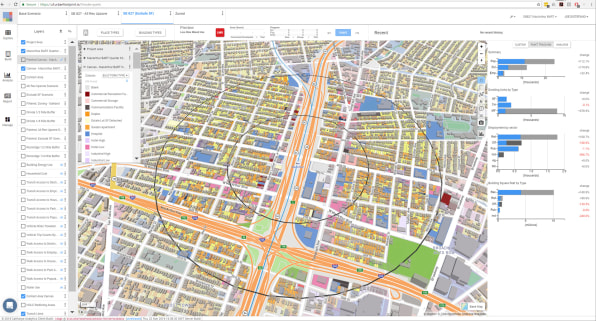
Urban Footprint makes it easy to run simulations to see how a new plan might change traffic and commute times, the ability of kids to walk to school, access to jobs, energy use, the local economy, health, and carbon emissions. [Image: courtesy UrbanFootprint]
Editor's Note: What about the infrastructure capacity of water, sewer, roads, schools, tunnels and bridges? Planners have big ideas but don't like to actually plan for these boring considerations. This is why many of us are strongly opposed to Plan Bay Area, SB827 and other rapid urbanization schemes. BY ADELE PETERS6 MINUTE READ
When a state senator in California proposed a bill that would require cities to allow developers to build dense housing near transit stops–including five-story apartment buildings on some streets where there are only one or two-story buildings now–Californians quickly took sides. Some say the change is a needed step to address the state’s housing crisis, and that it would lower carbon emissions because people living near transit would no longer have to drive. Some say that it would change neighborhood character, or that the increased development will drive displacement of low-income renters. [Image: courtesy UrbanFootprint]
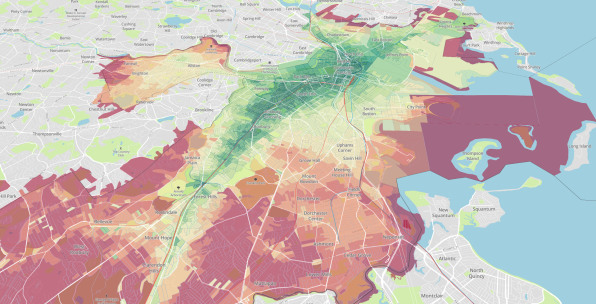
One thing that’s helpful–but often lacking–in arguments across the country about major urban policy like this is specific numbers about how the change might affect the city in the future. UrbanFootprint, a startup with a software tool of the same name, was first to begin providing stats. Near one Oakland BART station, for example, they found that the surrounding area could go from 4,447 housing units to 27,156. In comparison to building the same amount of housing in a typical Alameda County location, they later calculated, the dense housing near the BART station would result in 270 million fewer miles traveled in cars per year, 12 million fewer gallons of fuel burned (a savings of $43 million in fuel cost alone), and nearly 110,000 metric tons of carbon emissions averted.[Image: courtesy UrbanFootprint]
The software makes it possible to plug in any urban planning scenario, push a few buttons, and see a broad set of impacts, including how a plan might change traffic and commute times, the ability of kids to walk to school, access to jobs, energy use, the local economy, health, and carbon emissions. (The software tool can’t predict changes to rents). In the past, these types of complex calculations–if they were done at all–could take months or years as teams of consultants gathered massive amounts of data and made or customized models. Today, the State of California announced that it is partnering with the company to make the tool available for free to more than 500 cities, counties, and regional agencies in the state.
When communities can see comprehensive data about multiple plans for the future, the startup’s founders say, it becomes easier to compare them and reach consensus. For planners and designers, the tool can lead to better designs.
[Image: courtesy UrbanFootprint]Co-founders Peter Calthorpe and Joe DiStefano first started using data in a similar way–without the software–around 25 years ago. As they had worked with cities as consultants, they’d seen information gaps. “Whether it was a decision about how to invest in transportation or a decision about where and how to put housing, battles about sprawl versus transit-oriented development, all this stuff was being done in a next-to-factless vacuum,” says DiStefano.
In Salt Lake City, in the late 1990s, they worked with the city to envision how it could meet a new demand for housing. Environmentalists were concerned about sprawl. Fiscally conservative legislators were concerned about the cost of water for new neighborhoods. The Mormon Church wanted affordable housing. Calthorpe and DiStefano ran the numbers for the various scenarios that each group wanted. When everyone saw the results, they collectively chose the option of transit-oriented development.
[Image: courtesy UrbanFootprint]“When you lay out all the facts against all the scenarios what happens is there are few really truly virtuous strategies that rise up and solve many problems simultaneously,” says Calthorpe. “And when you find those strategies you get a political consensus that didn’t exist before.”
This happens, he says, despite living in a time when facts sometimes don’t seem to matter. The process doesn’t ask environmentalists or fiscal conservatives to change their values; it shows which solutions can best meet a variety of desires.
Looking at several impacts of a plan simultaneously also makes connections between multiple problems clearer, such as the link between walkable neighborhoods, transit, and health. “We tend to deal with our issues one at a time,” says Calthorpe. “If it’s obesity, we think about diet and exercise. But actually, the kind of environments we create have a huge impact.”[Image: courtesy UrbanFootprint]
They used a similar process in Portland, Oregon, post-Katrina Louisiana, China, and elsewhere. In Hawaii, the local Sierra Club opposed a new transit system, but the group changed its mind after seeing the data about the reductions in car trips the project would bring. The process worked. But Calthorpe and DiStefano also realized that it was difficult to scale. The work in Salt Lake City took two years, a massive budget, and “an army of consultants.” They started to play with the idea of creating software that could make the process cheaper, quicker, and more accessible.
When California passed a 2008 law that required cities and regions to create plans for more sustainable design to reduce emissions, the state needed software to set targets and measure compliance. The government asked Calthorpe and DiStefano to take its early version of the software and develop it further. The tool helped the state see a range of financial, environmental, and social impacts beyond carbon, helping win broader support for smart growth rather than climate action alone. Seeing that success, UrbanFootprint decided to make another version that any city can use.
In late 2017, the company raised $5 million in seed funding from the venture firm Social Capital and angel investors. Social Capital, a purpose-driven firm in Silicon Valley, has a different perspective than some peers. “We believe UrbanFootprint will be transformative for one of the most critical real-world challenges of our times,” says Jay Zaveri, a partner at Social Capital. “It sits at the nexus of software technology, machine learning, and urban infrastructure scenario planning to drive sustainable and equitable outcomes for cities everywhere.”[Image: courtesy UrbanFootprint]
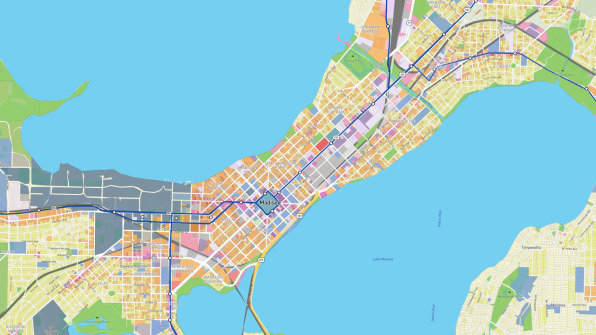
The tool pulls in data from around 100 datasets–about jobs and the people living in a neighborhood, how many people are driving or biking, existing buildings, predictions for sea levels rise, decaying infrastructure, inequality, health, and more–and uses machine learning to clean up the data. When someone using the software enters information about a proposed plan or policy, the tool feeds back environmental, social, and economic metrics. The tool uses a variety of models, some built in-house, and others that build on academic work. California energy and water agencies helped build the models for measuring energy and water impacts; conservation modeling was developed with the Nature Conservancy. After entering data about a proposed plan, a city can see detailed, color-coded maps that show, for example, access to public transit.
As new data becomes available from the growing range of sensors used by city governments or from startups like Aclima, which is using air quality sensors attached to Google StreetView cars, that can be added to the tool. UrbanFootprint worked with The Nature Conservancy to add data about conservation and ecosystem services, and with the American Lung Association to add data about air quality impacts like asthma.
“The data is getting to the point now where one of the biggest challenges for people engaged in city building is filtering through it all,” Calthorpe says. “It turns into an avalanche of information that people can’t really manage their way to clarity and insights.” It isn’t really useful, he argues, unless it’s in a tool that makes it easily accessible.
The software is currently built for the U.S., though UrbanFootprint is also working with international cities like Chongqing, China, which has a population of 30 million, nearly as large as all of California. They believe it can be useful anywhere, and as cities continue to grow–by 2050, 70% of the world’s population will be urban–good planning, which shapes social opportunity and environmental impact, is also necessary.
“In China alone, they’re going to be building cities for another 300 million people in the next 20 years,” says Calthorpe. “That’s basically building the urban environment of the United States. And they’re going to do that in 20 years instead of 200 years. So getting cities right is really at the crux of the well-being of mankind.”
My husband and I were active in the effort to pass the Berkeley Gay Rights Ordinance in the late 1970s, getting encouragement from Harvey Milk. (Soon thereafter, we got to thank him at an event in Berkeley.) That successful effort led to the passage of similar ordinances in Oakland and then San Francisco (as depicted in the movie Milk).
As a gay rights, now neighborhood, activist, I hoped that the participation of gays inside the government would be a vast improvement. We’d be more compassionate, democratic, and inclusive, based upon our own history of marginalization and oppression. Unfortunately, we’ve seeing gay politicians can be just as wrong-headed and doctrinaire as their straight counterparts, and as susceptible to the powerful financial interests as those they’ve replaced.
And gays were, once upon a time, well-known for appreciating historic preservation and neighborhood character, being pioneers in appreciating San Francisco Victorians for instance. Or Mid-century Modernism, as in Palm Springs.
Senator Scott Wiener at the Folsom Street Fair in 2016
This history, and gene, seems missing in San Francisco State Senator Scott Wiener who is pushing Senate bills 827 and 828. San Francisco Assemblyperson David Chiu, a “ straight ally,” is promoting Assembly bill 2923. All promote high density, high rise housing development in “ transit corridors,” reducing or eliminating local controls like zoning that allow local resident input. The very “little people” that Milk reached out to, unionists, blue collar workers, longtime residents, to reassure them about his openness and awareness of their issues.
Victoria Fierce, Ex. Director of the East Bay Yimby cell, East Bay For Everyone, at the BART Board’s March 8 meeting public comment period, said: “I’m extremely gay—really, really gay—and a single-family home does not work for me.” Single-family homes, she declared, “enforce the patriarchy.”
YIMBY Activist/Socialist Victoria Fierce wants to eliminate single family zoning.
SB 827 would allow housing projects as high as 105 ft., no off-street parking provided, within a half-mile of a major transit stop or a quarter mile radius of a transit bus stop on a “high quantity” transit corridor. If passed, the dramatic rise in land values and subsequent demolition of existing houses and apartments would likely cause massive dislocation of low income tenants and residents. It would be a gold mine for the real estate and development interests, providing housing for tech workers but doing little to address the pressing issues of homeless, gentrification, and affordability. It may make a good sound bite to suggest that simply building more market-rate housing will make housing more available and affordable for everyone who needs it, but that simply isn’t true!
As former LA Councilmember and LA County Supervisor Zev Yaroslavsky has written, SB 827 “isn't a housing bill; it’s a real estate bill.”
Wiener first burst upon the political scene with his campaign against public nudity. In retrospect, that now seems a diversion from his true goal of promoting developer and real estate interests, all in the name of solving the housing crisis, affordability, transit-oriented development, or smart growth. In this effort, he’s enabled by other gay elected officials like Rebecca Saltzsman of the BART board.
The bills are moving forward at lightning speed, at the state level, before many are even aware of their long-term radical impacts. Unfortunately, many of us that are paying attention to politics are distracted by the Trump national nightmare, with immigration, war and peace, the environment, and minority rights all threatened.
A residential area in San Jose, Calif. Silicon Valley companies helped create the state's housing crunch by attracting well-paid new workers who can outbid long-time residents. (Marcio Jose Sanchez / AP)
California is bracing for a high-profile fight over the state's housing crisis. And the clash is pitting Silicon Valley technology executives, who want to cut regulations that make it hard to build multi-story apartment buildings, against existing homeowners and affordable housing advocates.
The housing crunch, particularly acute in Bay Area cities such as San Francisco and San Jose, is a problem that the tech industry helped create by attracting well-paid new workers who can outbid longtime residents. That, combined with zoning restrictions, has helped to push up housing prices to the highest in the nation, with a median price of $1.3 million in San Jose, according to the National Association of Realtors. Los Angeles, home to Snap Inc., is in similar straits.
At the same time, the technology sector is frustrated with the limited housing supply and high prices in its home state that make it difficult to recruit workers and foster a diverse community. It has spent years building the political machinery to push for change: It has state and local lobbying groups, a long list of donors and favored politicians.
Now, it also has a sledgehammer of a bill, which would force California cities to allow new multi-story apartments to be built near public transportation. The bill — SB 827, introduced this year by state Sen. Scott Wiener (D-San Francisco) — is set to be one of the most contentious pieces of legislation in Sacramento this session. The Los Angeles City Council voted unanimously Tuesday to oppose the bill.
A new guard of powerbroker chief executives has put their names and wealth behind the pro-growth movement that's laying the groundwork for the bill, including Twitter Inc. Chief Executive Jack Dorsey, Stripe Inc. co-founders Patrick and John Collison, Lyft Inc. CEO Logan Green, and Yelp Inc. CEO Jeremy Stoppelman.
Facebook Inc. is getting on board, too. "Facebook supports legislation that spurs the creation of new housing near high-quality transportation to reduce traffic congestion on local roadways," Ann Blackwood, Facebook's state and local public policy manager, said in a statement.
They're up against neighborhood preservation groups and affordable housing activists who for years have dominated housing policy in the Bay Area.
Neighborhood councils often block new construction projects, since locals want to preserve the city's charm and, critics say, impose artificial limits on housing inventory that keep home values rising. They fear the bill would lead to the "Manhattan-ization" of the Bay Area, with towering buildings casting shade on iconic single-family Victorian homes.
It's about damn time that the tech sector started to engage in housing policy. CALIF. STATE SENATOR SCOTT WIENER (D-SAN FRANCISCO) Share quote & link
What's more, they argue that the new construction won't help with lowering costs because their proximity to public transportation will make them "premium" rentals.
"It's about damn time that the tech sector started to engage in housing policy," Wiener said in an interview. "This is a major industry in our state. It employs an enormous amount of people and the tech sector, like other economic sectors, relies on the health of our state to succeed."
At the end of 2017, 56% of households in the U.S. could afford the median-priced U.S. house, according to the California Association of Realtors. But only 21% of people in the Bay Area can afford the median-priced house there, which rose to a record $825,000 in November.
To address that problem, with Stoppelman at the forefront, Silicon Valley is bankrolling the YIMBY movement — Yes in My Backyard — a network of pro-housing, pro-development groups.
"In California, we have dug ourselves into a massive housing hole in the last 50 years by making it progressively harder to build housing by making it more time consuming and expensive," says Brian Hanlon, who heads the California YIMBY group. "We're past the point of viewing housing as a pure local issue. It is a statewide concern."
California YIMBY has raised more than $1 million and has a registered lobbyist on its payroll. The group hopes to collect another $1.5 million this year, Hanlon says. He estimates that about 90% of the money has come from technology executives.
Marco Zappacosta, the 32-year-old CEO for the local services start-up Thumbtack Inc., is a contributor. "Technology companies have such insane margins that they're one of the few sectors that can continue to be viable in this environment — Google and Facebook and all of us are going to continue to be OK," he said. "The real question is do you want plumbers and cleaners and baby-sitters?"
A mix of self-interest and shared ideology is motivating the tech industry's housing obsession. Companies such as Lyft and Pandora Media Inc. have moved their customer support offices away from Silicon Valley to save money. Thumbtack has opened offices in Salt Lake City, where it is cheaper to live and to hire workers. The company also has a team of remote contractors in the Philippines.
And while tech workers are generally free-market minded, in the battle for housing they're also taking a moral stand. The tech industry's high-profile role championing the legislation comes amid rising scrutiny of companies — from Facebook to Google — and a tech backlash.
The bill's critics come in various stripes. Homeowners and neighborhood groups worry that the legislation will negatively alter the character of historic neighborhoods. Other opponents say the bill will just encourage teardowns and evictions and ultimately create more high-end housing. Without protections such as rent control, they say, new, taller apartment buildings will cater to the area's wealthy residents and attract more tech interlopers.
"There's a whole lot more money, as Scott Wiener has shown, in trying to gentrify communities," says Damien Goodmon, director of the Housing is a Human Right campaign. He compares the proposal to an "Ayn Rand, trickle-down" housing philosophy that assumes that more high-end housing supply will somehow help the poor.
"The market is not going to build to a level that's affordable," he said.
The bill's drafters say that they're in the process of revising the legislation to avoid unintended side effects, mitigate some local concerns, and to win over more supporters. Protections have been added that would make it more difficult to tear down housing that already has affordable units.
As proposed, the new housing could be as much as eight stories high, depending on the location, though many would be just three stories tall, Hanlon said. The bill also eliminates local requirements that new housing projects near public transportation create additional parking spaces.
"The bill is a work in progress," Wiener said. "We definitely have a winding path ahead of us and a lot of people to convince."
Here's a link to a map that includes the "Major Transit Stops" in Marin (Sausalito, Tiburon, and Larkspur Ferry Terminals and all the SMART depots). However, it does not show any of the "High-Quality Transit Corridors" in Marin.
If you live in the red dot areas, a building like this could be built next door with NO PLANNING REVIEW. Under SB827 it could be 50% taller (10 stories) and there is literally nothing that can be done to stop it.
The discussion over the bill became a debate about much larger housing issues – and demonstrated the sharp distinctions between political leaders who want to rely on the private market to solve housing problems and those who say that market has failed.
A coalition of neighborhood groups, tenants, and small businesses rallied against SB 827. Photo by Dan Raile
Peskin argued that the bill “fundamentally disrupts communities. We need to send a signal to Sen. Wiener and [co-sponsor] Assemblymember Phil Ting that the discussion needs to start here.” He called for a “full stop, let’s start this over.”
If the state wants to address housing, he said, the legislators could start by sending cities more money and repealing Costa-Hawkins and the Ellis Act.
Sup. Hillary Ronen went further, saying that “I don’t believe that increasing the supply of luxury housing will trickle down” and provide affordable units. “It’s never going to happen.”
And, she noted, the bill “gets rid of the entire discipline of city planning.”
Sup. Sandra Lee Fewer pointed out the bill would not provide funding for the public amenities, particularly the schools, that would be needed for all the new residents. “We are five schools short of what we need” with the existing approved new housing, she said.
Sup. Jane Kim said: “When you confer value to land, you are giving those landowners and developers money. This is a giveaway without asking anything back.” In her district, she said, she has sought to get some of that money back by demanding more affordable housing, parks, transit funding and other amenities.”
In the case of the recent Giants project, she said, by demanding that some of the new wealth the team received from upzoning be shared with the city, we got an agreement to build 40 percent affordable housing instead of 12 percent.
A local planning process, she said, allows for that.
“Government used to be in the business of building housing,” Kim said. “In 1980, Ronald Reagan decided that the private market should be responsible for building housing for all of us.” That’s been the policy ever since (through both Republican and Democratic administrations). The result: Homelessness and displacement.
Peskin argued that this sort of upzoning is going to run up land costs. The land on Haight and Stanyan, where a McDonald’s will be replaced with affordable housing, would have cost the city a lot more than $15 million if it were zoned at 85 feet.
Sup. London Breed, who yesterday refused to take a stand on the bill as she was being endorsed by Wiener (across from Leno’s Castro campaign headquarters), today said that she wouldn’t vote to oppose it. “The intent of the bill is to promote more housing near transit,” she said. “We aren’t doing enough to build housing and we aren’t doing it fast enough.”
Her position directly conflicts with what Ronen was saying and puts her on record supporting market-rate housing as a solution to the crisis.
It also has an impact on the mayor’s race: Kim and Mark Leno are opposing SB 827, and with Breed taking a public position in support of the bill’s basic idea and declining to oppose it, the three major candidates have a clear difference.
Peskin proposed amendments to the ordinance, which had been watered down in committee; he asked that the measure specifically put the city on record opposing SB 827. That amendment passed 7-4 with Breed, Ahsha Safai, Katy Tang, and Jeff Sheehy in opposition.
Then Breed said she would vote against the resolution and would work closely with Sen. Wiener to create more housing for San Francisco.
The final measure passed 8-3, with Katy Tang voting this time in favor.
So the San Francisco Board of Supes has taken a stand against SB 827, joining Los Angeles as a major city that doesn’t want to see the Wiener bill pass.
The vote came after a rally on the steps of City Hall by a broad coalition of neighborhood, tenant, housing, small business and community groups – disrupted repeatedly by a small group of Yimbys.
The coalition brought some 60 people to the event, with Sup. Aaron Peskin, Sup. Jane Kim, and former Mayor Art Agnos among the speakers. Also represented were leaders of community organizations from the Mission, Chinatown, Cow Hollow and Excelsior, the Sierra Club, the local chapter of Democratic Socialists of America, and tenant rights groups.
Things quickly devolved into cacophony as the outnumbered Yimbys chanted over every speaker who took the podium. In the merciful pauses between chants, speakers could be heard decrying the projected impacts of the bill.
“I want to announce that we have the votes!” said Supervisor Peskin early in the proceedings. Yet chants continued unabated.
A small group of Yimbys tried to shout down the No on SB 827 rally. Photo by Dan Raile
“Look at these people and look at us, the people they are chanting over,” Shanti Singh of the DSA SF Housing Committee said from the podium. “Do you see any differences?”
The Yimby delegation was overwhelmingly composed of young white men shouting over a diverse series of speakers at the podium. As Singh wrapped up her comments the Yimbys chanted “Hey, Hey, Ho, Ho, the status quo has got to go!” The larger group quickly countered with a chant of “You are the status quo!”
Following is the letter that this unusual coalition sent the board:
We, the undersigned residents and organizations, represent communities across San Francisco— rich and poor, tenant and homeowner, newcomers and old-timers. We stand together with others across the State of California to urge defeat of SB 827 (Wiener) in any form.
This bill unilaterally removes the opportunity of residents in every part of this city to participate in basic decisions about land use, zoning, and the livability and sustainability of our communities. It is fundamentally and irreparably flawed.
SB 827 forces a top-down, one-size-fits-all strategy that would destabilize the character of many of our neighborhoods, revoking power from our local elected representatives and planning departments, and silencing public input on new development — input that can and has resulted in more affordability, more jobs, and stronger communities.
In the name of ‘transit friendly housing’, SB 827 undermines the ability of San Francisco, the most transit friendly city in the state, to plan and support our publicly financed transit system and it would discourage other cities from creating or expanding their own systems to avoid triggering SB 827. In the name of affordability, it would reward real estate speculators with enormous windfalls and weakens our city’s ability to incentivize and create more affordable housing. It would not require the actual building of a single affordable unit, but instead allows entitled projects to be bought and sold over and over again; making money for speculators and not producing critically needed housing. And while it would include limited protections for tenants who are directly displaced by new market rate projects, it completely fails to address indirect displacement caused by rising real estate prices and higher rents.
Furthermore, SB 827 would incentivize the destruction of established commercial spaces and the displacement of neighborhood-serving businesses. Such losses would accelerate the widespread cultural and economic displacement that many of our communities are already experiencing.
In addition to the direct and physical harm it would cause to our neighborhoods, SB 827 would more generally undermine our democratic processes and ability to protect the environment.
By overriding local planning and environmental requirements, SB 827 would also override our city’s efforts to be sustainable. If the bill is adopted, new growth would be imposed by developers at almost any city location of their choosing, increasing demands on existing water and sewer systems, roads, utilities, schools, parks, and other public services and infrastructure. Such developments would be approved with minimal public review, without full disclosure or analysis of impacts, and without consideration of more sustainable and environmentally sound alternatives.
Advocates of SB 827 have created a false narrative. The bill promises smart growth, but it would deliver the opposite. It would require unplannedgrowth imposed by Sacramento at the behest of for-profit developers and real estate investors. Yet contrary to the claims of those developers and their allies, there are better, more inclusive, and more sustainable alternatives when we are able to work together as a city.
San Francisco has more housing density and more affordable housing per square mile than most cities in the country — not because of a mandate by Sacramento — but because of decades of action at a local level. We have the most intensive public transit systems in the state — not because of politicians in Sacramento — but because our residents vote to support and pay for it. Through our own locally controlled planning process we have more than 60,000 fully approved new units of housing awaiting construction. And we can do even more together.
Indeed, if it were not for restrictive laws imposed by politicians in Sacramento, San Francisco would have stronger protections for tenants against excessive rents and evictions, and we would require for-profit developers to build more inclusionary housing.
Consensus building and local democracy can work if we are allowed to practice it.
For all these reasons, the assumptions, values, and logic of SB 827 are fundamentally flawed. We therefore urge the Board of Supervisors to adopt a resolution to oppose SB 827.
Respectfully,
ART AGNOS, Former Mayor
AFFORDABLE DIVIS
Gus Hernandez and Charles Dupigny, Co-Chairs
AFFORDABLE HOUSING ALLIANCE
Mitchell Omerberg, Executive Director
ALLIANCE OF CALIFORNIANS FOR COMMUNITY EMPOWERMENT (ACCE) ACTION
ANTI EVICTION MAPPING PROJECT
ASIAN AMERICANS ADVANCING JUSTICE — CALIFORNIA
Andrew Medina
THE BOOKSMITH
Christin Evans, Owner
CATHEDRAL HILL NEIGHBORS
CAUSA JUSTA :: JUST CAUSE
Vanessa Moses, Executive Director
CHINATOWN COMMUNITY DEVELOPMENT CENTER
Rev. Norman Fong, Executive Director
CHINESE PROGRESSIVE ASSOCIATION
Alex Tom, Executive Director
COALITION FOR SAN FRANCISCO NEIGHBORHOODS
George Wooding, President
COMMUNITY TENANTS ASSOCIATION
Wing Hoo Leung, President
CORBETT HEIGHTS NEIGHBORS
Sponsored link
Gary Weiss, President
COW HOLLOW ASSOCIATION
Lori Brooke, President
CULTURAL ACTION NETWORK\
D5 ACTION
Tes Welborn, Coordinator
DOLORES HEIGHTS IMPROVEMENT CLUB
Carolyn Kenady, Chair
DOLORES STREET COMMUNITY SERVICES
BECKY EVANS, Chair, SF Group, Sierra Club*
FACTORY 1 DESIGN
Larisa Pedroncelli and Kelly Scott Hill, Owners
FAYE LACANILAO, Communities United for Health and Justice*
GOLDEN GATE VALLEY NEIGHBORHOOD ASSOCIATION
Bob David, Director
GROW POTRERO RESPONSIBLY
HAIGHT-ASHBURY NEIGHBORHOOD COUNCIL
Bruce Wolfe, President
MATT HANEY, School Board Commissioner
HOMIES ORGANIZING THE MISSION TO EMPOWER YOUTH (HOMEY)
Roberto Eligio Alfaro, Executive Director
HOUSING RIGHTS COMMITTEE OF SAN FRANCISCO
Fred Sherburn-Zimmer, Executive Director
LIBERTY HILL NEIGHBORHOOD ASSOCIATION
Dr. Elizabeth Fromer Valenzuela, President
LITTLE HOUSE COMMITTEE
Nancy Wuerfel
LIVABLE CALIFORNIA
ERIC MAR, Educator, Former Supervisor
MARINA COMMUNITY ASSOCIATION
Jason Pelligrini, President
MISSION ECONOMIC DEVELOPMENT AGENCY
Luis Granados, Executive Director
MISSION NEIGHBORHOOD CENTER
Sam Ruiz, Executive Director
NOE NEIGHBORHOOD COUNCIL
Ozzie Rohm, Co-founder
PEOPLE ORGANIZING TO DEMAND ENVIRONMENTAL AND ECONOMIC RIGHTS (PODER)
PRESIDIO HEIGHTS ASSOCIATION OF NEIGHBORS
Charles Ferguson, Board President
REDSTONE TENANTS ASSOCIATION
Gary Gregerson, Board President
RUSSIAN HILL COMMUNITY ASSOCIATION Kathleen Courtney, Chair Housing & Zoning
SAN FRANCISCO INFORMATION CLEARINGHOUSE
Calvin Welch, Board member
SAN FRANCISCO TENANTS UNION
Deep Varma, Executive Director
SAVE THE HILL
SAVE MUNI
SENIOR AND DISABILITY ACTION
SHANTI SINGH, SF Democratic Socialists of America, Steering Committee*
SUNSET-PARKSIDE EDUCATION AND ACTION COMMITTEE (SPEAK)




 [Image: courtesy UrbanFootprint]
 [Image: courtesy UrbanFootprint]Co-founders Peter Calthorpe and Joe DiStefano first started using data in a similar way–without the software–around 25 years ago. As they had worked with cities as consultants, they’d seen information gaps. “Whether it was a decision about how to invest in transportation or a decision about where and how to put housing, battles about sprawl versus transit-oriented development, all this stuff was being done in a next-to-factless vacuum,” says DiStefano.
 [Image: courtesy UrbanFootprint]“When you lay out all the facts against all the scenarios what happens is there are few really truly virtuous strategies that rise up and solve many problems simultaneously,” says Calthorpe. “And when you find those strategies you get a political consensus that didn’t exist before.”
 [Image: courtesy UrbanFootprint]
 [Image: courtesy UrbanFootprint]


