Showing posts with label smart. Show all posts

Tuesday, January 29, 2019

She handed a stranger $2,220 cash in a paper bag. Her reward: a BART parking spot

She handed a stranger $2,220 cash in a paper bag. Her reward: a BART parking spot


Rachel Swan Jan. 24, 2019 Updated: Jan. 24, 2019 1:19 p.m.
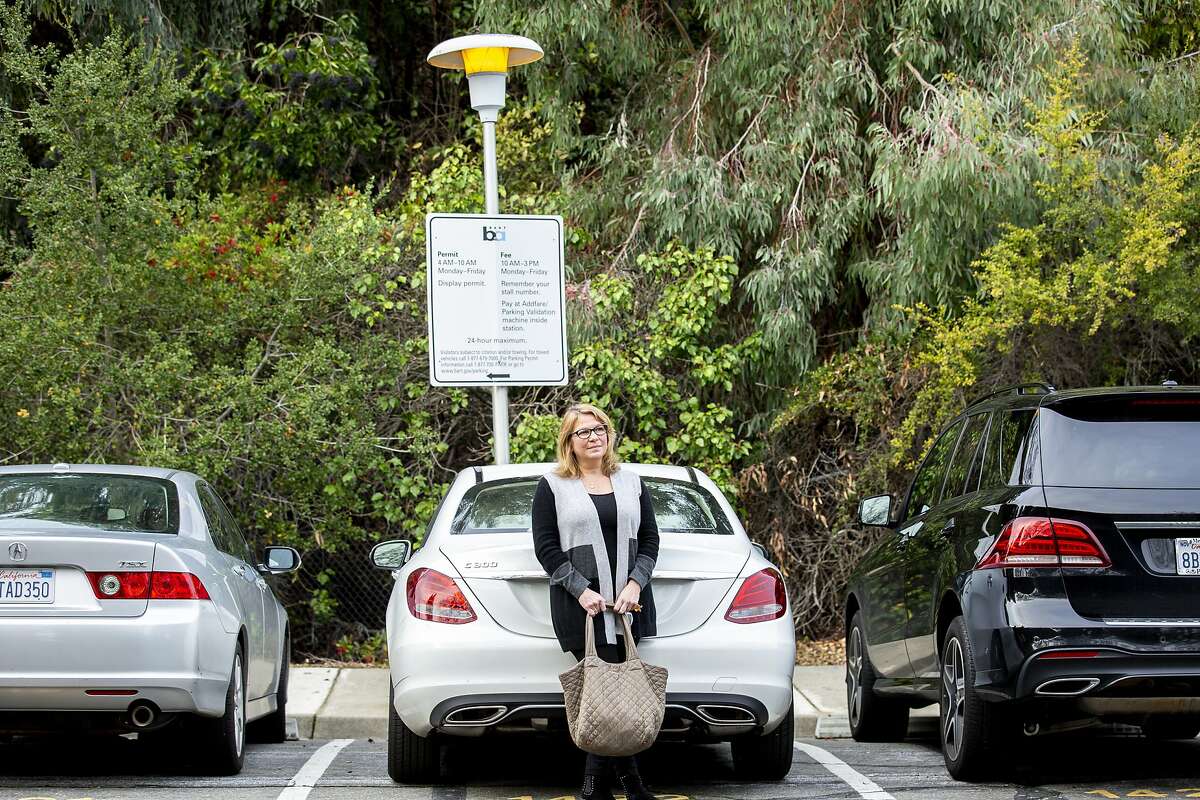
1of2Joy Hoffmann paid $2,220 cash for another BART rider’s permit to park in the Lafayette Station lot until she got a space in S.F.Photo: Santiago Mejia / The Chronicle
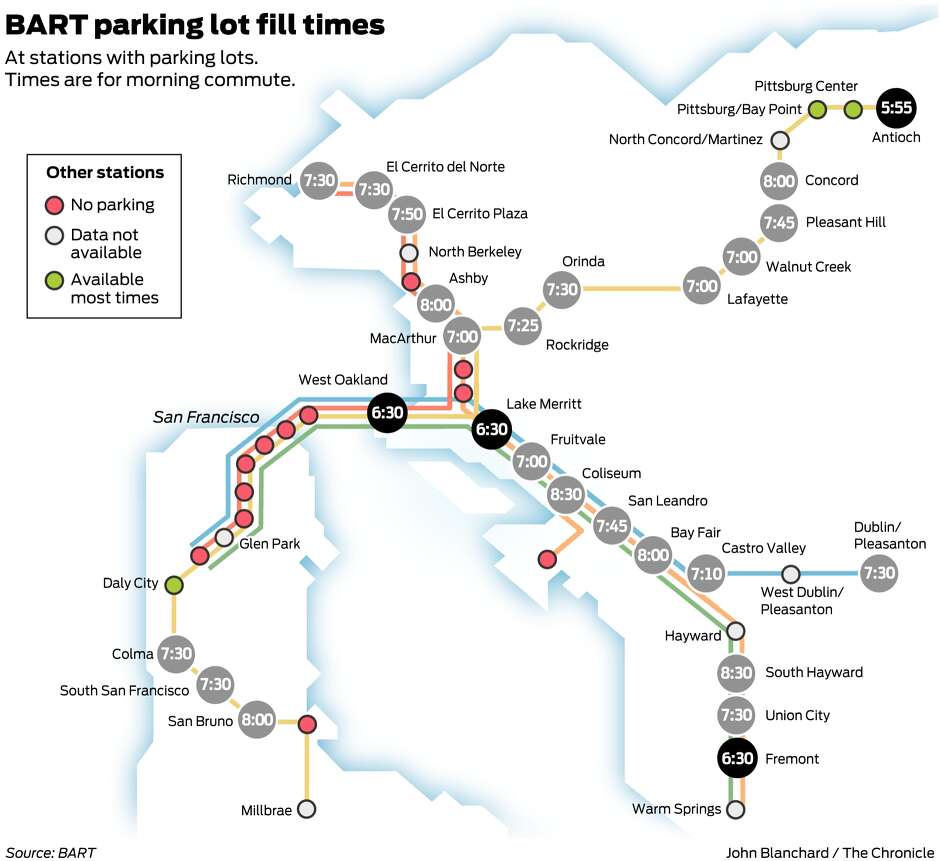
2of2The Lafayette BART Station parking lot fills early, as do most other lots in the system — 7 a.m. in this case, some even earlier.Photo: Santiago Mejia / The Chronicle

It was like a drug deal.


Once a year, Joy Hoffmann would arrive at a Safeway parking lot next to the Lafayette BART Station clutching a paper bag with $2,220 cash. A white car would be idling there, with a woman waiting inside. Hoffmann would furtively hand over the bag, and the woman would give her a plastic tag to hang in her car windshield: 12 months of permitted parking at BART.

“And then I’d be jumping up and down,” said Hoffmann, a financial worker in Moraga who rode BART for 20 years from Lafayette to downtown San Francisco. She paid a huge markup for the permit — $185 a month, compared with BART’s fee of $105 — but the price was worth it. Before she stumbled on the subletting scheme, Hoffmann was among thousands of commuters marooned on a waiting list that never seemed to budge.


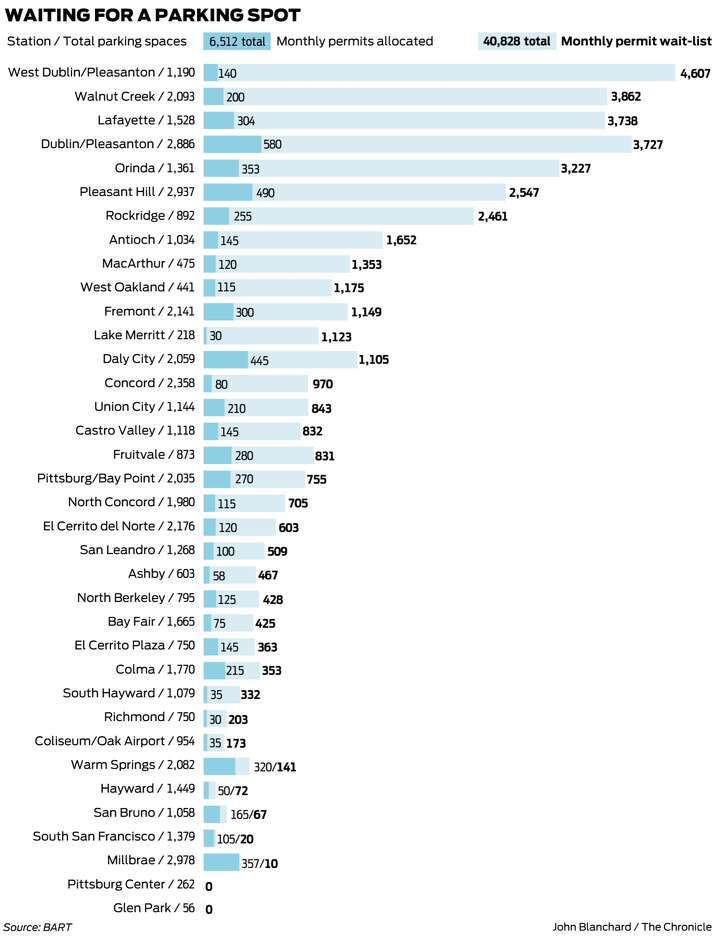
Today, the list of applicants is just shy of 41,000 people for 6,512 monthly parking spots scattered throughout the BART system. Board directors will discuss the crunch during an intensive two-day workshop that starts Thursday, where parking likely will emerge as a contentious issue.

“We’re seeing this shift to thinking about climate change, greenhouse gases, that we should eliminate cars,” said board Director Debora Allen. Her district spreads through the hills and flatlands of central Contra Costa County, where driving is essential to daily life.

The car-free vision works in San Francisco, which has robust alternatives to get from Point A to Point B, Allen said. But in suburban areas where housing is sprawled out and buses are scarce, commuters are out of luck.

BART’s numbers show that parking permit demand is highest in the suburbs. At West Dublin/Pleasanton Station, 4,607 people are lined up for 140 permitted spaces. Walnut Creek has 3,862 people jockeying for 200 monthly permit spots. And in Lafayette, 3,738 people linger on a wait-list for 304 monthly permits, at a station that draws commuters from as far away as Dixon and Davis (Yolo County).


Those conditions opened the door for gray market trading, which came as no surprise to some board directors, riders and city officials who are pressing for more parking. They say the situation will only get worse when BART starts filling its lots with housing under a state law enacted last year.

“BART could care less about parking,” said Lafayette Mayor Cameron Burks. He opposed the law, arguing that dense development at BART stations — without any requirement for a garage or parking structure — will only put more cars on the road. When people circle a parking lot and can’t find any space, they wind up on the freeway, Burks and others said.

BART also sets aside one-day permitted spots for people who reserve them in advance, and spaces for travelers seeking to stow their cars for several days. The vast majority of BART’s nearly 50,000 parking spaces are not reserved, and at most stations they fill up by 7:30 a.m. on weekdays.

After 10 a.m. anyone can park in permitted spots, which doesn’t help people who have to be at work hours earlier, Allen said.

The issue has created an ideological split among BART riders. Some cling to the concept that shaped BART back in 1972: suburban stations with vast parking lots that guaranteed a space for every commuter. But others see those lots as prime space for apartments, plazas and town houses — a form of urban design that would wean people off cars and reduce carbon emissions.


“If we stopped subsidizing housing for cars, we’d have enough money to subsidize housing for people,” said Jeffrey Tumlin, a principal at the San Francisco transportation consulting firm Nelson\Nygaard. “And then people wouldn’t need to drive.”

Fear of parking scarcity has made the monthly permits a valuable and sought-after commodity.

Lark Hilliard, who lives in Orinda and got a permit several years ago, said she still hangs on to it even though she no longer rides BART every day.

“I knew I’d never get it again,” she said.


That sentiment appears to be widespread. Permit turnover has been slow, said Bob Franklin, department manager of customer access and accessibility at BART. In December, he said, the agency issued just 136 permits, barely chipping away at its long queue. Anecdotally, people wait as long as two years to get a spot.

Subletting permits is against the rules, but that hasn’t stopped people from doing it. Since 2016, BART officials caught at least five permit holders who advertised on Craigslist or NextDoor, Franklin said.

“Other people on the wait-list see that and call it to our attention,” he said. “They don’t appreciate it.”

He also recalled three instances in the past three years of people putting fake parking placards in their windows.
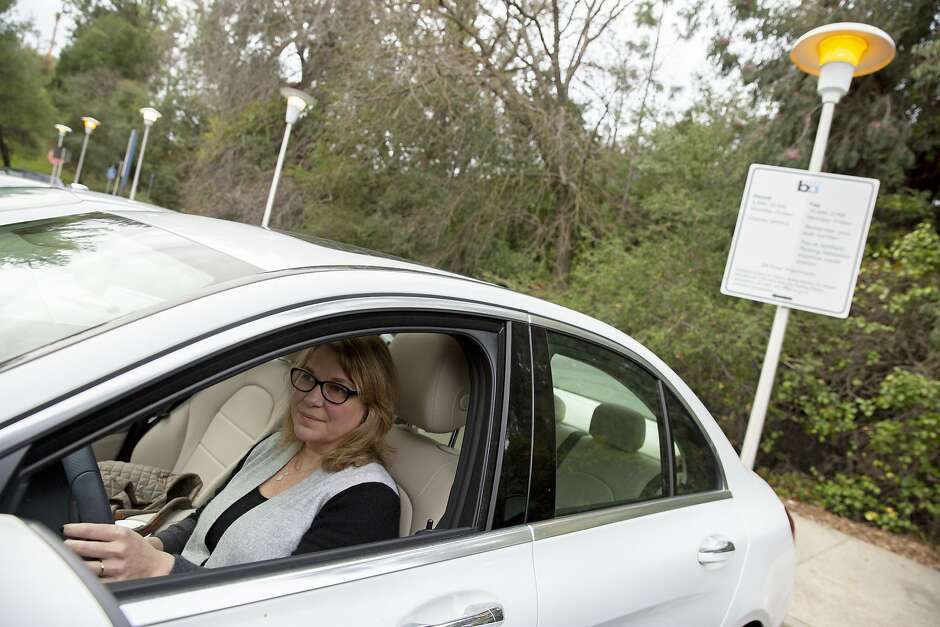
Joy Hoffmann at the Lafayette BART Station parking lot where she used to pay a premium to a permit holder for use of their tag.
Photo: Photos by Santiago Mejia / The Chronicle

Hoffmann said she found her dealer by posting a desperate plea on an internet discussion board. The exchange was somewhat complicated — besides paying cash in a paper bag, Hoffmann also had to give the woman her license plate number so it could be linked to the tag — but it worked for three years. Then, in 2017, Hoffmann snagged a parking space at a private lot through her job.

She urges BART to adopt a more equitable permit strategy, with incentives for people to give up their spaces.


“This is like people who sublet apartments in New York when they have rent control,” Hoffmann said. “It’s the same model.”

One solution that’s not on the table: more parking. BART doesn’t have land or money to build new structures or lots, which cost $20,000 to $30,000 a space. The planned surface lot at Antioch Station, scheduled to open next year with 850 spaces at a cost of $16.4 million, will likely be BART’s last parking expansion.


Instead, the agency will focus on modernizing its carpool program so that people who share a vehicle can be guaranteed a spot. Board directors will also discuss new enforcement tools, such as license plate readers, which could free up police while clamping down on underground trading.

Board Director Lateefah Simon, whose district stretches from Richmond to downtown San Francisco, said she gained a new perspective on suburban commuting last August, when she moved from West Oakland to North Richmond.

Simon doesn’t drive, so she takes Uber or Lyft to Richmond BART each morning.

“A bus to BART would take 45 minutes, and as a single mom with multiple jobs, I don’t have that kind of time,” Simon said. “I now understand in a different way the complexities of why people need a place to park.”

Rachel Swan is a San Francisco Chronicle staff writer. Email: rswan@sfchronicle.com

Friday, January 25, 2019

Payback is a b*tch. Rohnert Park de thrones Jake MacKenzie.

Jake McKenzie was passed over for nomination to the Sonoma County Transportation Commission and the SMART board. at the January 22, 2019 Rohnert Park City Council meeting.  Jake MacKenzie, long time council member and  chairman of the MTC CASA Compact committee shocked the community on 1/8/2019 when he approved the CASA compact which among other things could cost Rohnert Park 15 million dollars per year.   He did not inform his fellow board members during the two years of negotiations at MTC.  Although fellow council people tried to cover up their disappointment,  all agreed unanimously that he abused his responsibility to Rohert Park citizens. This marks the end of an era in Sonoma County regional politics for Jake MacKenzie even though he will still serve his term as director for MTC.


You may recall the councils negative reaction to Jake MacKenzie "forgetting" to regularly inform his board during the 2 years of negotiations of the CASA compact.  The council was very upset...


Wednesday, June 13, 2018

North Coast’s ‘Great Redwood Trail’ wins approval in California Senate, but lacks funding

North Coast’s ‘Great Redwood Trail’ wins approval in California Senate, but lacks funding

  
THE PRESS DEMOCRAT | June 9, 2018, 11:31PM

Imagine a 300-mile trail from San Francisco Bay to Humboldt Bay taking hikers, bicycle and horseback riders through a stunning North Coast river canyon and old growth redwood forests.
It would cost untold millions of dollars and won’t come soon, but the idea for what’s called the Great Redwood Trail is embodied in state Sen. Mike McGuire’s bill, which would also abolish a debt-ridden public agency and put commuter train operator Sonoma-Marin Area Rail Transit in charge of railroad freight service in its two counties.
SMART to take over Rail Service?  It is the taxpayers that are going to suffer.
The buzz is all about a trail along railroad tracks through some territory most people have never seen and which advocates are likening to the 210-mile John Muir Trail through the Sierra Nevada.
“It’s an amazing prospect,” said Alisha O’Loughlin, executive director of the 1,000-member Sonoma County Bicycle Coalition. “Something we’re very enthusiastic about.”
The trail, affording “gorgeous recreational opportunities,” would draw cyclists and equestrians from far and wide, she said.
The coalition’s only concern is that work on the trail not take priority over completion of pathways along the 70-mile SMART corridor in Sonoma and Marin counties. Just 16 miles of pathways have been built to date in segments from Healdsburg to San Rafael.
Caryl Hart, the former Sonoma County Regional Parks director and past chairwoman of the state Parks and Recreation Commission, said the proposed trail runs through “some of the most spectacular landscapes in the world.”
North of Willits, the trail would adjoin unused tracks through the 50-mile Eel River Canyon, a remote, pristine area rich in wildlife with few public access points.
Following the designated wild and scenic river as it snakes toward the ocean near Arcata, the trail would pass by the Redwood National and State Parks in Humboldt County, including visitor favorite Founders’ Grove.
“This is a once-in-a-lifetime opportunity,” said McGuire, a Healdsburg Democrat whose district spans the North Coast from Marin County to the Oregon border.
His bill, SB 1029, zipped through three committees and final Senate approval, which came on May 30, without a single no vote.
Even the two Republican members of the Senate Appropriations Committee supported the trail bill — with cost estimates running into the hundreds of millions of dollars — most likely because there was no actual spending included.
Behind the lure of creating a world-class outdoor experience, the bill addresses the matter of an obscure public agency created in 1989 to preserve the North Coast freight rail line and oversee service. It operates on revenue of about $500,000 a year, primarily from property and equipment leases, but loses about $250,000 a year. In the absence of state funding, it has amassed a debt of about $9.5 million.
The bill would dissolve the Ukiah-based North Coast Railroad Authority, which has been faulted by its own auditor and the California Transportation Commission as a financial failure, leaving the state to resolve the debt.
Moving forward, creation of the Great Redwood Trail would require millions of dollars worth of studies, track improvements and maintenance and ultimately “very major” costs, “potentially in the hundreds of millions,” to build and operate the trail and rail line, according to a Senate committee analysis.
McGuire said $4 million has been earmarked in the Senate’s budget proposal for rail crossing repairs and the start of a right-of-way study and trail master plan — and nothing more.
But he is resolute about the need to abolish NCRA, deal with its “suffocating debt” and proceed with the trail, steps that have support from 21 organizations, including the state transportation commission, Sonoma County Regional Parks and a host of environmental groups.
“We know it’s a multiyear process,” McGuire said. “We’ve always known we couldn’t snap our fingers and clean up this financial mess in one year.”
NCRA has only two full-time employees — the executive director and his assistant — and four contract employees. Its payroll spending accounts for about half its operating budget.
Its persistent losses and excess liabilities were cited in an independent auditor’s report in 2016.
“This raises substantial doubt about NCRA’s ability to continue as a going concern,” the report by the Napa firm Pisenti & Brinker said.
The transportation commission said in a December report to state lawmakers that NCRA had failed to develop a plan “that makes the business case for its existence,” noting that it also is “routinely unable to pay its obligations.”
Hart, an Occidental resident who is also a new member of the NCRA board of directors, made the motion to give McGuire’s bill a qualified endorsement at her first meeting in March. It was unanimously approved.
“This isn’t an either-or proposition,” she said. “This is a ‘you-have-to-do-something issue.’ ”
Allowing the NCRA to go bankrupt and still have to pay its debts, along with abandoning the railroad right of way, is “not an option,” she said.
Nor would environmental groups, such as Friends of the Eel River, tolerate harm to the river from ruined rails collapsing into the water, Hart said.
There is no intention to restore freight train operations through the river canyon, where estimates of the cost of repairing the storm and slide-damaged line run as high as $1 billion.
California voters have consistently supported parks and waterways, Hart said, pointing to Tuesday’s 56 percent approval of Proposition 68, which authorized $4 billion in state bonds for parks and natural resources protection.
The November ballot will include a proposed $8.9 billion bond that earmarks $2.4 billion for parks and conservancies to restore and protect watershed lands.
Hart contends that bond measures, state funding and private philanthropy can ultimately pay for the trail, which supporters say could provide a sorely needed economic boost to the North Coast.
McGuire’s bill would abolish the NCRA and transfer management of the rail line’s northern segment, from Willits to Arcata, to a new public entity called the Great Redwood Trail Agency by July 2019.
The line south of Willits would be transferred by April 2019 to SMART, which began operating commuter train service from near the Sonoma County Airport to San Rafael in August.
SMART would be required to conduct a study of rail freight service south of Willits, create or assign the positions of trail manager and freight rail manager and submit annual reports to the Legislature.
McGuire noted that SMART’s original mandate was to “advance both rail and trail,” as well as passenger service.
“They can take on freight service,” he said, adding that freight holds “revenue potential” for SMART.
Debora Fudge, chairwoman of the SMART board of directors, said the organization supports McGuire’s bill.
“It makes sense to us that one agency manages both passenger and freight rail,” she said. “SMART understands that freight is important to some businesses in Sonoma County.”
Asked if SMART might consider a new approach to freight operations, she said the board has put off that discussion until the bill becomes law.
Northwestern Pacific, a private company, operates nighttime freight trains two or three times a week between Napa and Windsor, partly on tracks it shares with SMART.
Doug Bosco, an NWP co-owner, said the company has 88 years remaining on a 2006 contract with NCRA. If the state were to deprive NWP of any contract benefits, the state Constitution would require compensation to the company, Bosco said.
In addition, NWP, the line’s sole freight operator, has “a right and an obligation” to serve its customers under a license from the federal Department of Transportation, he said.
Bosco said he “totally favors” the trail “but we are going to have to work the railroad into that.” The railroad is profitable, he has said, declining to cite recent annual revenues.
Bosco is a former North Coast congressman and an investor in Sonoma Media Investments, which owns The Press Democrat.
McGuire said that NWP representatives have been “active and engaged” in discussions of the freight operator’s future in the event NCRA is abolished. Among the issues to be resolved is the $4.4 million NCRA owes to NWP, accounting for nearly half of the agency’s debt, McGuire said.
The contract, scorned by critics of the close ties between NCRA and NWP, allows the freight operator to pay nothing for use of the rail line until it earns more than $5 million a year, which has never happened. Freight operations were restored in 2011.
Bosco and NCRA officials have agreed it is time to renegotiate the contract.
Senate approval of McGuire’s bill came on a bipartisan 36-0 vote and the measure now moves to the Assembly.
You can reach Staff Writer Guy Kovner at 707-521-5457 or guy.kovner@pressdemocrat.com. On Twitter @guykovner.

Thursday, November 30, 2017

The great transit rip-off

The great transit rip-off


AP Photo/Jae C. HongIn this Saturday, May 16, 2015 photo, A Metro Expo Line train travels as traffic builds up on the 110 freeway in Los Angeles.

By JOEL KOTKIN and WENDELL COX | Orange County Register
PUBLISHED: August 27, 2017 at 12:06 am | UPDATED: August 27, 2017 at 8:42 am


Over the past decade, there has been a growing fixation among planners and developers alike for a return to the last century’s monocentric cities served by large-scale train systems. And, to be sure, in a handful of older urban regions, mass transit continues to play an important — and even vital — role in getting commuters to downtown jobs. Overall, a remarkable 40 percent of all transit commuting in the United States takes place in the New York metropolitan area — and just six municipalities make up 55 percent of all transit commuting destinations.

But here’s an overlooked fact: Transit now serves about the same number of riders as it did in 1907, when the urban population was barely 15 percent of what it is today. Most urban regions, such as Southern California, are nothing like New York — and they never will be. Downtown Los Angeles may be a better place in which to hang out and eat than in the past, but it sorely lacks the magnetic appeal of a place like Manhattan, or even downtown San Francisco. Manhattan, the world’s second-largest employment center, represents a little more than 20 percent of the New York metropolitan area’s employment. In Los Angeles, by contrast, the downtown area employs just 2 percent.

Transit is failing in Southern California


As we demonstrate in a new report for Chapman University, our urban form does not work well for conventional mass transit. Too many people go to too many locales to work, and, as housing prices have surged, many have moved farther way, which makes trains less practical, given the lack of a dominant job center. But in its desire to emulate places like New York, Los Angeles has spent some $15 billion trying to evolve into what some East Coast enthusiasts call the “next great transit city.”

The rail lines have earned Mayor Eric Garcetti almost endless plaudits from places like the New York Times. Yet, since 1990, transit’s work trip market share has dropped from 5.6 percent to 5.1 percent. MTA system ridership stands at least 15 percent below 1985 levels, when there was only bus service, and the population of Los Angeles County was about 20 percent lower. In some places, like Orange County, the fall has been even more precipitous, down 30 percent since 2008. It is no surprise, then, that, according to a recent USC study, the new lines have done little or nothing to lessen congestion.

This experience is not limited to L.A. Most of the 19 metropolitan areas with new mass transit rail systems — including big cities like Atlanta, Houston, Dallas and even Portland, Ore. — have experienced a decline in transit market share since the systems began operations.

Transit as social engineering

To achieve their transit goals, boosters in Southern California and other wannabe metros need to “elect a new people,” to paraphrase German Communist playwright Bertolt Brecht. Desperate to force commuters onto trains, they feel compelled to foster a dense, “pack and stack” housing pattern that they feel might better fit the needs of expanding transit agencies.

Virtually all housing development proposals are required to be “transit-oriented,” which seems bizarre, given the sector’s declining market share. Meanwhile, poor people get degraded local bus service and ever-higher gas prices to accommodate a supposed surge of wealthier potential transit riders. This won’t help them find jobs, either. In the Los Angeles metropolitan area, for a commute of 30 minutes or less, the average employee is within 60 times as many jobs by car as by transit.


Are there alternatives?

Rather than try to re-engineer the region, perhaps we should seek mobility solutions that can work. Building new rail lines — and, and even more absurdly, trolleys, which average a pathetic 8 miles per hour — will do nothing relieve traffic. More densification can be expected only to worsen congestion.

Arguably, the most promising step would be to encourage work at home. There are already more people working at home than transit riders in Southern California. Since 1990, home office use increased by eight times that of transit use, with virtually no public expenditure. Home-based workers, needless to say, do not receive subsidies.

Ride-hailing services such as Uber and Lyft, cited as a factor in the recent ridership declines in Los Angeles — and even New York — can also provide cost-effective solutions. Already, one local transit operator in suburban San Francisco has established a one-year pilot program to extend local transit service through ride-hailing, and canceled a lightly patronized bus route, reducing costs while providing quicker door-to-door service.

Furthermore, rapidly evolving autonomous technologies could speed up traffic along freeways. They may take time to gain widespread acceptance, but are likely to be in place well before the much-ballyhooed “build-out” of the Los Angeles rail system, which, in any case, cannot make transit commuting remotely competitive with the car, except, perhaps, for very few. Under any circumstance, autonomous technology seems likely to further weaken conventional transit.

Southern Californians need to demand transportation policies that accommodate them, not those that merely acquiesce to the urbanist fantasies of planners, politicians and developers. Decision-makers need to both embrace our geography and economic form and look for 21st-century solutions to 21st-century problems.

Joel Kotkin is the R.C. Hobbs Presidential Fellow in Urban Futures at Chapman University in Orange and executive director of the Houston-based Center for Opportunity Urbanism (www.opportunityurbanism.org). Wendell Cox is principal of Demographia, a St. Louis-based public policy firm, and was appointed to three terms on the Los Angeles County Transportation Commission.

Friday, April 21, 2017

A warning about the SMART train from the California Public Utilities Commission


Full Meeting segment below

Director mistakenly congratulates SMART for "converting to electricity" which is of course, false.  He was referring to the proposal by CalTrain on the San Mateo peninsula to electrify.  Also, his praise of SMART is wholly unfounded. SMART has been plagued with landslides, faulty engines,  crossing controls, engineering challenges and budget over runs.

We pay these folks hundreds of thousands of dollars to mismanage the tax payers funds.  Buses are ONE HUNDRED times less expensive.

Tuesday, April 4, 2017

SMART construction crews shoring up Landslide in San Rafael 4/3/2017


Tons of Soil slide onto SMART train tracks in January 2017 and SMART officials kept the disaster hid from the public until it was reported by the Marin IJ on 4/3/2017 based on a tip from the neighbor.  The SMART train has had disaster,  technical problems with Signalling,  Train Engine defects and more.  This latest cover up is no surprise to Citizen watchdogs.  The next fiasco involves moving the San Rafael bus terminal and extending the track to Larkspur.  The cost over runs have been enormous and the plans have been scaled back from the project voted for.  If a referendum were taken today,  SMART would lose.

Sunday, April 2, 2017

COVER UP!: SMART train halted by Landslide for Several Week!

The SMART train has not been operating for several weeks due to a landslide at Lincoln Hill.

What is other problems is SMART trying to hide?  Funding shortfalls?  Mechanical failures? Budget Overruns?   Can we TRUST the SMART Management and BOARD to tell us the TRUTH?

The "SMART" train is looking very dumb


Monday, March 13, 2017

San Rafael SMART station workshop 3/8/2017


San Rafael SMART station workshop on March 8, 2017.  The SMART train board wants to demolish the Bettini Bus Terminal to make way for the track to Larkspur.  This terminal serves 9000 passengers daily while the train is expected to serve several hundred at most.  The cost to the public is enormous in relocation costs, inconvenience and more traffic.  Virtually every private citizen who spoke was against the plan.

Monday, February 6, 2017

San Rafael wants a delay in SMART trains to Larkspur

San Rafael wants a delay in SMART trains to Larkspur

Mayor Gary Phillips raised issues about traffic impacts to downtown San Rafael if SMART trains continue to Larkspur as planned. (Robert Tong/Marin Independent Journal)
Mayor Gary Phillips raised issues about traffic impacts to downtown San Rafael if SMART trains continue to Larkspur as planned. (Robert Tong/Marin Independent Journal) 
A SMART train sits at the end of the line in San Rafael. (Robert Tong/Marin Independent Journal)
A SMART train sits at the end of the line in San Rafael. (Robert Tong/Marin Independent Journal) 
Citing traffic concerns, the mayor of San Rafael is requesting the Sonoma-Marin Area Rail Transit system halt plans to extend trains to Larkspur until a new downtown transit center can be built — a project that is at least five years away.
The letter from Mayor Gary Phillips and City Manager Jim Schutz to SMART General Manager Farhad Mansourian raises issues about traffic impacts to downtown San Rafael if trains continue to Larkspur as planned.
“We understand fully the value of people coming to San Rafael on SMART, but it does not appear there will be many people going to Larkspur,” Phillips said Friday. “It would benefit a few riders, but to the detriment of many.”
The SMART plan has trains crossing busy Second and Third streets then going through the Bettini Transit Center, which sees 9,000 passengers a day, to get to Larkspur. Phillips fears trains crossing those streets will serve to back up traffic not only downtown, but on nearby Highway 101 off and on-ramps.
In addition, in order to accommodate trains passing through the transit center, bus stops will move to the perimeter of the facility, creating more traffic problems, the city believes. The San Rafael to Santa Rosa rail segment is scheduled to begin operation later this year.
In December 2015, SMART officials announced the agency was in line to receive funding to extend the commuter rail service to Larkspur, with construction starting as soon as this summer and service starting next year.
Now the city wants to put the brakes on that plan and instead wait until a site for a new permanent transit center is found and funding available. A new transit center — which could more easily accommodate bus and train service — would cost between $32 million and $42 million, according to preliminary estimates. Funding has not been identified. See Full Article HERE

Letter from San Rafael to SMART

Text Box: xa, RA .,4 Text Box: ‘91". Text Box: zText Box: 0Text Box: WITH „January 23, 2017
Farhad Mansourian, General Manager
Sonoma-Marin Area Rail Transit District
5401 Old Redwood Hwy., 2nd Floor
Petaluma, CA 94954
Dear Farhad
The City of San Rafael has many policies in our General Plan and other planning documents that encourage the expansion of regional transit by the Sonoma-Marin Area Rail Transit (SMART). The City has appreciated our productive working relationship with SMART and the other transit agencies in the development of our Station Area Plan, Transit Center Relocation Study, and many other efforts.
Our work to date has demonstrated clearly the significant impacts of SMART particularly on downtown San Rafael. While the impacts of the Initial Operating Segment are significant, there are severe impacts on this important downtown gateway area due to the Larkspur Extension. The tracks bifurcate and will require the relocation of the Bettini Transit Center, which serves approximately 9,000 riders per day, and are less than a block away from the north and south bound ramps of US-101. The area is the center of both a major north-south and east-west corridor. When the tracks cross Second and Third Streets, a three to four lane, one-way, major arterial couplet, tens of thousands of vehicles per day will be impacted.
San Rafael has been preparing for this project as expeditiously as possible, such as:
·         We invested approximately $4.5 million in City funds and an additional $1.9 million in
grant funds in traffic signal SMART coordination and accessibility improvements.
·         We are in the process of applying to the CPUC to allow the at-grade crossing at Andersen Drive, estimated to cost the City an additional $4-5 million and expected to take six months to more than a year for approval.
·         We recently approved the contract for the environmental and design work for the Multi-Use Path along the SMART tracks from Second Street to Andersen Drive, estimated to cost approximately $3-4 million (no construction funding secured).
·         We partnered with SMART and the transit agencies on the Station Area Plan and the Transit Center Relocation Study. The latter estimated the Interim Transit Center as costing approximately $3.2 million (funding secured) and the Permanent Transit Center as costing between $22-32 million (no construction funding secured).
·         We have begun discussions with SMART on agreements related to Quiet Zone maintenance, the W. Francisco Blvd. "Flip," Andersen Drive, and other issues.
·         We have been awaiting the required MOU between the Golden Gate District and SMART regarding the Transit Center so that we may understand the impacts that may arise from that agreement.
·         We are working with SMART staff to clarify Right-Of-Way ownership through the downtown gateway area.
CITY OF SAN RAFAEL 11400 FIFTH AVENUE, SAN RAFAEL, CALIFORNIA 94901 CITYOFSANRAFAEL.ORG
Gary 0 Phillips, Mayor Maribeth Bushey, Vice Mayor • Kate Colin, Councilmember John Gamblin, Councilmember Andrew Cuyugan McCullough, Councilmember

SMART's current schedule to begin construction of the Larkspur Extension in Summer 2017 (estimated completion at the end of 2018) would require that the City of San Rafael either: 1) approve an Interim Transit Center allowing buses, taxis, and other ride sharing vehicles to use city streets for their operations — thus impacting traffic congestion, pedestrian safety, and reducing the already very limited parking, or 2) decline to approve an Interim Transit Center which would result in the elimination of bus service to thousands of riders per day.
As mentioned above, our local policies and planning documents support the SMART train and pathway. We feel SMART would be more successful if the negative impacts on bus transit riders and vehicular trips are minimized, which can be done through the creation of a Permanent Transit Center and through minimizing or eliminating the need for an Interim Transit Center that uses City streets.
The selection of a Permanent Transit Center is underway, and Golden Gate Transit will soon be releasing a Request for Proposals to begin an environmental review process to analyze final alternatives. As a consultant has not been selected yet, there is no timeline for completion, but similar processes have taken in the range of one to two years. Possible construction funding mechanisms that have been mentioned include one or a combination of: a potential Regional Measure 3 ballot measure, a potential TAM sales tax increase, a potential future SMART reauthorization, and Cap and Trade funds. Each would require considerable further exploration and approvals outside of the control of the City of San Rafael.
The City's concern is that SMART's current schedule necessitates an Interim Transit Center in advance of the selection of a site and the funding for a Permanent Transit Center. The City of San Rafael therefore respectfully requests that the SMART Board of Directors add an item to your February 1 agenda to consider modification of SMART's current schedule so that the construction of the Larkspur Extension does not begin until such time that a final site of the Permanent Transit Center in downtown San Rafael is agreed upon (by the City and transit agencies) and funding to construct the Permanent Transit Center has been obtained.
Thank you for your consideration of this request and we await your response.
Gary Philips, 
Mayor
City of San Rafael


Monday, November 28, 2016

Dick Spotswood: Kinsey’s new job a sign of the revolving door


Dick Spotswood: Kinsey’s new job a sign of the revolving door


Dick Spotswood, seen on Tuesday, Jan. 05, 2016, in San Rafael, Calif. (Frankie Frost/Marin Independent Journal)
Dick Spotswood, seen on Tuesday, Jan. 05, 2016, in San Rafael, Calif. (Frankie Frost/Marin Independent Journal) 

The revolving door is in full motion. Supervisor Steve Kinsey will retire from the Board of Supervisors in five weeks. His next job will be using contacts he’s made with county government, the Metropolitan Transportation Commission and California’s Coastal Commission.
In Marin Magazine, Kinsey is quoted, “Eventually what I want to do is be involved as a consultant at the local or regional level in strengthening community, either in the field of transportation or working to achieve equity in various aspects of contemporary life.” Kinsey promptly pursued his goal by snagging a $50,000 contract with the city of San Rafael to help guide the city in joint efforts with SMART to relocate the C. Paul Bettini bus depot so it’s compatible with the city’s new rail station.
It’s not that Kinsey, 63, lacks private-sector skills. He was a successful San Geronimo Valley designer-builder when he was first elected to the board 20 years ago.
Kinsey was a good supervisor. There’s never been a whiff of financial scandal about him. Perhaps his contract with San Rafael will be a one-off arrangement.
In justification, Kinsey pointed out to me that his Mission City contract is consulting with a public agency, not working as a private-sector advocate.
It’s still a problem given Kinsey’s role as a reliable supporter of MTC’s management led by top honcho Steve Heminger.
Now that the five-term supervisor will be “interfacing” with MTC as a consultant, the issues of cronyism naturally will arise.
Ditto for the Coastal Commission where Kinsey, along with a few other commissioners, remains under a cloud. The Los Angeles Times reported that a handful of appointees, including Kinsey, had failed to publicly disclose ex-officio communications with entities coming before the coastal land use authority.
The revolving-door phenomenon, so prevalent in Washington, D.C., also encourages See Article HERE.

Monday, March 21, 2016

Like it or not, There is a Train coming to town!


.whether you like it or not. Gridlock in San Rafael; demolished transit center; Anderson Drive eliminated???; bike and pedestrian path??? There's a train coming to town!

Monday, December 7, 2015

MTC No Money for SMART train because of Questionable Statistics.


May 13, 2015 meeting of the MTC Regional Advisory Board of San Francisco explains why the SMART train in the North Bay won't be receiving funds because of questionable ridership projections. 

MTC staff ran the math and realized SMART were peddling Greenhouse Gas reductions based on ridership assuming:
- every train was packed full (with as many standing as could fit)
- they were packed the length of the line
- all 22 trains per day were packed

Essentially the MTC is calling them liars because they use train capacity vs. realistic ridership projections.  The "train to nowhere" is along a sparsely populated corridor with few businesses to support large movements of people.  Commuter rail is only economically feasible in highly dense urban corridors like New York City.  

But they have a billion dollars of our Cap and Trade tax money to spend.....

Very informative clip on the real politics at the MTC and Plan Bay Area.  

We must Save Marin Again!