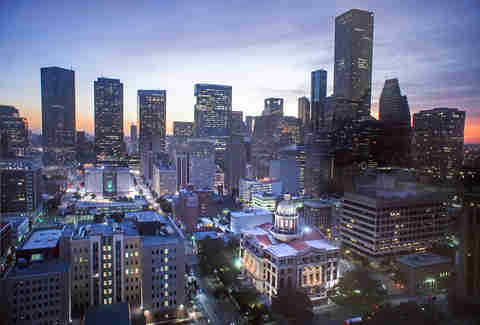
How Spontaneous Order Keeps Houston Affordable
A metropolitan economy, if it is working well, is constantly transforming many poor people into middle-class people, many illiterates into skilled people, many greenhorns into competent citizens. … Cities don’t lure the middle class. They create it.
– Jane Jacobs, The Death and Life of Great American Cities
If you follow urban issues in the press, you might be forgiven for thinking that there are only three cities in America: San Francisco, New York, and Portland. All three are victims of their own success, as rising demand for housing has increased rents to unsustainable levels. Despite their best efforts, from rent control to doublespeak “inclusionary zoning” mandates, middle- and lower-class households are increasingly forced to leave these cities as each progressively transforms into a playground of the rich.
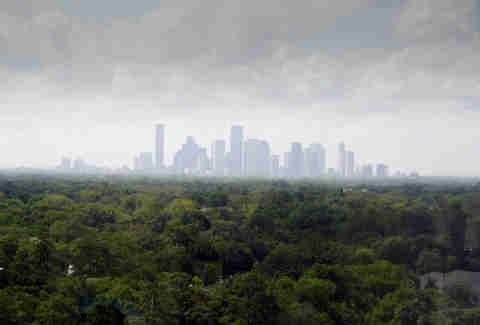
Yet there is a fourth city, a city which must not be named except to be derided as a sprawling, suburban hellscape. This fourth city has managed to balance a booming economy, explosive population growth, and affordable housing. This city has—as cities have for thousands of years—steadily grown denser, more walkable, and more attractive to low-income migrants seeking opportunity. This city is Houston, and it’s well past time for her to come out of the shadows.
Explosive Economic Growth, Booming Population, Functioning Housing Market
Before jumping into the nitty-gritty of how Houston has handled explosive growth in the demand for housing, it is worth first getting a handle on the magnitude of the challenge facing the city. When many people think of the Houston economy, they understandably think of large energy companies. Indeed, energy companies dominated Houston’s economy for much of the last century and continue to play a major role today. But in the years following the 1980s oil glut, Houston’s economy has been diversified in large part by startups and emerging small businesses. Mixing the Lone Star State’s
light regulatory touch with the inherently entrepreneurial spirit of domestic and international migrants, Houston and other Texas cities have shot to the top of entrepreneurship rankings like the
Kauffman Index. These entrepreneurs aren’t just wealthy oil barons in bolo ties either; Houston ranks high among cities in creating brand new entrepreneurs, well above cities like Portland and New York City.
Almost like an Econ 101 practice problem, booming demand for labor at all skill levels has translated into wage growth in Houston.
Supplementing this healthy, emergent economic development has been a
deluge of existing companies arriving in Texas from high tax, high regulation states like California and Illinois. Between 2008 and 2014 alone, 219 California companies moved to or expanded in Texas. Houston’s high number of engineers per capita and affordable energy have
attracted manufacturing in particular, turning the city into the third largest manufacturing hub in the country.
Almost like an Econ 101 practice problem, booming demand for labor at all skill levels has translated into
wage growth in Houston comparable to affluent cities like San Jose, Boston, and New York. Adjusting average annual wages for the cost of living, including consumer prices and services, utilities, transportation costs, and—most importantly—housing,
Houston tops the list of all major US metropolitan areas. This shouldn’t be written off as torturing the numbers, either. This means middle- and lower-class Houstonians enjoy a higher standard of living than even their higher paid counterparts in high-cost cities on the West Cost and in the Northeast.
This blend of good governance, high real wages, and an urban ethos described by researchers at the Kinder Institute for Urban Research at Rice University as
“tolerant traditionalism”—an attractive mix of conservative personal values and toleration on social issues—has attracted hundreds of thousands of new residents over the past two decades. From 2014 to 2015 alone, the Houston metropolitan area welcomed
159,083 new residents, far more than any other city outside of Texas. The city is projected to
pass up Chicago by 2025, bumping America’s “Second City” from third to fourth largest in the country. Ample opportunities for new immigrants from across Latin America and Asia have transformed the city into one of America’s most diverse metros, offering a glimpse of
America’s dynamic demographic future. Houston has also grown into a magnet for domestic migration. Since 2010, the city has welcomed
nearly 100,000 black residents fleeing untenable rents along the West Coast and economic stagnation in the Midwest in what some are calling the “Third Great Migration.”
Even while experiencing much milder population growth, cities along the coasts have struggled to get a handle on exploding housing costs. Between January 2014 and January 2016, median home values in Portland, San Francisco, and New York City increased by an average of approximately $188,000. During the same period, in which Houston experienced a population boom far outpacing any other city in absolute terms, the
median home value in Houston increased by approximately $9,000. Even expanding out to account for a recent downturn in oil markets, the median home values only increased by $28,000 between January 2012 and January 2016. It’s not just houses either; even beyond luxury cities along the East and West coasts, Houston remains one of the
most affordable Sun Belt cities for renters. So what gives?
The Fruits of Market Urbanism
Houston’s remarkable affordability might seem strange to policymakers in high-cost cities along the East and West coasts. After all, the city has no rent control, whether of the now-discredited twentieth century kind or the new, shiny,
equally counterproductive “inclusionary zoning” kind. Houston has
less public and subsidized housing than the other top five major US metros. The fact is that Houston’s affordability doesn’t flow from top-down plans or strict land-use regulations. Rather, its affordability flows precisely from its lack of top-down plans or strict land-use regulations.
A growing
consensus of
economists and policymakers have argued for permitting more development in order to meet rising demand for urban living. The challenge facing high-cost cities is not their remarkable economic success and the subsequent rise in demand for housing—this is precisely the kind of success cities should yearn for—but their ongoing commitment to an out-of-date planning regime designed to keep cities frozen in amber. In its most extreme form, cities like San Francisco continue to enforce startlingly low densities in and around downtown despite burgeoning demand. Yet even in comparable Sun Belt cities friendly to new development, including Atlanta, Dallas, and Phoenix, much of the city is zoned and regulated in a way that effectively mandates low densities and prohibits urban, mixed-use development.


The kind of unpredictable diversity that calls to mind Jane Jacobs’ Hudson Street: a TV station and a US Secret Service office nestled among a beautiful neighborhood mixing single-family homes and apartments. (Google Maps)
Where nearly every other city attempts to tightly control emergent urban growth and restrict the mixing of urban uses, Houston has adopted what
Justin Fox of Bloomberg View recently described as “zoning lite.” As researchers at
the Wharton School have pointed out, Houston has some of the least restrictive land-use regulations in the country. Houston never adopted the bundle of orthodox urban planning policies that made spontaneous urban development impossible, and insomuch as Houston implemented land-use regulation, many of these rules have been liberalized in recent years. The city famously never implemented use-based zoning, a policy that mandates the separation of residential, commercial, and industrial activity, and effectively bans traditional urban development and forces automobile dependence on residents. This means that urban land in Houston can naturally shift alongside changing market demands, enhancing the flexibility of housing markets and empowering residents and business owners to collectively determine the right mix of uses in a decentralized process.

 Gradual densification underway in Uptown, far from the 20th century downtown. Without parking requirements, it’s unlikely lots and garages would take up so much space. (Google Maps)
Houston has also benefited from a liberal approach to urban density, which was kicked into high gear by reforms in 1998. Nearly two decades ago, Houston policymakers dramatically eased density controls within the 610 loop, breaking the city down into “urban” and “suburban” classifications. In urban areas, regulations controlling lot coverage, setbacks, and height limits were significantly liberalized and in some cases eliminated altogether. The most visible result of this hands-off approach to land-use regulation has been the proliferation of
high-rise developments both in downtown and the mini-downtowns scattered in and around Harris County. Yet possibly more important are the coveted
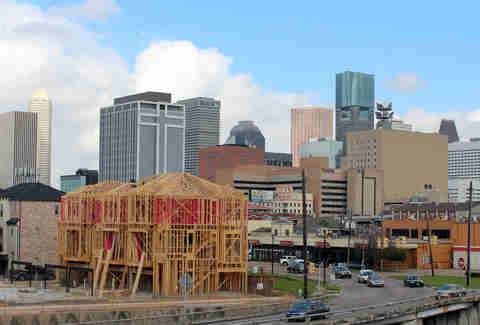
“missing middle” developments underway across the city. Ranging from duplexes to live-work units, these developments offer an attractive compromise between the walkability of high-density environments and the human scale of low-density developments. Such developments, alongside innumerable apartment and mixed-use developments, are helping to keep desirable neighborhoods like Montrose, Midtown, and the Heights accessible to normal Houstonians. This explosion in medium-density, infill developments has turned Houston into
a national leader in new multifamily units, creating a greater diversity of housing options than nearly every other Sun Belt city. These developments are helping to preserve and expand access to urban living in Houston, and they’re possible thanks in large part to the city’s lack of centralized urban planning and relatively light regulation of land-use.
 New “missing middle” development within biking distance of downtown. (Google Maps)
The fruits of Houston’s unique approach to urbanization are also evident in the city’s lack of interest in aesthetic control. While many cities require design or aesthetics-oriented architecture reviews for most developments to take place, Houston places
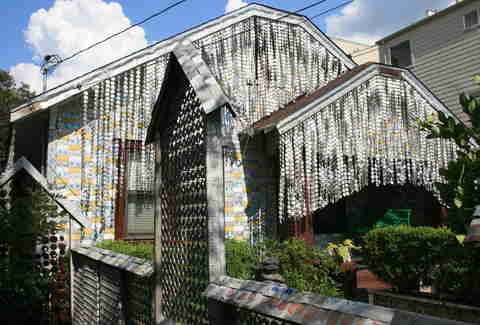
no such burdens on new building. This live-and-let-live approach to urban development gives residents, developers, and business owners the freedom to experiment with new designs. The result is a kind of “tolerant traditionalism” physically manifested, as architectural styles playfully mix within neighborhoods. A stressful experience, perhaps, for the orthodox planner who prefers conformity and order, but an exhilarating experience for residents who appreciate the spontaneity and novelty offered by urban life.
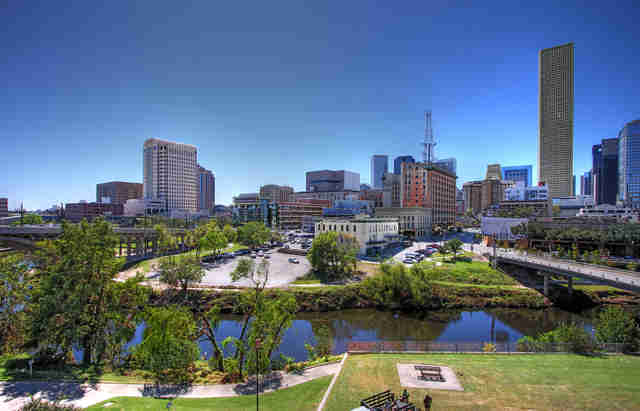
Beyond allowing diverse and exciting streetscapes, Houston’s lack of design-oriented, top-down planning has allowed the emergence of multiple urban centers. Where many US planners continue to plan cities around an industrial era model of one urban center—typically a twentieth century downtown—Houston enjoys multiple downtowns. In
Metropolitan Revolution, researchers Bruce Katz and Jennifer Bradley describe how Houston’s lack of centralized planning has allowed the gradual development and densification of distinct urban centers. As Katz and Bradley describe in the book, urban centers like Gulfton and Pasadena gradually developed from low-density neighborhoods optimized for middle-class whites into mixed-use, medium-density neighborhoods optimized for newly arriving immigrants. Where the conventional planning regime that controls most US cities would have required hundreds of hours of hearings, committees, and paperwork, Houston’s liberal approach allows communities to organically change and adapt to shifting community needs.
 The magic of toleration manifests itself physically in odd neighbors on W Mckinney Street: Intriguing, unconventional townhouses sit next to… (Google Maps)
 …a beautiful, conventional single-family home. Houston’s light regulation of design allows for residents with different conceptions of the good life to peacefully live alongside one another. (Google Maps)
None of this should be taken to mean that Houston is perfect. As
Stephen Smith and
Daniel Hertz have rightly pointed out, regulations related to mandatory parking minimums, minimum lot sizes, and wide minimum street widths have served to restrict urban development and make Houston more spread out than it naturally might have been. More troublingly, the city has opened up opportunities for neighborhood majorities to push for mandated increases in minimum lot sizes and various historical preservation restrictions, potentially creating a
two-tiered system of development restrictions in affluent neighborhoods and a relaxed approach everywhere else.
State subsidized enforcement of private covenants likely exacerbates this issue. To be sure, these problematic policies probably need to go. But the presence of these lingering restrictions above all speaks to the potential of even partial liberalization of urban land-use controls. Insomuch as Houston has adopted a market urbanist approach, it has resulted in a city that is more affordable than cities along the East and West coasts and denser and
more walkable than most other Sun Belt cities, all while offering unparalleled economic opportunities for middle- and lower-class residents.
But What About Transportation?
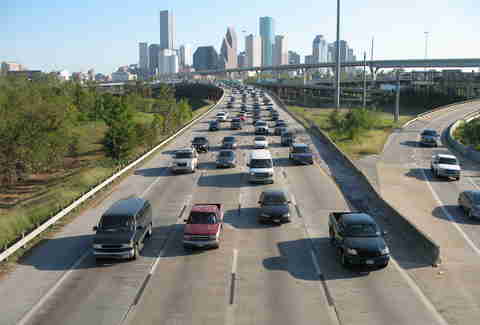
Aside from “sprawl,” the other stereotype typically associated with Houston is endless traffic. While the city diverged with orthodox urban planning, it unfortunately fell in line with orthodox transportation planning.
Like most other US cities, Houston spent most of the second half of the twentieth century building a congested web of freeways and expressways. Combined with policies like wide
minimum street widths and mandated parking spots, the public provision of unparalleled and unpriced road capacity helped to build a city largely dependent on the automobile.
Houston has opted to take a back seat to residents, entrepreneurs, and civil society groups in cultivating economic development.
Thanks in part to Houston’s decision to forgo conventional urban planning, many traditional urban developments were able to survive and reemerge—likely an important factor in the city’s high
Walkscore among Sun Belt cities. To supplement existing walkability and accommodate rapidly rising demand among young Houstonians for walkable communities, the city adopted a
Complete Streets ordinance in 2013. The policy requires that all new and redeveloped roads be designed in a way that accommodates pedestrians and cyclists of all ages. Houston City Hall even invited chief walkability evangelist Jeff Speck to speak
earlier this year, responding positively to low-cost, high-value ideas like adding street trees, installing protected bike lanes, and converting downtown roads from one-way to two-way. The city also adopted its first bike plan in
early 2016, declaring its intent to build 300 miles of “high comfort” bikeways.
 High density office space, apartments—and yes, parking—playfully mix. A Whole Foods sits in the middle, easily accessible to pedestrians and cyclists in the surrounding area. (Google Maps)
Houston has also started taking the need for transit seriously. Last year, the city transformed its bus system into a high-frequency grid
without increasing operating costs, substantially increasing the feasibility of car-free living. While the city has unfortunately taken an
antagonistic approach to ride-sharing services, local
jitney services—private buses operating on fixed routes with fixed rates—have emerged to supplement the city’s public bus system. The
planned expansion of bus rapid transit—essentially buses operating as light rail—offers an attractive way of addressing commuter traffic without the enormous costs and inflexibility associated with light rail transit.
Of course, not everyone can or will ditch their car for bicycles or buses and improved pedestrian, cyclist, and transit infrastructure can only do so much to address traffic congestion. In fact, Texas may soon have something to learn about traffic management from states like
California and
Oregon. In recent years, the two West Coast states have started experimenting with mileage-based fees, an alternative to the regressive gas tax that would charge road users based on actual mileage travelled. When combined with
congestion pricing, a mileage-based system offers incentives for road users to find ways to avoid driving when road demand is high and shift necessary trips to when road demand is low. While observers often assume that Houston’s traffic jams are the byproduct of unrestrained markets, it is ironically the lack of a market for road use that puts publicly-owned roads in a
tragedy of the commons situation.
Where Do We Go From Here?
Contrary to conventional wisdom, many US cities have a lot to learn from Houston. With tight development restrictions, out-of-date urban planning regimes, and burdensome regulations forcing middle- and lower-class Americans out of West Cost and Northeastern cities, Houston’s mix of affordable housing and economic opportunity is more valuable than ever. As other cities have attempted to maintain tight, centralized control on urban and economic development—exemplified by
a recent push by Dallas to shutter local businesses in order to attract chains—Houston has opted to take a back seat to residents, entrepreneurs, and civil society groups in cultivating economic development and crafting urban communities.
Some continue to blame Houston’s unique approach for everything from
flood damage—as if imposing side setbacks and keeping delis out of neighborhoods would avoid statewide flooding—to remaining
pockets of poverty within the city. Certainly some form of
citywide coordination on data collection and service allocation in pursuit of efficiency and equity makes sense. Yet past attempts to impose greater centralized urban planning on Houston have been defeated by
overwhelming working-class opposition every time. Those residents know something many in the urban planning world don’t. It is well past time that we start taking Houston’s success seriously.