Showing posts with label St. Vincents. Show all posts

Friday, October 30, 2015

How Far to St. Vincents Senior Housing?


Join me on a trip from Marinwood Plaza (4 minutes) to the site of St. Vincents senior housing that is proposed for 240 units.  It is located along the SMART railroad tracks. The whistle will blow every 15 minutes from 5AM daily.  

It is quite a walk with armload of groceries.

We welcome housing that represents wise land use and responsibility.  Unfortunately, the remote location of this project (like the Grady Ranch) proposal belongs in the "What the heck are they thinking?" category. It is high density sprawl with none of the accessibility to shopping, transportation and jobs.

Is this "smart" planning?  Our seniors deserve better.  


We must Save Marin Again!

Sunday, August 23, 2015

California builds first farm-to-table new home community


California builds first farm-to-table new home community

the-canary
Urban farming is in the air and California is setting an example by creating the first American housing project of its kind with an urban farm built intentionally in the center of the community. The farm will be 7.4 acres and will include a teaching center for sustainable farming. Some 547 new homes have been built around the farm.
This is no straw bale hippy paradise, but fulfilling the dreams of mainstream urbanites who want the pleasures of big, single dwelling homes with access to fresh, local, organic produce.
The project is called The Cannery, and this Saturday 14 model homes will go on sale. Owned by NEW HOME (NYSE: NWHM) this event marks California’s first farm-to-table new home community. It is located in Davis, Calif.
the_cannery-retail_1_by_jda_architects
“We have worked extremely hard over the past several years to get to this moment,” said Kevin Carson, Northern California President for NEW HOME. “The Cannery is unlike any other community in the western United States and it has truly been a rewarding experience to contribute to such an innovative concept.
Through a collaborative effort with the Center for Land-Based Learning of Winters, Calif., the Urban Farm will serve as a state-of-the-art example of sustainable urban farming and as an agri-classroom for students and beginning farmers.
“To see The Cannery today becoming a viable farm community is not only personally exciting for me, but also one of the most fulfilling accomplishments in my career,” said Craig McNamara, founder of the Center for Land-Based Learning. “The Cannery Urban Farm honors what I believe in most: Connecting eaters directly to food.”
Hear, hear. Let’s here of more projects like this multiplying across the US and the world.

Saturday, June 13, 2015

The secret St. Vincents Vision, Peter Calthorpe and the 55 acres of Affordable Housing that may be in the works today.


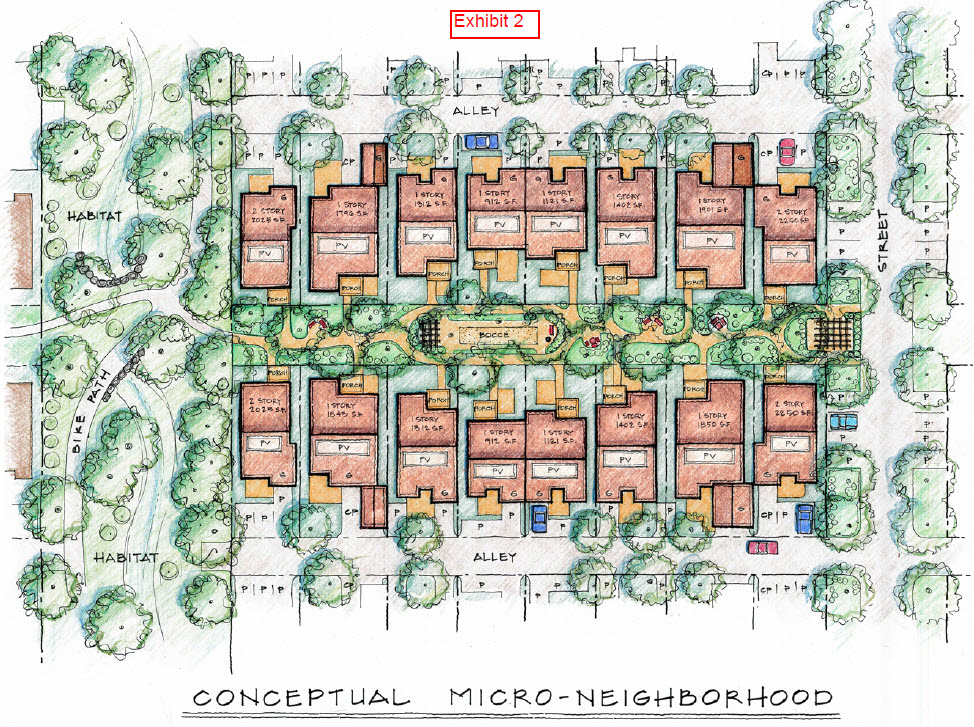
Peter Calthorpe's Original Vision for St. Vincents/Silveira Ranch from the 1980s.  Note the SMART rail line and the Marinwood exit on 101  designed as a cloverleaf in the upper left hand corner. Apparently people won't be driving cars anywhere.  Each time parking has been ignored such plans have resulted in failure. Mobility is key to the modern world.


From the Congress of New Urbanism website regarding Peter Calthorpe's St. Vincent plan:

The pedestrian pocket

One of the West Coast strands began with the “pedestrian pocket” initiative that Peter Calthorpe launched in the early 1980s. That work started with a study—funded by a $10,000 grant from the National Endowment for the Arts and completed in 1982—of a proposed rail corridor in Marin County. After the study was released, Calthorpe’s ideas generated a great deal of interest within the academic community and some media attention, but they sparked very little interest on the part of citizens or elected officials within the study area. [Editor's Note: The Citizens of Marin rejected the high density urban vision of development. Ironically they elected Susan Adams to stop it.  Instead she carried the vision forward for the next twelve years at ABAG. After suffering a humiliating defeat at the polls, she now serves as a "citizen's representative" at ABAG. ]
Since that time, severe traffic congestion has prompted local officials to ask Calthorpe to update his earlier study. The current plan is much more ambitious than the 1982 study: the rail link in the latest iteration, Sonoma Marin Area Rail Transit, or SMART, will connect Sonoma County to Marin, terminating in a ferry at Larkspur Landing with service into San Francisco. This 70-mile passenger rail line is now under construction, with an initial 37-mile segment due to open in 2016.
Peter Calthorpe, Architect, Developer and one of the Pied Pipers behind the New Urbanist movement.  He teaches at UC Berkeley and lives in a multimillion dollar compound in Berkeley Hills.  No high density housing for him.  He just sells it.


Just recently I learned that 55 acres of St. Vincents has been set aside for the "Affordable Housing Combining District" at 30 units per acre and can house 2227 units of housing for roughly 6500 people.  This is roughly the footprint of what you see above.  Without water, jobs and a significant tax base, it is difficult to image the real effects of building housing like this in the real world.  It will double the population of Marinwood-Lucas Valley with this project alone.  Affordable Housing usually pays almost no taxes and community costs are carried by the surrounding taxpayers.
 We believe the entire Community Development Planning department, Gary Giacomini (also involved in the first effort) and big interests from the world of finance and development are working to bring this vision to life.


Thursday, May 1, 2014

The Death of St Vincents Plans circa 2002

St. Vincent's Chapel in Marinwood/Lucas Valley


St. Vincents Plans Could Be On Hold
 [print]

By Richard Halstead

Recent developments could spell double trouble for Shapell Industries' controversial plan to develop the 836-acre site owned by the St. Vincent's School for Boys between Highway 101 and San Pablo Bay.

At the request of San Rafael Mayor Al Boro, San Rafael is re-evaluating its support for annexation of the county land. Without the services that annexation to San Rafael would provide, the project cannot be built.

At the same time, representatives of four key environmental groups - the Marin Conservation League, the local chapter of the Sierra Club, the Marin Audubon Society, and Citizen Advocates for Preservation of St. Vincent's/Silveira - are meeting with county supervisors behind the scenes, urging them to take a more prominent role in determining the property's fate.

Shapell's proposal calls for construction of a 766-unit residential subdivision and 124,000 square feet of commercial and retail space. Critics worry that the project would aggravate the county's traffic woes, while proponents stress it would supply crucial housing.

Boro said recent developments, such as Susan Adams' upset election to the Board of Supervisors, have called into question whether or not the Marin Local Agency Formation Commission would approve annexation, even if San Rafael approves the project.

"I'm getting the very strong impression that it's not annexed to the city yet, and it may never be," Boro said. "I don't want to waste a lot of time and effort."

Acting with the support of the San Rafael City Council, Boro has directed San Rafael's city manager, community development director and city attorney to prepare a report outlining the city's options. City Manager Rod Gould said he expects to present the report sometime next month, perhaps in a special meeting.

Following Adams' dramatic upset victory, local environmentalists signaled they would make the future of the St. Vincent's property an issue in the elections of three San Rafael City Council members next year. The terms of Boro and Councilmen Paul Cohen and Gary Phillips expire next November. Boro said his decision to re-evaluate had nothing to do with politics.

The mayor's surprising move elicited a variety of reactions from local officials.

"I don't know what it means yet; I think he wanted to get something on the table so we could talk about it," said Cohen, who lost last month's run-off election to Adams. During the campaign Adams opposed the Shapell proposal while Cohen said he would wait for the completion of an environmental report before taking a position on the plan.

"I don't know if we'll change our position or whether we'll just simply accept the report," said San Rafael Councilwoman Barbara Heller. "But I think it is prudent to get all the information you can."

Supervisor Steve Kinsey, however, believes the development proposal is headed to the deep freeze for a long period of hibernation.


"I think San Rafael is coming to the realization that it will be expensive and ultimately unsuccessful in being able to meet the very legitimate goals it has for workforce housing, baylands protection and support for the School for Boys," Kinsey said, "and as such is on the verge of walking away from the project, which means it will probably lie dormant for as least as long as it takes to get free-flowing traffic on Highway 101."


"I'm very excited about this turn of events," said Adams, who begins her term next month. "I believe the planning of these properties reverting to the county jurisdiction would more fully represent what voters in the district would like to see happen."

Practically speaking, however, Kinsey said that if the project went to the county now it would face a "certain and swift demise," because the property's current zoning prohibits such development there.

Until now, San Rafael has taken the lead because the St. Vincent's land is within its sphere of influence. If the county assumes that role, it could place the on-going updating of the Countywide Plan at center stage.

"It will put us in the position of needing to pay a lot more attention to what the site could be," Kinsey said.

San Rafael's deliberations have resulted in yet another delay in approving a contract to perform a costly environmental impact report on Shapell's proposal. The council was scheduled to review the contract on Dec. 16 - after previous dates in October and November were postponed. No new date has been set for considering the contract, Gould said.

Shapell vice president Tom Koch said Friday that he had not been notified of the new developments. Koch said there has been no change in Shapell's desire to move ahead with the project.

"None at all," Koch said. "It has always been clear to us that dealing with the hyperbole and political rhetoric - that is easy to promulgate and difficult to counteract - would be a major challenge. But we're certainly prepared to move forward."

If San Rafael does reverse course on the development proposal, it could render academic the recent efforts of local environmental groups to lobby supervisors.

"I think in effect that San Rafael is on the verge of beating the environmentalists to the punch," Kinsey said. "Instead of them saying, 'County take it back' San Rafael is saying, 'County here it is.'"

"I don't really know what it means," said Marge Macris, who serves on the executive committee of the Sierra Club's Marin group. She was a member of a contingent that met with Supervisor Annette Rose last week.

"At this point, it is just a very general request," Macris said. "We would like for the board to look at what their options are regarding the St. Vincent's project."

She acknowledged the 1998 memorandum of understanding between the county and San Rafael, which designated San Rafael as the lead agency for processing development applications related to the site.

"Our position is the county ought to take another look at that," Macris said. "The land is of countywide importance and therefore the whole county should have an interest in doing the planning."

Rose said, "I honestly don't know if it is possible for the county to reconsider its position that San Rafael is the lead agency here. But we will investigate that."

See Related Stories: Does Supervisor Adams still care about Marinwood-Lucas Valley?

St Vincents Then and Now