Showing posts with label millennials. Show all posts

Friday, June 22, 2018

Pervasive Suburbanization: The 2017 Data

Pervasive Suburbanization: The 2017 Data

The most recent Census Bureau population estimates have made it clear that migration to the suburbs and away from urban cores has accelerated dramatically since the early years of the Great Recession (see here and here). More detailed national data, from the Current Population Survey (CPS) indicates that moving to the suburbs is pervasive (CPS is a joint program of the Census Bureau and the Bureau of Labor Statistics). The CPS data is much higher level geographically than similar data Census Bureau and Internal Revenue Service migration, providing no state, county or metropolitan area breakdowns. CPS data is national, and divided further into the 4 regions (Northeast, Midwest, South and West) and nine divisions (New England, Mid-Atlantic, East North Central, West North Central, South Atlantic, East South Central, West South Central, Mountain and Pacific).

Domestic Migration: Plus 2.3 Million to Suburbs, Minus 2.3 Million from “Principal Cities”

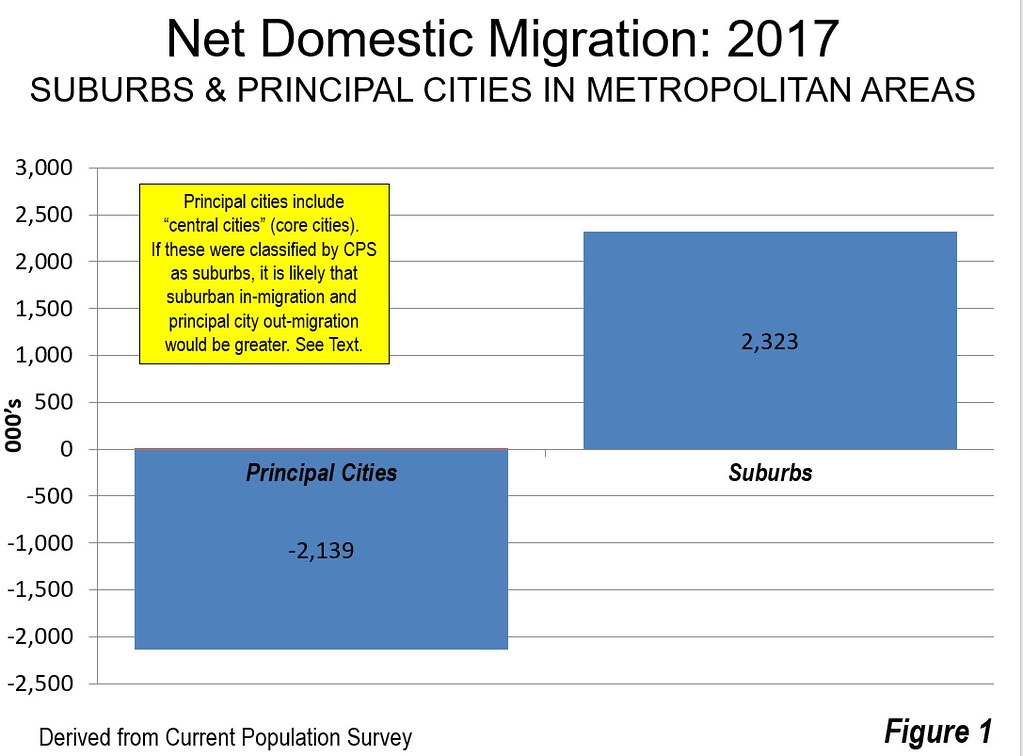
Between 2016 and 2017, more than 2.3 million (net) US residents moved into what the CPS classifies as. “suburbs.” At the same time, 2.3 million (net) moved away from “principal cities,” with most of their population in those classified as “central cities” (urban core cities) before 2003 (Figure 1). In fact this approach probably under-estimates the extent of migration into suburbs and out of the urban cores of metropolitan areas. This is because many principal cities are, in fact suburbs whose high employment levels, not their overwhelmingly suburban and automobile oriented urban form, determines their classification. For example, suburban principal cities, such as Plano, Texas, Mesa, Arizona, Bellevue, Washington, Sandy Springs, Georgia, and many others are likely to be not losing domestic migrants, while the suburbs with smaller employment bases around them are gaining. Indeed, many non-historical core principal cities did not even exist when the great post-World War II automobile -oriented suburbanization started and were some were primarily rural into the 1960s.
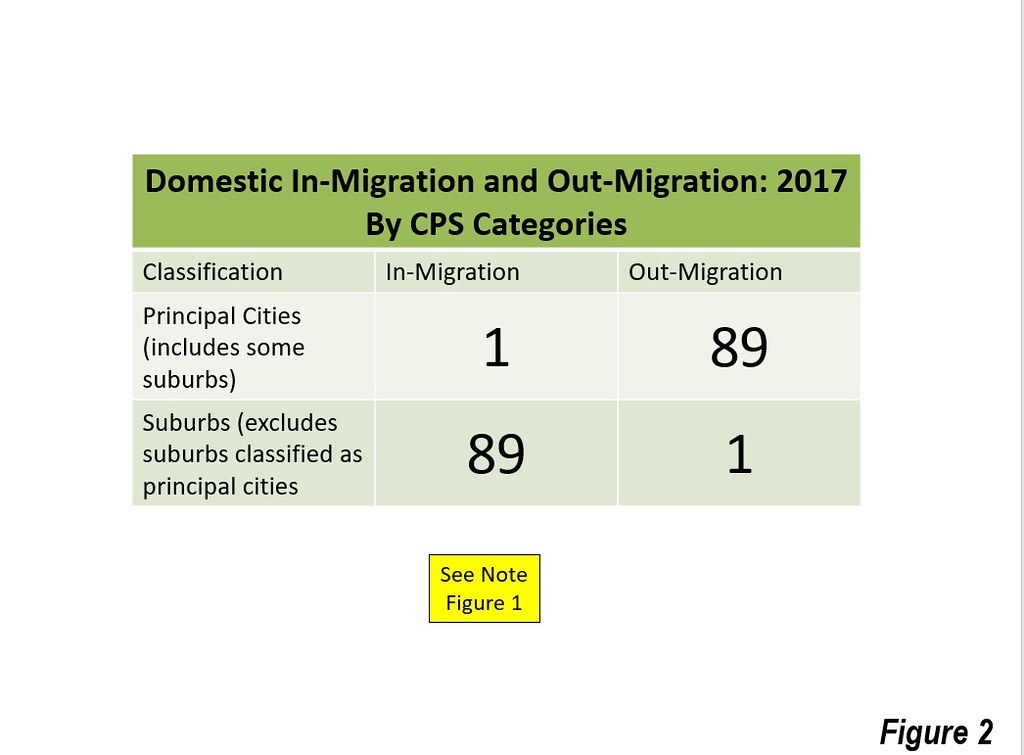
The move to the suburbs was so pervasive that CPS found gains in 89 of 90 categories. The principal cities, on the other hand lost in 89 of 90 categories (Figure 2), which are organized into total, sex, age, race and Hispanic origin, relationship to householder (formerly called “head of household), educational attainment, marital status, nativity, tenure, poverty status, income, labor force status, major occupation and major industry.
This article summarizes some of the most important findings from the latest CPS data.

Millennials: Moving to the Suburbs

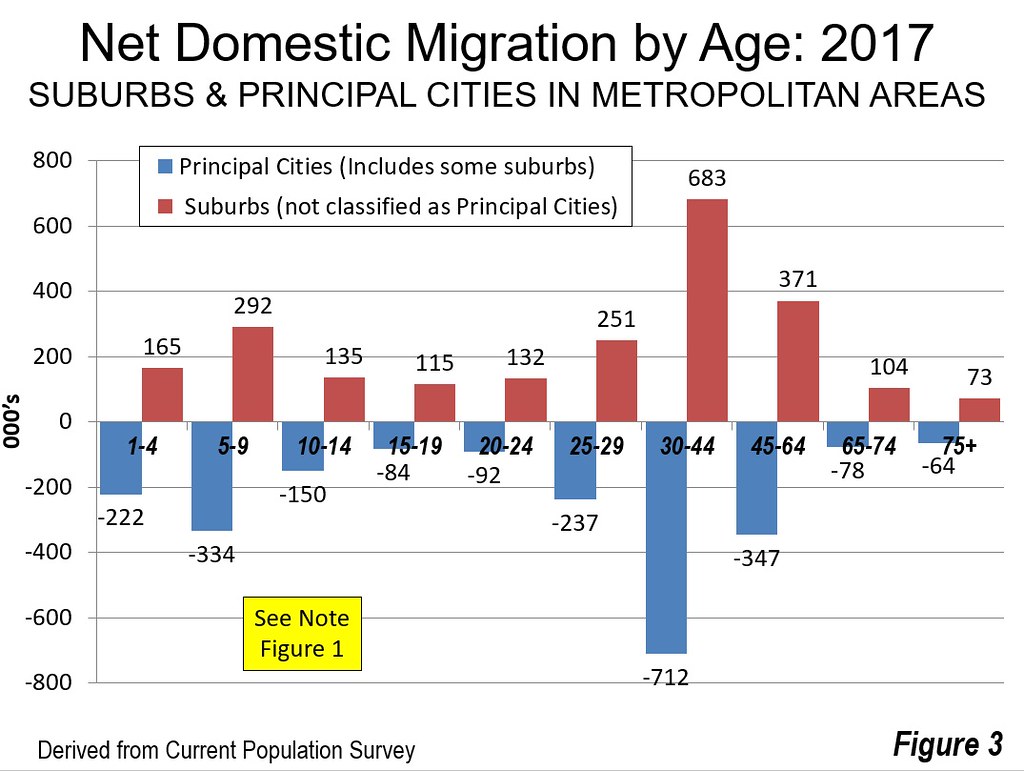
One of the most enduring urban myths has been that millennials are rejecting the suburbs for the inner cities. We have previously shown that the largest percentage of millennial growth is in the suburbs not the urban core. According to CPS, those aged 20 to 29 are net moving in large numbers away from the principal cities, even including some largely suburban cities, (minus 329,000) and to the suburbs (plus 383,000)

All Other Ages: Moving to the Suburbs

Millennials are not alone. It is well known that the more family friendly characteristics of the suburbs attract people with young children. This is obvious by the 165,000 children aged 1 to 4 who are moved to the suburbs by their parents, compared to the 222,000 who are moved away from the principal cities (the balance of 57,000 were moved to non-metropolitan areas).
An even bigger gap is noted among children aged 5 to 9, 292,000 of whom were moved to the suburbs compared to the 334,000 moved away from the principal cities (and the 42,000 moved to non-metropolitan areas). This is consistent with the perception that core cities generally have inferior public schools, inducing parents to move to the suburbs or beyond when it comes time to enroll their children in schools.
The largest suburban advantage occurs in the 30 to 44 age category, when households are often starting families. Suburbs attract an astounding 683,000 domestic migrants in this category, while the principal cities lose 712,000. The suburban gains continue, but at a lower rate, as people reach 45 to 64 years of age. Suburbs gained 371,000 net domestic migrants, while principal cites lost 347,000.
The often suggested view that retirees are flocking to the inner cities is countered by the reality that in 2017, 104,000 aged 65 to 74 moved to the suburbs, while 78,000 moved away from the principal cities. The numbers moving are small since older people are increasingly aging in place, which for most is in the suburbs.
In every age category, then, the suburbs gain net domestic migrants, while the principal cities lose (Figure 3).

Minorities: Moving to the Suburbs

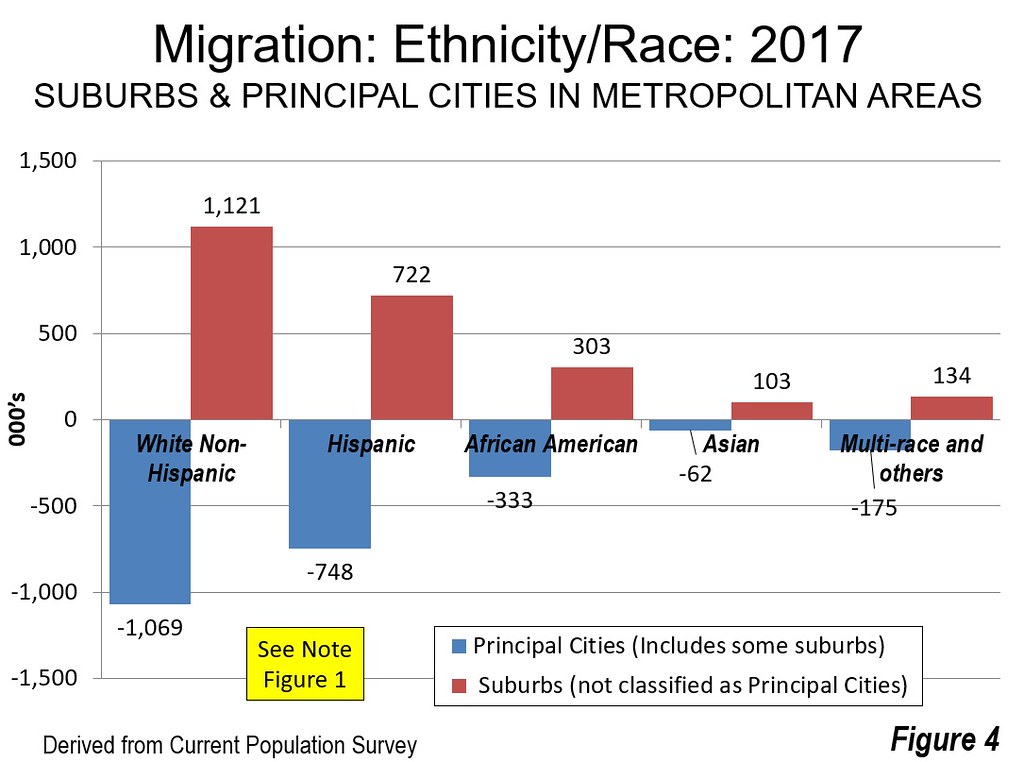
Perhaps the most important trends relate to ethnicity and race. The early post-World War II suburban migration might be characterized as “white flight,” but in recent decades minorities have been migrating to the suburbs. It is no surprise that White Non-Hispanics migrated strongly to the suburbs (plus 1,121,000) and away from the principal cities (minus 1,069,000). But Hispanics migrated even more strongly to the suburbs (plus 722,000) and away from the principal cities (minus 748,000). Similarly, African-Americans migrated to the suburbs (303,000) and away from the principal cities (minus 333,000). Asians, though a much smaller share of the population, also chose the suburbs overwhelmingly (plus 103,000) and abandoned the principal cities (minus 62,000).
Overall, among those who are minority or mixed race, 1.3 million moved to the suburbs, while 1.3 million moved away from the principal cities (Figure 4).

All Levels of Educational Attainment: Moving to the Suburbs

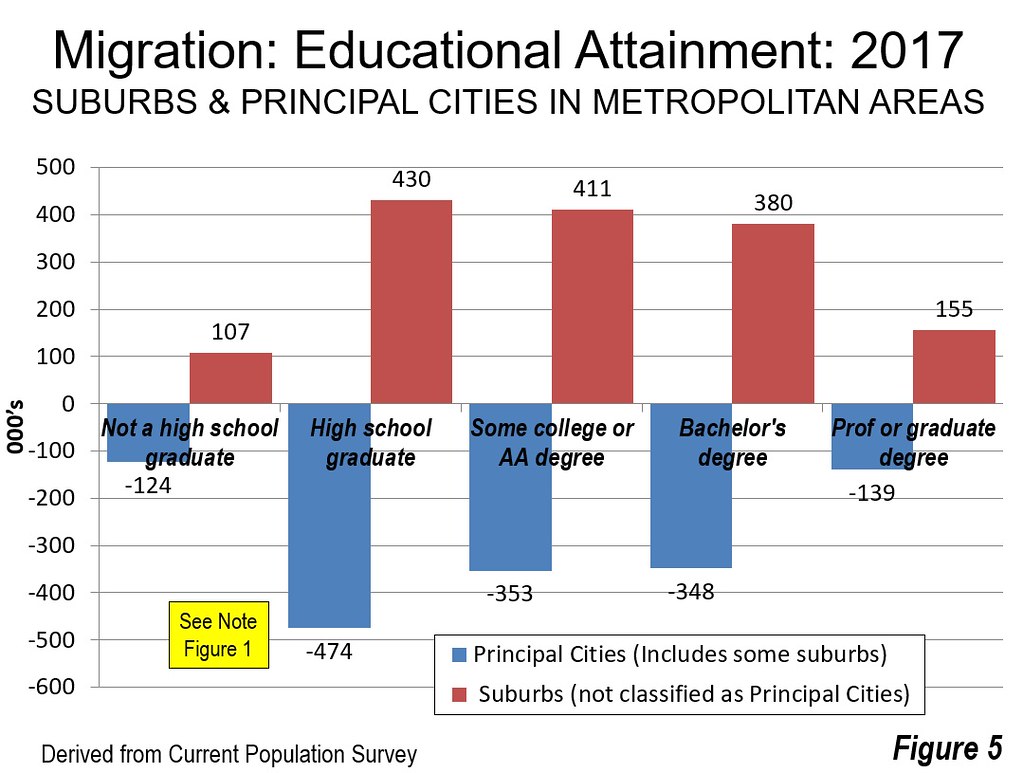
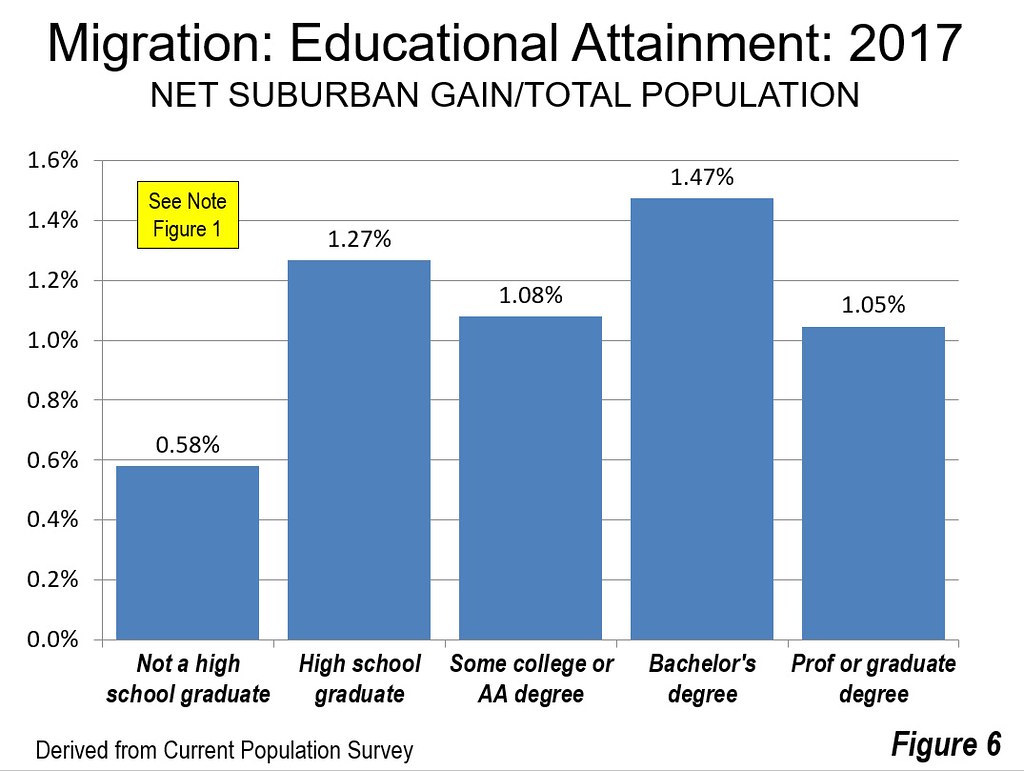
Regardless of educational attainment, net domestic migration is positive to the suburbs and negative to the principal cities (Figure 5). In relation to the total population of the educational attainment categories, the largest suburban over principal city gain was among those with bachelor’s degrees, while the smallest was among those without high school educations (Figure 6).

All Income Levels: Moving to the Suburbs

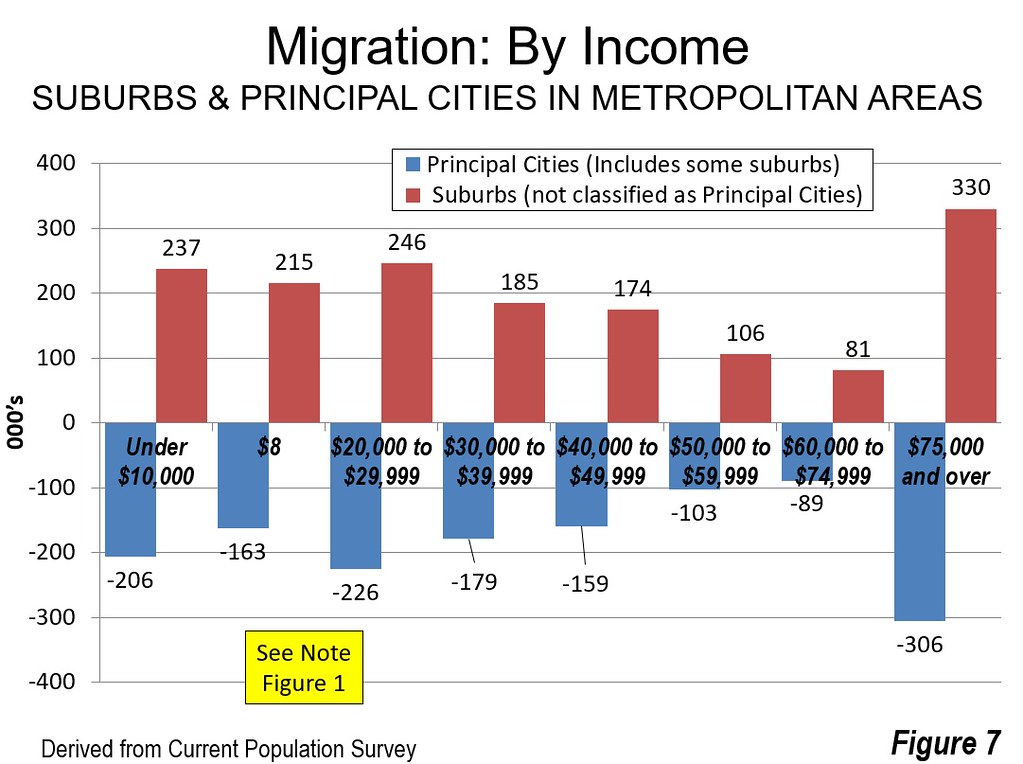
People of all income levels are moving to the suburbs. The highest income category shows the most significant movement into the suburbs and away from the principal cities (Figure 7)

Regardless of Poverty Status: Moving to the Suburbs

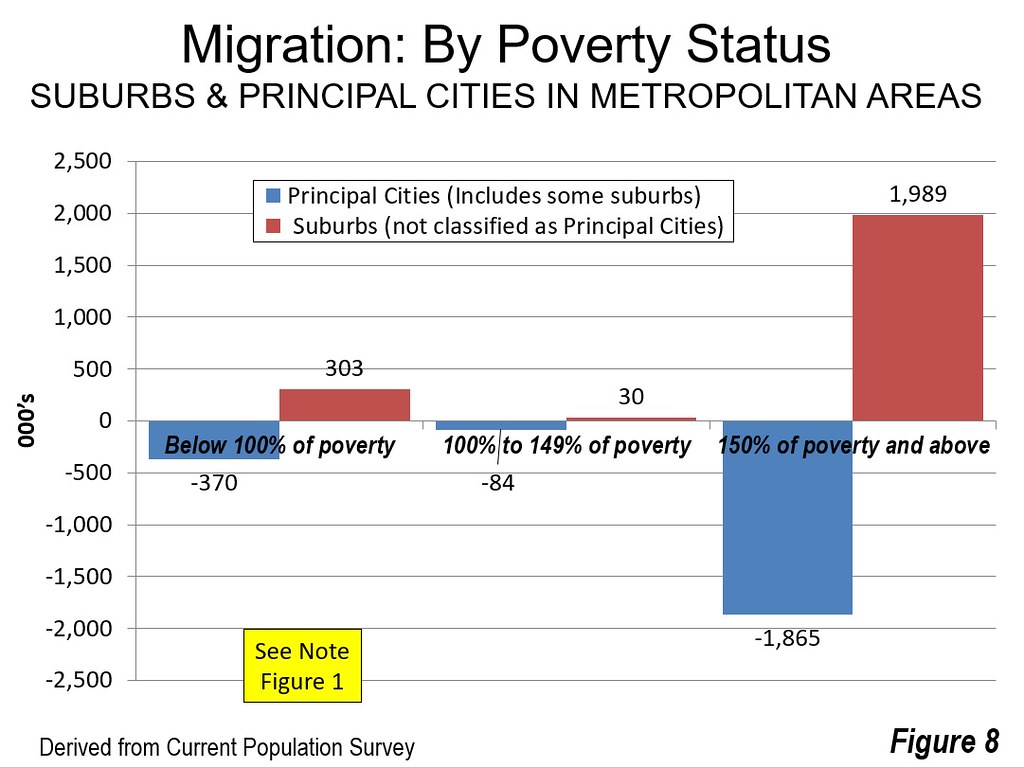
Both people above and below the poverty line exhibited strong net domestic migration to the suburbs and away from the principal cities. Approximately 85 percent of domestic migrants to the suburbs were above the poverty line (Figure 8). Our last review of central city versus suburban poverty showed that urban core poverty rates were double those of the suburbs.

Native Born and Foreign Born: Moving to the Suburbs

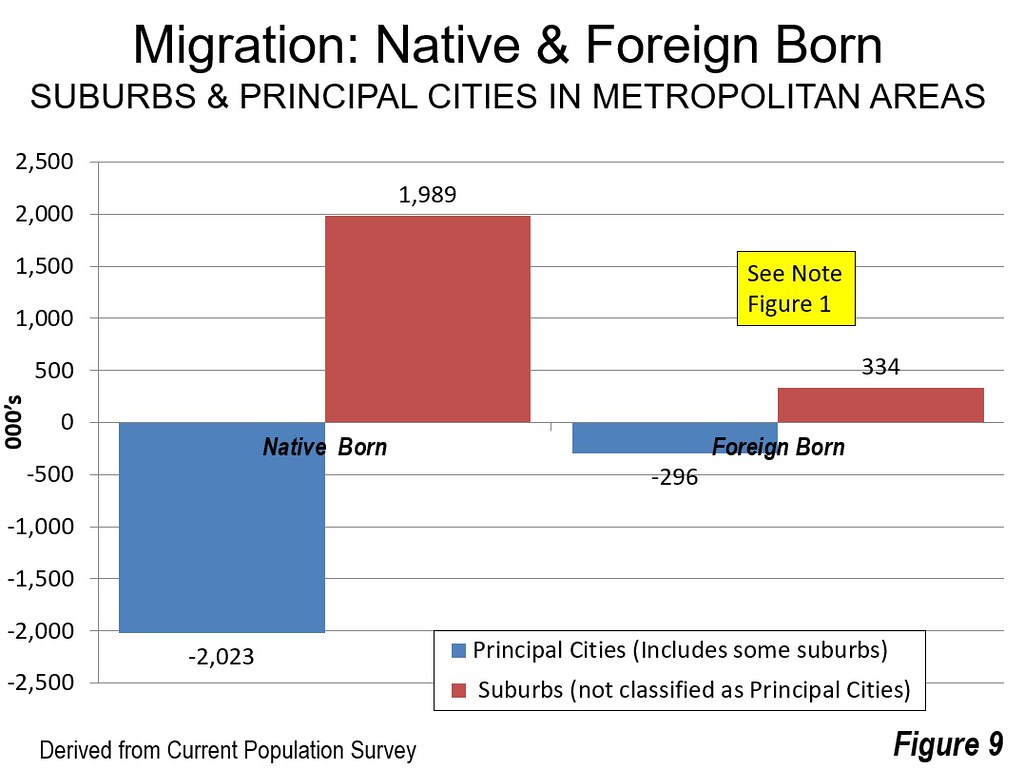
Both the native born and foreign born population exhibited strong net domestic migration to the suburbs and away from the principal cities (Figure 9).

Why People Continue to Move to the Suburbs

CPS summarizes reasons for moving, indicating that 43.0 percent of moves are housing related, 27.9 are family related, and 18.5 percent are employment related. Other reasons account for 10.6 percent. Housing related reasons would include moving to larger houses with yards, especially for their children. Family reasons would include households moving to school districts perceived likely to provide better educations to their children. Finally, employment reasons doubtless includes many households that move to be closer to jobs. All of these reasons favor the suburbs, where the houses are bigger and more spacious, where schools are perceived to be better and where 80 percent of the jobs are located.
Wendell Cox is principal of Demographia, an international public policy and demographics firm. He is a Senior Fellow of the Center for Opportunity Urbanism (US), Senior Fellow for Housing Affordability and Municipal Policy for the Frontier Centre for Public Policy (Canada), and a member of the Board of Advisors of the Center for Demographics and Policy at Chapman University (California). He is co-author of the “Demographia International Housing Affordability Survey” and author of “Demographia World Urban Areas” and “War on the Dream: How Anti-Sprawl Policy Threatens the Quality of Life.” He was appointed to three terms on the Los Angeles County Transportation Commission, where he served with the leading city and county leadership as the only non-elected member. He served as a visiting professor at the Conservatoire National des Arts et Metiers, a national university in Paris.

Thursday, April 19, 2018

The Suburb Wooing Millennials With Avocados, Kombucha, and Cheap Houses

thinkhomewood.com

The Suburb Wooing Millennials With Avocados, Kombucha, and Cheap Houses


AMANDA KOLSON HURLEY APR 9, 2018

In a new comic-strip ad campaign, Homewood, Illinois, bills itself as a hip, diverse, urban neighborhood that Millennials can afford. The only catch: It’s in the suburbs.

Four friends in early middle age are chatting on a small-town sidewalk. “So, what are you doing this weekend?” asks one of them, a man in a button-down shirt. “The usual,” replies his friend, a black woman wearing a t-shirt with a rainbow-striped heart. “A guitar lesson, checking out the artisan street fair with the littles, and then some Aurelio’s—“

Her partner, a blond woman, cuts in. “From the old oven, of course!”

The man and the third woman look pleasantly surprised. “And here we thought you’d miss living in Chicago,” he says.(thinkhomewood.com)

Welcome to Homewood, Illinois, a suburb of 20,000 that is marketing itself to urbanites as a hidden hipster gem.

The town, which is about 25 miles south of downtown Chicago, just launched a new advertising campaign called “Think Homewood.” Ads posted inside trains on the L’s Blue Line and elsewhere in Chicago contrast the laid-back vibe of Homewood to the stress of city living. The ads are comic strips drawn by illustrator and Homewood resident Marc Alan Fishman.

In one strip, a Homewood mom with a purple streak in her hair and a tattoo praises the school system. “Zen gets to be with the same kids all the way through high school,” she says. Meanwhile, “Somewhere in Wicker-Humboldt-Pilsen”—Chicago neighborhoods that have experienced dramatic gentrification and zooming housing prices in recent years—two anxious moms in a city park talk about school options for their kids. “Have you started figuring out the schools yet?” a Janeane Garofalo lookalike asks her companion.

“No … I’m so overwhelmed with all the options,” the other mom says. “I’m just pretending like it’s not happening.”(thinkhomewood.com)(thinkhomewood.com)

The ads, which will run through the end of May, were the idea of Mary Jane Maharry, a public relations consultant to the town. Maharry enlisted Fishman, the local artist, and presented the concept to the village board, whose members embraced it, according to Homewood Mayor Richard Hofeld.

Hofeld said the town wants more young families to move there, and as urban Millennials start to think about homeownership and child-rearing, it’s the right time to recruit them. “We found the Millennials [in Chicago] are prone to looking to the north suburbs and the west suburbs, and rarely look to the south,” Hofeld said. “We have all the amenities that a family could ask for. And on top of it, as far as the housing stock goes, it’s affordable. We feel those are good sells.”This proves a fact that would have been unthinkable 20 years ago: Suburbs now have to work to attract the cohort they were built for.

The ads evoke a bougie paradise with as much tongue-in-cheek detail as an episode of Portlandia: avocados, kombucha, farm-to-table brunch, street fairs. In the one with the tattooed mom, she’s joined by a guy (her partner?) who’s looking at his iPhone and wearing a t-shirt that says LOCAL FOOD. But there’s a twist: Here, the people living out this progressive urban cliché are suburbanites.

In Homewood, we’re told, people walk to the farmer’s market, keep chickens in their yards, and hang out with friends of different races and sexual orientations. By contrast, their urban peers come across as either a bit square (see the first ad above), or just stressed out from having to deal with school bureaucracy and oversubscribed city services, like rec classes that fill up immediately.

Who’s the sucker for moving to the suburbs now, eh?, the ads seem to ask. But the characters are more or less interchangeable; the implication is that if they move to Homewood, those tightly wound Chicagoans will chill out and name their kids “Zen,” too.

While they might seem suspiciously like they were generated by an algorithm fed with marketing data and New York Times trend pieces, the comic-strip Homewood denizens are based on real residents and real events, according to Maharry (who lives in Homewood herself).

In fact, “Think Homewood” reveals just how much the old dichotomy of city vs. suburb is blurring. It proves a fact that would have been unthinkable 20 or 30 years ago: Suburbs now have to work to attract the cohort they were built for. As certain cities become more sought-after and lively, suburbs can no longer just sit back and wait for the inevitable stampede of first-time homebuyers and new parents. They have to convince skeptical young folk of their essential urbanity first. (Another Chicago suburb, Berwyn, is running ads on city billboards proclaiming that it’s “nothing like a suburb.”)

They also have to offer a competitive advantage vis-a-vis the city. In Homewood, that advantage is affordable real estate and good public schools. The median home value in Homewood is a reasonable $149,800, according to Zillow. The area high school, Homewood-Flossmoor, is well regarded. And the K-8 schools have a streamlinedstructure, which the ads dangle in front of Chicago parents as sweet relief. Even as school choice brings more educational options to Chicago and other U.S. cities, it can be a gamble, and a fragmented school landscape can be difficult and exhausting for parents to navigate.

In the view of sociologist John Joe Schlichtman, Homewood is basically promising gentrification without the guilt. Ditto for guilt-free driving: The ads promise easy car trips on traffic-free streets along with (limited) walkability and Metra rail service into Chicago. This “car-light” lifestyle is portrayed as the best of both worlds.

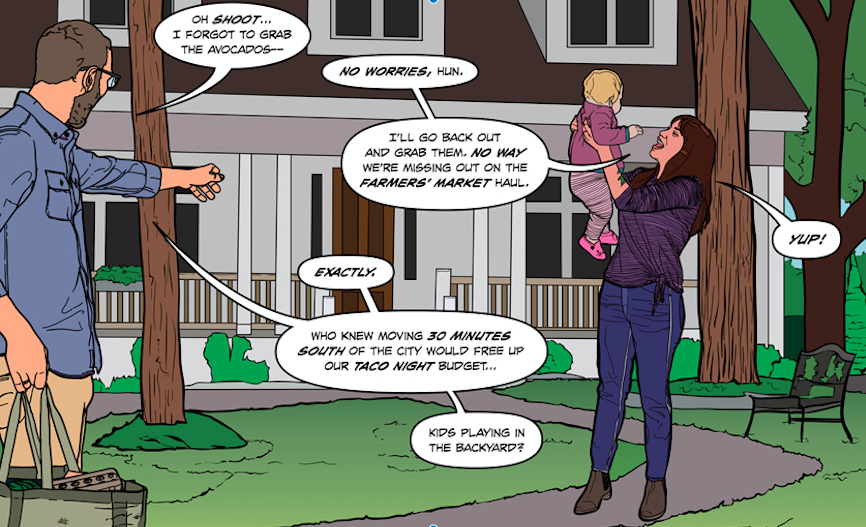
One comic panel shows Chicago Dad stuck in traffic on the way back from the store. He realizes he forgot to get avocados. Frak! That’s taco night ruined. But when Homewood Dad remembers the avocados, he can hop in the car and be back at the store in minutes. Taco night is saved.(thinkhomewood.com)(thinkhomewood.com)

The multiracial cast of these ads is not a sleight of hand. Homewood is legitimately diverse: 53 percent white, 37 percent black, 2 percent Asian, and 8 percent Hispanic. Its schools are majority nonwhite. These figures reflect larger demographic shifts as people of color move out (or are pushed out) of expensive cities, and as immigrants bypass central cities and head straight to the ’burbs. But Homewood-Flossmoor also has a history of proactive integration efforts: The South Suburban Housing Center, a regional fair-housing organization, was founded in Homewood in 1975.

Mayor Hofeld told me that in Homewood, “the glue that really binds [the] community together” is a series of annual festivals, including a chili cook-off and a rail fest. He hopes people who are interested in the town will attend one. Millennials, he said, “have enjoyed living in the city, and the features the city might afford. But they’re getting a little bit older, thinking of raising families, and looking around for a stable community that has a lot of amenities. And that’s what we are.”

I asked the mayor, who is 80 and has been in office for two decades, if “Think Homewood” reflects the town as it is today. “Very much so,” he said. “This cartoonist and MJ [Maharry], they really nailed it down. There are choices here. And that’s what’s nice.”

Wednesday, February 7, 2018

The New Opportunity Boomtowns

The New Opportunity Boomtowns

A century ago Detroit was a boomtown and Los Angeles a sleepy refuge for sun-seeking Midwesterners. A half-century later, L.A. was the fastest-growing big city in the high-income world, while Detroit was beginning its long tailspin. In the ’70s, New York was the “rotten apple” and seemed destined for further decline. But for the past 20 years it has enjoyed an enormous surge of wealth, as have many of the countries’ dense, culturally creative cities.
In other words, when it comes to the death and life of American cities, things change, often in unpredictable, once unthinkable ways. Now, high prices and a lean to the left in the nation’s coastal metropolises could spell new opportunity for more business-friendly, less costly regions like Dallas-Fort Worth and Salt Lake City. If current trends continue, there may be new hope not only for Midwestern cities like Columbus, Indianapolis and Kansas City, but even for some long down-on-their-luck metros, like Detroit and Cleveland.
The post-recession economy favored many dense urban centers like New York, Boston, San Francisco and Seattle, which just a quarter century ago seemed unable to grow jobs or population. Even less successful big metros, such as Chicago and Los Angeles, experienced something of a surge in the central core, despite substandard overall economic performance.
Several factors paced the growth of the “superstars,” notably the surge in the number of educated millennials headed for dense urban areas. The extreme concentration of venture capital in a handful of cities, led by the Bay Area, which on its own accounts for nearly half of the VC world, followed by New York, Boston and Southern California, helped these places dominate growth in tech over the past decade. A post-recession boom in the stock market also paced growth, particularly in New York, but also in the affluent suburban regions surrounding these cities.
This has created something of a celebratory meme that suggests only elite cities can compete successfully in a globalized economy, leaving the rest to lag behind. Yet, as longtime urban booster Richard Florida and others note, the big city boom may be coming to an end.
FALLING STARS?
In some ways this tapering effect reflects the extent of their success. Virtually all the superstars, with the exception of Chicago, have seen a rapid ascent in housing prices, chasing people out of these metros. In the Bay Area, for example, 74 percent of millennials plan to leave, according to the Urban Land Institute. Even in Seattle, still a major lure for young people, many younger residents are now looking outside the city as they get ready to buy houses or raise families. Chicago is also facing an exodus, exacerbated by crime and a desultory economy.
This demographic challenge will grow as more millennials enter their 30s. The fastest growth in millennial migration is taking place not in New York, Washington and Los Angeles, but in cities like Charlotte, Houston and Austin. Immigrants, too, may be looking elsewhere; Los Angeles, long a major center for entrants, has seen its annual immigration rate fall by nearly two-thirds this decade.
These trends are likely to grow as job growth and startups slow in places like the Bay Area and New York. Since 2010, for example, Manhattan and Brooklyn’s population growth has dropped 90 percent. No surprise then that many of those leaving New York, California and other blue havens are people in their mid-30s to their early 50s, precisely the age when people start families, buy houses and launch businesses.
To these issues, add strong progressive politics in many of the nation’s biggest cities, including higher minimum wages, threats of new wealth taxes and an ever more stringent regulatory environment. This could prompt many firms to seek other locations. The Amazon search for a second headquarters (I am working on Kansas City’s bid) may presage expansion to other locales, even among firms that may remain headquartered in the superstars.
THE RISE OF THE OPPORTUNITY BOOMTOWNS
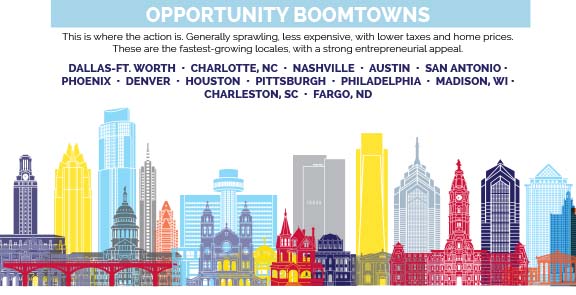
So where is the next generation of talented people and innovative companies most likely to go? The fastest growth in educated millennials today is taking place not in New York, Washington or San Francisco, but in opportunity cities like Nashville, Denver, Charlotte, Raleigh and Orlando, as well as the Texas metros outside of Houston, which has been slowed, at least for now, by low oil prices and hurricane Harvey.
Growth in tech and professional services in these areas suggest a new trend. At a time when tech growth has slowed in the Bay Area—down by 80 percent over the past two years, according to Chapman University economist Jim Doti—it has been surging in many of these cities. Since 2014, says Mark Schill, vice president of the Praxis Strategy Group, the fastest growth in tech jobs has taken place not in San Francisco, but in Charlotte. Nashville, Raleigh, Indianapolis, Phoenix, Denver and Salt Lake City all grew their tech ranks faster than such superstars as New York, Los Angeles and Chicago.
Despite the much-ballyhooed shift in small executive headquarters to some core cities, the fastest growth in professional services is increasingly not Chicago and New York but up-and-comers like Nashville, Austin, Charlotte and San Antonio. In financial services, there is a rapid “decentralization” from high-cost markets like San Francisco and New York to more affordable places like Nashville, Dallas, Salt Lake, Charlotte and Phoenix.
Demographic trends could drive this further as millennials and young families struggle with ultra-high costs. In New York City, millennial incomes (ages 18–29) have dropped in real terms compared with the same age cohort in 2000—despite considerably higher education levels—while rents increased 75 percent. New York, Los Angeles and San Francisco have three of the nation’s four lowest home-ownership rates for young people and among the lowest birthrates.
According to Zillow, for workers between 22 and 34, rent costs claim up to 45 percent of income in the Los Angeles, San Francisco, New York and Miami metropolitan areas, compared with closer to 30 percent of income in metros like Dallas-Fort Worth and Houston. Even more stark is the difference in home prices. In Dallas-Fort Worth (the nation’s fastest-growing housing market) as well as Houston, San Antonio and Charlotte, prices can be just one-third of those in the superstar cities.
Urbanist author Derek Thompson suggests that cities like New York are wonderful for new immigrants, hipsters and the ultra-rich, but “not a great place for middle-class families.” Yet young families, not single hipsters, will now be increasingly critical to urban success. The opportunity cities are also bolstering their appeal to millennials and young families by focusing on urban amenities and walkable suburban areas while maintaining policies that keep housing prices relatively low.
THE NEW WANNABES
As cities in Texas, the Intermountain West and even the Southeast grow, they become more exposed to higher housing prices and, in some cases, stronger anti-business sentiment. This could prove good news for a host of cities, many of them long-time economic laggards that could become the next opportunity cities.
Many of these cities, largely in the Midwest, enjoy significant advantages. Their large, but still affordable central cores and suburbs, notes Chicago-based analyst Pete Saunders, attract millennials. These metro regions often boast great legacy resources, such as universities (Ohio State), hospitals (Cleveland Clinic) and high concentrations of engineering talent, such as that found in Detroit. These, in turn, are attracting educated millennials from urban cities like New York to places like Ohio’s Cuyahoga County, which now enjoys a net surplus in educated millennials from Kings County, home to Brooklyn, New York.
This is beginning to occur with tech jobs. Cities such as Detroit, Kansas City and Indianapolis are all growing tech employment faster than New York or Los Angeles and enjoy more employment in this critical sector per capita. In professional service growth, Kansas City ranks second among the largest metros. Superstar cities like to brag about being “ideopolises,” but both talent and innovation are mobile and capable of heading to less congested, costly and far less celebrated environments.
Midwestern cities increasingly also offer companies a business-friendly environment, including “right to work” laws that limit unionization. Virtually all, except for laggard Illinois, are run by Republican governors and legislators. These places are not likely to impose the kind of regulatory or tax policies that flourish in the superstars and even some opportunity cities. The ability to accommodate young families could also prove crucial. Metropolitan areas such as Kansas City, Columbus, and Indianapolis combine strong economic growth with low costs.
The pro-manufacturing agenda of the Trump Administration, as epitomized by the Foxconn plant being built in southeastern Wisconsin, could be a plus in places like Detroit and Cleveland, devastated by the erosion of factory jobs and straining to cope with severe social dysfunction, most notably high crime. What the wannabes offer companies and individuals is a place where one can live decently in the urban core, and then later find an affordable home in a nice suburb, which two-thirds of millennials prefer—the youth to middle-aged life cycle, once common in places like the Bay Area, Southern California and many parts of the Northeast.
LEFT BEHIND?
Not all metros have a clear path to recovery, much less any prospect of ascending towards superstar status. Many smaller towns across the country, largely in the Midwest, have lost much of their economic base, a trend that includes the movement of firms like Caterpillar from cities like Peoria, Illinois, to the suburbs of Chicago. These parts of Trump’s America, notes analyst Aaron Renn, himself a native of southern Indiana, continue to lose population, becoming ever older and whiter as their ambitious young head elsewhere.
But not all smaller metros are hurting. Some smaller towns are benefiting from “on-shoring” of services that were once in East Asia and India. Places that have retained their largest companies—for example the Fayetteville, AR-MO region that is home to Walmart—continue to gain new migrants and jobs at among the highest rates in the country.
Price pressures and aging millennial populations, as well as advances in telecommunications, could make some smaller cities more attractive over time. What is certain is change. Just as places like New York arose from decades of torpor, so too may many other places around the country; even unlikely metros in the Midwest could re-emerge.
America’s typology of prosperity is protean and will continue to be so, forcing CEOs, investors, workers and policy-makers to re-examine their models to fit ever-changing conditions.

Tuesday, January 30, 2018

Millennials Search for Home…On Their Terms


Millennials Search for Home…On Their Terms


Rarely has a generation spawned such a cottage industry of profiling. The largest and most diverse generation in American history, millennials are also the most contradictory, sparking endless intrigue, analysis and caricature. They’re at once idealistic and anxious, wholesome and distrustful. They consistently clamor for meaning and community while the polls show an unprecedented exile from the institutions (e.g. marriage and religion) that traditionally offered both. They’re the most educated and socially conscious generation to date, and yet with the help of social media, millennials are being driven to unprecedented levels of anxiety and loneliness.
How does all this play out in the housing market? As millennials come of age and the older tier in particular begins to settle down, there are four key trends worth noting. The first is that, for millennials, dollars have replaced relationships as the primary basis for security. The second is that they are leaving big and established coastal cities for smaller and reviving inland cities. The third is that many increasingly prefer to live in hybrid arrangements that integrate one’s life, work and play, which, along with costs, may explain the revived embrace of suburban amenities, albeit in fresh forms. And the fourth is that while this generation is less mobile than previous generations, there is a crucial divide between millennials who have agency to follow their desires – who some call the “supermobile” – and those who don’t.
Editor's Note: If you are a millennial and home ownership is important, don't be afraid to move.

The Screwed Millennial Generation Gets Smart

https://www.thedailybeast.com/the-screwed-millennial-generation-gets-smart


MILLENIAL MOVEMENT

The Screwed Millennial Generation Gets Smart

It turns out that kids today want the same thing their parents did—a home of their own that they can afford to raise a family in.

It’s been seven years since I wrote about “the screwed generation.” The story told has since become familiar: Millennials, then largely in their twenties, faced a future of limited economic opportunity, lower incomes, and too few permanent, high-paying jobs; of soaring college debt and structural insecurity (PDF). The Census Bureau estimates that, even when working full-time, they earn $2000 less than the same age group made in 1980 (PDF). More than 20 percent of people 18 to 34 live in poverty, up from 14 percent in 1980 (PDF).
Incredibly, many pundits applauded these conditions and credited millennials, forced by economic circumstances into difficult choices, for fulfilling the old boomer dreams that the boomers themselves had long since abandoned of a less materialistic, greener future in dense and heavily planned urban environments.
The environmental magazine Grist envisioned “a hero generation” that will escape the material trap of suburban living and work that engulfed their parents. “We know the financial odds are stacked against us, and instead of trying to beat them, we’d rather give the finger to the whole rigged system,” the millennial author concludes. An editor at the same magazine declared herself a part of the GINK generation (as in “green inclinations, no kids”) that she said meant not only a relatively care-free and low-cost adult life, but also “a lot of green good that comes from bringing fewer beings onto a polluted and crowded planet.”
It has been often asserted that millennials (defined as the generation born between 1982 and 2002) do not want to buy homes or live in suburbia; Fast Company, saw this as “an evolution of consciousness.” The Guardian declares that millennials are refusing to accept “the economic status quo” while Wall Street looked forward to profiting from the idea that millennials will be satisfied to live within a “rentership society” (PDF).
But millennials, as noted in a new paper from Anne Snyder and Alicia Kurimska, aren’t embracing downward mobility but rather are increasingly creating their own aspirational strategies (PDF). Some are doing this consciously by ignoring the wise planners and establishing homes for themselves in suburban and Sun Belt locales once considered insufficiently hip.
Despite the hype from the press and urban planners, millennials are following in the footsteps of previous generations by locating on the periphery major metropolitan areas and Sun Belt cities, most of which are simply agglomerations of suburbs.
This pattern seems certain to accelerate as millennials enter their thirties, the age when contemporary populations tend to marry, settle down, and have children. To be sure, notes Pew, more 18- to 34-year-olds now live with their parents than with spouses or significant others for the first time since the question was first asked in the 1880s. But when they do leave the nest, albeit later than in previous generations, they are becoming adults whose collective decisions are not so different from those of their parents.
Their searches for homeownership and procreation reflect this trend. It turns out that millennials did not reject homeownership because of their enhanced social consciousness, but because of high prices and low incomes. In survey after survey, the clear majority of millennials—roughly 80 percent, including the vast majority of renters—express interest in acquiring a home of their own. A Fannie Mae survey of people under 40 found that the vast majority thought owning made more financial sense, a sentiment shared by an even larger share of owners (PDF). They cited such things as asset appreciation, control over the living environment, and a hedge against rent increases.
“Homes and families will change many millennials, much as they changed previous generations.”
As generational researchers Morley Winograd and Mike Hais have long pointed out, millennial attitudes about family and their preferred future remained fundamentally mammalian and surprisingly conventional, albeit with a greater emphasis on gender equality. The vast majority of millennials, according to Gallup and others, want to get married and have children. Their top priority, according to Pew, is to be “good parents.”
The average millennial is now in their late twenties, and will be well into their thirties by the end of the decade. Already, 16 million millennials have had children, up from barely 6 million a decade ago, a number that is likely to soar in coming years, particularly if this group continues the recent trend of more women, and especially better educated ones, having children in their forties.
Despite endless talk about millennials as the group triggering a “back to the city” movement, census data shows that their populations in many core cities are stagnating or declining. In April 2016, the real estate website Trulia found that millennials were rushing out of expensive cities, with the group making up roughly a quarter of the population in New York and Washington, D.C., but accounting for half of all departures from them.
Its report concludes: “To summarize, those who earn very little income, those who work in unstable, less urban-based, and low-paying industries, and younger generation households that have not yet established a stable career have moved away from these pricey cities at much greater rates than the rest of the population.”
GET THE BEAST IN YOUR INBOX!

By clicking “Subscribe,” you agree to have read the Terms of Use and Privacy Policy
Between 2013 and 2014, only 2,662 people between the ages of 25 and 34 migrated to D.C., according to census data, roughly a quarter of the 10,430 people in that age bracket who arrived between 2010 and 2011.
Since 2010, the 20 to 29 populations have declined in the core areas of much celebrated youth magnets including Chicago (-0.6 percent) and Portland (-2.5 percent). Other areas, like Los Angeles and Boston, have lost millennials since 2015.
“In New York, incomes for young adults have dropped since 2000, even as rents have shot up by 75%.”
Costs appear to be key here. According to Zillow, for workers between the ages of 22 and 34, rent costs claim upwards of 45 percent of income in Los Angeles, San Francisco, New York, and Miami, compared to closer to 30 percent of income in metropolitan areas like Dallas-Fort Worth and Houston. The costs of purchasing a house are even more lopsided. In Los Angeles and the Bay Area, a monthly mortgage takes, on average, close to 40 percent of income, compared to 15 percent nationally. In many cities millennials seem destined to live as renters, without gaining any equity in property. In San Francisco, 18- to 24-year-olds now make up one of the fastest-growing homeless populations.
A recent survey by the UCLA Luskin School suggests that 18- to 29-year-olds were the age group least satisfied with life in Los Angeles (PDF), perhaps something reflected in the overbuilt and increasingly vacant downtown market. Similarly a recent USC study found that high prices made attracting talent increasingly difficult. In the Bay Area, according to ULI, 74 percent of millennials are considering an exit, largely due to high housing prices.
In New York, incomes for people aged 18 to 29 have dropped in real terms since 2000, despite considerably higher education levels among millennials (PDF). At the same time, rents have shot up by 75 percent.
Meanwhile, the much mocked suburbs have continued to dominate population trends, including among millennials. As people age, they tend, economist Jed Kolko notes, to move out of core cities to suburban locations. Although younger millennials have tended toward core cities more than previous generations had, the website FiveThirtyEight notes that as they age they actually move to suburban locations at a still higher clip than those their age have in the past. We have already passed, in the words of USC demographer Dowell Myers, “peak millennial,” and are seeing the birth of a new suburban wave (PDF).
To some extent, the meme about millennials and cities never quite fit reality outside of that observed by journalists in media centers like New York, D.C., and San Francisco. More than 80 percent of 25- to 34-year-olds in major metropolitan areas already live in suburbs and exurbs, according to the latest data—a share that is little changed from 2010 or 2000.
Suburban tastes remain predominant with 4 in 5 people under 45 preferring the single-family detached houses most often in suburban locales (PDF). Surveys such as those from the Conference Board and Neilson consistently find that most millennials see suburbs as the ideal place to live in the long run (PDF). According to a recent National Homebuilders Association report, more than 2 in 3 millennials, including most of those living in cities, would prefer a house in the suburbs.
“As millennials grow up, they are moving to the ’burbs at an even faster pace than previous generations did at the same age.”
In the process, note authors Snyder and Kurimska, their generation is also changing suburbia. “These transplants value high social cohesion and want neighborhoods with walking trails and other community features like fitness centers, local shops and manmade lakes,” they observe. They may also initially at least choose smaller homes, according to Zillow, and often in places closer to work and with more things close by to do. The good news for them: The majority of new jobs continue to be created in suburbs, along with most theaters, ethnic restaurants, and music venues.
At the same time, millennials are shifting to different regions. Much of this has to do with housing costs. The income required to buy a home in Silicon Valley ($216,000), San Francisco ($171,000), Los Angeles ($115,000), or New York City ($100,000) dwarfs what is required in places like Orlando ($54,000), San Antonio ($54,000), or Nashville ($47,000).
Not coincidentally, those more affordable places are growing their millennial populations far more quickly. The Millennial homeownership rates is 37 percent in Nashville 29 percent in San Antonio and 27 percent in Orlando, compared to under 20 percent in New York, Los Angeles and San Francisco.
To be sure, some millennials are moving into downtowns in these places, at least for a few years, but many more remain in what Grist called “sprawling car dependent cities.” Among the 10 major metropolitan areas whose 25- to 34-year-old populations grew most rapidly between 2010 and 2016, seven have more than 95 percent of their population in suburban or exurban settings.
In fact, most of the places with the biggest growth among millennials are highly suburban, sprawling cities. The top 10 regions with the fastest growth in their 25- to 34-year-old populations since 2000 include nontraditional urban areas such as Austin, Orlando, San Antonio, San Bernardino-Riverside, Las Vegas, Houston, Oklahoma City, and Jacksonville. In contrast, Boston ranks 40th out of 53 metro regions, New York 44th, San Jose 47th, Los Angeles 48th, and Chicago 51st.
So perhaps there is hope, after all, of millennials as a “hero generation.” As more of them follow their parents’ path to homes of their own in the suburbs and the Sun Belt’s sprawling metros, they will surely be changed by their environment and they will surely change it. Parenting, as well as homeownership, tends to make people more conservative.
While the strongest population growth now takes place in what Jed Kolko calls “the suburbiest” suburbs, those on the outer fringes, even there millennials are drawn to locations with town centers—whether restored or created—and prefer things such as bike trails and parks over golf and malls. The millennial suburb, as MIT’s Alan Berger has noted, will be different—more walkable, more environmentally sustainable, and likely more connected eventually by autonomous technologies.
While millennials may push back against the efforts of progressives, evident in California particularly, to limit suburban development that thus closes off their housing options, they will also oppose the culturally conservative agendas that long dominated many suburbs. This will be particularly true in areas attracting young minorities, such as northern Virginia, Ft. Bend County, outside of Houston, and Orange County, California.
In this sense, the millennials may be our best hope for a more reasoned future. They are unlikely—particularly as they raise families—to embrace planners’ fantasies of a high-density future. What they can accomplish is to shift the debate about how we live toward a more reasoned, collaborative, tolerant but also family-friendly direction.
That alone would make them smarter than their parents.