Showing posts with label alternative transportation. Show all posts

Sunday, April 1, 2018

The High-Stakes Race to Rid the World of Human Drivers

The High-Stakes Race to Rid the World of Human Drivers

The competition is fierce, the key players are billionaires, but the path—and even the destination—remains uncertain.

Image Rudy Balasko / Andrey_Kuzmin / Shutterstock / Zak Bickel / The Atlantic
Rudy Balasko / Andrey_Kuzmin / Shutterstock / Zak Bickel / The Atlantic

The race to bring driverless cars to the masses is only just beginning, but already it is a fight for the ages. The competition is fierce, secretive, and elite. It pits Apple against Google against Tesla against Uber: all titans of Silicon Valley, in many ways as enigmatic as they are revered.
As these technology giants zero in on the car industry, global automakers are being forced to dramatically rethink what it means to build a vehicle for the first time in a century. Aspects of this race evoke several pivotal moments in technological history: the construction of railroads, the dawn of electric light, the birth of the automobile, the beginning of aviation. There’s no precedent for what engineers are trying to build now, and no single blueprint for how to build it.
Self-driving cars promise to create a new kind of leisure, offering passengers additional time for reading books, writing email, knitting, practicing an instrument, cracking open a beer, taking a catnap, and any number of other diversions. People who are unable to drive themselves could experience a new kind of independence. And self-driving cars could re-contextualize land-use on massive scales. In this imagined mobility utopia, drone trucks would haul packages across the country and no human would have to circle a city block in search of a parking spot.
If self-driving vehicles deliver on their promises, they will save millions of lives over the course of a few decades, destroy and create entire industries, and fundamentally change the human relationship with space and time. All of which is why some of the planet’s most valuable companies are pouring billions of dollars into the effort to build driverless cars.
“This is an arms race,” said Larry Burns, a professor of engineering at the University of Michigan and a former GM executive who also serves as an adviser to Google. “You’re going to see a new age for the automobile.”

See the full story HERE

Tuesday, March 27, 2018

Falling transit ridership poses an ‘emergency’ for cities, experts fear

Falling transit ridership poses an ‘emergency’ for cities, experts fear


Number 7 subway cars are parked at the MTA's Mets-Willets Point rail yard, February 4, 2018 in New York. (AP Photo/Mark Lennihan) (Mark Lennihan/AP)
By Faiz Siddiqui March 24 at 9:52 PM Email the author

Transit ridership fell in 31 of 35 major metropolitan areas in the United States last year, including the seven cities that serve the majority of riders, with losses largely stemming from buses but punctuated by reliability issues on systems such as Metro, according to an annual overview of public transit usage.

The analysis by the New York-based TransitCenter advocacy group, using data from the U.S. Department of Transportation’s National Transit Database, raises alarm about the state of “legacy” public transit systems in the Northeast and Midwest, and rising vehicle ownership and car-based commuting in cities nationwide.

Researchers concluded factors such as lower fuel costs, increased teleworking, higher car ownership and the rise of alternatives such as Uber and Lyft are pulling people off trains and buses at record levels.

[Metro is mulling a major redesign of the bus system. But first, officials need to figure out why people aren’t riding.]

The data also showed 2017 was the lowest year of overall transit ridership since 2005, and bus ridership alone fell 5 percent.


“I think it needs to be considered an emergency,” said Jarrett Walker, a transit planner who served as a consultant on a top-down bus network redesign to curb declining ridership in Houston. “When we don’t share space efficiently, we get in each other’s way. And that is a problem for the livelihood, the viability, the livability and the economy of a city . . . . It means more traffic, more congestion.”

The Washington region’s overall ridership fell in the middle of the pack with a 3.4 percent decline in overall trips between 2016 and 2017. Specifically, Metro’s ridership dropped by 3.2 percent. The trend was largely driven by a 6 percent decline in bus ridership. Dramatic losses to subway ridership, including a 10 percent decline in 2016, had appeared to level off by 2017, when the total number of trips fell by about a percent and a half.

Metro has said about 30 percent of its ridership losses are tied to reliability issues, with teleworking, a shrinking federal workforce, Uber and Lyft, and other factors to blame for the rest.

Exceptions to the trend: Seattle, Phoenix and Houston, which either expanded transit coverage and boosted service or underwent ambitious network overhauls, as in Houston’s case. (New Orleans ridership stayed flat.) In 2015, the Houston bus system was transformed overnight from a traditional hub-and-spoke design focused on downtown to a grid that apportioned equal service to other parts of the city. In the aftermath of the redesign, the system saw significant weekend ridership gains and quelled a trend of dramatic losses that included losing a fifth of its ridership over a little more than a decade.

That was not the case for the majority of U.S. cities. Between 2016 and 2017, ridership fell in each of the seven largest transit markets: New York, Chicago, Los Angeles, D.C., San Francisco, Boston and Philadelphia.

Transit researchers said it is crucial for cities and transit agencies to slow the losses even amid declining revenue, as alternatives threaten to lure people back into cars, particularly as shared rides become cheaper with the arrival of autonomous vehicles. The problem: The declines mean a decrease in farebox recovery, which can often lead to fare increases and reduced service, as in Metro’s case.

[What city bus systems can tell us about race, poverty and us]
1:00

How do riders feel about carpets in Metro trains?
Embed
Share


We asked some evening commuters on Feb. 7 about their feelings on carpet in Metro trains.(Video: Patrick Martin, Elyse Samuels/Photo: Salwan Georges/The Washington Post)

“The thing that’s perhaps a little bit more scary about this downturn [is] the prospect of technology will continue to nibble away [riders],” said Steven Polzin, program director for mobility policy research at the University of South Florida’s Center for Urban Transportation Research. He laid out the factors responsible: online shopping, distance learning, teleworking, ride-hailing apps and alternatives such as bike sharing.

Polzin described what he called a “tough political sell” for agencies faced with decreasing ridership.

“Ridership declines, and then fare revenue declines, and then you have to cut service which means ridership declines more,” he said. “So folks get nervous about the cyclical nature of the decline because of lost fare revenue. But [ridership declines] also undermine kind of the public will to invest additional subsidy dollars and service as well. It’s very hard to go to your government and say ‘My ridership is down 10 percent, and I need more money to subsidize 10 percent less riders.’ ”

Planners warn that cities simply do not have the capacity to handle a wholesale shift to other modes — whether today’s version of ride hailing, driving or eventual ride sharing through autonomous vehicles. Those alternatives, Walker said, are no match for “the basic geometry problem that only transit can solve — which is to move large numbers of people through a city in very little space.”

But some researchers said declining ridership is not always indicative of transit’s failures.

Los Angeles-area transit agencies have seen dramatic bus ridership declines since the mid-2000s, with overall bus ridership falling about 30 percent over the course of a decade, according to the Transit­Center analysis.

Michael Manville, an assistant professor of urban planning at the University of California at Los Angeles, co-authored a January 2018 study that found many of the losses could be attributed to increased car ownership, particularly among low-income and immigrant populations, who were in a better position to afford cars following the Great Recession.

“I think it puts transportation planners in a bit of an unusual position . . . if in fact the reason for that departure is low-income people are doing better, getting the ability to move around like everyone else, it’s hard to say that what we should do is get them to remove themselves from their cars and back on trains and buses,” Manville said. “Transit systems should deliver quality service to low-income people. But low-income people do not owe us a transit system.”

[Are Uber and Lyft cutting into Metro’s ridership?]

(Researchers also pointed out the increased ease of obtaining a car, through factors such as subprime auto loans.)

Walker warned of the future the trends could portend.

“That can’t just be a free-market­ conversation of transit losing ridership, that’s fine, let the best mode win,” he said. “City governments have an urgent imperative to do what’s necessary to make it attractive for people to use modes that use space efficiently.”

Metro and other systems’ reliability issues have hit low-income riders hardest, and now those systems are having a tough time winning them back in the face of increasing alternatives, advocates say.

Kristen Jeffers, founder and editor of the Black Urbanist blog, said riders are leaving because of declining service and the increased availability of other options to fill the gaps.

“Now that you have a car or a bike or a scooter on an app in your hand, and it’s right there — in a lot of major cities, why not use that?” Jeffers said. “Now you don’t have the indignity of being stuck on the side of the road for a bus that never comes.”

She said transit systems need to regain trust through community outreach and going out of their way to cater to riders who might previously not have had a choice.

“Treating the bus like a prestige system,” she said, similar to their treatment of heavy-rail systems in the past.

Metro is pondering a wholesale redesign of its bus system, with a study “to examine travel patterns, customer demand, technology opportunities and how to most cost-effectively deliver Metrobus service to riders,” according to agency spokeswoman Sherri Ly. The agency has yet to award a contract for the study, she said.

Meanwhile another West Coast city, Seattle, is viewed as the model for how transit agencies can recoup ridership in an era of population growth, an improving economy and rapid technological change — in part because of the popularity of buses. The city’s bus ridership has steadily grown from 92 million trips to 119 million over 16 years, the TransitCenter analysis shows. Meanwhile light-rail ridership ballooned amid expansions, from 3 million trips in 2002 to 32 million in 2017.

The city, which has some of the worst traffic congestion in the country, hosts about 45,000 Amazon employees and had added 60,000 workers to its center city core since 2010, according to Andrew Glass-Hastings, director of transit and mobility for the Seattle Department of Transportation.

Meanwhile Seattle voters have approved three high-dollar, ­transit-friendly initiatives that in the eyes of public officials have paid dividends and will continue to boost ridership: a $50 million annual funding boost to bus service, a billion-dollar Bus Rapid Transit expansion and a $54 billion light-rail expansion plan that would build 62 miles of light-rail in a project that will extend into the 2030s.

The improved bus service has meant the build-out of priority bus lanes and higher frequencies, with buses coming every four to six minutes, Glass-Hastings says. The state also requires large employers to enact programs that encourage alternatives to workers driving alone to work, resulting in ­commuter-benefit programs.

[Is riding the bus finally becoming cool?]

The lesson, says Glass-Hastings: “You can’t neglect your transit system for decades, have it be in disrepair and expect people to continue to use it, especially in a day and age when alternatives are so readily available.”


The Washington region, like many transit-centric cities, is a major player in the battle for Amazon’s second headquarters, which brings the promise of about 50,000 jobs. Glass-Hastings said HQ2 could be a coup for whichever city lands it. About 95 percent of workers to Seattle’s new center city jobs commute by a mode other than driving alone, he said, and in Amazon’s case, its workers’ transit costs are ­company-covered.

But Amazon’s preference of Seattle should be a message for the cities, he said: 

“You can’t just drop 50,000 people in sort of a transit desert and expect them to seek out the bus.”

“You can’t just drop 50,000 people in sort of a transit desert and expect them to seek out the bus.”

Wednesday, February 21, 2018

Toyota announces e-Palette vehicle as its future of mobility at CES 2018


This video shows Toyota's e-Palette prototype, which made its debut at the Consumer Electronics Show (CES) in Las Vegas yesterday, and presented by Toyota president Akio Toyoda.

Car company Toyota has unveiled an autonomous, fully electric concept vehicle that could function as a communal taxi, delivery truck and mobile retail store depending on the time of day.

The company aims to create a network of the pod-like vehicles, overhauling current mobility systems by offering a service that accommodates the needs of passengers, businesses and logistics operations.

"Toyota remains committed to making ever better cars," Toyoda said. "Just as important, we are developing mobility solutions to help everyone enjoy their lives, and we are doing our part to create an ever-better society for the next 100 years and beyond."

Designed for a wide range of uses, the automated cuboid volume has wheels at each corner of the low flat floor, freeing up as much space as possible on the inside and offering maximum flexibility.

The vehicles could be produced in three sizes, between four and seven metres in length, to accommodate different amounts of cargo. Companies could customise the interiors to their requirements, and update the digital exterior panels with their branding.

Alternatively, the pods could remain flexible and serve multiple purposes throughout the day, simply updating their digital displays to reflect current use.

Read more on Dezeen: https://www.dezeen.com/?p=1171065

Friday, February 2, 2018

Is there a "Narrow Car" in your future?

Narrow cars are under development at all of the major auto manufacturers.  Personalized transport systems are unlikely to be replaced by mass transit.  Narrow cars will effectively DOUBLE our FREEWAY capacity at virtually no cost.

Saturday, July 1, 2017

Uber program for seniors unveiled

Uber program for seniors unveiled


It was standing room only at the Senior Recreation Center in Gainesville. Seniors and city leaders gathering around. One city commissioner even taking a seat on the floor for the unveiling of a project a year in the making.

"We've moved from talk to implementation of a real plan and in the next few weeks, we'll begin really enrolling people and moving them from point A to point B which is really exciting," said Anthony Clarizio with Elder Care of Alachua County.

Elder Care of Alachua County along with the city of Gainesville, and Gainesville Chamber of Commerce teamed up with the popular smartphone app, Uber. 

A partnership aimed at giving senior citizens some "freedom in motion".

"We want seniors to maintain their independence and we just needed to figure out a way with Uber to make that happen. And I think we've done it with "Freedom in Motion"," said Uber Operations Manager, Tony Spadafino.

"We want to help them get to and from the grocery store, to and from any kind of store that they need, in order to get the things that they need in order to maintain their lifestyle," said Clarizio.

The 6-month pilot program was officially announced at the event. 

Serving seniors who live in the 400 building and Turkey Creek Forest neighborhoods. With funds from the city helping them get around town for a small co-pay of $0 to $5.

Sam Ulbing says he's excited to get started.

"The city is all spread out. You wanna go to Walmart, or you wanna go to a restaurant, you're gonna have to drive. And this will allow people to get out instead of sitting in their house," said Ulbing.

Elder Care will even be offering classes making sure seniors know how to navigate the app. Helping them get out the door and on the road.

"Once you learn how to use the smart phone, the Uber app will be a piece of cake," said Ulbing.

"We've got some business partners already in place that are gonna provide us some loaner phones. The loaner phones will have the Uber app on it. It'll have 9-1-1," said Clarizio.

Though the pilot program is starting small, Mayor Ed Braddy hopes it will soon take off.

"I think our potential is limited only by our imagination," said Braddy.

And as for Ulbing, he already has an idea of where he would take his first Uber ride.

"I'd go to a restaurant so I can have that second drink and know that I don't have to drive home," joked Ulbing.

A responsible senior citizen who now has even more options to get around town.

Wednesday, May 18, 2016

Government owned Autonomous Cars from our Technocratic Overlords are coming


The Technocrats are going to "take humans out of the loop" to improve our lives from driving decisions, controlled access, taxes per mile.  Government bureaucrats go wild.

It is easy to imagine that you could be assigned a quota of mileage based upon your "need" and that cars will not allow you to visit certain "off limits" areas.

These creepy bureaucrats are hostile to freedom.  Redefining mobility is THEIR CONTROL of your life.  A true dystopian nightmare.

Monday, January 4, 2016

ArciMoto-an everday narrow electric car for $12k


ARCIMOTO ELECTRIC VEHICLE MOVES CLOSER TO PRODUCTION

“THE LIGHTER YOU MAKE IT, THE MORE FUN IT BECOMES.”
Arcimoto Generation 8
Arcimoto
Arcimoto Generation 8
Since 2007, Mark Frohnmayer and his team at Arcimoto in Eugene, Oregon, have been working to create affordable personal electric-powered transportation for the masses. They knew the numbers: most trips are just one or two people in a vehicle driving an average of 33 miles a day. They also knew that globally, urban parking was the biggest problem people had.
The problem was building a vehicle that solved all these problems and was inexpensive enough for nearly everyone to afford it, especially the half of the global population that lives in urban areas. Through seven iterations, the Arcimoto team worked to create the vehicle that would solve all these problems and run on battery power alone, but it was still too heavy, too expensive, and too awkward.
“We were fighting for ounces on generation 7,” says Frohnmayer. “We kept aiming for global transportation, and we kept landing on a midlife-crisis mobile. Others are building low-volume specialty cars for rich people; that doesn’t move the needle” on reducing carbon emissions and improving the transportation landscape.
The answer came on the winter solstice in 2014 when Frohnmeyer questioned, as he puts it, “the very first thing that had never been questioned”: the steering wheel and pedals. Though the Arcimoto vehicle was always intended to be classified as a motorcycle rather than a car, his first design choice—“made when we had the least information,” he says—was to use car-style controls. Using handlebars similar to those on a motorcycle or snowmobile made all the difference.
Once the controls were changed, Arcimoto was able to add more capabilities in a smaller, lighter, more affordable vehicle, all of which benefits the electric power plant.
Generation 8, which will make its world debut in Eugene November 14, is 700 pounds lighter than generation 7. It’s easier for both occupants to get in and out via a unique Eagle Wing door, and the safety structure is improved. The new design is just short enough to park nose-in in a parallel parking space. Arcimoto calls it the rock-star parking feature and notes that it comes standard on every vehicle.
“The lighter you make it, the more fun it becomes,” Frohnmeyer says. “Less is more has created a much better product.”
That extends to the price as well. Arcimoto is targeting an $11,900 base price for a 70-mile range, though there will be extended range options when the cars go into production at the end of 2016.

Tuesday, December 1, 2015

Narrow track vehicles - the convergence of the car and the motorcycle

Narrow track vehicles - the convergence of the car and the motorcycle


Since Nicholas Negroponte first came up with his landmark teething ring visualization of the coming together of communication, computing and content, the term convergence has become the uber buzzword. Now there’s convergence going on in the personal transport industry, with the car and the motorcycle morphing as car makers attempt to downsize their vehicles to make them better suited to the world’s increasingly crowded roads. This article begins with Nissan’s tandem two-seat, half width tilting car, the Landglider, and examines all the other work being done around the world as narrow track vehicles seriously begin to make their case.
Sitting in Nissan’s Landglider was an experience, I’d been looking forward to it since I first spied the pre-show imagery – this truly is near the point where the motorcycle and automobile meet. It’s a two passenger vehicle, one behind the other, it’s half the width of a conventional car and it leans through corners like a motorcycle.
Being fully enclosed and with impact absorption zones and a composite protection tub, the Land Glider’s pilot is a lot less vulnerable than a motorcycle rider, yet the Land Glider’s light weight and the punchy electric motors mean a motorcycle-like torque to weight ratio for quick acceleration and the steer-by-wire system leans the Land Glider up to 17 degrees – it may not be the 45 degree plus of a sports motorcycle, and the proof-of-concept will surely be in the driving experience as to how drive-by-wire feels in comparison to the mechanical systems we’re all accustomed to, but it’s more than enough to have safe, low-speed fun commuting to the office.
The Land Glider is one of a wave of new single track concept vehicles being shown by auto makers this year as they begin preparing for yet another looming crisis for the auto industry - Global Traffic Congestion!

Global Traffic Congestion

The number of vehicles on the world’s roads will double between 1989 and 2025, while the total length of commonly used roadway will essentially remain the same.
In Europe, drivers already spend one quarter of their road-going time in traffic jams, so as the number of vehicles grows, a future of extremely congested roadways looks likely unless something is done. The developing super nations of Brazil, Russia, India and China alone will add billions of new cars to our roads over the next few decades.
Automobiles per capita has long been an indicator of a country’s economic prosperity and as these highly populous nations grow wealthy, massive automobile uptake is being forecast.
Right now, China has 131 cars per thousand people and India just 12 cars per thousand.
By 2050, India will have 382 cars per thousand people, and China will have 363 cars per thousand. By 2050, India will be the most populous nation on earth with 1.6 billion people, and China will be a close second with 1.5 billion. Do the math and you’ll begin to understand the problems we face – by 2050 China and India alone will have 1.1 billion cars – and that’s more than the total number of cars in use on the planet right now, and with an infrastructure likely to be well behind the growth.
Two years ago, humanity passed the point where 50% of the world's population is living in urban areas. Cities are a relatively recent development in civilization. Two hundred years ago just 3% of the global population lived in cities, by 1950, that grew to 30%. But the numbers are surging and by 2030 five billion people will live in urban areas – more than 60% percent of the population.
Yet cities cannot build more roads because there is no more space.
Traffic congestion is very bad for economic health. It wastes the time of all caught in it and the resultant inability to forecast accurate travel time means more people add additional time to their travel "just in case" and a huge lump of non-productive time gets added to everyone’s routine.
Traffic jams waste fuel and increase air pollution, and no country knows this better than Japan where road congestion is at its greatest on Earth.
The automobile-based mobile society Japan helped build has ironically created the world’s largest traffic jams in its heartland for several decades now.
See the full article and photos HERE

Tuesday, November 17, 2015

A Driverless Future?

A driverless future?


This artwork by Mark Weber relates to the development of the driverless automobile.


BY STEVEN STRAUSS


STEVEN STRAUSS IS A VISITING PROFESSOR AT PRINCETON UNIVERSITY’S WOODROW WILSON SCHOOL OF PUBLIC AND INTERNATIONAL AFFAIRS.
November 15, 2015, 12:01AM


In 1898, just before the dawn of the automobile age, delegates from around the world came to New York for the world’s first international urban planning conference. One topic dominated the discussion. It wasn’t the effects of the coming car revolution on urban land use, the need for gasoline stations or the implications for economic development. It was horse manure. At that time, Americans used roughly 20 million horses for transport, and cities were drowning in their muck.

But we shouldn’t mock our forebears because our current planning debates are just as rooted in the present, just as ignorant of the oncoming avalanche of changes. As the delegates in New York obsessed over horses when they should have been thinking about cars, our policy wonks obsess over cars when they should be thinking about autonomous vehicles.

Consider that the first semi-autonomous vehicles are already on the roads. Fully autonomous cars could be available for purchase as soon as 2020.

It’s widely expected that autonomous vehicles will be cheaper to operate and travel faster than cars; be fleet-owned (individual ownership won’t be worthwhile if self-driving cars are both affordable and guaranteed to arrive promptly); and mostly use electric and/or hybrid power.

Given these assumptions, let me sketch out a few high-level implications.


Fleet ownership of autonomous vehicles could reduce the number of cars on the road by 60 percent to 90 percent due to more efficient usage and, consequently, reduce car sales by an equivalent percentage. Many of the 1 million jobs in U.S. auto manufacturing will probably disappear.

More than 2.5 million driving jobs (there are 1.7 million truck drivers, 650,000 bus drivers and 230,000 taxi drivers — about 2 percent of the U.S. workforce) will also be eliminated or transformed. In terms of the resulting human disruption, remember that all of these workers are part of families and communities; the loss of their jobs will produce a ripple effect.

On a positive note, self-driving cars will make our roads safer and bring major savings in health care and auto repair. About 33,000 people die each year in auto accidents. In 80 percent of the cases, the cause is alcohol consumption, driving in excess of the speed limit or a distracted driver. Computers should have none of these problems. Highway accidents have direct costs of about $240 billion a year and more than $800 billion a year if quality-of-life issues are included. Autonomous vehicles have the potential to eliminate most of these deaths and costs.

Relatedly, the automobile insurance industry (which now has revenue of about $200 billion) will shrink dramatically. Fewer accidents will mean fewer claims and lower premiums. The benefit to the economy from these savings could be $400 billion to $1 trillion a year, and should be reflected in lower transportation costs.

More good news is that land currently tied up for parking can be repurposed for other uses. Again, assuming expanded fleet ownership and less individual ownership, autonomous vehicles won’t need to park in city centers. Of course, changes in land use won’t benefit everyone equally. Self-driving cars could facilitate a significant shift to housing away from city centers, thereby reducing central urban property values and increasing values in outlying areas. For example, New York has several neighborhoods not accessible to mass transit, but autonomous vehicles may open these areas to development.In 1898, the U.S. population was about 74 million, and there were only 800 registered cars. By 1927 — less than 30 years — the U.S. had more than 19 million cars on the road, and more than 55 percent of American families owned one. The 20th century shift to automobiles, within the span of a normal human life, destroyed many existing sectors (anything to do with maintaining 20 million horses, for example). Entirely new laws, regulations and infrastructure (roads, tunnels and bridges suitable for motor vehicles, gasoline distribution and much else) had to be created.

The delegates to the 1898 urban planning conference failed to recognize the developments that would transform their world. Today’s transportation infrastructure discussions — about building a $10 billion bus terminal in New York, or a $70 billion high-speed rail system in California — may prove similarly shortsighted. These transportation mega-projects don’t seem to take self-driving cars into account. Yet by the time these initiatives are completed, these vehicles will be a major part of the transportation landscape. Self-driving minibuses, providing home to office direct service, may completely replace traditional buses. And there’s little doubt that autonomous vehicles will radically change the economic calculations and assumptions that make high-speed rail projects seem worthwhile (i.e. the speed and cost of travel by conventional car).

Policy leaders need to seriously consider winding down vocational schools that teach bus and truck driving as a career. Cities need to start rethinking their housing policies. And that’s not all. As self-driving technology facilitate a shift to electric and hybrid vehicles, highway trust fund revenue, which comes from the gasoline sales tax and pays for most federal road work, will collapse. How will road repair be funded going forward?

All sorts of technological, legal and regulatory barriers must be addressed for autonomous vehicles to deliver their full potential. But these barriers aren’t higher than those encountered in the shift from horses to conventional cars. Autonomous vehicles are coming. We need to stop thinking within the limitations of the past and focus instead on the tectonic shifts of the future.

Steven Strauss is a visiting professor at Princeton University’s Woodrow Wilson School of Public and International Affairs. From the Los Angeles Times.

Monday, August 31, 2015

Thugs on Bikes

Critical Mass event turns ugly in the Marina District


By Evan Sernoffsky
Updated 9:41 am, Monday, August 31, 2015


Photo: YouTube / Bike42363


A YouTube video showing an altercation between Critical Mass cyclists and a driver in San Francisco’s Marina District on Friday August 28, 2015.
IMAGE 1 OF 15

A YouTube video showing an altercation between Critical Mass cyclists and a driver in San Francisco’s Marina District on Friday August 28, 2015.


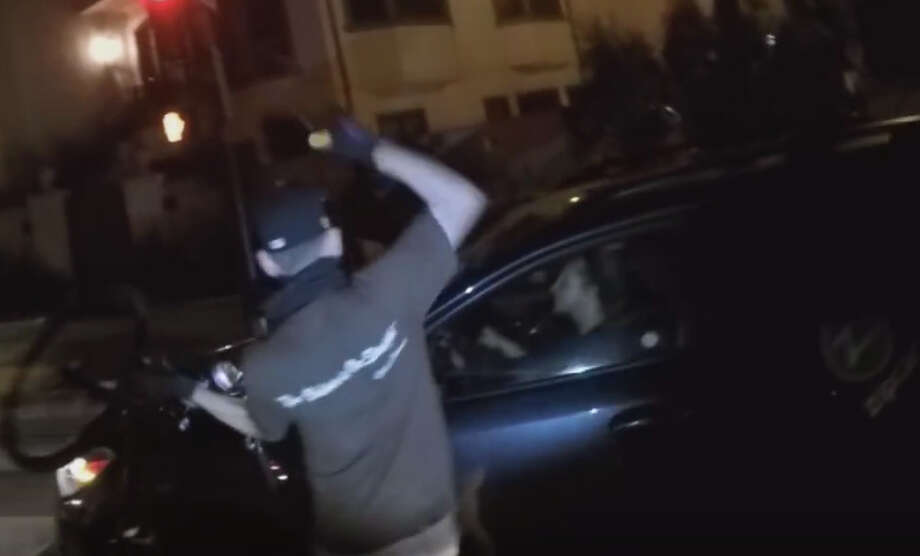
A YouTube video showing a tense altercation between Critical Mass cyclists and a driver in San Francisco’s Marina District, captured a man beating a woman’s Zipcar and smashing her window with a bike lock.

The video was purportedly shot Friday night at 8:16 p.m. on Marina Boulevard at Lyon Street during a Critical Mass bike ride.

About a dozen cyclists were seen riding against traffic on Marina Boulevard when one person stopped in front of a dark-colored station wagon and yelled, “Hey! Stop that! — No, no, no, no, no.”

The man’s buddies then swarmed over and surrounded the car.

“You ain’t going nowhere,” another man is heard saying.

“You f— hit my bike,” the original rider shouted to the driver.

“Selfish, b—,” someone else yelled.

The cyclists then lectured the Zipcar driver for several minutes while Harvey Danger’s “Flagpole Sitta” blared from a speaker on another cyclist’s backpack.

Apparently the driver had enough. She backed up and tried to drive around the pack only to be blocked again. Meanwhile, several other drivers appeared to keep a safe distance back from the altercation.

It was unclear if the incident had been reported to San Francisco police. Department officials could not immediately be reached for comment Monday morning.Finally, the Zipcar slowly pushed past the group while one rider landed four blows on the side of the car with a U-lock, smashing the driver’s side window.

YouTube user bike42363 posted the video Saturday. It already had more than 13,000 views by Monday morning and was inspiring an enthusiastic discussion in the comments section.

“Wow. You guys area pieces of s—for doing that,” YouTube user One TwiztidMunky wrote in part.

“It was a protest Einstein,” user drie wiel fired back.

Critical Mass is a monthly protest ride that happens on the last Friday of every month in San Francisco. The demonstrations began in the city in 1992 but are now held in nearly 300 cities around the world, according to the organization’s web page.

On its website, SF Critical Mass tells participants “Don’t ride into oncoming traffic on the wrong side of the road” and “Don’t pick fights with motorists, even if they’re itching for one.”


Evan Sernoffsky is a San Francisco Chronicle staff writer. E-mail: esernoffsky@sfchronicle.com Twitter: @EvanSernoffsky

Monday, July 27, 2015

If an Electric Bike Is Ever Going to Hit It Big in the U.S., It's This One

If an Electric Bike Is Ever Going to Hit It Big in the U.S., It's This One

Is the Copenhagen Wheel poised to become the next big thing in alternative urban transportation?


Image
Michael D. Spencer / Superpedestrian

CAMBRIDGE, Mass.—On a sunny but brisk spring morning near the Charles River in Cambridge, I took a test ride on the bicycle of the future. No rockets or lasers (alas), the bicycle of the future looks pretty much like the bicycle of the present. But with the first pumps of my feet on the pedals, I felt the difference. The bike wasn't just moving, it was pushing, adding extra propulsion to my own pedaling, giving me a boost with every revolution of the pedals. Faster than expected, I reached the end of a quiet block leaning into a corner. I took a straightaway for a few blocks and pushed 20 miles an hour without hardly trying. My feet were putting out a solid paper-route effort, but the bike had me racing in the Tour de France.
The bike I tested was equipped with the Copenhagen Wheel, an electric pedal-assist motor fully contained in the oversized red hub of an otherwise normal back bicycle wheel. Inside that red hub is a delicately crammed array of computing equipment, sensors, and a three-phase brushless direct current electric motor that can feel the torque of my pedaling and add appropriately scaled assistance.


Replace the back wheel of any bike with the Copenhagen Wheel and it's instantly an electric bike—one that not only assists the rider but senses the surrounding topography and can even collect and share data about environmental, traffic, and road conditions. First developed in 2009, through a partnership between MIT'sSenseable City Lab and the City of Copenhagen, the wheel is now in its

Wednesday, June 10, 2015

More people prefer working at home to taking transit


More people prefer working at home to taking transit


June 9, 2015

Updated June 8, 2015 5:12 p.m.
By ORANGE COUNTY REGISTER EDITORIAL


As urban planners continue to spend tax dollars on archaic transportation alternatives to the automobile, technology, which has already bypassed many of those modes of conveyance, continues to march forward.

Witness a report on Newgeography.com, a site offering expert analysis on demographic and urban issues, and led by executive editor Joel Kotkin, Roger Hobbs Distinguished Fellow in Urban Studies at Chapman University and a Register opinion columnist.

The report cites data from the U.S. Census Bureau’s American Community Survey for 2013 that working from home, or telecommuting, has surpassed transit, “as the principal commuting alternative to the automobile” in much of the U.S.

“Overall, working at home leads transit in 37 of the 52 major metropolitan areas (over 1 million population in 2013),” the report reads. “Only two of the top 10 metropolitan areas have larger transit shares than work-at-home shares.”

San Diego came in fourth overall, with 6.38 percent of people claiming to work from home. But while that city has built a robust transit network, transit claims “approximately one half its working-at-home share,” at 3.17 percent of commuters.

“Nine of the top 10 working at home metropolitan areas have built or expanded rail systems, yet working at home has grown far faster than transit,” the report states. “The exception is Seattle, where transit has grown faster, but nearly all the increase has been on buses and ferries.”

Given this reality, and particularly the inefficiency of rail transit, instead of planning trolleys, multimillion-dollar transit centers for a bullet train that may never arrive, area governments should heed commuters’ preferences and focus on transportation options that best serve them, not engage in social engineering or indulge in fanciful projects funded by other people’s money.

Thursday, February 26, 2015

Electric car benefits? Just myths


Electric car benefits? Just myths


It is time to stop our green worship of the electric car. It costs us a fortune, cuts little CO2 and surprisingly kills almost twice the number of people compared with regular gasoline cars.

 6748 677 47LINKEDIN 362COMMENTMORE
It is time to stop our green worship of the electric car. It costs us a fortune, cuts little CO2 and surprisingly kills almost twice the number of people compared with regular gasoline cars.
Electric cars' global-warming benefits are small. It isadvertised as a zero-emissions car, but in reality it only shifts emissions to electricity production, with most coming from fossil fuels. As green venture capitalist Vinod Khosla likes to point out, "Electric cars are coal-powered cars."
The most popular electric car, a Nissan Leaf, over a 90,000-mile lifetime will emit 31 metric tons of CO2, based on emissions from its production, its electricity consumption at average U.S. fuel mix and its ultimate scrapping. A comparable diesel Mercedes CDI A160 over a similar lifetime will emit 3 tons more across its production, diesel consumption and ultimate scrapping.
The results are similar for the top-line Tesla car, emitting about 44 tons, about 5 tons less than a similar Audi A7 Quattro.
Subsidies vs. savings
Yes, in both cases the electric car is better, but only by a tiny bit. Avoiding 3 tons of CO2 would cost less than $27 on Europe's emissions trading market. The annual benefit is about the cost of a cup of coffee. Yet U.S. taxpayers spend up to $7,500 in tax breaks for less than $27 of climate benefits. That's a bad deal.
The other main benefit from electric cars was supposed to be lower air pollution. Yes, it might be powered by coal, but unlike the regular car, coal emissions are far away from the city centers where more people live and where damage from air pollution hits hardest.
However, new research in Proceedings of the National Academy of Sciences foundthat while gasoline cars pollute closer to home, coal-fired power pollutes a lot more.
Like this column? Get more in your e-mail inbox
The researchers estimate that if the U.S. has 10% more gasoline cars in 2020, 870 more people will die each year in the U.S. from air pollution. Hybrids, because they are cleaner, will kill just 610 people. But 10% more electric vehicles powered on the average U.S. electricity mix will kill 1,617 more people every year, mostly from coal pollution. The electric car kills almost three times as many as a hybrid.
Of course, electric car proponents would venture that the perceived rapid ramp-up of renewables will make future electric cars much cleaner. This, however, is mostly wishful thinking. Today, the U.S. gets 14% of its electric power from renewables. In 25 years, Obama's Energy Information Administration estimates this will have gone up just 3 percentage points to 17%.
Similarly, fossil fuels generate 65% of U.S. electricity today, and will generate 64% in 2040, although natural gas will gain four percentage points and lead to slightly cleaner power.
Instead of focusing on electric cars, we should focus on making coal-fired power cleaner.
What proponents say
Proponents could also argue that the more mileage an electric car logs, the more its carbon footprint is reduced because the battery production is a significant part of their total emissions.
Yet, it hardly matters. The added mileage saves little in the way of emissions, and the electric car's extended use might mean it would have to replace its batteries, entirely blowing the climate benefit.
Moreover, because the Nissan gives you only 84 miles on a charge, most people buy it as a second car for shorter trips. If such a second car goes only 50,000 miles, it will actually end up emitting more CO2.
In the public conversation, electric cars are seen as the new uber-green. But they're nothing of the sort. If we had 25 million extra electric cars rather than gasoline cars on the road in 2020, they would over their lifetime avoid 75 million tons of CO2 at a market value of more than half a billion dollars.
However, at present-day subsidies, they would cost a phenomenal $188 billion whilecreating more pollution than gasoline cars, costing about $35 billion in lives cut short by poor air quality. For every dollar of cost, the electric car does less than half a cent of good.
For the next decades, hybrids are the way to go, while we innovate cheaper green energy that hopefully over some decades will make the electric car worthwhile.
Bjørn Lomborg, author of The Skeptical Environmentalistand Cool Itis president of theCopenhagen Consensus Center.